by Bruce Wells | Jan 1, 2021 | Petroleum History Almanac
A research post for helpful comments
The American Oil & Gas Historical Society (AOGHS) website is designed to help researchers, journalists, teachers, and students learn more about U.S. petroleum history. When contacted about oilfield family heirlooms, AOGHS also has located suitable museum collections for preserving the histories (see Adding Family Petroleum Heritage to Museum Collections).
There are many more stories and research requests meeting to be shared. AOGHS now adds posts to create simple, comment-forums for site visitors to exchange information. If your have ideas or suggestions for this post, please comment below.
Using Cypress Swamp Tree Stumps…
January 2020
I am a graduate student at the Architectural Association in London working on a project that looks at the potential use of tree stumps as structural foundations. While researching I found the following extract from an article on The Petroleum Industry of the Gulf Coast Salt Dome Area in the early 20th century:
“In the dense tangle of the cypress swamp, the crew have to carry their equipment and cut a trail as they go. Often they use a tree stump as solid support on which they set up their instruments”
I have been struggling to find any photos or drawings of how this system would have worked (ie how the instruments were supported by the stump) I was wondering if you might know where I could find any more information? I would greatly appreciate your help!
Kind regards, Andrew
—————————-
The American Oil & Gas Historical Society preserves U.S. petroleum history. Join today as an annual AOGHS supporting member. Help maintain this energy education website and expand historical research. For more information, contact bawells@aoghs.org. Copyright © 2021 Bruce A. Wells. All rights reserved.
.
by Bruce Wells | Jan 1, 2021 | Petroleum History Almanac
Oil history forums and other resources for sharing information about all things petroleum.
Welcome to the American Oil & Gas Historical Society’s oil history forums with links for those seeking information about anything from family heirlooms, books, images, and oilfield equipment to service station collectibles.
For students, teachers and researchers, the AOGHS History Research Forum offers a simple way to post questions, images, and research links for artifact information sharing. AOGHS regularly updates this informal Q&A forum.
There also is an oil history forum page exclusively devoted to finding a museum to preserve family petroleum-related heirlooms — Oil & Gas Families.
Finally, for sharing information about old oil stock certificates and other financial oil history, AOGHS maintains the popular and appropriately titled forum Is my Oil Oil Stock worth Anything?

What’s it worth? If you are not researching an artifact but simply seek a commercial value, it’s better to use eBay. Use the AOGHS forums’ comment sections to share your information (the more details, the better) and visit again to see if others might have commented.
The American Oil & Gas Historical Society preserves U.S. oil history. Please join today as an annual AOGHS supporter. Help maintain this energy education website and expand historical research. For more information, contact bawells@aoghs.org. Copyright © 2025 Bruce A. Wells. All rights reserved.
by Bruce Wells | Aug 19, 2020 | Petroleum History Almanac
|
August 19, 2020 – Oil & Gas History News, Vol. 1, No. 8
Oil & Gas History News
Welcome to our August newsletter, and thank you for subscribing. The pandemic continues to bring more people than ever online, especially as an unprecedented school year struggles to begin. The American Oil & Gas Historical Society is sharing energy education research and articles during this time of social distancing. We are adding new and updated posts to the website, which is undergoing improvements, thanks to supporting members.
This Week in Petroleum History Monthly Update
Links to summaries from five weeks of U.S. oil and natural gas history, including new technologies, oilfield discoveries, petroleum products, and pioneers.
August 17, 1785 – Oil Discovered Floating on Pennsylvania Creek
Two years after the end of the Revolutionary War, oil was reported floating on a creek in northwestern Pennsylvania. “Oil Creek has taken its name from an oil or bituminous matter being found floating on its surface,” noted a report by Army Gen. William Irvine. His report of the natural oil seeps would lead to the first U.S. oil well in 1859…MORE
August 10, 1909 – Hughes patents Dual-Cone Roller Bit
“Fishtail” drill bits became obsolete after Howard Hughes Sr. of Houston, Texas, patented a roller bit consisting of two rotating cones. By pulverizing hard rock, his bit led to drilling faster and deeper. Hughes and business associate Walter Sharp established the Sharp-Hughes Tool Company to manufacture the new bit…MORE
August 3, 1769 – La Brea Asphalt (Not Tar) Pits discovered
The La Brea, “the tar,” pits were discovered during a Spanish expedition on the West Coast. “We debated whether this substance, which flows melted from underneath the earth, could occasion so many earthquakes,” noted a Franciscan friar. Commonly called tar pits, the sticky pools between modern Beverly Hills and downtown L.A. are actually comprised of natural asphalt, also known as bitumen…MORE
July 27, 1918 – Standard Oil of New York launches Concrete Oil Tanker
The Socony, America’s first concrete vessel designed to carry oil, launched from its shipyard at Flushing Bay, New York. Built for the Standard Oil Company of New York, the barge was 98-feet long with a 32-foot beam and carried oil in six center and two wing compartments, “oil-proofed by a special process,” according to Cement and Engineering News…MORE
July 20, 1920 – Texas Company reveals Permian Basin
The first commercial well of the Permian Basin produced oil from a depth of 2,750 feet on land owned by William Abrams, an official of the Texas & Pacific Railway. Later “shot” with nitroglycerin by the Texas Company (the future Texaco), the W.H. Abrams No. 1 well today is part of the 75,000-square-mile Permian Basin…MORE
Featured Image
|
 |
|
About 450 million years ago, a meteor struck north-central Oklahoma, creating an impact crater – an astrobleme – eight miles wide. Hidden beneath 9,000 feet of sediment, an oilfield discovery at the crater in 1991 attracted worldwide attention of petroleum companies.
“The Ames Astrobleme is one of the most remarkable and studied geological features in the world because of its economic significance,” noted independent producer Lew Ward from nearby Enid in 2007. Learn more in Ames Astrobleme Museum.
Energy Education Articles
Updated editorial content on the American Oil & Gas Historical Society website includes these articles:
It was a foggy summer morning in 1927 as eight airplanes prepared for takeoff before a crowd of more than 50,000 at the Oakland Airport in California. Aviation history was about to be made with a 2,400-mile air race to Honolulu. High-octane gasoline refined by Phillips Petroleum Company powered the “Woolaroc” monoplane to victory in the record-setting but deadly air race. See Flight of the Woolaroc.
“The World’s Wonder Oil Pool” discovery in 1918 on a small farm along the Red River in Texas launched a drilling boom that would bring prosperity — and inspire a Hollywood movie starring Clark Gable, who was a teenager working in Oklahoma oilfields. Two decades later, he would star in “Boom Town,” a 1940 MGM movie inspired by the Burkburnett oilfield discovery. See Boom Town Burkburnett.
|
|
In addition to the above articles, a recent AOGHS website posting features Ray Sorenson, a petroleum geologist who has researched first oil sightings in the United States, Canada, and many parts of the world. Sources cited in the ongoing Exploring Earliest Signs of Oil would add up to 11 feet of shelf space!
Please share our latest newsletter. Like many small, educational organizations, the 2020 pandemic has put a financial strain on this historical society. We need your help to tell the many stories of petroleum history.
— Bruce Wells
“Any survey of the natural resources used as sources of energy must include a discussion about the importance of oil, the lifeblood of all industrialized nations.” — Daniel Yergin, bestselling author and winner of the Pulitzer Prize
_______________________________
The American Oil & Gas Historical Society preserves U.S. petroleum history. Become an AOGHS supporting member and help maintain this energy education website and expand historical research. For more information, contact bawells@aoghs.org. © 2020 Bruce A. Wells. All rights reserved.
|
by Bruce Wells | Jun 17, 2020 | Petroleum History Almanac

June 17, 2020 – Oil & Gas History News, Vol. 1, No. 6
Oil & Gas History News
Thank you for taking time to read this month’s American Oil & Gas Historical Society summary of petroleum history during these extraordinary times. Please forward articles from This Week in Petroleum History to your friends and consider becoming a supporting member. Individual donations help the society add more articles, maintain the website, and expand our historical database for educators, students, researchers — and you.
Monthly Highlights from “This Week in Petroleum History”
Links to summaries from four weeks of U.S. oil and natural gas history, including new technologies, oilfield discoveries, petroleum products, and pioneers.
June 15, 1954 – Launch of First Mobile Offshore Rig
The barge drilling platform Mr. Charlie left its Louisiana shipyard and went to work for Shell Oil Company in the East Bay field near the mouth of the Mississippi River. Navy veteran Alden “Doc” LaBorde, a marine superintendent for Kerr-McGee Company, designed this first transportable, submersible drilling rig…
June 9, 1894 – Water Well finds Oil in Corsicana, Texas
A contractor hired by the town of Corsicana to drill a water well on 12th Street found oil instead, launching the first Texas oil boom seven years before the more famous Spindletop gusher. Although the discovery would bring great prosperity, the city paid the drilling contractor only half his $1,000 fee. The agreement had been for drilling a water well…
June 4, 1872 – Robert Chesebrough invents Petroleum Jelly
A young chemist living in New York City, Robert Chesebrough, patented “a new and useful product from petroleum,” which he named Vaseline. His patent proclaimed the virtues of the purified extract of oil distillation residue as a lubricant, hair treatment, and balm for chapped hands. Vaseline later helped launch a cosmetics empire…
May 26, 1891 – Patent will lead to Crayola Crayons
A new petroleum product would get its name from the French word for chalk, craie, and an English adjective meaning oily, oleaginous. Crayola Crayons began when Edwin Binney and C. Harold Smith of Easton, Pennsylvania, received a patent for their “Apparatus for the Manufacture of Carbon Black”…
Energy Education Articles
Updated editorial content on the American Oil & Gas Historical Society website includes these articles:
Oil from Alaska’s North Slope began moving through the Trans-Alaska Pipeline System on June 20, 1977. Four years earlier, a deciding vote in the U.S. Senate by Vice President Spiro Agnew had passed the Trans-Alaska Pipeline Authorization Act. The 800-mile pipeline system has since carried billions of barrels of oil to the port of Valdez and been recognized as an engineering landmark. See Trans-Alaska Pipeline History.
Following the first commercial New Mexico oil well in 1922, the state’s petroleum industry took off with the discovery of the Hobbs field on June 13, 1928, by the Midwest State No. 1 well. Oil production attracted investors and drilling companies, transforming Hobbs from “sand, mesquite, bear grass and jack rabbits” to the fastest growing town in America. See First New Mexico Oil Wells.
In 1923, near Big Lake in West Texas, on arid land leased from the University of Texas, a new Permian Basin oilfield was discovered after 21 months of cable-tool drilling (averaging less than five feet a day). Within three years of the discovery by the Santa Rita No. 1 well, royalties endowed the University of Texas with $4 million, which the student newspaper reported, “made the difference between pine-shack classrooms and modern buildings.” See Santa Rita taps Permian Basin.
Featured Image

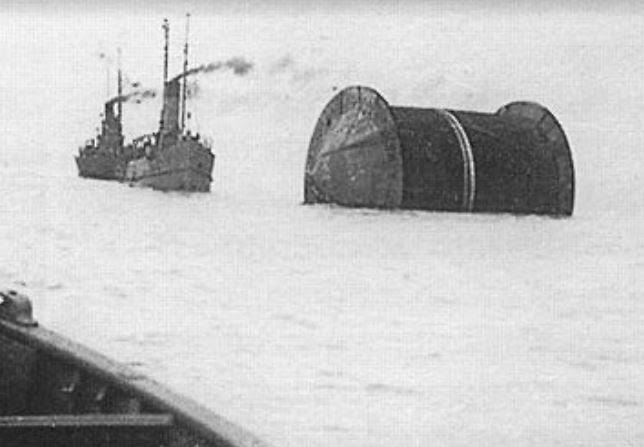
To prevent fuel shortages from stalling the 1944 Normandy invasion, Operation PLUTO – Pipe Line Under The Ocean – became a top-secret Allied strategy. Pipe was wound onto enormous floating “conundrums” designed to spool off the pipe when towed across the English Channel. Each mile used over 46 tons of lead, steel tape, and armored wire, for crossing almost 70 miles from Isle of Wight to Cherbourg. Learn more in PLUTO, Secret Pipelines of WW II.
Thank you again for subscribing. Please share this newsletter with your friends — and visit our website often. Help promote using petroleum history in energy education programs and teacher workshops. Finally, support keeping the American Oil & Gas Historical Society operating during these iconic times. — Bruce Wells
_______________________
The American Oil & Gas Historical Society preserves U.S. petroleum history. Become an AOGHS supporting member and help maintain this energy education website and expand historical research. For more information, contact bawells@aoghs.org. Copyright © 2021 Bruce A. Wells. All rights reserved.
“Any survey of the natural resources used as sources of energy must include a discussion about the importance of oil, the lifeblood of all industrialized nations.” — Daniel Yergin, bestselling author and winner of the Pulitzer Prize.
by Bruce Wells | Apr 15, 2020 | Petroleum History Almanac
|

April 15, 2020 – Oil & Gas History News, Vol. 1, No. 4
Oil & Gas History News
Spring is here, but most of us must take in the changing of the season from home. As communities navigate this difficult period, the American Oil & Gas Historical Society hopes this month’s newsletter might help you fill your time at home with intriguing reading material. Even in these tough times, we continue to look to history for inspiring stories that show America’s enduring energy heritage. These latest This Week in Petroleum History posts share distance learning resources for teachers, students and parents.
Monthly Highlights from “This Week in Petroleum History”
Links to summaries and articles from four weeks of U.S. oil and natural gas history, including oilfield discoveries, new technologies, petroleum products, and more.
April 13, 1974 – Oklahoma Well sets World Depth Record
After 504 days and about $7 million, the Bertha Rogers No. 1 well reached a total depth of 31,441 feet before being stopped by liquid sulfur. Drilled in the heart of Oklahoma’s Anadarko Basin, it was the deepest well in world for several years and the deepest in the United States for three decades until exceeded in 2004…
April 10, 1866 – Brothers patent Railroad Oil Tank Car
James and Amos Densmore patented their “Improved Car for Transporting Petroleum” designed for the new Pennsylvania oil regions. The Densmore tank car briefly improved oil industry transportation infrastructure. A decade later, Amos invented a new design for typewriter keyboards; his “Q-W-E-R-T-Y” arrangement helped prevent keys from colliding…
April 4, 1951 – First North Dakota Oil Well reveals Williston Basin
After eight months of difficult drilling and severe snowstorms, Amerada Petroleum discovered oil in North Dakota – revealing the Williston Basin two miles beneath Clarence Iverson’s farm near Tioga. About 30 million acres would be leased within two months of the discovery…
March 26, 1930 – “Wild Mary Sudik” makes Newreels
What would become one of Oklahoma’s most famous oil wells of the Great Depression erupted from a geologic formation about 6,500 feet beneath Oklahoma City. Pressured natural gas from the Wilcox Sand proved difficult to control in the prolific Oklahoma City field. Within a week of the gusher, Hollywood newsreels featured it in theaters across the country…
Recent Article Updates
Editorial content on the American Oil & Gas Historical Society website includes these articles:
The offshore industry’s robotic technology advanced in 1966 when the government retrieved hydrogen bombs lost in the Mediterranean Sea after a B-52 crashed off the coast of Spain. America’s first cable-controlled underwater research vehicle (CURV) recovered three 70-kiloton bombs from a depth of 2,850 feet. See ROV – Swimming Socket Wrench.
Exploration companies rushed to Portland, Indiana, in 1886 after natural gas was found at a depth of only 700 feet. The discovery came just months after a spectaculargas well about 100 miles to the northeast – the “Great Karg Well” of Findlay, Ohio. Andrew Carnegie would proclaim natural gas replaced 10,000 tons of coal a day for making steel. See Indiana Natural Gas Boom.
South of the Red River border with Oklahoma, at Electra, Texas, the Clayco No. 1 well struck oil on April 1, 1911. As news spread through town, people thought it was an April Fools joke, but the gusher on William Waggoner’s ranch launched an oil boom that would last for decades. In 2001, community oil history activists convinced Texas legislators to designate Electra the Pump Jack Capital of Texas.
Featured Map
|
|

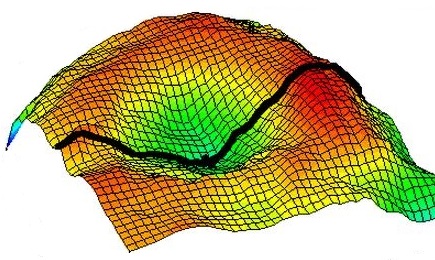
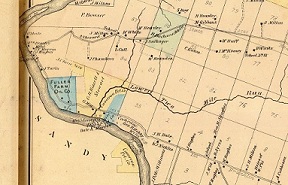
In early 1864, John Wilkes Booth made the first of several trips to Franklin, Pennsylvania, where he purchased an oil lease on the Fuller farm. Maps of the day show the three-acre strip of land on the farm, about one mile south of Franklin and on the east side of the Allegheny River. Booth formed an oil company, believing his well would make him a fortune. It didn’t. Learn more in Dramatic Oil Company.
|
 |
|
I hope these and the website’s other petroleum history articles and images can help brighten your day at home. The historical society is especially grateful to the growing number of supporting members and their expressions of genuine concern. Any contribution is appreciated and helps keep the historical society operating.
— Bruce Wells, Executive Director, American Oil & Gas Historical Society
_______________________________
The American Oil & Gas Historical Society preserves U.S. petroleum history. Become an AOGHS supporting member and help maintain this energy education website and expand historical research. For more information, contact bawells@aoghs.org. © 2020 Bruce A. Wells.
|
by Bruce Wells | Jan 26, 2020 | Petroleum History Almanac
Founded in 1934, the Dallas Petroleum Club witnessed the city becoming a financial center for the Texas petroleum industry.
The Dallas Petroleum Club in 2014 celebrated its 80th anniversary, according to Nina P. Flournoy, who wrote a book about the milestone.
Dallas-based Flournoy’s The Lions Among Us: Celebrating 80 Years of The Dallas Petroleum Club describes how the club grew out of 1930s East Texas discoveries that ignited the Texas oil and natural gas industry. Founded in 1934, the club witnessed the city becoming a financial center for the Texas industry.
The club was organized just four years after Columbus Marion “Dad” Joiner had discovered the East Texas oilfield near Kilgore, about 120 miles to the east. Learn more about Joiner, “Doc ” Lloyd and Haroldson Lafayette Hunt in East Texas Oilfield Discovery. (more…)