May 18, 1912 – Last Coal-Powered Battleship –
The USS Texas, America’s only surviving dreadnought — and the last battleship fueled by coal — was launched from a shipyard in Newport News, Virginia. Commissioned in 1914 and converted to fuel oil in 1925, the “Big T” earned five World War II battle stars (see Petroleum and Sea Power). The 27,000-ton battleship became a museum in 1948, the first and oldest of eight U.S. battleship museums. After extensive repairs and restoration, a reopening of the floating museum in Galveston is planned for late 2026, according to the Battleship Texas Foundation.
May 19, 1885 – Lima Oilfield discovered in Ohio
Ohio’s petroleum industry began when Benjamin Faurot found oil at Lima in the northwestern part of the state. He had been searching for natural gas in the Trenton Rock Limestone (see Indiana Natural Gas Boom). “If the well turns out, as it looks now that it will, look out for the biggest boom Lima ever had,” proclaimed Lima’s Daily Republican newspaper.
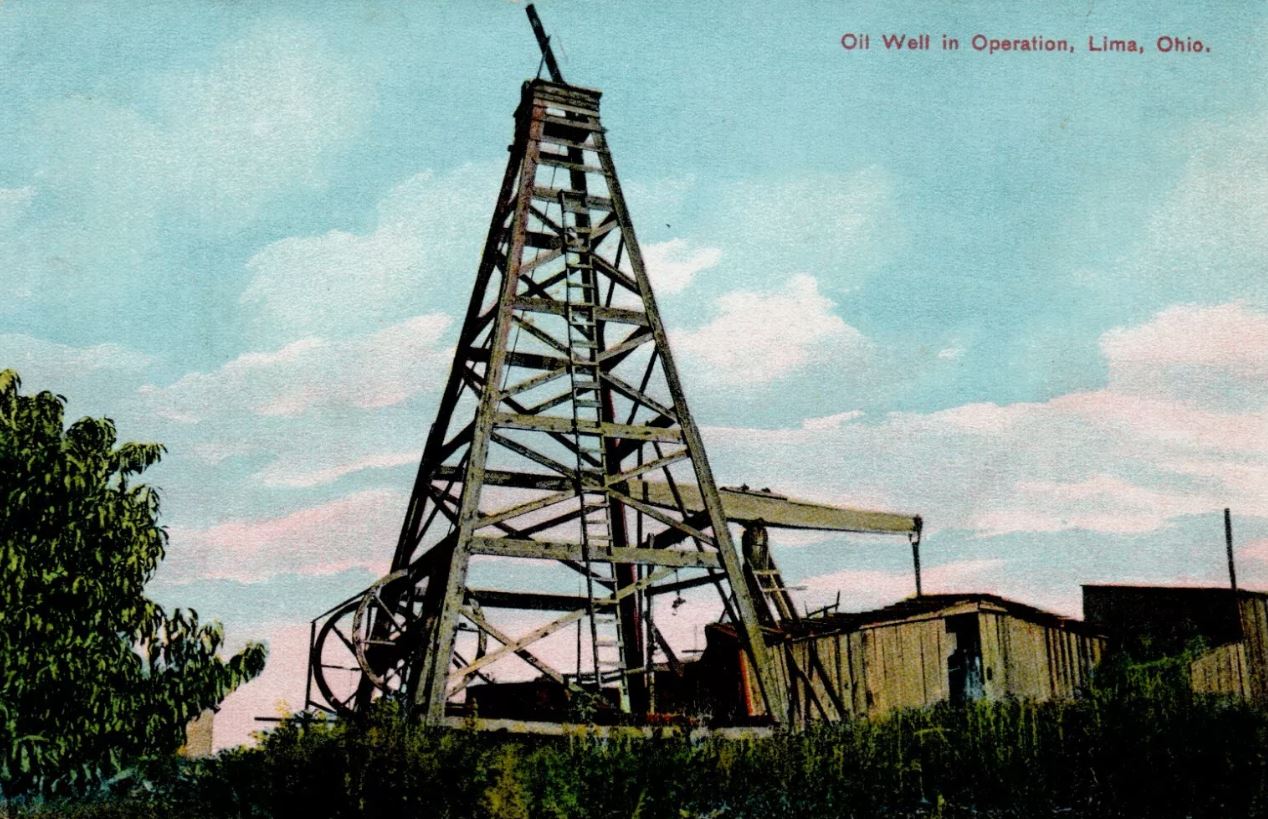
An 1885 oil discovery in Allen County, Ohio, attracted cable-tool drillers — and made the Lima oilfield the most productive in the world. Circa 1910 postcard by Thomas & Company, Findlay.
Faurot organized the Trenton Rock Oil Company, and by 1886 the Lima oilfield was producing more than 20 million barrels of oil, the most in the nation. The Lima field’s heavy oil needed special refining, and Standard Oil Company of New Jersey in 1889 began construction on the Whiting refinery.
Learn more in Great Oil Boom of Lima, Ohio.
May 19, 1942 – Oklahoma Inventor patents Portable Drilling Rig
A pioneer in oilfield technologies, George E. Failing of Enid, Oklahoma, received a patent for his design of a drilling rig on a truck bed. “I designate the rear portion of a drilling rig such as used in drilling shallow wells, the taking of cores, drilling of shot-holes, and performing similar oil field operations,” Failing noted in his patent.
In 1931, he had mounted a rig on a 1927 Ford farm truck, “adding a power take-off assembly to transfer power from the truck engine to the drill,” according to the Oklahoma Historical Society. Failing received more than 300 patents for oilfield tools, “from rock bit cores to an apparatus for seismic surveying.”
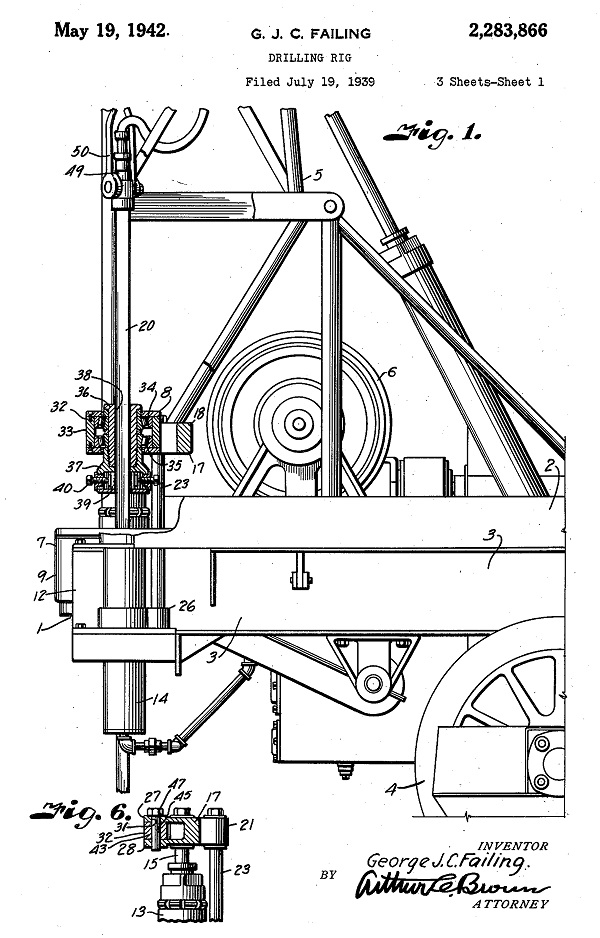
George Failing’s rig design — powered by a pickup truck’s engine — proved ideal for rapidly drilling slanted wells.
Failing’s portable rig could drill ten slanted, 50-foot holes in a single day, while a traditional rotary rig took about a week to set up and drill to a similar depth. He demonstrated his portable drilling technology at a 1933 well disaster in Conroe, Texas, working with H. John Eastman — the father of directional drilling.
Learn more in Technology and the “Conroe Crater.”
May 19, 1969 – First Offshore Technology Conference
Houston’s largest convention and tradeshow, the Offshore Technology Conference, began in response to “growing technological needs of the global ocean extraction and environmental protection industries,” according to the History of OTC. In 2013, more than 2,700 companies exhibited in “an area equivalent to 10 U.S. football fields.”
The 2026 Offshore Technology Conference (OTC) in Houston closed May 7 after “four days of technical exchange, executive dialogues, and dealmaking.”
Since 1969, the conference has generated more than $3.2 billion for Houston. OTC Brasil was launched in 2011 along with an Arctic Technology Conference (2011-2016). OTC Asia was launched in 2012. The 2026 Houston OTC concluded on May 7 at Houston’s NRG Park with nearly 25,000 people attending.
May 20, 1930 – Geophysicists establish Professional Society
Earth scientists in Houston established the Society of Economic Geophysicists to encourage the ethical practice of geophysics in the exploration and development of natural resources. The organization in 1937 adopted the name Society of Exploration Geophysicists (SEG), which in 2025 reported 14,000 members in 114 countries.
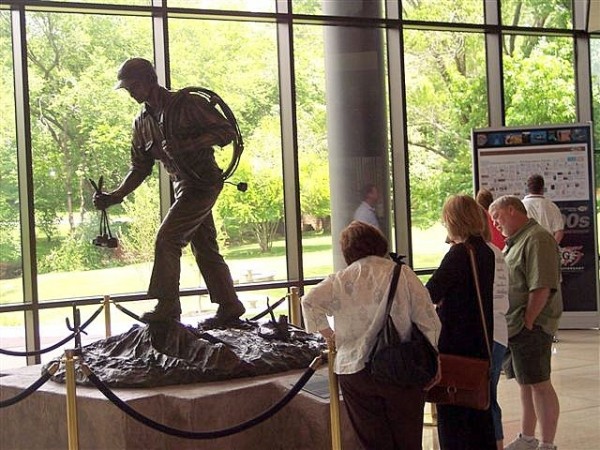
The Doodlebugger by Oklahoma sculptor Jay O’Melia has welcomed visitors to SEG headquarters since 2002. Photo by Bruce Wells.
SEG’s journal Geophysics began publishing in 1936 with articles on exploration technologies, including seismic, gravity, and magnetic imaging. The journal warned of hucksters using vague or unproven properties of oil and geological formations. At its Tulsa headquarters in 2002, SEG unveiled The Doodlebugger, a 10-foot bronze statue by Oklahoma sculptor Jay O’Melia, who also sculpted the Oil Patch Warrior, a World War II memorial.
May 21, 1923 – “Esso” first used by Standard Oil Company
For the first time, the Standard Oil Company of New Jersey used “Esso” to market the company’s “refined, semi-refined, and unrefined oils made from petroleum, both with and without admixture of animal, vegetable, or mineral oils, for illuminating, burning, power, fuel, and lubricating purposes and greases.”
Standard Oil of New Jersey logo, 1923 to 1934, when text became plainer and inside an ellipse.
In 1923, Esso — the phonetic spelling of the abbreviation “S.O.” for Standard Oil — became a registered trademark. The future children’s book author Theodor Geisel — Dr. Seuss — began drawing Essolube product ads in the 1930s. Exxon (now ExxonMobil) removed its U.S. Esso brand in 1973.
May 23, 1905 – Patent issued for Improved Metal Barrel Lid
Henry Wehrhahn, superintendent for the Iron Clad Manufacturing Company of Brooklyn, New York, received the first of two 1905 patents that presaged the modern 55-gallon oil drum. The first design included “a means for readily detaching and securing the head of a metal barrel.”
Wehrhahn assigned his patent rights to the widow of Robert Seaman, founder of Iron Clad Manufacturing, Elizabeth Cochrane Seaman — journalist Nellie Bly. In December 1905, Wehrhahn also assigned her the rights to his improved metal barrel patent.
Learn more in Remarkable Nellie Bly’s Oil Drum.

May 23, 1937 – Death of World’s Richest Man
Almost 70 years after founding Standard Oil Company in Ohio and 40 years after retiring from the company in 1897, John D. Rockefeller died in Ormond Beach, Florida, at age 97. His petroleum empire had peaked in 1912.
Born on July 8, 1839, in Richford, New York, Rockefeller attended high school in Cleveland, Ohio, from 1853 to 1855. He became an assistant bookkeeper with a produce shipping company before forming his own company in 1859 — the same year of the first U.S. oil well in Pennsylvania. Rockefeller was 24 in 1865 when he took control of his first refinery, which would be the largest in the world three years later.
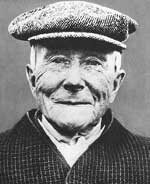
John Davison Rockefeller Sr., 1839-1937. Photo courtesy of Cleveland State University.
By the time his petroleum fortune peaked at $900 million in 1912 ($29.7 billion in 2025 dollars), Rockefeller’s philanthropy was well known. His unprecedented wealth funded the University of Chicago, the Rockefeller Institute for Medical Research (now the Rockefeller Foundation), and Spelman College in Atlanta.
May 24, 1902 – Oil & Gas Journal published
Holland Reavis founded the Oil Investors’ Journal in Beaumont, Texas, to report on financial issues facing operators and investors in the giant oilfield discovered nearby one year earlier at Spindletop Hill. Reavis sold his semimonthly publication to Patrick Boyle of Oil City, Pennsylvania, in 1910.
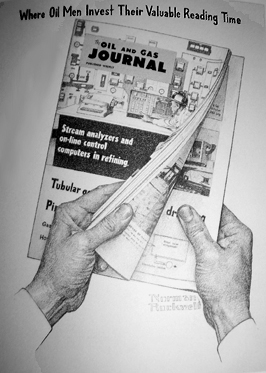
Norman Rockwell illustrated a 1962 ad promoting the Oil and Gas Journal.
Boyle, a former oilfield scout and publisher of the Oil City Derrick, increased publication frequency to weekly and renamed it the Oil & Gas Journal. Following his death in 1920, son-in-law Frank Lauinger moved operations to Tulsa and further expanded the company, which became PennWell Publishing in 1980. The Derrick newspaper in Oil City, which began in 1885, continues to be published by the Boyle family.

May 24, 1920 – Huntington Beach Field discovered in California
A Standard Oil Company of California exploratory well discovered the Huntington Beach oilfield. The beach town’s population grew from 1,500 to 5,000 within a month of the well being drilled at Clay Avenue and Golden West Street.

Derricks crowded California’s Huntington Beach in 1926. The oilfield produced more than 16 million barrels of oil in 1964 and reached one billion barrels by 2000. Photo courtesy Orange County Archives.
The field had 59 producing wells with daily production of 16,500 barrels of oil by November 1921. The activity brought national attention to Huntington Beach and renewed interest in the Los Angeles City oilfield.
By 2000, the giant oilfield had produced more than one billion barrels of oil, according to the Orange County Register, which noted that as production peaked, “the pressure of explosive population growth began pushing the wells off land that had become more valuable as sites for housing.”
_______________________
Recommended Reading: Ohio Oil and Gas (2008); History Of Oil Well Drilling


_______________________
The American Oil & Gas Historical Society (AOGHS) preserves U.S. petroleum history. Support this energy education website, our monthly email newsletter, This Week in Oil and Gas History News, and help expand historical research. Contact bawells@aoghs.org. Copyright © 2026 Bruce A. Wells. All rights reserved.