April 20, 1875 – Improved Well Pumping Technology –
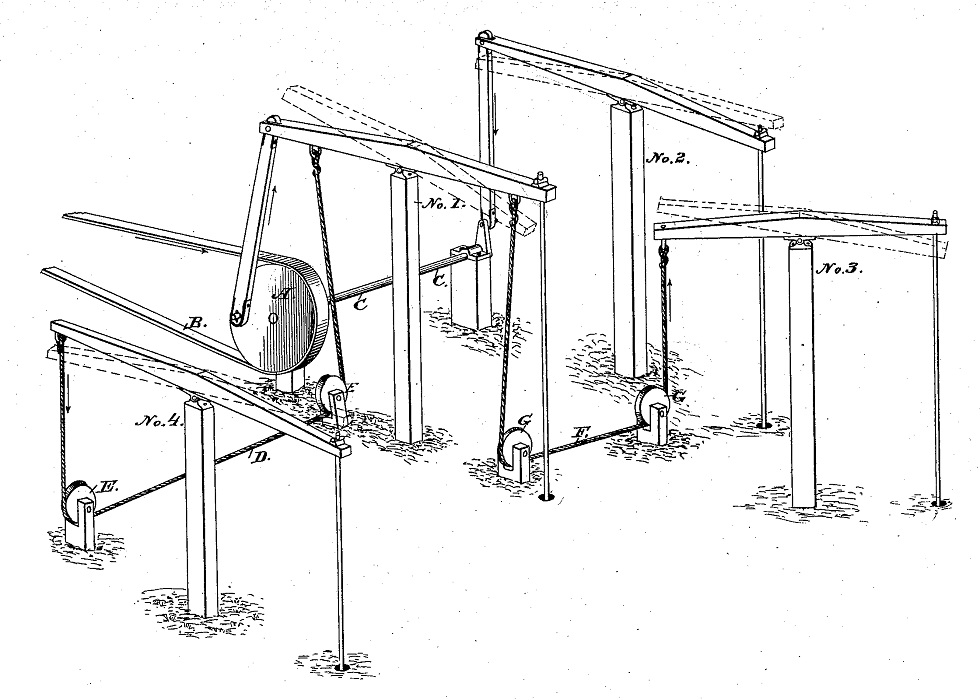
Pumping multiple wells with a single steam engine boosted efficiency in early oilfields when Albert Nickerson and Levi Streeter of Venango County, Pennsylvania, patented their “Improvement In Means For Pumping Wells.” The new technology used a system of linked and balanced walking beams to pump oil wells.
Inventions of new oilfield production technologies for pumping multiple wells from a single power source proliferated in the 1870s.
“By an examination of the drawing it will be seen that the walking-beam to well No. l is lifting or raising fluid from the well. Well No. 3 is also lifting, while at the same time wells 2 and 4 are moving in an opposite direction, or plunging, and vice versa,” explained. Their system was the forerunner of rod-line (or jerk-line) eccentric wheel systems that operated into the 20th century using iron rods instead of rope and pulleys.
Learn more in All Pumped Up – Oilfield Technology.
April 20, 1892 – Prospector discovers the Los Angeles City Oilfield
The giant Los Angeles oilfield was discovered when a struggling prospector, Edward Doheny, and his mining partner Charles Canfield drilled into natural seeps between Beverly Boulevard and Colton Avenue. Their well produced about 45 barrels of oil a day.
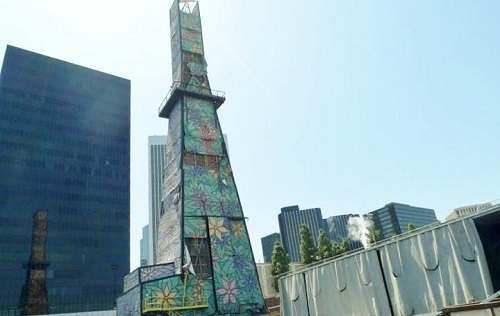
Artfully camouflaged petroleum production continues in downtown Los Angeles. Edward Doheny discovered the oilfield in 1892. Photo courtesy the Center for Land Use Interpretation.
Although the first California oil well had been drilled after the Civil War, Doheny’s 1892 discovery near present-day Dodger Stadium launched California’s petroleum industry. In 1897, about 500 Los Angeles City wells pumped more than half of the state’s annual production of 1.2 million barrels of oil. By 1925, California supplied half of all the world’s oil.
Learn more in Discovering Los Angeles Oilfields.
April 20, 2010 – Deepwater Horizon Offshore Disaster
At 10 a.m., while completing a well in the Macondo Prospect, 50 miles off the Louisiana coast, the Deepwater Horizon exploded and sank, killing 11 and injuring another 17 workers. An estimated 3.19 million barrels of oil flowed into the Gulf of Mexico after the platform’s 400-ton blowout preventer failed, resulting in the largest accidental marine oil spill in U.S. history.
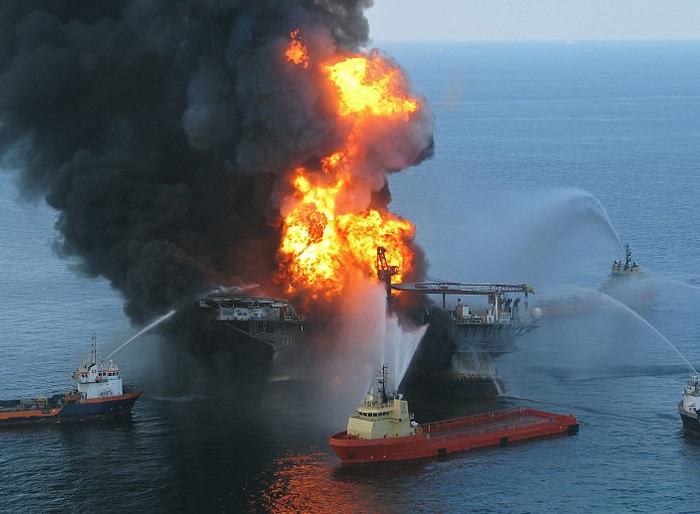
The 2010 Deepwater Horizon explosion and fire killed 11 and injured 17 workers. It was the largest accidental ocean spill in history. Photo courtesy U.S. Geological Survey.
Six months earlier at another site, the advanced, semi-submersible drilling rig had set a world record for the deepest offshore well (35,050 feet vertical depth in 4,130 feet of water). When the Macondo Prospect well was capped in mid-July, a National Commission on the Deepwater Horizon Oil Spill and Offshore Drilling launched an eight-month investigation. The commission released its final report on January 11, 2011.
April 21, 1967 – GM celebrates its 100 Millionth Car
General Motors celebrated its 100 millionth American-made car (a two-door Chevrolet Caprice). Founded in 1908 by William Durant, the Flint, Michigan, company began as a manufacturer of horse-drawn carriages. After leaving GM, Durant and partner Louis Chevrolet founded the Chevrolet Motor Company in 1911, which became part of GM five years later.
After World War II, GM was the first American corporation to pay more than $1 billion in taxes, according to the Detroit Historical Society, which also notes the company declared bankruptcy in 2009 and emerged less than 40 days later after a federal bailout that saved more than a million jobs.
April 22, 1920 – Natural Gas Well leads Arkansas Discoveries
Although natural gas was first discovered in 1887 at Fort Smith, the first commercial production began in southern Arkansas with a well completed southeast of El Dorado. Drilled to a depth of almost 2,250 feet, the well produced up to 60 million cubic feet of natural gas a day and showed signs of oil from the Nacatoch formation sandstone. The first Arkansas oil wells arrived one year later at El Dorado and at Smackover in 1922.

April 22, 1926 – Osage Oil Lease Auctioneer Statue dedicated
A statue commemorating the friendship between oil and gas lease auctioneer Colonel E.E. Walters and Osage Indian Chief Baconrind (phonetically, Wah-she-hah) was dedicated in Walters’ hometown of Skedee, Oklahoma. Beginning in 1912, Colonel Elmer Ellsworth Walters (his full name) and the popular chief of the Osage Nation raised millions of dollars for the tribe from mineral lease sales.
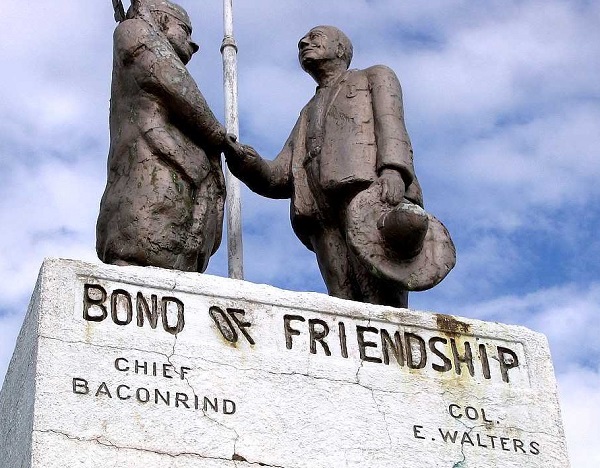
Skedee, Oklahoma, has declined in population, but the 1926 statue of its beloved auctioneer and Osage chief endures. Photo by Bruce Wells.
The auctions took place beneath an elm tree at the Tribal Council House in Pawhuska, where crowds gathered to witness bidding from Frank Phillips, E.W. Marland and William Skelly. The Skedee unveiling revealed “painted bronze” statues of Walters and Chief Baconrind shaking hands on a sandstone monument’s base.
Learn more in Million Dollar Auctioneer.
April 22, 1930 – E. W. Marland unveils Pioneer Woman
One block from the Marland Mansion in Ponca City, Oklahoma, Ernest Whitworth “E.W.” Marland unveiled the Pioneer Woman statue, his gift to the state to honor the role of women who settled there. Marland had invited sculptors to submit competitive designs in the form of small models, notes the Oklahoma Historical Society (OHS).

The Pioneer Woman was dedicated in 1930 after a nationwide competition by E.W. Marland. A model was exhibited in the Smithsonian American Art Museum in 2025. Photo by Bruce Wells.
A dozen models were exhibited nationwide, and after 750,000 votes, sculptor Bryant Baker won, and his 17-foot bronze statue was erected for $300,000. In 1968, the artist donated a bronze of the model to the Smithsonian American Art Museum (SAAM). Other of the contest models are preserved at the Woolaroc Ranch, established by Marland’s friend and rival, Frank Phillips of Phillips Petroleum Company.
Marland founded Marland Oil in Ponca City in 1917 after losing a fortune in the Pennsylvania oilfields during the panic of 1907. He was among the earliest to use seismography and core drilling for petroleum exploration.
April 22, 1964 – Sinclair Dinoland returns to the New York World’s Fair
Continuing its successful marketing campaign begun in the 1930s, Sinclair Oil opened a Dinoland pavilion at the 1964-1965 New York World’s Fair. The exhibition of giant, fiberglass dinosaurs proved a hit with the 50 million people attending the fair.
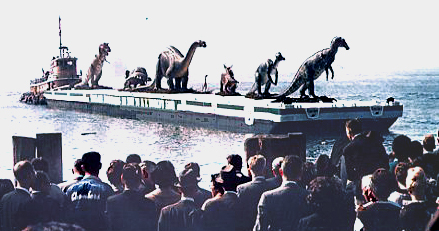
“For the first time in 70 million years a herd of dinosaurs will travel down the Hudson River this month,” noted Popular Science in September 1963.
The first Sinclair Oil Dinoland, which attracted crowds to the Texas Centennial Exposition in 1936, was expanded for the 1939-1940 New York World’s Fair. Following the 1964-1965 exhibition, the 70-foot green “Dino” and eight more dinosaurs traveled to parking lots at shopping centers, delighting children in 25 states.
April 23, 1878 – Oil Exchange Building opened in Pennsylvania
The Oil Exchange of Oil City, Pennsylvania, opened a new, $100,000 brick building on Seneca Street. Independent producers began meeting there to trade oil and pipeline certificates. They had earlier gathered at local hotels or along Oil City’s Centre Street, then known as the “Curbside Exchange.”
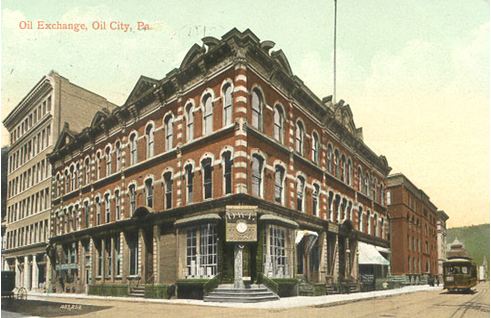
By 1877, Pennsylvania oil companies had created the third-largest financial exchange of any kind in America, behind only New York and San Francisco.
Before the 1870s, most Pennsylvania oil buyers had taken on-site delivery of oil in wooden barrels they provided themselves. A rapidly growing oil pipeline infrastructure created the need for a place to trade certificates as oil commerce expanded. The Standard Oil Company of New Jersey would bring an end to Pennsylvania’s highly speculative oil-trading markets.
Learn more in End of Oil Exchanges.
April 23, 1907 – Birthday of Shell
A telegram announced the merger of Royal Dutch Petroleum Company and Shell Transport and Trading Company to form the Royal Dutch Shell Group. Shell Transport and Trading was an 1897 British company founded by Sir Marcus Samuel for exporting “Shell” kerosene refined near Texas oilfields. Royal Dutch had begun to construct its own tankers as competition with Standard Oil intensified.

The 1907 telegram to Marcus Samuel confirming the merger to create Royal Dutch Shell Group. His transport company logo evolved from a mussel shell trademarked in 1900 to the Shell scallop in 1909.
Samuel’s company marketed kerosene in red cans to “stand out against Standard Oil’s blue when the companies were competing back at the end of the 19th century,” according to Shell. The yellow and red scallop shell logo began as a black and white mussel shell trademarked in 1900; the telegram’s 1907 date is celebrated as the birthday of Shell.
April 24, 1911 – Magnolia Petroleum founded
The Magnolia Petroleum Company was founded as an unincorporated joint-stock association — a consolidation of several companies, the first of which began in 1898 as a small refinery in Corsicana during the first Texas oil boom.
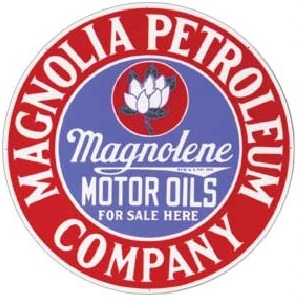
Magnolia Petroleum would merge with Socony Mobil Oil in the 1930s and replace its flower with the “Flying Pegasus” logo.
As Magnolia Petroleum established service stations in southwestern states, Standard Oil Company of New York (Socony) began acquiring the company in 1925 before merging with the Vacuum Oil Company in 1931.
The new company, Socony-Vacuum Oil — the future Mobil Oil — included stations in 20 states operated by Magnolia Petroleum, headquartered in an early Dallas skyscraper. Magnolia adopted the Socony-Vacuum Oil Pegasus logo, which began rotating atop the building in 1934.
April 24, 1917 – Maybell trademarks “Lash-Brow-Ine”
Tom Lyle Williams, doing business in Chicago as Maybell Laboratories, trademarked the name Lash-Brow-Ine as mascara and “preparation for stimulating the growth of eyebrows and eyelashes.” Two years earlier, Williams had watched his sister Mabel perform what she called “a secret of the harem,” mixing petroleum jelly with coal dust and applying it to her eyelashes.
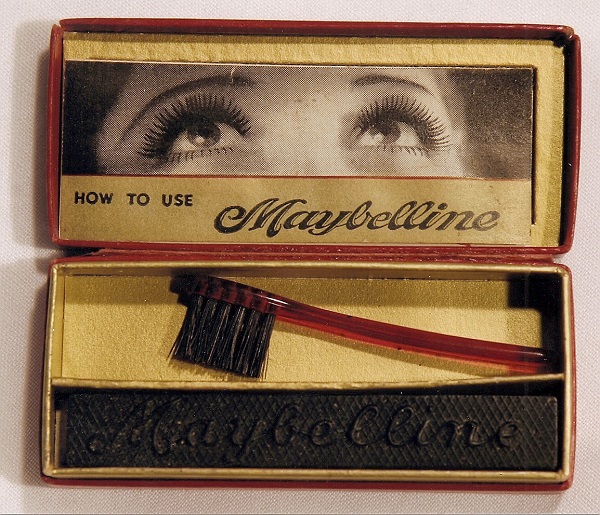
Toothpicks were once used to mix lampblack with Vaseline, but by the 1930s Maybelline mascara was available at local five-and-dime stores. Photo courtesy Sharrie Williams.
The mascara’s key ingredient, Vaseline, had been patented in 1872 by Robert Chesebrough, a young chemist in Brooklyn, New York (see The Crude Story of Mabel’s Eyelashes). Williams began selling tins of Mabel’s mixture by mail-order catalog, calling it “lash-brow-ine.” With sales exceeding $100,000 by 1920, Williams renamed the mascara Maybelline in honor of his sister, who worked with him in his Chicago office.
April 25, 1865 – Civil War Veteran patents Well Torpedo
Civil War veteran Col. Edward A.L. Roberts of New York City received the first of his many patents for an “Improvement in Exploding Torpedoes in Artesian Wells.” The invention used controlled downhole explosions “to fracture oil-bearing formations and increase oil production.”
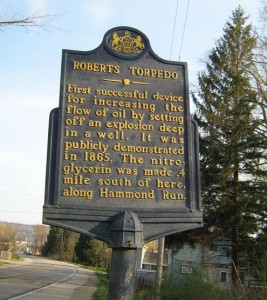
A Pennsylvania historical marker notes the 1865 first demonstration of the invention of Union Col. E.A.L. Roberts.
The Roberts torpedoes were filled with gunpowder, lowered into wells, and ignited by a weight dropped along a suspension wire to percussion caps. In later models, nitroglycerin replaced gunpowder. Before the well torpedo’s invention, many early wells in the new oil regions of Pennsylvania, New York, and West Virginia often produced limited amounts of oil.
With its exclusive patent licenses, the Roberts Petroleum Torpedo Company charged up to $200 per torpedo “shoot” and a one-fifteenth royalty. Seeking to avoid the expense, unlicensed practitioners operated at night with their own explosive devices, reportedly leading to the term “moonlighter.”
Learn more in Shooters – A “Fracking” History.
April 26, 1947 – Oil Industry promoted on Radio
For the first time since its establishment in 1919, the American Petroleum Institute launched a national advertising campaign. “The theme of the drive is that the petroleum industry is a modern and progressive one, and is now turning out the best products in its history,” noted The Billboard.
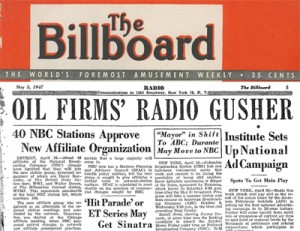
Founded in 1919 in New York City, API moved its headquarters to the nation’s capital in 1929.
“Radio this week struck real pay dirt as a ‘Gusher’ will come mainly from expansion of current air time on spot local or regional levels by the thousands of petroleum and related corporations,” proclaimed the weekly publication. API today is a Washington, D.C.-based lobbying organization representing major petroleum companies. It issues industrywide recommended practices “to promote the use of safe equipment and proven engineering.”
_______________________
Recommended Reading: Modern oil-well pumping, An Oil and gas journal book (1962); Dark Side of Fortune: Triumph and Scandal in the Life of Oil Tycoon Edward L. Doheny (2001); Deep Water: The Gulf Oil Disaster and the Future of Offshore Drilling: Report to the President


_______________________
The American Oil & Gas Historical Society (AOGHS) preserves U.S. petroleum history. Please support this energy education website, our monthly email newsletter, This Week in Oil and Gas History News, and help expand historical research. Contact bawells@aoghs.org. Copyright © 2026 Bruce A. Wells. All rights reserved.