The true oil production from an 1882 Pennsylvania well was a closely guarded secret.
In the dense woods of Cherry Grove, Pennsylvania, in June 2025, the community celebrated the 143rd anniversary of its 19th-century well — and an oilfield’s place in American petroleum history. Led by local and visiting oil-patch historians, the Cherry Grove Old Home and Community Day featured tours of the well that once shook world petroleum markets.
When the daily oil production from the Cherry Grove “Mystery Well” on Lot 646 was revealed in 1882, oil prices plunged worldwide. Drillers of the exploratory well in the wilderness of Warren County had kept news of their oilfield discovery secret.
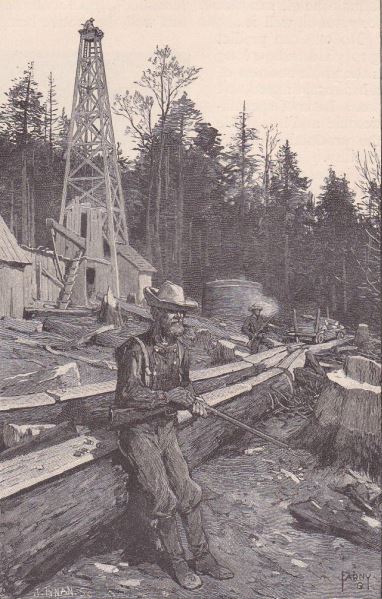
Image “Guarding a Wildcat Well,” 1883, from The Century Illustrated Monthly Magazine, courtesy Raymond P. Sorenson.
Rumors of the Cherry Grove discovery came at a time when markets were already oversupplied by the nearby Bradford field, the first truly giant U.S. oilfield. Widespread speculation about the well’s production influenced oil prices, according to petroleum geologist and historian Ray Sorenson.
“Numerous operators and marketers sent personnel to watch the well on 646, leading to the development of oil scouting as a recognized profession,” Sorenson noted in 2012, adding that his grandfather celebrated his first birthday in 1882 less than two miles from the well.
Lot 646 Mystery Well
Even the best oilfield detective tactics of early oil scouts were initially stymied at Cherry Grove.
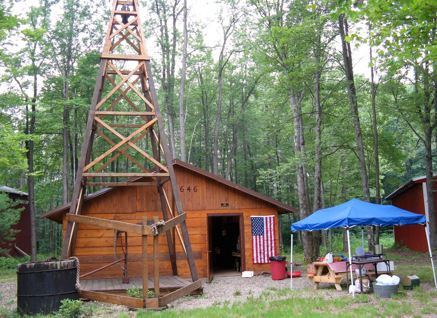
Dedicated volunteers in the Cherry Grove community of Warren County, Pennsylvania, have never forgotten “the great 1882 Oil Excitement.”
Owners of the lot 646 well had quietly secured nearby leases before word began to spread about the May 17, 1882, discovery well that flowed with 1,000 barrels of oil per day. The true oil production news about the mystery well, operated by the Jamestown Oil Company, sent shock waves through early oil market centers.
“The hilltop settlement of Cherry Grove saw national history in the spring and summer of 1882 when the 646 Mystery Well ushered in a great oil boom,” explained historian Paul H. Giddens in his 1938 book The Birth of the Oil Industry.
“The excitement in the oil exchanges was indescribable,” Giddens proclaimed in his classic historical account. “Over 4,500,000 barrels of oil were sold in one day on the exchanges in Titusville, Oil City and Bradford.”
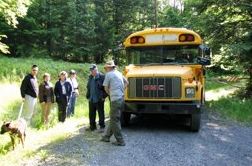
Petroleum historians frequently have toured the “mystery well” site in Cherry Grove, Pennsylvania.
According to Giddens, the Cherry Grove discovery demoralized the market and drove the price down to less than 50 cents per barrel. It brought an early financial crisis for the young U.S. petroleum industry, which was developing new drilling technologies.
Despite the collapse of oil prices, hundreds of derricks appeared around Cherry Grove — and thousands of people moved there while the boom lasted.
Historian Sorenson’s research discovered that in the first 22 years after the first U.S. oil well of 1859, there were 30 wells that reported daily flow rates greater than 1,000 barrels. Between May 17 and August 1, 1882, the Cherry Grove oilfield had 48 wells producing more than 1,000 barrels of oil per day.
Celebrating Cherry Grove
Although short-lived, the drilling boom deserves to be remembered, according to dedicated volunteers of the Cherry Grove Old Home and Community Day, which for decades hosted petroleum history events every June.
“Before the railroad could lay a new line to Cherry Grove, the boom went bust,” noted Walt Atwood, president of the Cherry Grove Old Home and Community Day, in 2012. “Thousands of people moved on. Those who remained kept the memory of the Oil Excitement alive with reunions that became known as Old Home Day.”
According to Atwood, in 1982 a group of Cherry Grove regulars rebuilt a “life-size 1882-style oil derrick and shanty” for the historic 646 Mystery Well’s centennial celebration.

Volunteers worked with township supervisors to raise funds and bring a work crew from the Pennsylvania Conservation Corps. The volunteers reunited in 2007 for the 125th anniversary to rebuild the 646 Mystery Well replica.
The 2022 celebration, “the 140th Anniversary of the Great 1882 Oil Excitement in Cherry Grove, Pennsylvania,” took place in mid-June with events at the replica derrick behind the Cherry Grove Fire Hall, 6045 Cherry Grove Road (State Road 2001), southwest of Clarendon Borough.
Geologist Sorenson in 2012 featured the 646 Mystery Well in “Cherry Grove Field, Warren County, Pennsylvania: The Lot 646 Mystery Well and Its Aftermath“ to the Tulsa Geological Society, adapted from his work published by the American Association of Petroleum Geologists (AAPG).

In addition to documenting Pennsylvania’s 646 Mystery Well, Sorenson has researched the earliest descriptions of oil found worldwide (Earliest Signs of Oil).
Meanwhile, volunteers at Cherry Grove continue to “keep the history alive” in their community, including hosting tours of the once top-secret well that shook global petroleum markets in 1882.
_______________________
Recommended Reading: Cherry Run Valley: Plumer, Pithole, and Oil City, Pa., Images of America
_______________________
The American Oil & Gas Historical Society (AOGHS) preserves U.S. petroleum history. Support this energy education website, subscribe to our monthly email newsletter, and help expand historical research. Contact bawells@aoghs.org. Copyright © 2026 Bruce A. Wells.
Citation Information – Article Title: “Cherry Grove Mystery Well.” Authors: B.A. Wells and K.L. Wells. Website Name: American Oil & Gas Historical Society. URL: https://aoghs.org/petroleum-pioneers/mystery-well-of-cherry-grove. Last Updated: May 7, 2026. Original Published Date: May 12, 2013.