June 1, 1860 – First Book about Oil published –
Less than 10 months after Edwin L. Drake completed the first commercial U.S. oil well at Titusville, Pennsylvania, Thomas A. Gale published an 80-page pamphlet many regard as the first book about America’s petroleum resources. The Wonder of the Nineteenth Century: Rock Oil in Pennsylvania and Elsewhere described the advantages of the new fuel source for kerosene lamps.
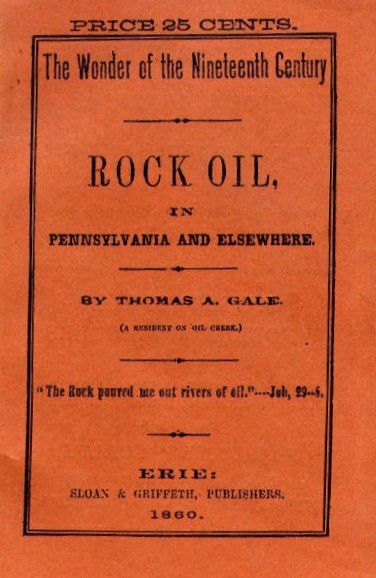
An 80-page pamphlet by Thomas Gale published in 1860 described the start of the Petroleum Age one year earlier at Titusville, Pennsylvania.
“Those who have not seen it burn may rest assured its light is no moonshine; but something nearer the clear, strong, brilliant light of day,” Gale declared in his pamphlet, which sold for 25 cents. Only three original copies were known to exist in 1952, when Ethyl Corporation of New York republished The Wonder of the Nineteenth Century.
Learn more in First Oil Book of 1860.
June 1, 1899 – California Oilfield discovered at Kern River
After others found signs of oil northeast of Bakersfield, California, Milton and Horace McWhorter drilled the region’s first commercial well. Their well revealed the 10,750-acre Kern River oilfield on the eastern edge of the southern San Joaquin Valley — the first of many contiguous fields to be found in Kern County.
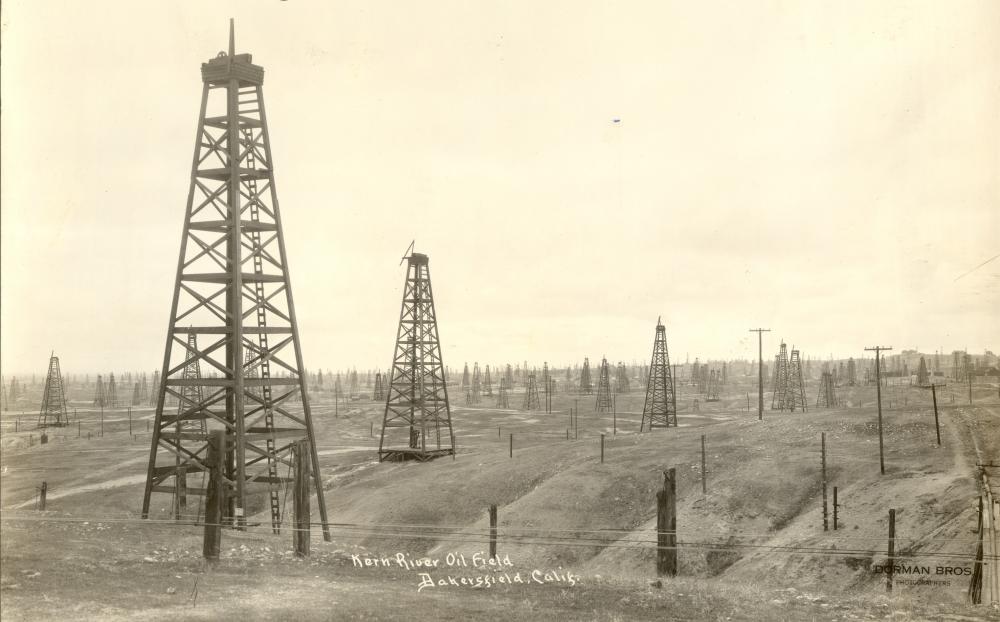
Discovered in 1899, the Kern River oilfield would become the third largest in California, after the Midway-Sunset and the Wilmington fields. Circa 1910 photo courtesy Kern County Oil Museum.
A drilling boom expanded the state’s petroleum industry by attracting major oil companies (and briefly, retired lawman Wyatt Earp). Kern County’s annual oil production peaked in 1985 at 256 million barrels of oil. The 8,000-square-mile county accounted for 70 percent of California’s oil and more than 90 percent of its natural gas in 2020.
Learn more California oil history by visiting the West Kern Oil Museum and the Kern County Museum.
June 1, 1940 – Dallas Artist depicts Life in Texas Oilfields
Jerry Bywaters
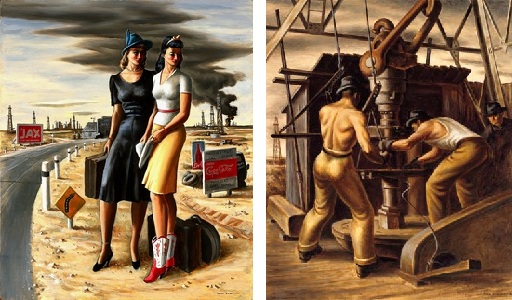
Jerry Bywaters (1906-1989) painted Oil Field Girls and the Oil Rig Workers in 1940. The Blanton Museum of Art describes Bywaters’ Oil Field Girls as “a work of incredible moral complexity.”
Bywaters and Alexandre Hogue (see Oil Art of Graham, Texas) were members of the Dallas Nine, a group of young painters in the 1930s, “who helped establish a regional artistic identity for Texas art,” according to the Blanton Museum of Art 
June 1, 1909 – Secret Test of Dual-Coned Drill Bit
At Goose Creek near Galveston Bay, Texas, a drilling crew secretly tested a dual-cone roller bit. “In the early morning hours of June 1, 1909, Howard Hughes Sr. packed an experimental bit into the trunk of his car and drove off into the Texas plains,” noted Gwen Wright of the History Detectives. The coned roller bit would soon make traditional rotary fishtail bits obsolete.
“When the Hughes twin-cones hit hard rock, they kept turning, their dozens of sharp teeth (166 on each cone) grinding through the hard stone,” the PBS episode explained in 2006. Hughes and partner R. Carlton “Carl” Baker formed Baker Hughes Tools Company (see Carl Baker and Howard Hughes).
June 2, 1908 – Goose Creek Oilfield discovered
Drilled on Galveston Bay wetlands, the first offshore well in Texas revealed a giant oilfield 20 miles southeast of Houston, according to the Texas State Historical Association (TSHA). Inspired by reports of bubbles on the surface where Goose Creek emptied into the bay, the Houston-based syndicate Goose Creek Production Company made the discovery at a depth of 1,600 feet.
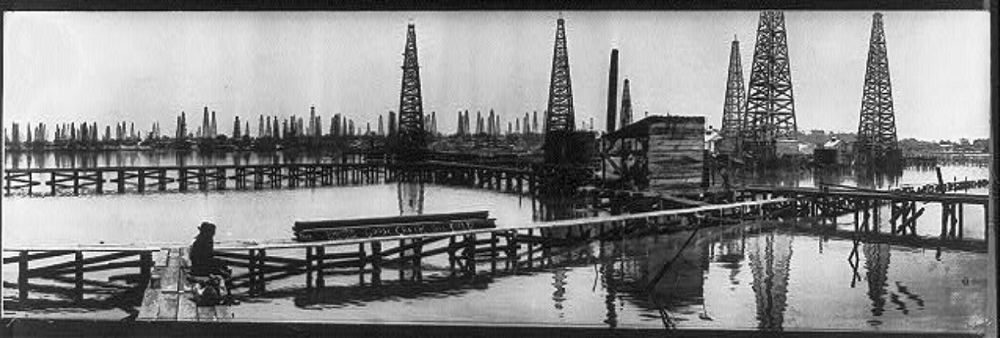
A single well of the Goose Creek field in 1917 produced 35,000 barrels of oil a day from a depth of 3,050 feet. Circa 1919 photo by Frank Schlueter courtesy Library of Congress Prints and Photographs Division.
“Within days the syndicate sold out to a subsidiary of the Texas Company, the future Texaco,” notes TSHA, adding the Goose Creek field, “spurred exploration for deep-seated (salt) domes, and led to the discovery of some of the largest oilfields in the United States.”
In 1909, Howard Hughes Sr. secretly tested an experimental dual-cone rock bit at Goose Creek. Humble Oil and Refining Company constructed a refinery adjacent to the field In 1921, naming the site Baytown.
June 3, 1979 – Bay of Campeche Oil Spill
Drilling in about 150 feet of water, the semi-submersible platform Sedco 135 suffered a blowout 50 miles off Mexico’s Gulf Coast. The Pemex well Ixtoc 1 spilled 3.4 million barrels of oil before being controlled nine months later. Considering the spill’s size, the environmental impact proved less than expected, according to a 1981 report by the Coordinated Program of Ecological Studies in the Bay of Campeche. Surveys of Campeche Sound conducted in 1980 reported, “Evaporation, dispersion, photo-oxidation and biodegradation processes played a major role in attenuating the harmful environmental effects of the oil spill.”
June 4, 1872 – Pennsylvania Oilfields bring Petroleum Jelly
A young chemist living in New York City, Robert Chesebrough,
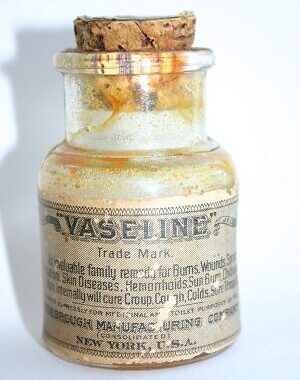
Robert Chesebrough consumed a spoonful of Vaseline each day and lived to be 96 years old. Photo courtesy Drake Well Museum.
When the 22-year-old chemist visited the new Pennsylvania oilfields in 1865, he noted drilling was often confounded by a paraffin-like substance that clogged the wellhead. Drillers used the “rod wax” as a quick first aid for abrasions.
Chesebrough returned to New York City and worked in his laboratory to purify the well byproduct, which he first called “petroleum jelly.” Female customers would discover that mixing lampblack with Vaseline made an impromptu mascara. In 1913, Mabel Williams employed just such a concoction, and it led to the founding of a cosmetic company.
Learn more in The Crude History of Mabel’s Eyelashes.
June 4, 1892 – Devastation of Pennsylvania Oil Regions
After weeks of thunderstorms in Pennsylvania’s Oil Creek Valley, the Spartansburg Dam on Oil Creek burst, sending torrents of water that killed more than 100 people and destroyed homes and businesses in Titusville and Oil City. The disaster was compounded when fires broke out.
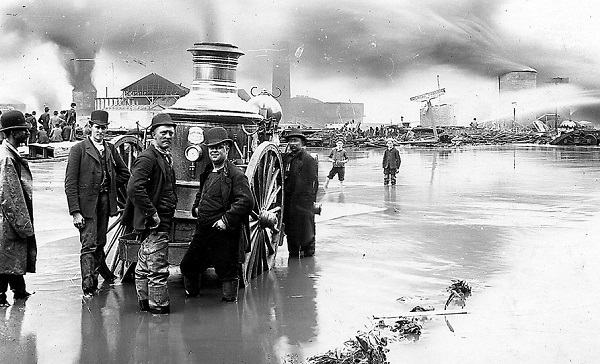
Titusville, Pennsylvania, residents used the “Colonel Drake Steam Pumper” during the great flood and fire of 1892. Photo by John Mather courtesy Drake Well Museum and Park.
“This city during the past twenty-four hours has been visited by one of the most appalling fires and overwhelming floods in the history of this country,” reported the New York Times from Oil City. Oilfield photographer John A. Mather documented the devastation, which included his Titusville studio and 16,000 glass-plate negatives.
Learn more in Oilfield photographer John Mather.
June 4, 1896 – Henry Ford drives his “Quadricycle”
Driving the first car he ever built, Henry Ford left a workshop behind his home on Bagley Avenue in Detroit, Michigan. He had designed his “Quadricycle” in his spare time while working as an engineer for Edison Illuminating Company. Ford chose the name because his handmade, 500-pound “horseless carriage” ran on four bicycle tires. Inspired by advancements in gasoline-fueled engines, he founded the Henry Ford Company in 1903.
June 4, 1921 – Petroleum Seismograph tested
A team of earth scientists tested an experimental seismograph device on a farm three miles north of Oklahoma City and determined it could accurately map subsurface structures. Led by Prof. John C. Karcher and W.P. Haseman, the team from the University of Oklahoma found that seismology could be useful for oil and natural gas exploration and production. Further seismic reflection tests, including one in the Arbuckle formation in August, confirmed their results.

June 6, 1932 – First Federal Gasoline Tax
The federal government taxed gasoline for the first time when the Revenue Act of 1932 added a one-cent per gallon excise tax to U.S. gasoline sales. The first state to tax gasoline was Oregon, which imposed a one-cent per gallon tax in 1919. Colorado, New Mexico, and other states followed. The federal tax, last raised on October 1, 1993, has remained at 18.4 cents per gallon (24.4 cents per gallon for diesel). About 60 percent of federal gasoline taxes are used for highway and bridge construction.
June 6, 1944 – English Channel Pipelines fuel WWII Victory
As the D-Day invasion began along 50 miles of fortified French coastline in Normandy, logistics for supplying the effort would include two top-secret engineering feats — the construction of artificial harbors followed by the laying of pipelines across the English Channel.
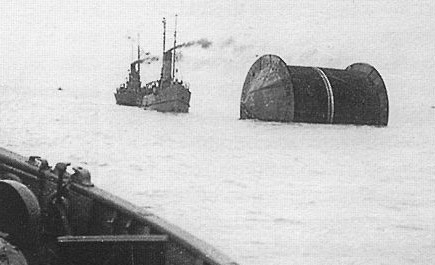
Operation PLUTO (Pipe Line Under The Ocean) unspooled flexible steel pipelines across the English Channel, but the channel was deep, the French ports distant.
Code-named “Mulberrys” and using a design similar to modern jack-up offshore rigs, the artificial harbors used barges with retractable pylons to provide platforms to support floating causeways extending to the beaches.
To fuel the Allied advance into Nazi Germany, Operation PLUTO (Pipe Line Under The Ocean) used flexible steel pipelines wound onto giant “conundrums” designed to spool off when towed. Gen. Dwight Eisenhower later acknowledged the vital importance of the oil pipelines.
Learn more in PLUTO, Secret Pipelines of WW II.
June 6, 1976 – Oil Billionaire J. Paul Getty dies
With a fortune reaching $6 billion (about $32 billion in 2023), J. Paul Getty died at 83 at his estate near London. Born into his father’s petroleum wealth from the Oil Company of Tulsa, Getty made his first million by age 23 from buying and selling oil leases.
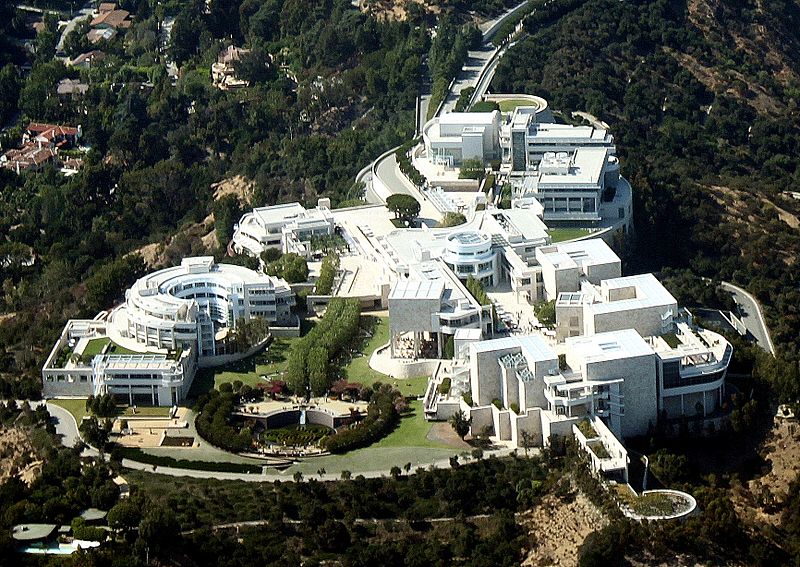
The J. Paul Getty Museum art collection is housed in the Getty Center and the Getty Villa at Malibu.
“I started in September 1914, to buy leases in the so-called red-beds area of Oklahoma,” Getty once told the New York Times. “The surface was red dirt and it was considered impossible there was any oil there. My father and I did not agree and we got many leases for very little money which later turned out to be rich leases.”
Getty, who incorporated Getty Oil in 1942, gave more than $660 million from his estate to the J. Paul Getty Museum.
______________________
Recommended Reading: The Wonder of the Nineteenth Century: Rock Oil in Pennsylvania and Elsewhere (1952); Black Gold in California: The Story of California Petroleum Industry (2016) History Of Oil Well Drilling


_______________________
The American Oil & Gas Historical Society (AOGHS) preserves U.S. petroleum history. Support this energy education website, our monthly email newsletter, This Week in Oil and Gas History News, and help expand historical research. Contact bawells@aoghs.org. Copyright © 2026 Bruce A. Wells. All rights reserved.