July 27, 1918 – Standard Oil of New York launches Concrete Tanker –
America’s first concrete vessel designed to carry oil, the Socony, left its shipyard at Flushing Bay, New York. Built for the Standard Oil Company of New York, the barge was 98 feet long with a 32-foot beam. It carried oil in six center and two wing compartments, “oil-proofed by a special process,” according to the journal Cement and Engineering News.

Socony, the first concrete oil tanker, launched in 1918. Below is a second version of the oil barge.
“Eight-inch cast iron pipe lines lead to each compartment and the oil pump is located on a concrete pump room aft,” the journal explained. Steel shortages during World War II would lead to the construction of larger reinforced concrete oil tankers.
July 28, 1924 – Oil Scouts form National Group
The National Oil Scouts Association of America, later the International Oil Scouts Association (IOSA), filed its charter in Austin, Texas, bringing new standards to an important oilfield profession. Since the 1860s, oilfield scouts have gathered field intelligence on drilling operations, including often sensitive information about the operator, well location, and lease details — anything that may yield a competitive advantage. These “night riders of the hemlocks” also sleuth drilling depths, geologic formations encountered, logs, and other data.
Learn more in Oil Scouts – Oil Patch Detectives.
July 28, 1953 – Final Oilfield Patent for Zero Hour Bomb Company
Manufacturer of oilfield products since 1932, the Zero Hour Bomb Company of Tulsa, Oklahoma, received its last U.S. patent relating to electric timer explosives for fracturing geologic formations. The service company patented its device for positioning blasting cartridges in wells — a “well bridge” that automatically opened “when the time bomb or weight reached a position at the bottom of the well.”
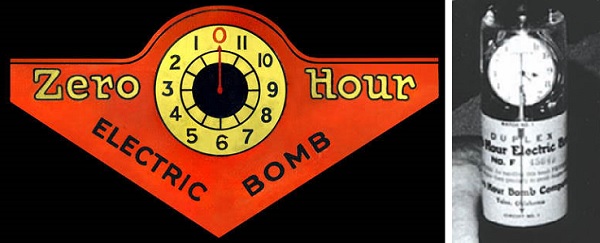
Oilfield service provider Zero Hour Bomb Company was founded in Tulsa, Oklahoma, in 1932. Photos courtesy Zebco.
The downhole apparatus was never built because company executives already were manufacturing and marketing a new, “cannot backlash” fishing reel invented by Jasper “R.D.” Hull, whom they had hired in 1947. Zero Hour Bomb Company changed its name to Zebco in 1956.
Learn more in Zebco Reel Oilfield History.
July 28, 1977 – Trans-Alaska Pipeline delivers Oil to Port of Valdez
The first barrel of oil from the North Slope’s Prudhoe Bay oilfield arrived at the Port of Valdez after an 800-mile journey through the Trans-Alaska Pipeline System.

Established in 1975, the Organization for Management of Alaska’s Resources (OMAR) became the Resource Development Council for Alaska (RDC) three years later.
At peak flow in 1988, 11 pumping stations moved 2.1 million barrels of oil a day. The 48-inch-wide pipeline has been recognized as a landmark of engineering (see Trans-Alaska Pipeline History).
July 29, 1918 – “World’s Wonder Oil Pool” discovered in Texas
Less than a year after the “Roaring Ranger” discovered an oilfield to the south, the Fowler No. 1 well at the cotton farming community of Burkburnett, Texas, revealed a new giant field at a depth of 1,734 feet. Within three weeks, 56 rigs were drilling near the Fowler Farm Oil Company site along the Red River in North Texas.
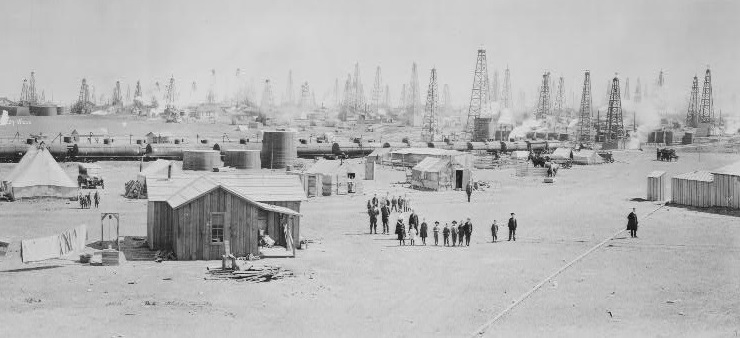
Circa 1919 photo captioned, “Burkburnett, Texas, the World’s Wonder Oil Pool,” showing eight months’ phenomenal development, viewed from the northwest side, opposite Fowler farm.” Newman Photographic Company photo courtesy Library of Congress.
Fowler’s decision to drill a well on his Wichita County farm had been called “Fowler’s Folly” until his oil discovery brought hundreds of oil companies to the county. By January 1919, Burkburnett’s population reached more than 8,000 people — with a line of derricks two miles long greeting new arrivals.
As the “World’s Wonder Oil Pool” made national headlines, teenager Clark Gable was a 17-year-old roustabout working in Oklahoma. Gable and Spencer Tracy would star in Hollywood’s version of Burkburnett oil history, the popular 1940 movie “Boom Town.”
Learn more in Boom Town Burkburnett.

July 29, 1957 – Eisenhower limits Oil Imports
As America’s reliance on foreign oil continued to grow — discouraging domestic production — President Dwight D. Eisenhower established a Voluntary Oil Import Program with import quotas by region. The intent was to ensure adequate domestic petroleum in case of a national emergency.
Using a presidential proclamation two years later, Eisenhower made the program mandatory. By 1962, oil imports were limited to 12.2 percent of U.S. production. The program continued until suspended by President Richard Nixon in 1973 as domestic oil production reached new highs during the OPEC oil embargo.
July 30, 1942 – U-166 sinks, discovered 60 years later
A Navy patrol boat attacked and sank a German U-boat in the Gulf of Mexico after the submarine had torpedoed a U.S. freighter. Despite being depth-charged, the U-166 was believed to have escaped — until a natural gas pipeline survey revealed it 59 years later.
The U-166’s identity was not learned until advanced geophysical survey technologies arrived in 2001, according to the National Oceanic and Atmospheric Administration (NOAA). The discovery resulted from an archaeological survey prior to construction of a natural gas pipeline by the British company BP and Shell Offshore Inc.
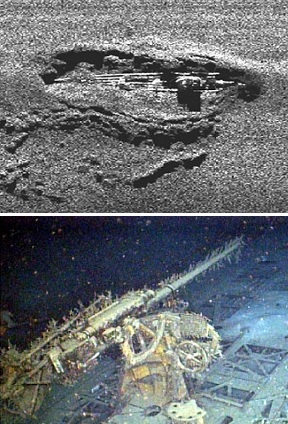
A natural gas pipeline survey revealed the U-166 about 45 miles off the Louisiana coast in 2011.
Remotely operating vehicles (ROVs) and an autonomous side-scan sonar revealed U-166 separated from its last victim, the Robert E. Lee, by less than a mile. BP and Shell altered their proposed pipeline to preserve the site.
With the petroleum industry the principal user of advanced underwater technologies for seafloor mapping, other World War II vessels have been discovered during oil and natural gas surveys.
Learn more in Petroleum Survey discovers U-boat.
August 1, 1872 – Iron Pipeline delivers Pennsylvania Natural Gas
The first large-scale delivery of natural gas by pipeline began when gas was piped five miles to more than 250 residential and commercial customers in Titusville, Pennsylvania, home to America’s first oil well. The two-inch-wide iron pipeline sent gas from a well producing four million cubic feet of gas a day. Investors, including the mayor of Titusville, had formed the Keystone Gas & Water Company to deliver “the most powerful and voluminous gas well on record,” according to the Drake Well Museum and Park.
August 2, 1956 – Missouri builds First U.S. Interstate Highway
Missouri became the first state to award a contract with interstate construction funding authorized two months earlier by the Federal-Aid Highway Act. The highway commission agreed to begin work on part of Route 66, now Interstate 44.
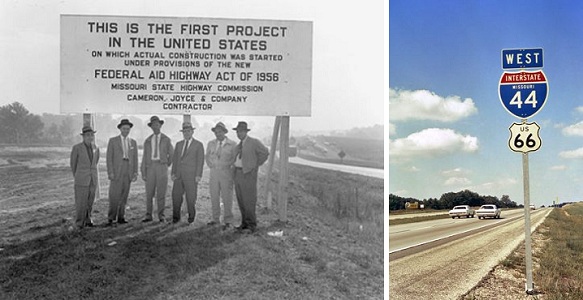
Missouri launched the U.S. interstate system after “inking a deal for work on U.S. Route 66.” Today, I-44 stretches across south central Missouri and is a major corridor linking the Midwest and the West Coast.
“There is no question that the creation of the interstate highway system has been the most significant development in the history of transportation in the United States,” proclaimed the Missouri Department of Transportation (also see America on the Move).
_______________________
Recommended Reading: The History of the Standard Oil Company: All Volumes (2015); The Oil Scouts – Reminiscences of the Night Riders of the Hemlocks


_______________________
The American Oil & Gas Historical Society (AOGHS) preserves U.S. petroleum history. Please support this website, subscribe to the monthly email newsletter, This Week in Oil and Gas History News, and help expand our historical research. Contact bawells@aoghs.org. Copyright © 2026 Bruce A. Wells. All rights reserved.