August 31, 1850 – San Francisco Utility manufactures Gas from Coal –
The San Francisco Gas Company was incorporated in 1850 to produce and distribute manufactured gas extracted from coal. Irish immigrants Peter and James Donahue and engineer Joseph Eastland erected a “gasification plant” to distill coal for manufacturing the gas for lighting. Their company in 1852 illuminated San Francisco’s first “town gas” street lamps. San Francisco Gas became Pacific Gas & Electric (PG&E) in 1905, and by 1915 the company operated almost 8,500 street lamps — each hand lit and shut off every day. The last coal-gas lamp was extinguished in 1930 (also see the History of Con Ed).
August 31, 1859 – Petroleum Industry’s First “Dry Hole”
Just four days after the first American oil well in Titusville, Pennsylvania, a series of far less-known “firsts” were achieved by local entrepreneur John Grandin in August 1859.
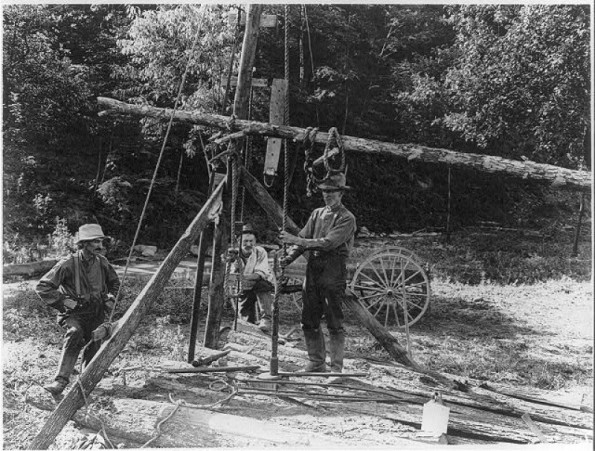
A spring-pole similar to the one above was used in 1859 to drill America’s first dry hole, which was deeper than the nearby Drake well. Photo from “The World Struggle for Oil,” a 1924 film by the Department of the Interior.
Grandin drilled using the simple (and ancient) spring-pole “kick down” method at Gordon Run Creek. His well found no oil but achieved several petroleum industry milestones. His attempt would be credited with the first stuck tool, the first “shooting” of a well with black powder, and the first well ruined by a failed shooting.
Learn more in First Dry Hole.
August 31, 1871 – Birth of “The Father of Route 66”
Cyrus Stevens Avery, an Oklahoma independent producer who became known as “The Father of Route 66,” died in Los Angeles at age 91. Born in Stevensville, Pennsylvania, in 1871, Avery lived in Oklahoma by 1897, selling life insurance before starting the Avery Oil and Gas Company in 1908, during the Tulsa oil boom. By 1916, after describing Tulsa as “little town without lights” with “pigs running loose in the streets,” Avery “helped lay out a state road plan and the national highway numbering system, becoming the champion of a road from Chicago to Los Angeles we know as Route 66,” notes the Tulsa Historical Society (THS).
September 1, 1862 – Union taxes Manufactured Gas
A new federal tax of up to 15 cents per thousand cubic feet was placed on manufactured gas to help fund the Civil War. Often processed from coal and stored in large gasometers, “town gas” had become popular for street and residential lighting. The Brooklyn Daily Eagle accused the local gas company of passing on the new tax, which “shifts from its shoulders its share of the burdens the war imposes and places it directly on their customers.”
September 2, 1910 – Cities Service Company incorporates
Henry Doherty organized the Cities Service Company as a public utility holding company in Bartlesville, Oklahoma. Doherty bought producing properties in Kansas and Oklahoma as he acquired distributing companies and linked them to natural gas fields. In 1915, a Cities Service subsidiary discovered the 34-square-mile El Dorado oilfield. In 1928, another subsidiary completed the discovery well of the giant Oklahoma City field.
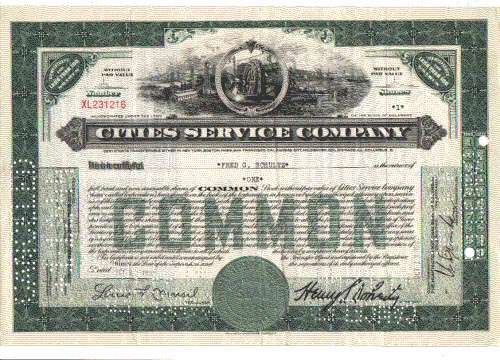
Cities Service Company subsidiaries discovered many Mid-Continent oilfields.
Federal court mandates in 1940 resulted in Cities Service’s divestiture of its public utilities; in 1959, the remaining companies were reformed as Cities Service Oil Company, which changed its marketing brand to Citgo in 1964. After being purchased by Occidental Petroleum in 1982, Citgo was acquired by the Venezuela state-owned oil company Petróleos de Venezuela (PDVSA) in 1990.
Learn more in Cities Service Company.
September 2, 1918 – Desdemona Oilfield adds to North Texas Boom
A third oil boom arrived in Eastland County, Texas, when the Hog Creek Oil Company exploratory well at Desdemona blew in at 2,000 barrels of oil a day — thrilling the venture’s investors. Production from the new oilfield, which joined prolific fields at Breckenridge (1916) and “Roaring Ranger” (1917), would peak at more than 7.3 million barrels of oil in 1919.
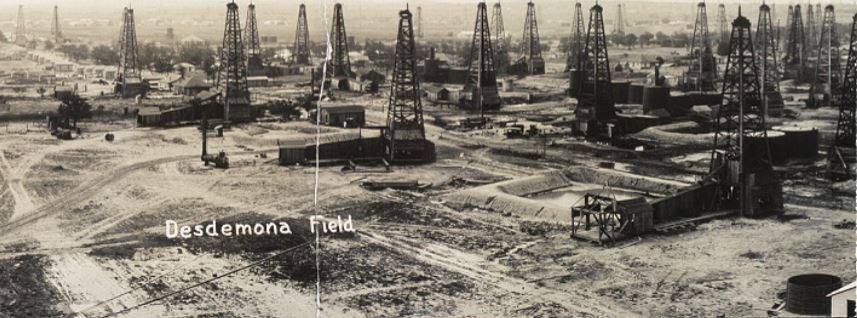
Desdemona, Texas, oilfield, circa 1919. Detail from panoramic photo courtesy Library of Congress.
“By 1919, the Desdemona field was probably the second largest in the oil belt, and the Hog Creek Oil Company’s stockholders were able to sell their $100 shares for $10,250 each,” noted Edwin Cox in his 1950 History of Eastland County, Texas. Thanks to its oilfield leases, Eastland County’s Merriman Baptist Church would be declared the richest congregation in America.
September 2, 2009 – Offshore Depth Record
BP discovered an offshore oilfield 250 miles southeast of Houston — and set a world depth record by drilling 30,923 feet into the seabed from a platform floating more than 4,130 feet above. The Tiber Prospect field at the time was estimated to contain more than three billion barrels of oil. The record-setting well was drilled by the semi-submersible rig Deepwater Horizon, which was destroyed in a deadly explosion and oil spill in April 2010.
September 4, 1841 – “Rock Drill Jar” Patent for Percussion Drilling
Early drilling technology advanced when William Morris, a driller in West Virginia, patented a “Rock Drill Jar.” It was an innovation he had been experimenting with while drilling brine wells. “The mechanical success of cable-tool drilling has greatly depended on a device called jars, invented by a spring pole driller,” according to historian Samuel Pees, who in 2004 noted Morris began using the technology as early as the 1830s.
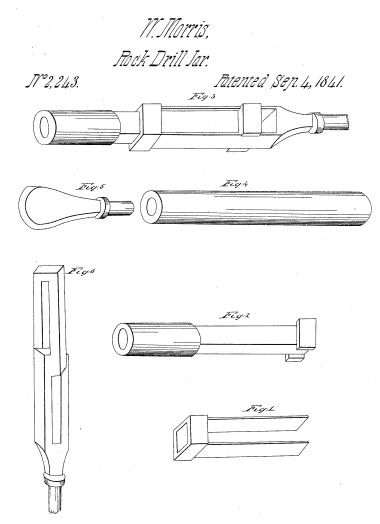
Drill-jar technology improved efficiency for drilling deeper brine wells using percussion tools — and later, oil wells.
For more advanced cable tools, Morris patented a “manner of uniting augers to sinkers for boring,” with the upper link of the jars helping the lower link to strike the underlying auger stem on the upstroke. This upward blow could dislodge the bit if it was stuck in the rock formation. Cable-tool drillers would soon improve upon the Morris jars.
Learn more in Making Hole — Drilling Technology.

September 4, 1850 – Illuminating Chicago Streets
The Chicago Gas Light & Coke Company delivered its first commercial gas processed from coal. “The gas pipes were filled, and the humming noise made by the escaping gas at the tops of the lamp-posts indicated that everything was all right,” reported the Gem of the Prairie newspaper. “Shortly afterward the fire was applied and brilliant torches flamed on both sides of Lake Street as far as the eye could see and wherever the posts were set.”
September 4, 1860 – Pennsylvania Offshore Industry
An oil well on Tidioute Island in the Allegheny River about 15 miles east of Titusville, Pennsylvania, “commenced flowing and as far as is known, this was the first successful well ever drilled on an island,” according to the Warren County Historical Society. After the first U.S. well, “the biggest drilling activity centered at Tidioute and by July 1860 more than sixty wells were being drilled,” noted the historical society in 2001.
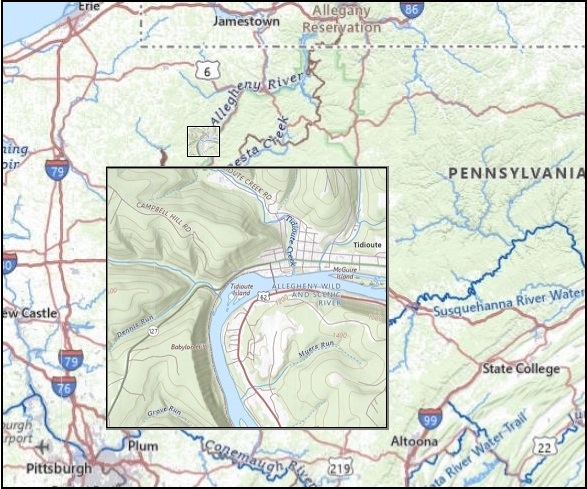
Tidioute experienced a drilling boom soon after the August 1859 oil discovery at nearby Titusville. An 1866 well at Triumph Hill sparked still more Allegheny exploration. Topographic maps courtesy USGS.
“In the fall of 1860, there were nearly fifty rafts floating in the Allegheny River along the Tidioute shore with derricks established on board of them and with drilling being done from the rafts,” the society adds in an Erie Times News article. That makes Warren County the earliest site of America’s offshore industry, although “a flood came and in one night swept all the derricks out of the river.”
September 5, 1885 – Birth of the “Filling Station” Gas Pump
Modern gasoline pump design began with inventor Sylvanus F. (Freelove) Bowser, who sold his first pump to a grocery store owner in Fort Wayne, Indiana. Designed to safely dispense kerosene as well as “burning fluid, and the light combustible products of petroleum,” Bowser’s pump included marble valves, a wooden plunger, and a simple, upright faucet.
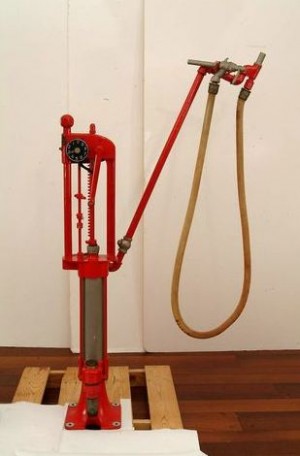
The 1916 Bowser gas pump included a “clock face” dial to measure pumped gas. Photo courtesy Smithsonian Institution.
Thanks to the pump’s success at Jake Gumper’s grocery store, Bowser formed the S.F. Bowser Company and patented his invention in 1887. Within a decade — as the automobile’s popularity grew — Bowser’s company added new pump designs. By 1905, the S.F. Bowser “Self-Measuring Gasoline Storage Pump” became known to motorists as a “filling station.”
The Bowser gas pump included a hand-levered suction pump and a hose attachment for dispensing gas. As other pump manufacturers arrived, Fort Wayne became known as the “Gas Pump Capital of the World.”
Learn more in First Gas Pump and Service Station.
September 5, 1927 – Schlumberger Brothers test Electric Logging Tool
An electric well-logging tool was first applied at Pechelbronn, France, after brothers Conrad and Marcel Schlumberger modified their surface system to operate vertically in a well.
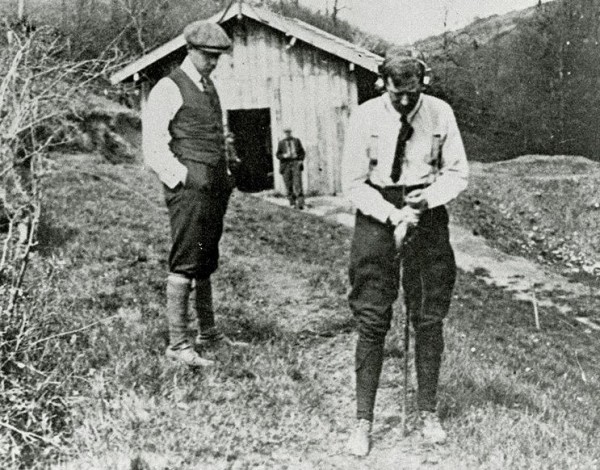
Near Caen, France, Conrad Schlumberger in 1912 recorded the first map of equipotential curves (imaginary lines in an electric field).
Conrad Schlumberger had conceived the idea of using electrical measurements to map subsurface rock formations as early as 1912. After developing an electrical four-probe surface approach for mineral exploration, the brothers created the electric downhole well log.
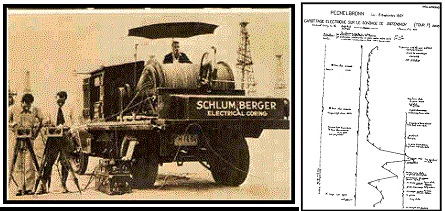
Conrad and Marcel Schlumberger tested their electronic logging tool in 1927, one year after founding the world’s first well-logging company. Photo and image courtesy Schlumberger Ltd.
Lowering their new tool into a well, they recorded a single lateral-resistivity curve at fixed points in the well’s borehole and graphically plotted the results against depth — creating a well log of geologic formations. Changes in subsurface resistance readings showed variations and possible oil and natural gas-producing areas.
The brothers’ technological breakthrough would lead to Schlumberger becoming the world’s first well-logging oilfield service company.
September 5, 1939 – Young Geologist reveals Mississippi Oilfield
Union Producing Company completed its Woodruff No. 1, the first commercial oil well in Mississippi. Drilled at Tinsley, southwest of Yazoo City, the well produced 235 barrels of oil a day from a depth of 4,560 feet in a sandstone later named the Woodruff Sand. Fieldwork by geologist Frederic Mellen led to the Tinsley oilfield discovery.
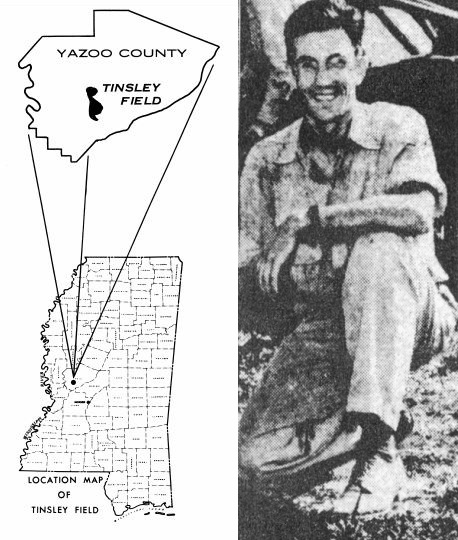
Fred Mellen was elected president of the Mississippi Geological Survey in 1946.
While working on a Works Progress Administration (WPA) project, Mellen earlier found indications of a salt dome structure similar to the giant Spindletop field of 1901 in Texas. The 28-year-old geologist urged more seismographic testing, and Houston-based Union Producing Company leased about 2,500 acres at Perry Creek.
Mellen’s original WPA project had been a clay and minerals survey, “to locate a suitable clay to mold cereal bowls and other utensils for an underprivileged children’s nursery.” Instead, he launched Mississippi’s oil industry.
Learn more in First Mississippi Oil Wells.
_______________________
Recommended Reading: The Extraction State, A History of Natural Gas in America (2021); Street Lights of the World


_______________________
The American Oil & Gas Historical Society (AOGHS) preserves U.S. petroleum history. Please support this website, subscribe to the monthly email newsletter, This Week in Oil and Gas History News, and help expand our historical research. Contact bawells@aoghs.org. Copyright © 2026 Bruce A. Wells. All rights reserved.