October 12, 1964 – Methane Princess delivers LNG –
Four months after entering service in June 1964, Methane Princess, the first purpose-built liquefied natural gas (LNG) carrier, delivered its cargo to Canvey Island in the United Kingdom. With nine tanks capable of holding the equivalent of 600 MMcf of gas, the 618-foot vessel and her sister ship, Methane Progress, made regular deliveries to Canvey Island for almost 20 years.
The Methane Pioneer — a converted World War II Liberty freighter — in 1959 delivered the first commercial transoceanic LNG cargo to the same Canvey Island terminal, “proving that the transoceanic transport of LNG was feasible,” according to the Energy Information Administration (EIA).
October 13, 1917 – U.S. Oil & Gas Association founded
Oklahoma independent producers established the Mid-Continent Oil & Gas Association in Tulsa, Oklahoma, six months after the United States entered World War I. The organization, today the United States Oil & Gas Association, was founded by petroleum industry leaders Frank Phillips, E.W. Marland, Bill Skelly, and Robert Kerr to increase petroleum supplies for the Allies during the war. The association in 1919 formed the Oklahoma-Kansas Division, now the Petroleum Alliance of Oklahoma.
October 13, 1954 – First Arizona Gas Well
After decades of searching, Arizona became the 30th petroleum-producing state when Shell Oil Company completed a natural gas well one mile south of the Utah border on the Apache County Navajo Reservation. The East Boundary Butte No. 2 well showed gas production of about 3 million cubic feet per day from depths between 4,540 feet and 4,690 feet — but produced low amounts of oil.
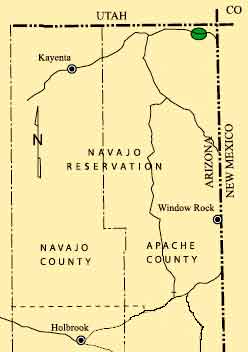
Arizona in 2024 produced about 6,000 barrels of oil in Apache County, according to the Energy Information Administration (EIA).
A rancher had reported finding natural seeps in central Arizona in the late 1890s, and by 1902, a part-time prospector from Pennsylvania, Joseph Heslet, began exploration efforts that ended in 1916 after finding traces of oil.
Arizona’s oil production declined after 2015, occasionally reaching 1,000 barrels of crude oil per month. There were no significant proven reserves by 2024, according to the Energy Information Administration (EIA), and the state’s few oil wells produced only about 6,000 barrels of oil.
Learn more in First Arizona Oil and Gas Wells.
October 14, 1929 – Van Oilfield discovered East of Dallas
Pure Oil Company completed its Jarman No. 1 well in Van Zandt County and launched a drilling boom east of Dallas. During its first hour, the oilfield discovery well produced 147 barrels of oil from the Woodbine Sandstone at a depth of 2,700 feet. Three more wells followed as construction began on a camp for oilfield workers.
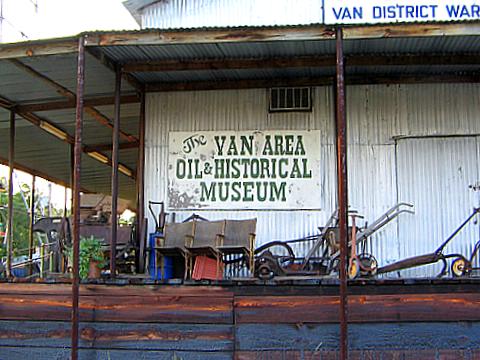
In Van, Texas, about 75 miles east of Dallas, Van Zandt County’s petroleum museum is housed in a 1930s Pure Oil Company warehouse. The 2026 Van Oil Festival is October 17. Photo by Bruce Wells
By April 1930, the Van field produced 20,000 barrels of oil a day as companies adopted advanced production techniques. New pipelines linked the oilfield to the Pure refinery in Beaumont, Texas, and Standard Oil Company’s refinery in Baton Rouge, Louisiana. Among the Van oilfield’s “Cook Camp” buildings was a sheet-metal warehouse, today home to the Van Area Oil and Historical Museum (Facebook page).
In May, the Van Zandt County Historical Commission unveiled a marker to commemorate the Texas & Pacific Railway short line from Grand Saline that “played a critical role in the rapid development of the oilfield by bringing in tons of heavy oilfield equipment.” On October 17, the annual Van Oil Festival will take place in City Park to celebrate 97 years of petroleum heritage. The Oil Queen Pageant was October 11.
October 15, 1895 – Patent for a Well Boring Machine
Oscar Benjamin of Lafayette, Louisiana, patented a compact, cable-tool drilling rig. His design for the “Well Boring Machine” used a framework mounted on wheels with a hinged derrick “adapted to swing over in transit.”
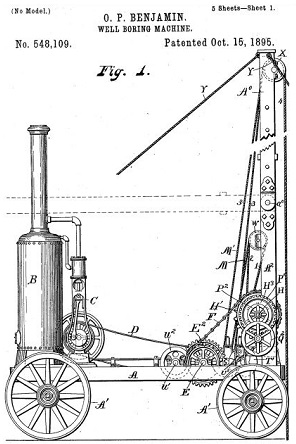
The 1895 patent for a portable cable-tool rig noted: “Mounted on this framework (A) are the boiler (B) and the steam engine (C), which drives the belt (D).”
Although Benjamin’s design included a boiler and steam engine mounted on the framework, any source of power could be used “independent of the portable boring machine,” he noted in his patent application (No. 548,109). The derrick could be steadied by stay-ropes, and the velocity of the shaft controlled by using a band brake.

October 15, 1966 – Johnson signs the Historic Preservation Act
Recognizing that the “spirit and direction of the nation are founded upon and reflected in its historic heritage,” President Lyndon Johnson signed into law the National Historic Preservation Act to protect historical and archaeological sites. The Act authorized the Secretary of the Interior to maintain a National Register of Historic Places. “The historical and cultural foundations of the nation should be preserved as a living part of our community life and development in order to give a sense of orientation to the American people,” the Act proclaimed.
October 15, 1997 – Kerosene fuels Land Speed Record
The current world land speed record was set at 763.035 miles per hour by the Thrust SSC, the British “supersonic car” fueled by a 19th-century petroleum product, kerosene. The vehicle’s twin turbofan engines burned JP-4, a fuel that first powered jet aircraft as early as 1951. SpaceX Falcon 9 rockets are fueled by a kerosene rocket fuel, which also powered the Apollo moon launches. Liquefied natural gas fueled the Blue Flame, holder of the world land speed record from 1970 to 1983.
October 16, 1931 – Natural Gas Pipeline sets Record
The first long-distance, high-pressure U.S. natural gas pipeline went into service during the Great Depression, linking prolific Texas Panhandle gas fields to consumers in Chicago.
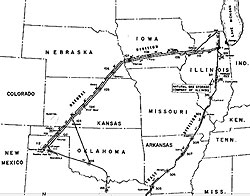
The original 1931 natural gas pipeline extended 980 miles from North Texas to Illinois.
A.O. Smith Corporation developed the technology for a thin-walled pipe, and Continental Construction Corporation built the 980-mile bolted flange line for the Natural Gas Pipeline Company of America (NGPL). The $75 million pipeline consumed 209,000 tons of specially fabricated 24-inch-wide steel pipe, which filled 6,500 freight cars. The project required 2,600 separate right-of-way leases (also see Big Inch Pipelines of WW II).
October 17, 1890 – Union Oil of California founded
Lyman Stewart, Thomas Bard, and Wallace Hardison founded the Union Oil Company of California by merging their petroleum properties to compete with Standard Oil of California, founded 20 years earlier. Union Oil made strategic alliances with smaller oil companies to build pipelines from Kern County oilfields to the Pacific Coast.
“This gave the independent producers an alternative to what they perceived as the low prices paid by Standard Oil and the high freight rates charged by the railroads to move crude oil,” noted the American Institute of Mining in 1914. Union Oil moved the company headquarters from Santa Paula to Los Angeles in 1901.
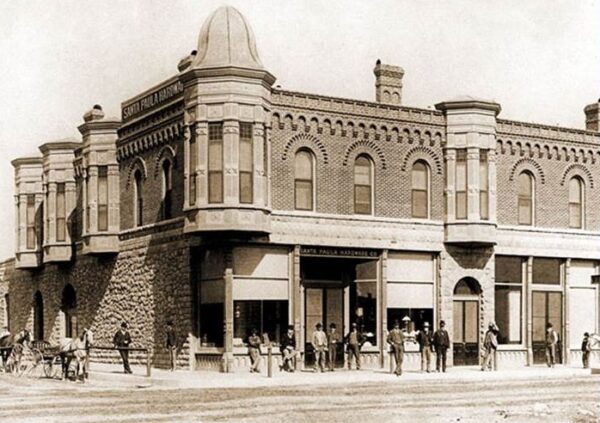
After becoming the Union Oil Museum in 1950, the company’s Santa Paula headquarters building was restored to in 1990 and reopened as the California Oil Museum, which closed in 2021 because of the pandemic.
In 1910, Union Oil lost control of its Midway-Sunset field’s Lakeview No. 1 well, which would take 18 months to control. The purchase of Pennsylvania-based Pure Oil in 1965 made the Unocal Union 76 brand a nationwide company. Chevron acquired Unocal in 2005.
Union Oil’s original Santa Paula headquarters building, added to the National Register of Historic Places in 1986, became home to the California Oil Museum in 1990. The museum closed in 2021 due to the the pandemic. In 2024, Chevron donated the historic building to the city of Santa Paula with a $2 million grant for its maintenance and preservation.
October 17, 1917 – “Roaring Ranger” launches Texas Drilling Boom
A wildcat well drilled between Abilene and Dallas launched the Texas drilling boom that helped fuel the Allied victory in World War I. The J.H. McCleskey No. 1 well erupted oil about two miles south of the small town of Ranger, which had been founded in the 1870s near a Texas Ranger camp in Eastland County.
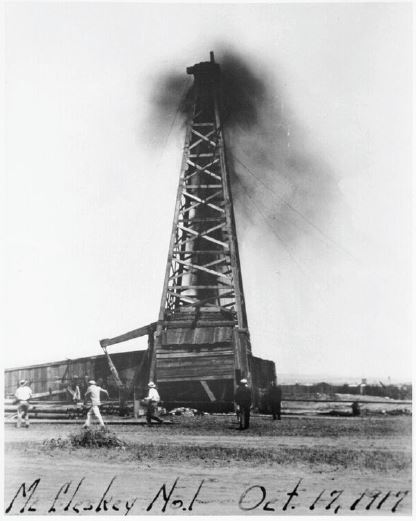
The 1917 McCleskey No. 1 oil gusher in Texas made headlines as the “Roaring Ranger” that helped win World War I.
William Knox Gordon of the Texas and Pacific Coal Company completed the oilfield discovery well at a depth of 3,432 feet. It initially produced 1,600 barrels a day of quality, high-gravity oil. Within 20 months, the exploration company’s stock value jumped from $30 a share to $1,250 a share.
“Roaring Ranger” launched a drilling boom that extended to nearby towns. With effective blowout-preventer technology still a decade away, more gushers followed, some producing up to 10,000 barrels of oil a day. Ranger’s population quickly grew from 1,000 to 30,000.
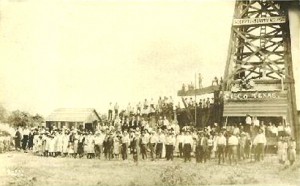
North Texas oil discoveries included 1920s wells drilled at Cisco in Eastland County, where Conrad Hilton witnessed a crowd of roughnecks waiting at the Mobley Hotel — and decided to buy it.
Petroleum proved essential in World War I. After the armistice was signed in 1918, a member of the British War Cabinet declared, “The Allied cause floated to victory upon a wave of oil.”
After the war, a veteran named Conrad Hilton visited Eastland County intending to buy a bank at Cisco. When his deal fell through, Hilton — at the Cisco train station ready to leave — noticed a small hotel with a line of roughnecks waiting for a room (see Oil Boom Brings First Hilton Hotel).
Learn more in “Roaring Ranger” wins WWI.
October 17, 1918 – End of “Gasless Sundays”
Three week before the end of World War I, and after seven voluntary “Gasless Sundays” east of the Mississippi River to support the war effort, the U.S. Fuel Administration ended the initiative after saving an estimated one million gallons of gasoline. Because of depleted East Coast reserves, gasoline deliveries to customers had been forbidden until all orders to the Army, Navy, and U.S. Allies were delivered. Mandatory “Lightless Nights” in 1917 required electrical signs to be turned off on Thursdays and Sundays. Other home-front conservation measures included “Heatless Mondays” and “Meatless Thursdays.”
October 17, 1973 – Arab Oil Embargo brings Gas Lines, Recession
The Organization of Petroleum Exporting Countries (OPEC) implemented what it called “oil diplomacy,” prohibiting any nation that had supported Israel in the Yom Kippur War from buying the cartel’s oil. “The oil crisis set off an upheaval in global politics and the world economy,” proclaimed Pulitzer Prize-winning author Daniel Yergin in 2013. “It also challenged America’s position in the world, polarized its politics at home and shook the country’s confidence.”
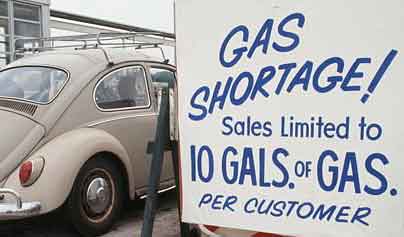
The OPEC embargo lasted from October 1973 until it was lifted in March 1974 and caused oil prices to almost quadruple. January 1974 photo by Warren Leffler, courtesy Library of Congress (LOC).
The New York Stock Exchange dropped by almost $100 billion, creating one of the worst recessions in American history. Following the “shuttle diplomacy” of Secretary of State Henry Kissinger Henry Kissinger, the embargo ended in March 1974 with an agreement between Israel and Syria.
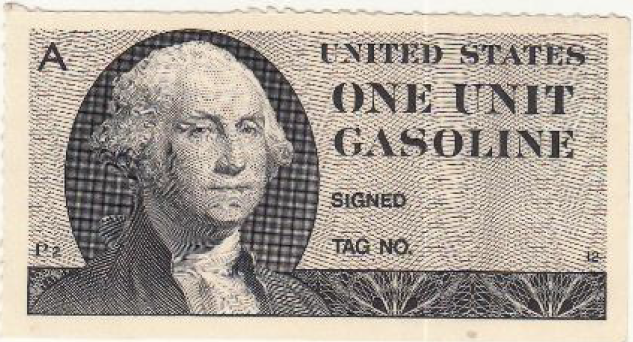
The U.S. government printed but never issued gasoline rationing coupons in response to the oil embargo. One is preserved in Philadelphia’s Science History Institute. Photo courtesy Bob Bauman.
In case the embargo proved lengthy, the U.S. Bureau of Engraving and Printing printed — but never issued — gasoline rationing coupons. A rare example is among petroleum and chemical industry currencies, 1870 to 1993, preserved in the Robert J. Bauman Collection at the Science History Institute Museum & Library in Philadelphia.
October 18, 2008 – Derrick dedicated at First Oklahoma Well
A reenactment of the dramatic moment that changed Oklahoma history highlighted the 2008 dedication of an 84-foot replica derrick at Discovery 1 Park in Bartlesville, Oklahoma. Events included roughneck reenactors and a water gusher from an 84-foot derrick that replaced one dedicated in 1948.
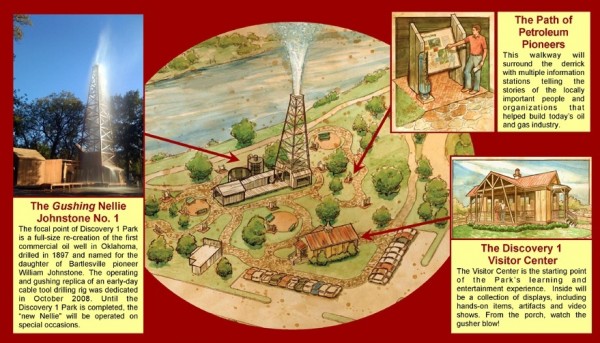
Discovery 1 Park in Bartlesville includes a replica derrick on the original site of Oklahoma’s first official oil well, the Nellie Johnstone No. 1, in 1897.
In 1897, a cable-tool drilling rig at the site of Oklahoma’s first commercial oil well had thrilled another group of spectators when Jenny Cass, stepdaughter of Bartlesville founder George W. Keeler, was given the honor of “shooting” the well in what today is Discovery 1 Park.
_______________________
Recommended Reading: Trek of the Oil Finders: A History of Exploration for Petroleum (1975); Arizona Rocks & Minerals: A Field Guide to the Grand Canyon State


_______________________
The American Oil & Gas Historical Society (AOGHS) preserves U.S. petroleum history. Please support this energy education website, subscribe to the free monthly newsletter, This Week in Oil and Gas History News, and help expand historical research. Contact bawells@aoghs.org. Copyright © 2026 Bruce A. Wells. All rights reserved.