August 17, 1785 – “Bituminous Matter” reported at Oil Creek –
Two years after the end of the Revolutionary War, oil was reported floating on a creek in northwestern Pennsylvania. “Oil Creek has taken its name from an oil or bituminous matter being found floating on its surface,” noted a report by Gen. William Irvine, adding, “Many cures are attributed to this oil by the natives, and lately by some of the whites, particularly rheumatic pains and old ulcers.”

Known for its prominence in the early petroleum industry, Oil City began in the 1600s as a Seneca village at a bend in the Allegheny River at the mouth of Oil Creek. Detail from 1864 map by J.T. Lloyd, publisher, courtesy Library of Congress.
The discovery confirmed an earlier Army survey reporting that Oil Creek “empties itself into the Allegheny River, issuing from a spring, on the top of which floats an oil, similar to what is called Barbados Tar (see Asphalt Paves the Way), and from which may be collected by one man several gallons in a day.” Decades later, George Bissell studied the seeps, which led to drilling of the first U.S. oil well there in 1859.
August 17, 1915 – End of Hand-Cranked Engines
Charles Kettering of Dayton, Ohio, patented an “engine-starting device,” the first practical electric starter for automobiles. Working as an engineer for Dayton Engineering Laboratories Company (DELCO), Kettering had earlier devised an electric motor to replace hand cranks on cash registers. “The present invention is particularly applicable to automobiles, wherein an engine of the combustion or explosion type is employed, as a means of propulsion,” Kettering noted in his patent.

Early automobile hand cranks connected directly to the crankshaft and could kick back during winding — breaking a thumb or a wrist. Photo courtesy Library of Congress.
“The hand crank at the front of the car was connected directly to the crankshaft. The operator would connect the hand crank, wind it up a few times, and hope the engine started smoothly,” noted Car and Driver in a 2016 article, How Cars Started Back in the Early Days, adding, “Of course, that engine could kick back tremendously, breaking a thumb or a wrist, depending on how you held the hand crank.”
Cadillac was the first manufacturer to add electric starters to its models. The Ford Model T used a hand crank until 1919; replacing the dangerous method proved popular, especially among women drivers. In addition to his engine-starting patent, in 1921 Kettering and fellow General Motors chemist Thomas Midgley Jr. discovered the gasoline additive tetraethyl lead (see Ethyl Anti-Knock Gas).
August 18, 1990 – Oil Pollution Act becomes Law
President George H.W. Bush signed the Oil Pollution Act of 1990, which was passed by the 101st Congress to strengthen the ability of the Environmental Protection Agency (EPA) to prevent and respond to catastrophic oil spills. Signed into law 17 months after the Exxon Valdez oil spill in Prince William Sound, Alaska, the act required vessels and oil storage facilities to submit to the federal government plans detailing how they would respond to large spills.
August 18, 2007 – Astrobleme Museum opens in Oklahoma
Ames, Oklahoma, celebrated the opening of its Astrobleme (meteor crater) Museum, designed to educate visitors about a meteor impact that led to a major oilfield discovery 450 million years later. Located about 20 miles southwest of Enid, the Ames meteor crater was buried by about 9,000 feet of sediment, making it barely visible on the surface. Most geologists believed impact craters to be unlikely locations for petroleum.
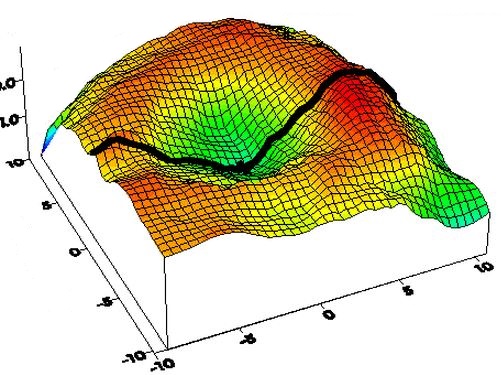
A 1,000-foot-wide meteorite struck Oklahoma 450 million years ago, producing a crater eight miles wide. Image courtesy University of Oklahoma.
Although wells were drilled nearby, no one had attempted to reach deep into the hidden, eight-mile-wide Ames crater in Major County. In 1991, Continental Resources CEO Harold Hamm decided to drill to a depth of about 10,000 feet, deeper than usual for the area, and found an oilfield. His Ames crater discovery well uncovered what became the most prolific of the six oil-producing craters found in the United States.
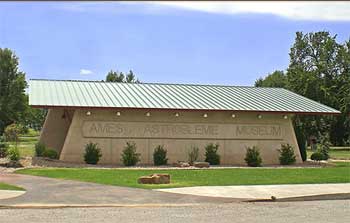
Oklahoma’s Ames Astrobleme Museum, which opened in 2007, requires no staff to educate visitors. Photo by Bruce Wells.
“The Ames Astrobleme is one of the most remarkable and studied geological features in the world because of its economic significance,” explained independent producer Lew Ward in 2007. The potential of drilling in impact craters got the attention of oil companies worldwide.
Learn more in Ames Astrobleme Museum.
August 19, 1909 – Canadian Journal lampoons Standard Oil
“The Standard Oil Company has decided to drive the cow and the dairyman out of business,” declared the Stanstead Journal of Quebec, reporting from Jersey City, New Jersey. “Its skilled chemists have discovered a process whereby they can make gilt-edge butter as a byproduct of crude petroleum.”
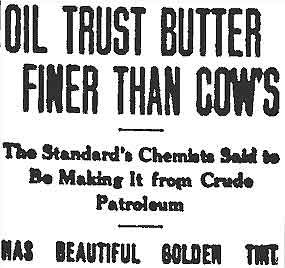
Many newspapers applauded the approaching breakup of the Standard Oil Trust, sometimes spreading the news with humor.
The journal fancifully proclaimed, “The chemists, in the steps leading up to the petroleum butter discovery, also have perfected a cheap process by which they can convert the kerosene into sweet milk.”
August 19, 1957 – First Commercial Oil Well in Washington
The first and only commercial oil well in the state of Washington was drilled by the Sunshine Mining Company. The Medina No. 1 well flowed 223 barrels a day from a depth of 4,135 feet near Ocean City in Grays Harbor County. The well produced 12,500 barrels before being capped in 1961.
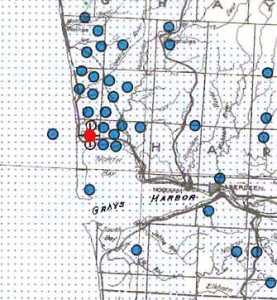
Surrounded by failed attempts, Washington’s only commercial oil well was capped in 1961.
By 2010, about 600 oil and natural gas wells had been drilled in Washington, but large-scale commercial production never occurred. The state’s most recent production — from the Ocean City field — ceased in 1962, according to the Washington Commissioner of Public Lands. No oil or gas has been produced since.

August 20, 1971 – Penn-Brad Oil Museum opens in Pennsylvania
Preserving the 1880s history of the world’s first billion dollar oilfield, the Bradford, Pennsylvania, Penn-Brad Oil Museum opened in nearby Custer City. At the end of the 19th century, the region produced high-quality oil from the upper Devonian Bradford Sands — accounting for more than 80 percent of U.S. production.
“A light golden amber to a deep moss-green in color, the ‘miracle molecule ‘ from the Bradford field is high in paraffin and considered one of the highest grade natural lubricant crude oils in the world,” explains the museum.
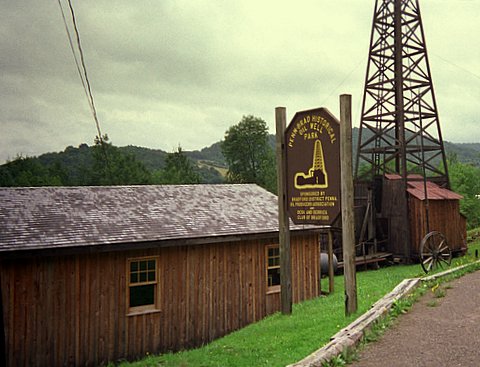
The Penn-Brad Museum and Historical Oil Well Park of Bradford, Pennsylvania, celebrates its 53rd birthday on August 20. Photo by Bruce Wells.
Outdoor exhibits include a replica 72-foot standard cable-tool derrick and engine house, and guided tours by oil country veterans educate visitors about “yellow dogs and barkers, headache posts, hurry-up sticks and sucker rods.”
Learn more Bradford oilfield history in Mrs. Alford’s Nitro Factory.
August 21, 1897 – Olds Motor Vehicle Company founded
American automotive pioneer Ransom Eli Olds (1864–1950) founded the Olds Motor Vehicle Company in Lansing, Michigan. Renamed Olds Motor Works in 1899, the company became the first auto manufacturer established in Detroit.
By 1901, Olds had built 11 prototype vehicles, including at least one powered by steam, electricity, and gasoline, according to historian George May. “He was the only American automotive pioneer to produce and sell at least one of each mode of automobile.”
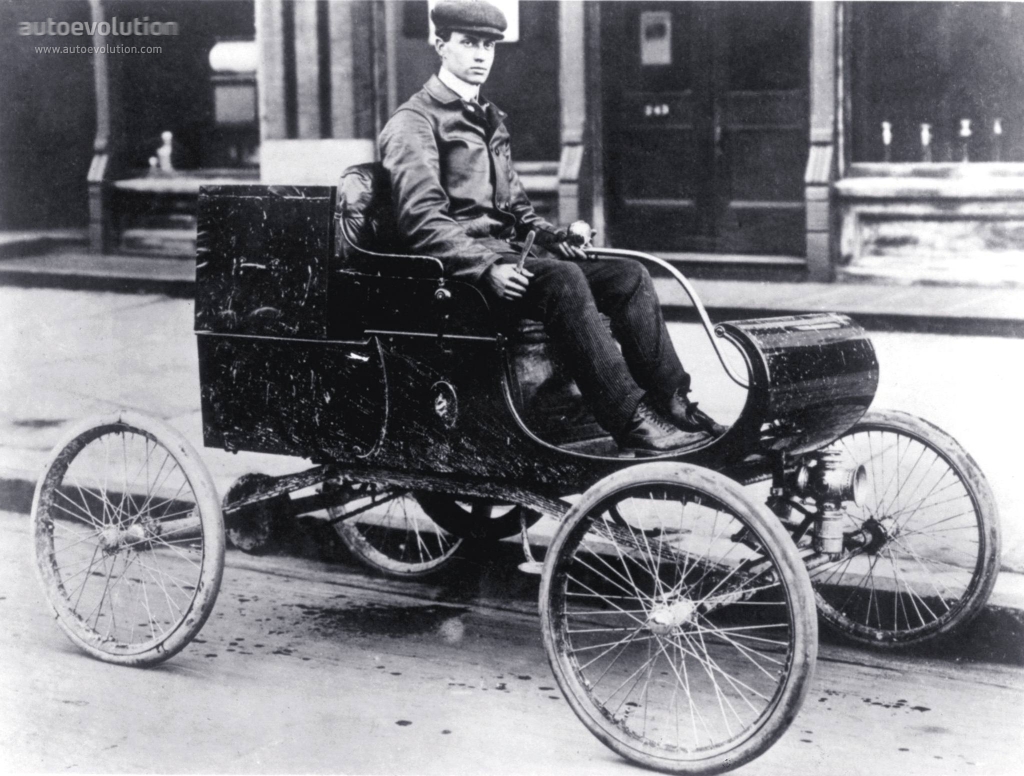
Powered by a single-cylinder, five-horsepower gasoline engine, the 1901 Oldsmobile Curved Dash was the first mass-produced U.S. automobile.
The modern assembly line concept also began with Olds, who used a stationary assembly line (Henry Ford would be the first to use a moving assembly line). Olds Motor Works sold the first mass-produced automobile in 1901, one year after the first U.S. Auto Show.
When the last Oldsmobile rolled off an assembly line in Lansing in 2004, it was the end of America’s oldest automotive brand.

August 21, 1993 – Henry Rouse Monument rededicated
Family members rededicated the original 1865 monument to Henry R. Rouse at his estate near Youngsville, Pennsylvania. Rouse — a respected leader of the early oil industry — died on April 17, 1861, when his highly pressurized well exploded into flames (see Rouseville 1861 Oil Well Fire).
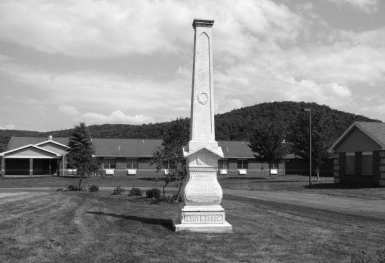
The 1865 Warren County, Pennsylvania, monument to Henry Rouse was rededicated by the family in 1993. Photo courtesy the Rouse Estate.
The monument stands in front of the Rouse family home, which has long served the Warren County poor as Mr. Rouse intended, according to the Rouse Estate. After more than 100 years, the “old” Rouse buildings became the Rouse Home, a county nursing facility and apartments for personal care.
_______________________
Recommended Reading: Myth, Legend, Reality: Edwin Laurentine Drake and the Early Oil Industry (2009); Unleaded: How Changing Our Gasoline Changed Everything (2021); Oil And Gas In Oklahoma: Petroleum Geology In Oklahoma (2013); Standard Oil Company: The Rise and Fall of America’s Most Famous Monopoly

_______________________
The American Oil & Gas Historical Society (AOGHS) preserves U.S. petroleum history. Please support this website, subscribe to our monthly email newsletter, This Week in Oil and Gas History News, and help expand historical research. Contact bawells@aoghs.org. Copyright © 2026 Bruce A. Wells. All rights reserved.