May 26, 1891 – Carbon Black Patent leads to Crayola –
Edwin Binney of New York City received a patent for his “Apparatus for the Manufacture of Carbon Black.” The process allowed the “manufacture lamp-black from oil in an improved and economical manner.” It created a fine, intensely black soot-like substance — a pigment blacker than any other available at the time. Its success led to a partnership with C. Harold Smith and another petroleum product, Crayola crayons.
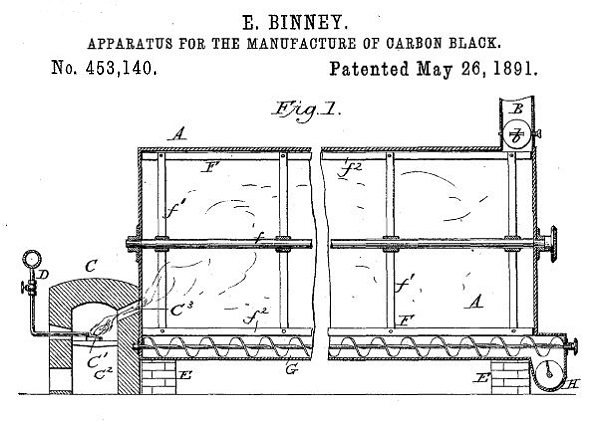
Edwin Binney patented an “Apparatus for the Manufacture of Carbon Black in 1891.” Twelve years later, Binney and partner Harold Smith produced another oilfield product, Crayola.
After introducing a popular black crayon called Staonal (stay-on-all), the Pennsylvania company began manufacturing Crayola crayons in 1903 using paraffin hand-mixed pigments. Each box contained eight colors: red, orange, yellow, green, blue, violet, brown, and black. Learn more in Carbon Black and Oilfield Crayons.
May 26, 1934 – Diesel-Electric Power sets Speed Record
A new diesel-electric “streamliner,” the Burlington Zephyr, pulled into Chicago’s Century of Progress exhibition after a nonstop 13-hour “dawn to dusk” run from Denver. The trip cut traditional steam locomotive times by half.
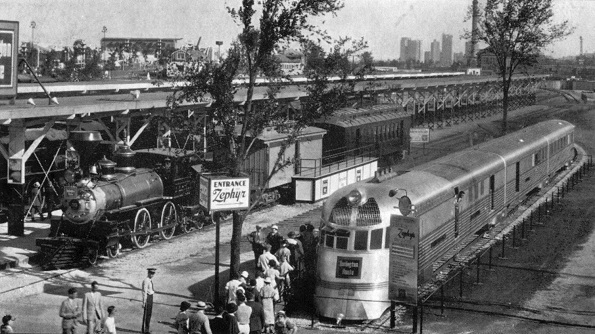
Chicago World’s Fair visitors tour the Burlington Zephyr, which helped save the railroad passenger industry using a diesel-electric engine. Photo from a 1934 Burlington Route Railroad postcard.
Powered by a single, eight-cylinder diesel engine, the passenger train traveled 1,015 miles on its record-breaking run. The Zephyr burned just $16.72 worth of diesel fuel. The same distance for a coal-burning train would have cost $255. The new diesel-electric engine technology had resulted from the U.S. Navy seeking a lighter-weight, more powerful engine for its submarine fleet. Learn more in Adding Wings to the Iron Horse.
May 27, 1893 – Oklahoma Historical Society founded
Before Oklahoma became a state, the Oklahoma Historical Society (OHS) was founded during the annual meeting of the Oklahoma Territorial Press Association in Kingfisher. An early mission included collecting and distributing newspapers published in the territory. In 2005 OHS opened its 215,000-square-foot Oklahoma History Center in Oklahoma City.
May 27, 1933 – Sinclair Dinosaur Debut at Chicago World’s Fair
Sinclair Oil’s Brontosaurus (more correctly, Apatosaurus) appeared for the first time during the 1933-1934 Century of Progress International Exposition, also known as the Chicago World’s Fair. Founded in 1916 as Sinclair Oil and Refining Company by Harry Sinclair, the company used dinosaurs to create hugely successful national marketing campaigns.
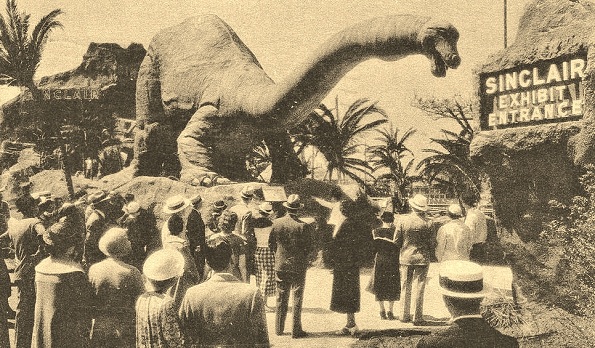
The first Sinclair “Brontosaurus” trademark made its debut in Chicago during the 1933-1934 “Century of Progress” World’s Fair. Sinclair Dinosaur Exhibit postcard published by Sinclair Refining Company Inc.
“Dino” and his prehistoric companions proved so popular that the company recreated its dinosaurs for the 1936 Texas Centennial Exposition and the 1939 New York World’s Fair. Refurbished, Sinclair Oil’s green giant returned to New York for another world’s fair in 1964-65 before touring shopping malls across America. Learn more in Dinosaur Fever – Sinclair’s Icon.
May 28, 1879 – Pipeline challenges Standard Oil
An 80-horsepower engine at Station No. 1 in Coryville, Pennsylvania, began pumping oil from the Bradford oilfield 109 miles to Williamsport — “the first pipe line to carry oil across the Alleghenies,” according to a Pennsylvania Historical and Museum Commission historic marker erected in 1949. Built by Byron Benson, founder of the Tidewater Pipe Company, the “Tidewater line” was six inches in diameter and pumped oil over a mountain nearly 2,600 feet high. Extended to Bayonne, New Jersey, in 1882, the pipeline successfully challenged Standard Oil’s dominance of the transportation market.
May 28, 1923 – “Oil Well of the Century” taps Permian Basin
It took 646 days of difficult cable-tool drilling before a well near Big Lake, Texas, proved there was oil on University of Texas land in the Permian Basin. The arid region of Reagan County has been thought to be worthless. In 1999, Texas Monthly proclaimed Santa Rita No. 1, the “Oil Well of the Century.”
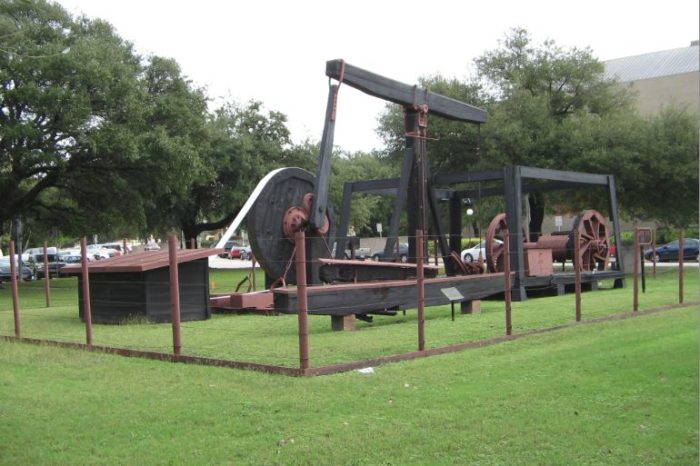
A University of Texas exhibit in 2007 featured the original Santa Rita cable-tool drilling equipment that has been moved to the Austin campus in 1958. Photo by Bruce Wells.
Named for the patron saint of the impossible, the Santa Rita well produced oil for the next seven decades, and the University of Texas received $4 million in royalties within three years of the discovery by Texon Oil and Land Company. The student newspaper described the well “as one that made the difference between pine-shack classrooms and modern buildings.” Learn more in Santa Rita taps Permian Basin.
May 29, 1940 – Nebraska’s First Oil Well
After more than a half-century of dry holes, Nebraska’s first commercial oil well was completed near Falls City in the southeastern corner of the state. Eager to join other states benefiting from tax revenue gained from petroleum, Nebraska lawmakers had offered a $15,000 bounty for the first well to produce 50 barrels of oil a day for two months.
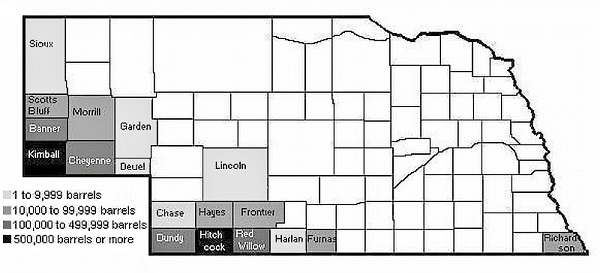
Nebraska oil production began in 1940 in the southeastern corner of the state, but most production would come from western counties.
Pawnee Royalty Company completed the Bucholz No. 1 well with production of about 170 barrels of oil a day in its first 60 days. The bonus-winning well was about five miles east of a “vein of petroleum” first reported by geologists in 1883. Learn more in First Nebraska Oil Well.
May 30, 1911 – First Indianapolis 500 takes Seven Hours
The first Indianapolis 500-mile race began with 40 cars; only 12 finished the 1911 test of endurance and automotive technology. The winner averaged almost 75 mph after about seven hours of racing.
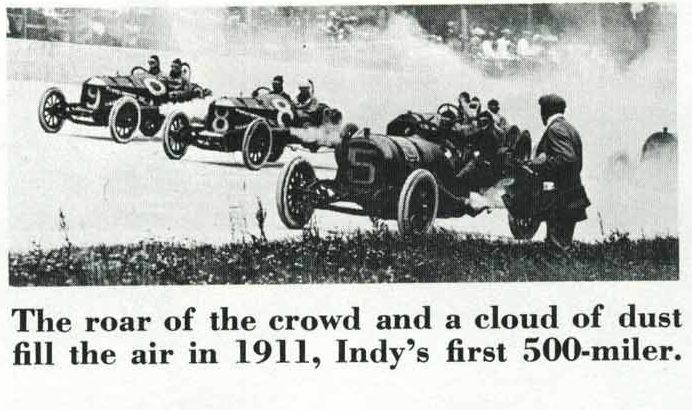
All of the cars except the winner had a mechanic to manually pump oil. More than 60,000 watched the first race.
All cars except the winning No. 32 Marmon Wasp had two seats because drivers traveled with “riding mechanics,” who manually pumped oil. Driver Ray Harroun later would invent a kerosene carburetor. “Let the fuel people fight it out amongst themselves, I’ll have a car soon that will burn anything they send,” he declared.
Eleven years before “The Greatest Spectacle in Racing,” gasoline powered less than 1,000 of the 4,200 autos sold in America (see Cantankerous Combustion – 1st U.S. Auto Show).

May 30, 1987 – Million Barrel Museum opens in Monahans, Texas
The Million Barrel Museum opened on a 14.5-acre site in Monahans, Texas. The museum’s main attraction is a large elliptical oil storage tank built in 1928 to store Permian Basin oil.
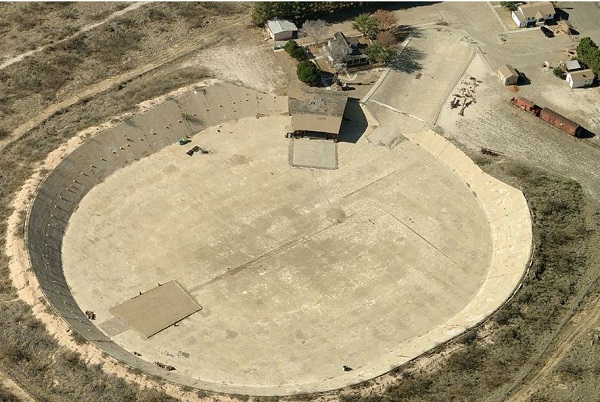
The Monahans Million Barrel Museum’s 525-foot by 422-foot concrete foundation once included a wooden roof. The structure, built to store Permian Basin oil in 1928, became a Monahans water park for one day in 1958.
The experimental concrete tank — 525 feet by 422 feet — was designed to hold more than a million barrels of oil. The highly productive West Texas region lacked oil pipelines. The tank’s 30-foot earthen walls sloped at a 45-degree angle and were covered in concrete. It included a roof made of California redwood.
Repeated efforts could not stop oil from leaking at the seams. Shell eventually abandoned the giant structure, which would be patched to briefly become a water park in the 1950s…until it leaked again. Learn more in Million Barrel Museum.
_______________________
Recommended Reading: Carbon Black, Its Manufacture, Properties, and Uses (2018); Crayola Creators: Edward Binney and C. Harold Smith, Toy Trailblazers


_______________________
The American Oil & Gas Historical Society (AOGHS) preserves U.S. petroleum history. Support this energy education website, our monthly email newsletter, This Week in Oil and Gas History News, and help expand historical research. Contact bawells@aoghs.org. Copyright © 2026 Bruce A. Wells. All rights reserved.