April 13, 1974 – Depth Record set in Oklahoma’s Anadarko Basin –
After drilling for 504 days and spending about $7 million, the Bertha Rogers No. 1 well reached a total depth of 31,441 feet — almost six miles — before being stopped by liquid sulfur. Drilled in Oklahoma’s Anadarko Basin, it held the record of the world’s deepest well for more than a decade.
The GHK Company of Robert Hefner III and partner Lone Star Producing Company believed natural gas reserves resided deep in the Anadarko Basin, extending across West-Central Oklahoma and the Texas Panhandle. Their first high-tech drilling attempt began in 1967 and took two years to reach a then-record depth of 24,473 feet.
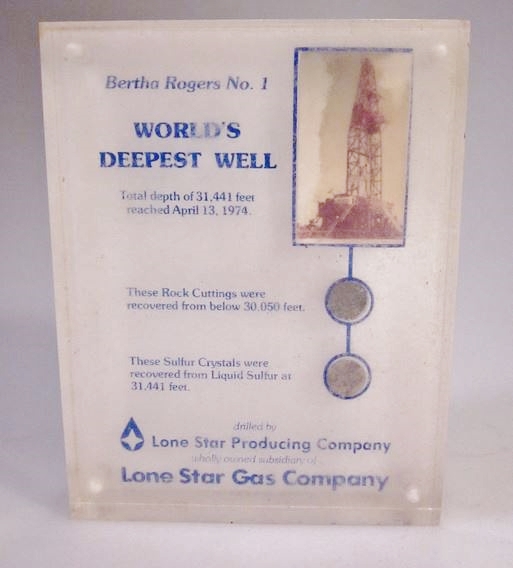
A 1974 souvenir plaque of the Bertha Rogers No. 1 well, which reached almost six miles deep in Oklahoma’s Anadarko Basin.
The 1969 well found plenty of natural gas, according to historian Robert Dorman, but because of federal price controls, “the sale of the gas could not cover the high cost of drilling so deeply — $6.5 million, as opposed to a few hundred thousand dollars for a conventional well.”
Drilling of the Bertha Rogers well began in late 1972 and averaged about 60 feet per day. By April 1974, bottomhole pressure reached almost 25,000 pounds per square inch with a temperature of 475 degrees. The well’s 1.5 million pounds of casing was the heaviest ever handled by a drilling rig, and it took eight hours for cuttings to reach the surface.
Learn more in Anadarko Basin in Depth.
April 14, 1865 – Failed Oilman turns Assassin
After failing to make his fortune in Pennsylvania oilfields, John Wilkes Booth assassinated President Abraham Lincoln in Washington, D.C. Booth had left his acting career a year earlier to drill an oil well in booming Venango County.
In January 1864, Booth visited Franklin, Pennsylvania, where he leased 3.5 acres on a farm, about one mile south of the village of Franklin and on the east side of the Allegheny River. With several partners, including his friends from the stage, Booth formed the Dramatic Oil Company and raised money to drill a well.
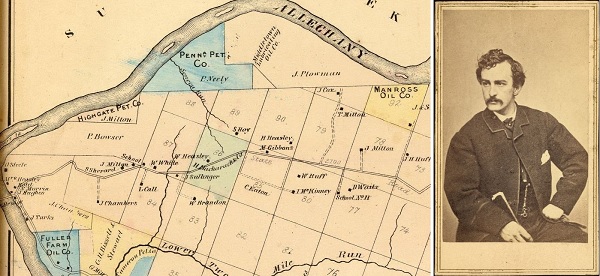
John Wilkes Booth traveled to the oil boom town of Franklin, Pennsylvania, in January 1864. He purchased a 3.5-acre lease on the Fuller farm (lower left). Photo courtesy Library of Congress.
Although the Dramatic Oil Company’s well found oil and began producing about 25 barrels a day, Booth and his partners wanted more and tried “shooting” the well to increase production. When the well was ruined, the failed oilman left the Pennsylvania oil region for good in July 1864.
Learn more in Dramatic Oil Company.
April 14, 1903 – Patent for Self-Heating Gasoline Iron
John Lake of Big Prairie, Ohio, a Civil War veteran of the 16th Ohio Volunteer Infantry Regiment, received a U.S. patent for a gasoline-fueled “Self-Heating Sad Iron.” The 61-year-old inventor’s ironing innovation made his family a fortune and brought prosperity to the Amish community of Big Prairie, Ohio, where he established the Monitor Sad Iron Company. His manufacturing company on the Pennsylvania Railroad line sold petroleum-fueled irons for the next 50 years.
Learn more in Ironing with Gasoline.
April 15, 1857 – First Natural Gas Company incorporated
Two years before the first U.S. oil well in Titusville, Pennsylvania, the Fredonia Gas Light and Water Works Company incorporated in Fredonia, New York, where a well drilled by local machinist and gunsmith William A. Hart supplied natural gas to a mill as early as 1825. Hart found the gas after drilling three wells, according to historian Lois Barris.
“He left a broken drill in one shallow hole and abandoned a second site at a depth of forty feet because of the small volume of gas found,” Barris noted in her “Fredonia Gaslight and Waterworks Company.”
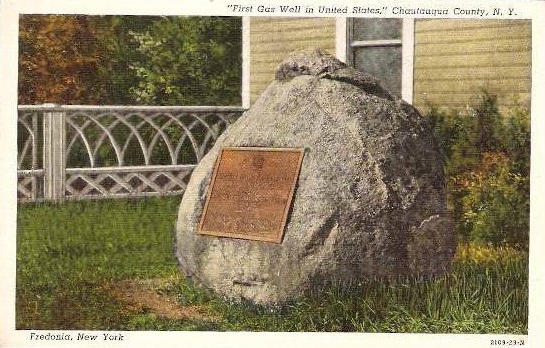
“First Natural Gas Well in the United States” bronze plaque in Fredonia, New York, dedicated in 1925 by the Daughters of the American Revolution, and featured on a circa 1950 postcard.
Hart’s third well produced natural gas from 70 feet beneath a “bubbling gas spring in the bed of a creek,” Barris reported, adding that after constructing a simple gasometer, he “proceeded to pipe and market the first natural gas sold in this country.”
As other communities adopted public lighting burning gas made from coal (manufactured gas street lamps began illuminating Baltimore in 1817), Fredonia Gas Light and Water Works built the first U.S. natural gas pipeline network.

April 15, 1897 – Birth of Oklahoma Oil Industry
With a crowd gathered at the Nellie Johnstone No. 1 well near Bartlesville in Indian Territory, George Keeler’s stepdaughter dropped a “Go Devil” that set off a downhole canister of nitroglycerin. The resulting gusher heralded the start of Oklahoma’s oil and natural gas industry.
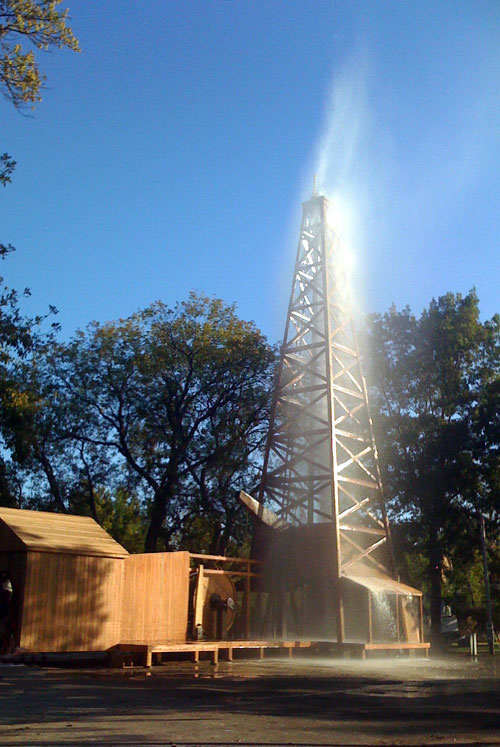
A 2017 water gusher demonstration of the Nellie Johnstone No. 1 replica in Discovery One Park, Bartlesville, Oklahoma.
Drilling had begun in January 1897, the same month that Bartlesville incorporated with a population of about 200 people. Four months later, at 1,320 feet, the Nellie Johnstone No.1 well showed its first signs of oil. There had been earlier marginal producers, including a Cherokee Nation 1890 oil well; the Johnstone well revealed the giant Bartlesville-Dewey field.
By the time of statehood in 1907, Oklahoma would lead the world in oil production. An 84-foot derrick in Discovery One Park helps educate visitors about Oklahoma’s petroleum industry. The surrounding land was donated by Nellie Johnstone Cannon, the descendant of a Delaware chief.
Learn more in First Oklahoma Oil Well.
April 16, 1855 – Scientist sees Value in “Rock Oil”
Yale chemist Benjamin Silliman Jr. reported Pennsylvania “rock oil” could be distilled into a high-quality illuminating oil. The professor’s “Report on the Rock Oil, or Petroleum, from Venango Co., Pennsylvania, with special reference to its use for illumination and other purposes” convinced a businessman George Bissell and a group of New Haven, Connecticut, investors to finance Edwin Drake to drill a well where Bissell had found oil seeps.
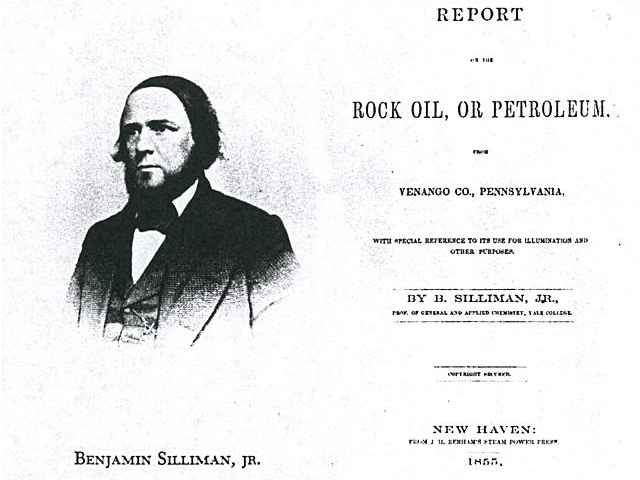
The Yale chemist’s 1855 report about oil’s potential for refining as an illuminant led to America’s first commercial well four years later.
“Gentlemen,” Silliman wrote, “it appears to me that there is much ground for encouragement in the belief that your company have in their possession a raw material from which, by simple and not expensive processes, they may manufacture very valuable products.”
Learn more in George Bissell’s Oil Seeps.

April 16, 1920 – First Arkansas Oil Well
Col. Samuel S. Hunter of the Hunter Oil Company of Shreveport, Louisiana, completed the first oil well in Arkansas. His Hunter No. 1 well had been drilled to 2,100 feet. Natural gas was discovered a few days later by Constantine Oil and Refining Company north of what would become the El Dorado field in Union County.
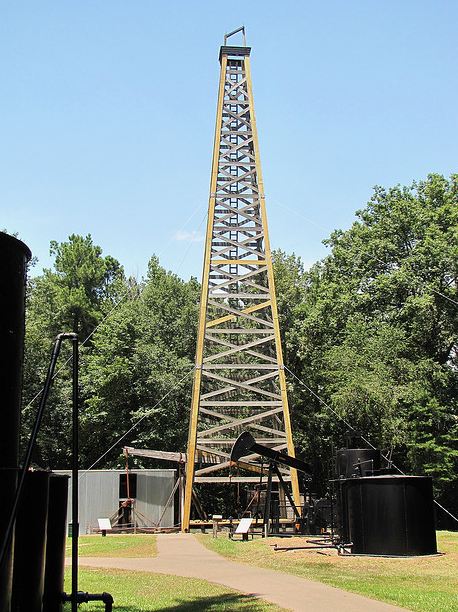
The Arkansas Museum of Natural Resources is just north of El Dorado.
Although Col. Hunter’s oil well yielded only small quantities, his discovery was followed by a January 1921 gusher — the S.T. Busey well — in the same field. These wells made headlines and launched the Arkansas petroleum industry, according to the Arkansas Museum of Natural Resources. Hunter later sold his original lease of 20,000 acres to the Standard Oil Company of Louisiana for more than $2.2 million.
Learn more in First Arkansas Oil Wells.
April 17, 1861 – Deadly Oil Well Fire in Pennsylvania
The lack of technologies for controlling wells led to a fatal oil well fire at Rouseville, Pennsylvania. Among the 19 people killed was leading citizen Henry Rouse, who subleased the land along Oil Creek. When his well erupted oil from a depth of 320 feet, the good news had attracted most Rouseville residents. “Henry Rouse and the others stood by wondering how to control the phenomenon,” noted the local newspaper. Then the gusher erupted into flames, perhaps ignited by a steam-engine boiler.
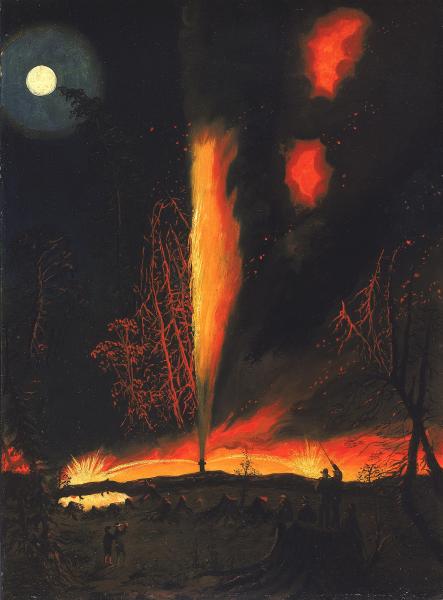
“Burning Oil Well at Night, near Rouseville, Pennsylvania,” a painting by James Hamilton, circa 1861, at the Smithsonian American Art Museum.
The oilfield tragedy near Titusville would be overshadowed by the Civil War, but it was immortalized in 1861 by Philadelphia artist James Hamilton’s “Burning Oil Well at Night, near Rouseville, Pennsylvania,” which was added to the Smithsonian American Art Museum collection in 2017.
Learn more in Fatal 1861 Rouseville Oil Well Fire.
April 17, 1919 – North Texas Burkburnett Boom grows
Yet another drilling boom began in Wichita County, Texas, when the Bob Waggoner Well No. 1 well began producing 4,800 barrels of oil a day — extending to the northwest a 1918 oilfield found on the Burkburnett farm of S.L. Fowler. Wichita County had been producing oil since the 1911 discovery of the Electra oilfield.
At Burkburnett, a 2006 historical marker of the Texas Historical Commission notes the 1919 discovery “became known as the Northwest Extension Oilfield, comprised of approximately 27 square miles on the former S. Burk Burnett Wild Horse Ranch.” The marker adds “the area was suddenly thick with oil derricks” thanks to the oilfield discoveries that created the boom town Burkburnett.
April 18, 1939 – Patent for perforating Well Casing
Ira McCullough of Los Angeles patented a multiple bullet-shot casing perforator and mechanical firing system. He explained the object of his oilfield invention was “to provide a device for perforating casing after it has been installed in a well in which projectiles or perforating elements are shot through the casing and into the formation.”
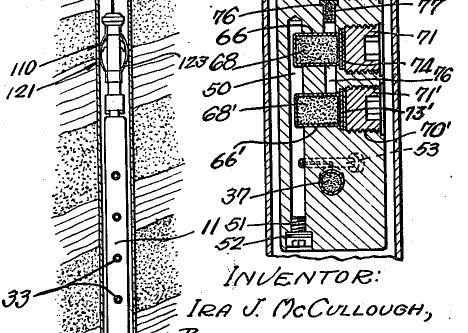
Ira McCullough’s 1937 patent drawing for perforating wells.
The innovation of simultaneous firing from several levels in the borehole greatly enhanced the flow of oil. McCullough’s device included a “disconnectable means” that rendered percussion inoperative until the charges were lowered into the borehole, acting as “a safeguard against accidental or inadvertent operation.”
Another inventor, Henry Mohaupt, in 1951 used anti-tank technology from World War II to improve the concept by using a conically hollowed-out explosive for perforating wells.
Learn more in Downhole Bazooka.
April 19, 1892 – First U.S. Gasoline-Powered Automobile
Brothers Charles and Frank Duryea test drove a gasoline-powered automobile they had built in their Springfield, Massachusetts, workshop. Considered the first model to be regularly manufactured for sale in the United States, 13 were produced by the Duryea Motor Wagon Company.
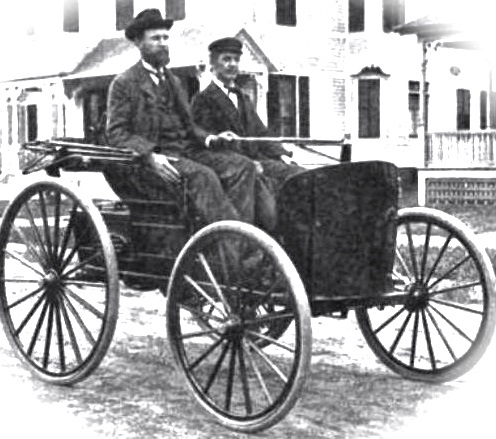
The Duryea brothers (above) built their pioneering autos in Springfield, Massachusetts.
The brothers sold their first Duryea motor wagon in March 1918. Two months later, a motorist driving a Duryea in New York City hit a bicyclist — reportedly America’s first auto traffic accident. By the time of the first U.S. automobile show in November 1900 at Madison Square Garden, of the 4,200 automobiles sold in the United States, gasoline powers fewer than 1,000.
_______________________
Recommended Reading: History Of Oil Well Drilling


_______________________
The American Oil & Gas Historical Society (AOGHS) preserves U.S. petroleum history. Please support this energy education website, our monthly email newsletter, This Week in Oil and Gas History News, and help expand historical research. Contact bawells@aoghs.org. Copyright © 2026 Bruce A. Wells. All rights reserved.