November 3, 1878 – Natural Gas is King in Pittsburgh –
While drilling for oil in 1878, a well drilled by Michael and Obediah Haymaker erupted with natural gas from a depth of almost 1,400 feet. “Every piece of rigging went sky high, whirling around like so much paper caught in a gust of wind. But instead of oil, we had struck gas,” Michael Haymaker recalled.
Eighteen miles east of Pittsburgh, the out-of-control well in Murrysville, Pennsylvania, produced an estimated 34 million cubic feet of natural gas daily. It was considered the largest natural gas well ever drilled up to that time.
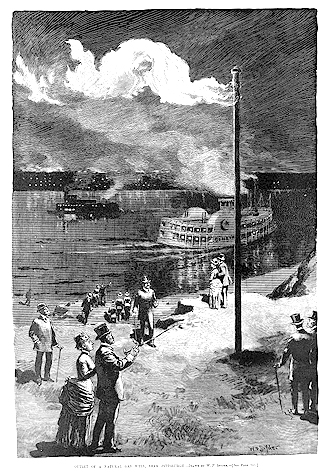
“Outlet of a natural gas well near Pittsburgh — a sight that can be seen in no other city in the world,” noted Harper’s Weekly in 1885.
Given the oilfield technologies of the late 1880s, there was no way to cap the well and no pipeline to exploit commercial possibilities. The Haymaker well drew thousands of curious onlookers to a flaming torch that burned for 18 months and was visible miles away.
“Outlet of a natural gas well near Pittsburgh — a sight that can be seen in no other city in the world,” noted Harper’s Weekly. When finally brought under control, the Haymaker well provided inexpensive gas light to Pittsburgh for many years.
Learn more in Natural Gas is King in Pittsburgh.
November 3, 1900 – New York City hosts First U.S. Auto Show
America’s first gathering of the latest automotive technologies attracted thousands to New York City’s Madison Square Garden. Manufacturers presented 160 different vehicles and conducted driving and maneuverability demonstrations on a 20-foot-wide wooden track that encircled the exhibits.
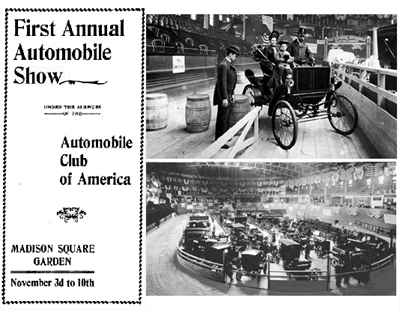
Automobiles powered by internal combustion engines at the 1900 National Automobile Show were primitive. The most popular models proved to be electric, steam, and gasoline — in that order.
Almost 50,000 visitors paid 50 cents each to witness autos driving up a 200-foot ramp to test hill-climbing power. The most popular models proved to be electric, steam, and gasoline…in that order. New Yorkers welcomed the new models as a way to reduce the 450,000 tons of manure, 21 million gallons of urine, and 15,000 horse carcasses that had to be removed from city streets every year.

The Winton Motor Carriage of 1898 was the very first American automobile advertisement.
Of the 4,200 automobiles sold in 1900, less than a thousand were powered by gasoline. But within five years, consumer preference established the dominance of gasoline-powered autos, leading to the first calibrated gas pumps and service stations.
Learn more in Cantankerous Combustion — 1st U.S. Auto Show.

November 6, 1860 – First Multi-Still Oil Refinery started in Pennsylvania
As the Civil War neared, construction began on America’s first multiple-still oil refinery. William Barnsdall, who completed an oil well soon after the first U.S. oil well of August 1859, spent $15,000 to build six stills for refining kerosene one mile south of Titusville, Pennsylvania.
Barnsdall and partners W.H. Abbott and James Parker purchased equipment in Pittsburgh and shipped it up the Allegheny River to Oil City and then to Oil Creek oilfields. With the refinery’s construction on the creek’s north bank finished in January 1861, the facility produced two grades of kerosene for lamps — white and the less expensive yellow. Each barrel of oil yielded about 20 gallons of kerosene.
November 6, 1991 – Ceremony marks end of Kuwaiti oilfield fires
Sheik Jabir Ahmed Sabah, emir of Kuwait, used a remotely controlled valve to extinguish a well fire in the Burgan oilfield (relit earlier for the ceremony). The event symbolized the conclusion of a “billion-dollar firefighting effort that capped the fires in just eight months — confounding initial predictions that Kuwait’s oil fields would burn for years,” according to the Washington Post. “With a flick of a switch that reduced a geyser of flame to a plume of smoke, Kuwait’s ruler today capped the last of about 650 oil-well fires that had been set by retreating troops of Iraqi leader Saddam Hussein.”

November 7, 1965 – Kerosene Jet Fuel powers Speed Record
Using high-octane jet fuel, Ohio drag racer Art Arfons set the world land speed record at 576.553 miles per hour at Utah’s Bonneville Salt Flats. His homemade Green Monster was powered by JP-4 fuel (a 50-50 kerosene-gasoline blend) in an afterburner-equipped F-104 Starfighter jet engine.
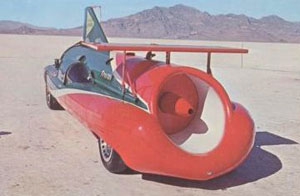
A kerosene-gasoline blend powered the F-104 jet engine of the record-setting “Green Monster.”
Arfons set the world record three times in the 1960s in what became known as “The Bonneville Jet Wars” as Californian Craig Breedlove’s jet-engine powered Spirit of America exceeded 600 mph on November 15, 1965.
A rocket car powered by liquefied natural gas (LNG) set the world speed record at more than 630 mph in 1970 (see The Blue Flame –– Natural Gas Rocket Car).
November 8, 1880 – Death of Father of U.S. Petroleum Industry
Edwin Laurentine Drake, the former railroad conductor who drilled the first U.S. oil well, died in Bethlehem, Pennsylvania, at the age of 61.
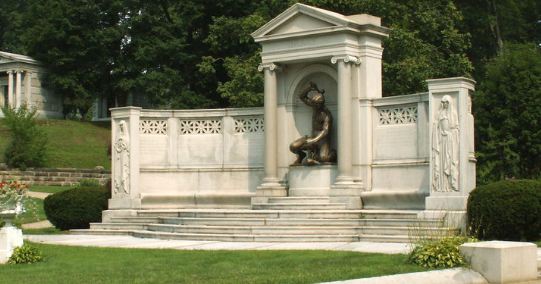
A monument to Edwin Drake with a bronze statue, “The Driller,” was dedicated on October 4, 1901, in Titusville, Pennsylvania. It was refurbished after the 2009 sesquicentennial of his historic well. Photo by Bruce Wells.
Drake’s 1859 oil discovery had brought prosperity to many, but he lost all of his money in speculative ventures, becoming so destitute the Pennsylvania legislature voted him a $1,500 pension in 1873.
A 1901 monument dedicated in Titusville’s Woodlawn Cemetery was the overdue recognition of the man who launched the U.S. oil industry (see Edwin Drake and his Oil Well).

November 8, 1928 – Oil Discovery at Hobbs, New Mexico
A giant oilfield was revealed in a remote region of Lea County at the southeast corner of New Mexico. Midwest Refining Company discovered what would become the Permian Basin’s Hobbs oilfield while searching for a northern trend of the Scarborough field, which had launched a 1927 drilling boom in nearby Winkler County, Texas.
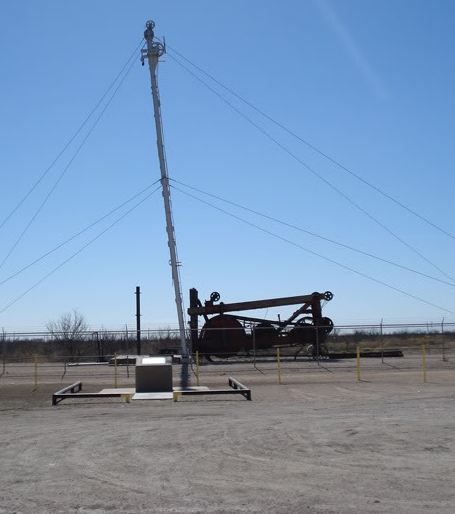
The American Petroleum Institute in 1952 erected a cable-tool rig to commemorate the 1928 Hobbs oilfield discovery well.
After finding signs of oil in June, the exploratory well was completed at a depth of 4,065 feet. “Midwest’s State No. 1, discovery well of the future Hobbs oil pool, was completed producing 700 barrels of oil per day on state land,” noted Gil Hinshaw in his 1976 book, Lea County’s Last Frontier.
By January 1930, a well drilled by Humble Oil Company (later becoming Exxon) three miles northwest of Hobbs would produce 9,500 barrels of oil a day. New Mexico’s first commercial oil well was completed on the Navajo Indian Reservation in 1922 by Midwest Refining, which would become Amoco, acquired by BP in 1998.
Learn more in First New Mexico Oil Wells.
November 9, 1978 – President Carter signs National Energy Act
As a result of the 1973 energy crisis, President Jimmy Carter signed into law the National Energy Act to cut oil imports and reduce energy demand. The 95th Congress legislation included the National Energy Conservation Policy Act, which mandated energy conservation in homes, schools, and public buildings. It also included the Power Plant and Industrial Fuel Use Act, the Public Utilities Regulatory Policy Act, the Energy Tax Act, and the Natural Gas Policy Act — temporarily authorizing the Federal Energy Regulatory Commission (FERC) to set price ceilings.
_______________________
Recommended Reading: Natural Gas: Fuel for the 21st Century


_______________________
The American Oil & Gas Historical Society (AOGHS) preserves U.S. petroleum history. Please become an AOGHS annual supporter and help maintain this energy education website and expand historical research. For more information, contact bawells@aoghs.org. Copyright © 2025 Bruce A. Wells. All rights reserved.