September 28, 1945 – Truman claims America’s Outer Continental Shelf –
President Harry Truman extended U.S. jurisdiction over the natural resources of the outer continental shelf, including oil and natural gas, under the control of the Secretary of the Interior. In August 1953, Truman’s edict would become the Outer Continental Shelf Lands Act, which affirmed exclusive jurisdiction over the continental shelf and a federal leasing program “to encourage discovery and development of oil.” Also see Offshore Oil & Gas History.
September 30, 2006 – Roughnecks Statue dedicated at Signal Hill
A bronze “Tribute to the Roughnecks” statue was dedicated near the Alamitos No. 1 well, which in 1921 revealed California’s prolific Long Beach oilfield 20 miles south of Los Angeles.
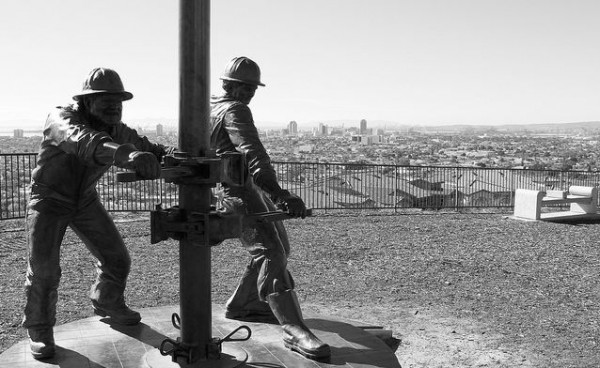
Signal Hill once had so many derricks people called it Porcupine Hill. The city of Long Beach is visible in the distance from the “Tribute to the Roughnecks” statue by Cindy Jackson.
The statue by Cindy Jackson has since commemorated the Signal Hill Oil Boom, serving as “a tribute to the petroleum pioneers for their success here, a success which has, by aiding in the growth and expansion of the petroleum industry, contributed so much to the welfare of mankind.”
October 1, 1908 – Ford Motor Company produces First Model T
The first production Ford Model T rolled off the assembly line in Detroit. Between 1908 and 1927, Ford built about 15 million more, each fueled by inexpensive gasoline. The popularity of the Model T was timely for the U.S. petroleum industry, which faced falling demand for kerosene as consumers switched to electric lighting.
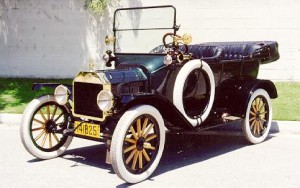
Ford Model T tires were white until 1910, when the petroleum product carbon black was added to improve durability.
New major oilfield discoveries, especially the 1901 “Lucas Gusher” at Spindletop Hill near Beaumont, Texas, helped meet growing demand for what had been a refining byproduct, gasoline.
October 1, 1920 – Gonzaullas becomes a Texas Ranger
Manuel T. Gonzaullas joined the Texas Rangers — and rowdy Texas boom towns would never be the same. He soon became known as “Lone Wolf” Gonzaullas.

Street scene in Kilgore, Texas, with steel derricks behind downtown stores. Circa 1935 photo by Russell Lee (1903-1986) courtesy Permian Basin Petroleum Museum, Library and Hall of Fame.
In East Texas, when the streets of downtown Kilgore sprouted oil derricks, the population grew from 700 to 10,000 in two weeks. With Depression-era petroleum discoveries multiplying, oil boom towns often attracted criminals. Riding a black stallion named Tony and sporting two pearl-handled .45 pistols, Gonzaullas soon earned a reputation for strictly enforcing the law.
October 1, 1942 – Water Injection begins in East Texas
The East Texas Salt Water Disposal Company drilled the first saltwater injection well in the 12-year-old East Texas oilfield near the towns of Tyler, Longview, and Kilgore. As early as 1929, the Federal Bureau of Mines had determined injecting recovered saltwater into formations could increase reservoir pressures and oil production.
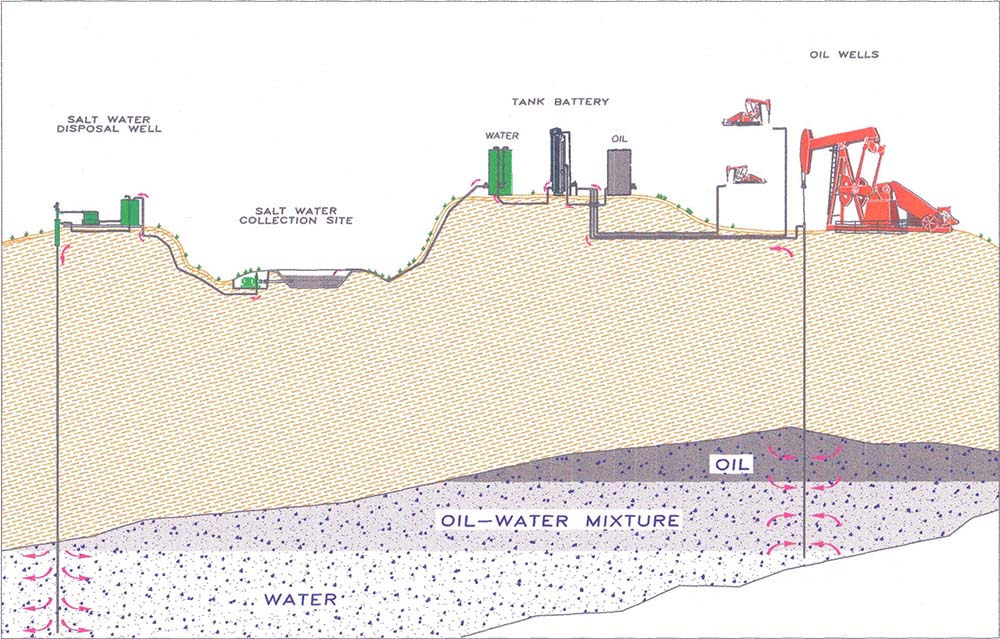
Saltwater injection wells improve oil production and keep marginal East Texas wells viable. Illustration courtesy East Texas Salt Water Disposal Company.
The Texas Railroad Commission established the saltwater disposal company as a public utility to operate in the oilfield. The company treated and reinjected about 1.5 billion barrels of saltwater in its first 13 years, prompting the commission to proclaim saltwater injection as the “greatest oil conservation project in history.”
October 2, 1919 – Future “Mr. Tulsa” incorporates Skelly Oil
Skelly Oil Company incorporated in Tulsa, Oklahoma, with founder William Grove Skelly as president. He had been born in 1878 in Erie, Pennsylvania, where his father hauled oilfield equipment in a horse-drawn wagon.
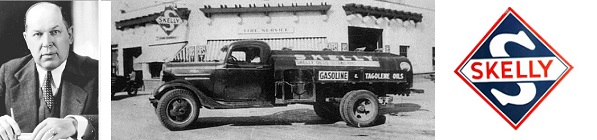
Born near Pennsylvania oilfields, William Skelly founded Skelly Oil Company in 1919 — and led an international petroleum exposition for 32 years, helping to make Tulsa the “Oil Capital of the World.”
Skelly’s success in the El Dorado oilfield east of Wichita, Kansas, helped him launch Skelly Oil and other ventures, including Midland Refining Company, which he founded in 1917. As Tulsa promoted itself as “Oil Capital of the World,” Skelly became known as “Mr. Tulsa.” Skelly served as president of Tulsa’s famous International Petroleum Exposition for 32 years until his death in 1957.
October 3, 1930 – East Texas Oilfield discovered on Widow’s Farm
Ninety-five years ago, with a crowd of more than 4,000 expectant landowners, leaseholders, creditors, and others watching, the Daisy Bradford No. 3 wildcat well was successfully shot with nitroglycerin near Kilgore, Texas.
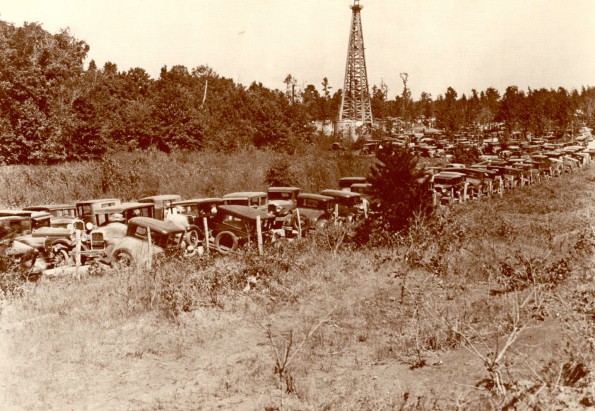
Spectators gathered on the widow Daisy Bradford’s farm near Kilgore, Texas, to watch the October 3, 1930, “shooting” of the discovery well of what proved to be the largest oilfield in the lower 48 states. Photo courtesy Jack Elder, The Glory Days.
“All of East Texas waited expectantly while Columbus ‘Dad’ Joiner inched his way toward oil,” explained historian Jack Elder in 1986. “Thousands crowded their way to the site of Daisy Bradford No. 3, hoping to be there when and if oil gushed from the well to wash away the misery of the Great Depression.”
Geologists were stunned when it became apparent the remote wildcat well on the widow Daisy Bradford’s farm — along with two other wells far to the north — were part of the same oil-producing formation (the Woodbine) that encompassed more than 140,000 acres. The “Black Giant” would produce billions of barrels of oil in coming decades.
Learn more in East Texas Oilfield Discovery.
October 3, 1980 – Museum opens in East Texas Oilfield
Fifty years after the discovery of the East Texas oilfield, the East Texas Oil Museum at Kilgore College opened as “a tribute to the independent oil producers and wildcatters, the men and women who dared to dream as they pursued the fruits of free enterprise.”
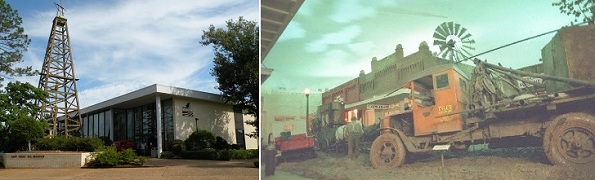
The East Texas Oil Museum since 1980 has hosted events and maintained exhibits preserving the “Black Giant” oilfield discovered during the Great Depression. Photos by Bruce Wells.
Established with funding from the Hunt Oil Company, the museum at Kilgore College recreated a 1930s boom town atmosphere. The museum, which is hosting special events on its 45th birthday, maintains a database that offers keyword search and advanced search options — along with a “random Images” button to browse photography from a wide assortment of online records.
October 4, 1866 – Oil Fever spreads to Allegheny River Valley
Just 15 miles east of Titusville, Pennsylvania, site of the first U.S. oil well, an oilfield discovery at Triumph Hill sparked another wild rush of speculators and new drilling. America’s petroleum industry was barely seven years old when wooden cable-tool derricks and engine houses replaced hemlock trees along the Allegheny River.
October 4, 1901 – Drake Memorial dedicated in Pennsylvania
More than 2,500 people, including his widow, Laura Dowd Drake, attended the unveiling of a monument to the “father of the petroleum industry,” Edwin L. Drake, who had died in relative obscurity in 1880. Standard Oil Company executive Henry Rogers commissioned the marble, semi-circle memorial in Titusville, Pennsylvania.
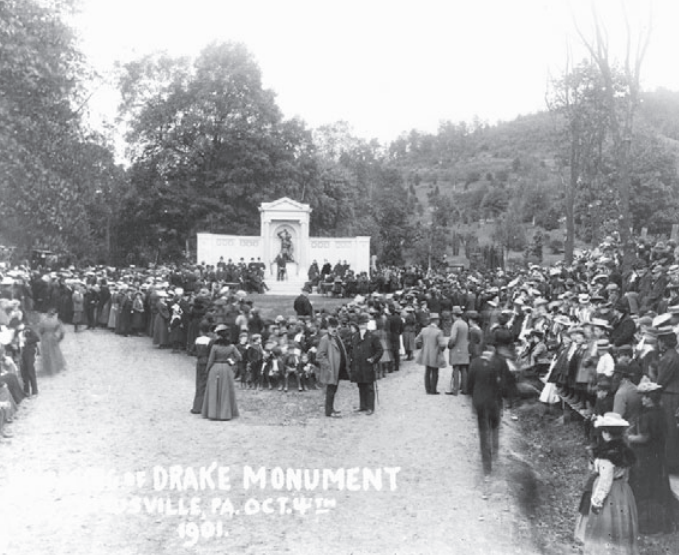
Unveiling of the Drake Monument in Titusville, Pennsylvania, on October 4, 1901. Thousands attended the dedication in Woodlawn Cemetery. Photo by John Mather courtesy Drake Well Museum.
East Texas Oil Museum,
The monument, which includes a bronze statue by Charles Henry Niehaus, was dedicated in Woodlawn Cemetery. Learn more by visiting Titusville’s Drake Well Museum and Park.
_______________________
Recommended Reading: The Extraction State, A History of Natural Gas in America (2021); History Of Oil Well Drilling


_______________________
The American Oil & Gas Historical Society (AOGHS) preserves U.S. petroleum history. Please support this website, subscribe to the monthly email newsletter, This Week in Oil and Gas History News, and help expand our historical research. Contact bawells@aoghs.org. Copyright © 2026 Bruce A. Wells. All rights reserved.