October 19, 1990 – First Emergency Use of Strategic Petroleum Reserve –
As world oil prices spiked after the August 1990 invasion of Kuwait by Saddam Hussein’s Iraqi troops, the first presidentially mandated emergency use of the Strategic Petroleum Reserve was authorized by George H. W. Bush, who ordered the sale of five million barrels of SPR oil as a test to “demonstrate the readiness of the system under real-life conditions,” according to the Department of Energy.
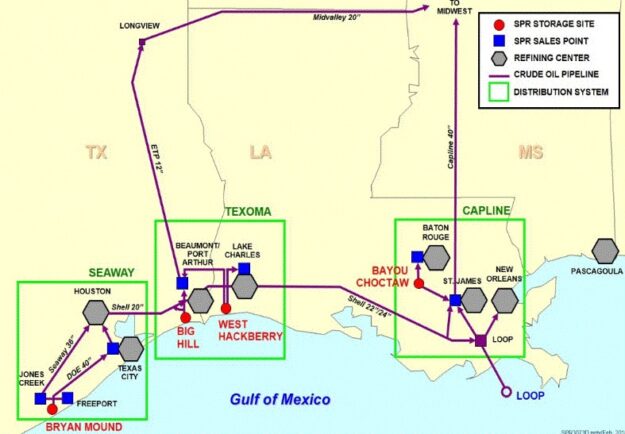
Strategic Petroleum Reserve oil storage facilities grouped into pipeline distribution systems in Texas and Louisiana. Map courtesy U.S. Department of Energy 2018 Report to Congress.
President Ford established the SPR in 1975 as a protection against severe supply interruptions. By 2020, four underground salt dome sites along the Gulf Coast stored 735 million barrels of oil — the largest stockpile of government-owned emergency oil in the world.
October 20, 1924 – API issues Tubular Goods Standards
Shortages of equipment and drilling delays during World War I revealed the petroleum industry’s struggle with a lack of uniformity of pipe sizes, threads, and couplings. Founded in 1919, the American Petroleum Institute (API) gathered industry experts to come up with industry-wide standards to promote equipment compatibility. “After bringing these experts together to agree upon design and requirements, the first standard, Specifications for Steel and Iron Pipe for Oil Country Tubular Goods, was published on October 20, 1924,” notes API, which has since published more than 800 standards and guidelines.
October 20, 1944 – Ohio Liquefied Natural Gas Tank Explosion
An explosion and fire from liquefied natural gas tanks in Cleveland, Ohio, killed 131 people and caused more than $10 million in damage. Temperatures inside one of East Ohio Gas Company’s tanks had been allowed to fall below minus 250 degrees, which caused the steel plates to contract and rupture. Investigators never discovered a cause for the explosion, but witnesses reported a leak in one of the tanks, according to Ohio History Central. “Some spark must have then ignited the gas, although, with World War II currently raging, some residents initially suspected a German saboteur.”
October 20, 1949 – Maryland produces Some Natural Gas
The first commercially successful natural gas well in Maryland was drilled by the Cumberland Allegheny Gas Company in the town of Mountain Lake Park, Garrett County. The Elmer Beachy well produced about 500 thousand cubic feet of natural gas per day.
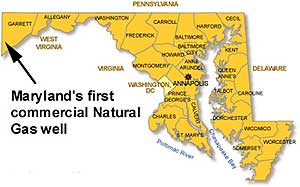
Although Garrett County, Maryland, produced limited amounts of natural gas in 1949, no oil was found.
The discovery well prompted a rush of competing companies and high-density drilling (an average of nine wells per acre), which depleted the field. Twenty of 29 wells drilled within the town produced natural gas, but overall production from the field was low. No oil has been found in Maryland.
October 21, 1921 – First Natural Gas Well in New Mexico
The New Mexico natural gas industry began when the newly established Aztec Oil Syndicate’s State No. 1 well found a gas field about 15 miles northeast of Farmington in San Juan County. The drilling crew used a tree trunk with a two-inch pipe and shut-off valve to control the well until a wellhead could be shipped from Colorado. The well produced 10 million cubic feet of natural gas a day.
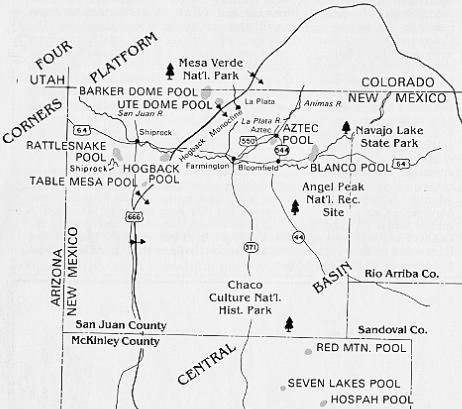
New Mexico’s first commercial natural gas service began after a 1921 discovery near Aztec. Oil discoveries followed in the southeast.
By the end of December 1921, a pipeline reached two miles into the town of Aztec, where citizens enjoyed New Mexico’s first commercial natural gas service. In 1922, natural gas could be purchased in Aztec at a flat rate of $2 a month (for a gas heater) and $2.25 (for a gas stove). Learn more about the state’s petroleum history in First New Mexico Oil Wells.
October 23, 1908 – Salt Creek Well launches Wyoming Boom
Wyoming’s first oil boom began when the Dutch company Petroleum Maatschappij Salt Creek completed its “Big Dutch” well about 40 miles north of Casper.
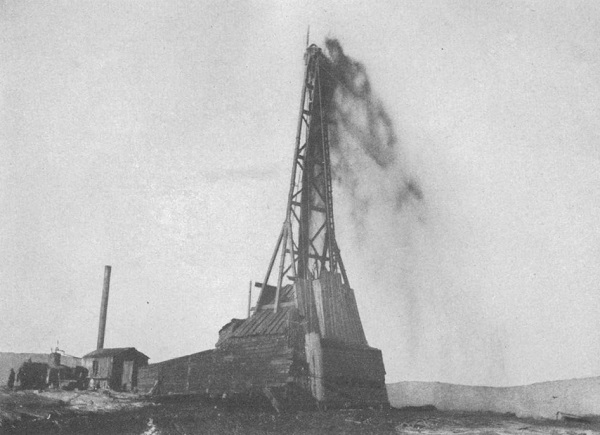
The “Big Dutch” No. 1 well produced 600 barrels of oil a day from a depth of 1,050 feet — and launched a Wyoming drilling boom in 1908. By 1930, about one-fifth of U.S. oil came from the Salt Creek oilfield. Photo courtesy U.S. Geological Survey.
Salt Creek’s potential had been known since the 1880s, but the area’s central geological salt dome received little attention until Italian geologist Cesare Porro recommended drilling there in 1906. Another salt dome formation had been revealed with the 1901 Spindletop oilfield discovery in Texas.
At Salt Creek, the Oil Wells Drilling Syndicate, a British company, drilled the “Big Dutch” well, which produced 600 barrels of oil a day from a depth of 1,050 feet and launched a Wyoming drilling boom. By 1930, about one-fifth of all U.S. oil came from the Salt Creek oilfield. Production continued in the 1960s with water-flooding technologies; the use of carbon dioxide injection began in 2004.
Learn more in First Wyoming Oil Wells.
October 23, 1948 – “Smart Pig” advances Pipeline Inspection
Northern Natural Gas Company recorded the first use of an X-ray machine for internal testing of petroleum pipeline welds. The company examined a 20-inch diameter pipe north of its Clifton, Kansas, compressor station. The device — today known as a “smart pig” — traveled up to 1,800 feet inside the pipe, imaging each weld.
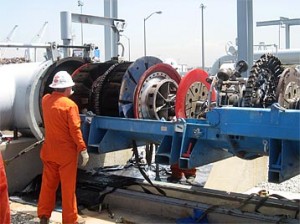
A pipeline worker inspects a “smart pig.” Photo courtesy Pacific L.A. Marine Terminal.
As early as 1926, U.S. Navy researchers had investigated the use of gamma-ray radiation to detect flaws in welded steel. In 1944, Cormack Boucher patented a “radiographic apparatus” suitable for many large pipelines. Modern inspection tools employ magnetic particle, ultrasonic, eddy current, and other methods to verify pipeline and weld integrity.
October 23, 1970 – LNG powers World Land Speed Record
Liquefied natural gas (LNG) powered the Blue Flame to a new world land speed record of 630.388 miles per hour. A rocket motor combining LNG and hydrogen peroxide fueled the 38-foot, 4,950-pound Blue Flame, which set the record at the Bonneville Salt Flats in Utah. The rocket motor could produce up to 22,000 pounds of thrust — about 58,000 horsepower.
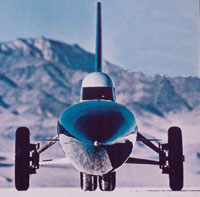
Hydrogen peroxide and liquefied natural gas (LNG) powered the Blue Flame to a world land speed record of 630.388 mph on October 23, 1970, at the Bonneville Salt Flats in Utah.
Sponsored by the American Gas Association (AGA) and the Institute of Gas Technology, the Blue Flame design came from three Milwaukee, Wisconsin, automotive engineers: Dick Keller, Ray Dausman, and Pete Farnsworth. Building a record-setting rocket dragster in 1967 got the attention of AGA executives.

The American Oil & Gas Historical Society interviewed Dick Keller in 2013 and used his home movies to produced a video about “the greenest world land speed record set in the 20th century.”
Interviewed by the American Oil & Gas Historical Society in 2013, Keller explained how the growing environmental movement of the late 1960s encouraged AGA “suits” to see value in supporting a new racer fueled by LNG. Keller in 2020 published Speedquest: Inside the Blue Flame, noting natural gas powered “the greenest world land speed record set in the 20th century.”
Learn more in Blue Flame Natural Gas Rocket Car.
October 25, 1929 – Teapot Dome Scandal
Albert B. Fall, appointed Interior Secretary in 1921 by President Warren G. Harding, was found guilty of accepting a bribe while in office, becoming the first cabinet official in U.S. history to be convicted of a felony. An executive order from President Harding had given Fall full control of the Naval Petroleum Reserves.

Wyoming’s Teapot Dome oilfield was named after Teapot Rock, (the “spout” later fell off). Photo courtesy Casper College Western History Center.
Fall was found guilty of secretly leasing the Navy’s oil reserve lands to Harry Sinclair of Sinclair Oil Company and to Edward Doheny, discoverer of the Los Angeles oilfield.
The noncompetitive leases were awarded to Doheny’s Pan American Petroleum Company (reserves at Elk Hills and Buena Vista Hills, California) and Sinclair’s Mammoth Oil Company (reserve at Teapot Dome, Wyoming). Fall received more than $400,000 from the two oil companies.
It emerged during Senate hearings that cash was delivered to Secretary Fall in a Washington, D.C., hotel. He was convicted of taking a bribe, fined $100,000, and sentenced to one year in prison. Sinclair and Doheny were acquitted, but Sinclair spent six and a half months in prison for contempt of court and the U.S. Senate.
_______________________
Recommended Reading: The Prize: The Epic Quest for Oil, Money & Power


_______________________
The American Oil & Gas Historical Society (AOGHS) preserves U.S. petroleum history. Please support this energy education website, subscribe to the free monthly newsletter, This Week in Oil and Gas History News, and help expand historical research. Contact bawells@aoghs.org. Copyright © 2026 Bruce A. Wells. All rights reserved.