by Bruce Wells | Oct 20, 2026 | Petroleum Pioneers
Acme Sucker Rod founder — and the future mayor of Toledo — patented an oilfield innovation in 1894.
Samuel “Golden Rule” Jones of Ohio made a fortune in oilfields and supplying equipment and services, patented an improved sucker rod for pumping oil, and created a better workplace for his factory employees. He ran on the progressive Republican ticket in 1897 and was elected mayor of Toledo. He would be reelected three times.
As the country weathered the “Panic of 1893” and is extended financial crisis, Samuel M. Jones brought a new business philosophy to Toledo, Ohio. A popular mayor, he was reelected in 1899, 1901 and 1903 — and served in office until dying on the job in 1904.
(more…)
by Bruce Wells | Oct 19, 2026 | This Week in Petroleum History
October 19, 1990 – First Use of Strategic Petroleum Reserve –
As world oil prices spiked after the August 1990 invasion of Kuwait by Saddam Hussein’s Iraqi troops, the first presidentially mandated emergency use of the Strategic Petroleum Reserve was authorized by George H.W. Bush, who ordered the sale of five million barrels of SPR oil as a test to “demonstrate the readiness of the system under real-life conditions,” according to the Department of Energy.
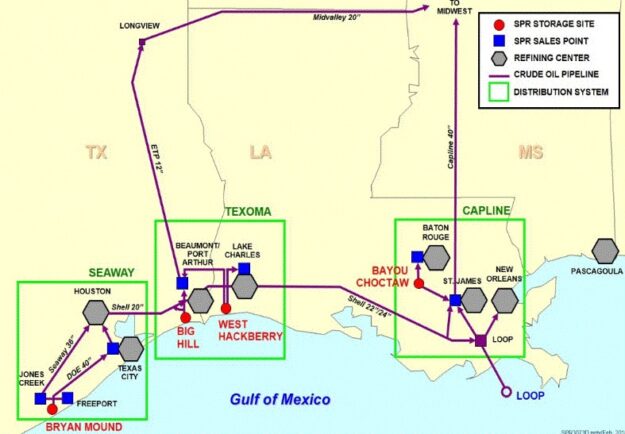
Strategic Petroleum Reserve oil storage facilities grouped into pipeline distribution systems in Texas and Louisiana. Map courtesy U.S. Department of Energy 2018 Report to Congress.
President Ford established the SPR in 1975 as a protection against severe supply interruptions. By 2020, four underground salt dome sites along the Gulf Coast stored 735 million barrels of oil — the largest stockpile of government-owned emergency oil in the world. In October 2026, the SPR held 283 million barrels oil, down 132.5 million barrels from 415.4 million in March. and its lowest level since October 1982.
October 20, 1924 – API issues Tubular Goods Standards
Shortages of equipment and drilling delays during World War I revealed the petroleum industry’s struggle with a lack of uniformity of pipe sizes, threads, and couplings. Founded in 1919, the American Petroleum Institute (API) gathered industry experts to come up with industry-wide standards to promote equipment compatibility. “After bringing these experts together to agree upon design and requirements, the first standard, Specifications for Steel and Iron Pipe for Oil Country Tubular Goods, was published on October 20, 1924,” notes API, which has since published more than 800 standards and guidelines. (more…)
by Bruce Wells | Oct 14, 2026 | Petroleum Pioneers
A popular 1837 book by Washington Irving helped reveal natural resources of the Far West.
Tales of a Wyoming “tar spring” convinced the experienced Pennsylvania oilfield explorer Mike Murphy to drill a shallow well in 1883. He sold his oil to Union Pacific to lubricate train axles. Others would follow in the search for Wyoming oilfields.
Civil War veteran Philip Shannon explored for oil at Salt Creek outside of Casper in 1890. His well revealed what proved to be a 22,000-acre oilfield. An oil gusher drilled by a Dutch company made headlines in 1908.
But the story of Wyoming’s petroleum really began with Washington Irving, author of “The Legend of Sleepy Hollow.” (more…)
by Bruce Wells | Oct 13, 2026 | Petroleum Technology
Gas industry executives recognized the public relations value of LNG fueling a land speed record.
Proclaiming natural gas “the fuel of the future,” the American Gas Association sponsored a sleek rocket car powered by liquified natural gas (LNG) that in October 1970 set a world land speed record that would remain unbroken for more than a decade.
In 1882, Mrs. Karl Benz secretly took her husband’s “Model III Patent Motorwagen” on a 65-mile road trip at an average speed of four mph. The public relations stunt took 15 hours. (more…)
by Bruce Wells | Oct 12, 2026 | This Week in Petroleum History
October 12, 1964 – Methane Princess delivers LNG –
Four months after entering service in June 1964, Methane Princess, the first purpose-built liquefied natural gas (LNG) carrier, delivered its cargo to Canvey Island in the United Kingdom. With nine tanks capable of holding the equivalent of 600 MMcf of gas, the 618-foot vessel and her sister ship, Methane Progress, made regular deliveries to Canvey Island for almost 20 years. (more…)