by Bruce Wells | Dec 29, 2024 | Petroleum Technology
The petroleum industry’s difficult job of retrieving broken (and expensive) equipment obstructing an oil well — “fishing” — began in 1859 when a drilling tool stuck at 134 feet deep and ruined a Pennsylvania well. The technical challenges at far greater depths have tormented exploration companies ever since.
Just four days after the August 27, 1859, first U.S. oil discovery by Edwin L. Drake at Titusville, Pennsylvania, a much less known oil and natural gas industry pioneer began America’s second well to be drilled for petroleum. John Livingston Grandin dug his well nearby using a simple spring pole — but soon wedged his iron chisel downhole.
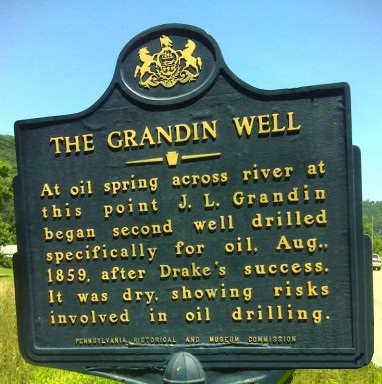
John L. Grandin attempted to recover a lost drill bit at his 1859 well near Tidioute, Pennsylvania. Warren County roadside marker photo.
The 22-year-old Grandin improvised his own well fishing tools, but not only lost his drill bit (an industry first), he ended up with America’s first dry hole among other petroleum industry milestones.

Searching for oil was less an earth science and more an art in the exploration and production industry’s earliest days. Geologists in Pennsylvania’s “valley that changed the world” knew far more about finding coal seams than characteristics of oil-bearing formations.
Making Hole
Even as drilling technologies evolved from spring poles and cable tools to modern rotary rigs, downhole problems remained — especially as wells reached new depths (learn more in Making Hole — Drilling Technology).
A 19th-century cable-tool rig, like its ancient predecessor the spring pole, utilized percussion drilling — the repeated lifting and dropping of a heavy chisel using hemp ropes. Drilling time and depth improved with the addition of steam power and tall, wooden derricks.
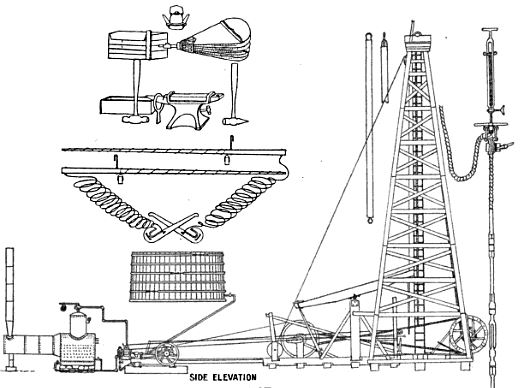
A standard, 82-foot cable-tool derrick used a steam boiler and one-cylinder engine connected to a “walking beam. Image from The Oil-Well Driller, 1905.
As depths increased, frequent stops were needed to bail out water and cuttings — and sharpen the bit’s iron edge. Small forges were often just feet from the well bore.
Despite drillers trying to avoid having expensive tools jammed deep in the well, accidents happened. The cable-tool rig’s manila rope or wire line would break. A pipe connection might bend. The downhole tool assemblies could no longer be lifted and dropped.

On the rig floor, fishing tools had to be lowered by a line into the well, armed at their end with spears, clamps and hooks. Sometimes a wood, wax and nails “impression block” was first lowered to get an idea of what lay downhole.
Hooks and Spears
In percussion drilling, the heavy cable-tool assembly could get jammed in the borehole and could no longer be repeatedly lifted and dropped. In the foreground of the photograph below, the large wheel at right (with small, square hub) received the uppermost part of a fishing pole. A rope was wound around this wheel’s rim and led to the “bull wheel” shaft.
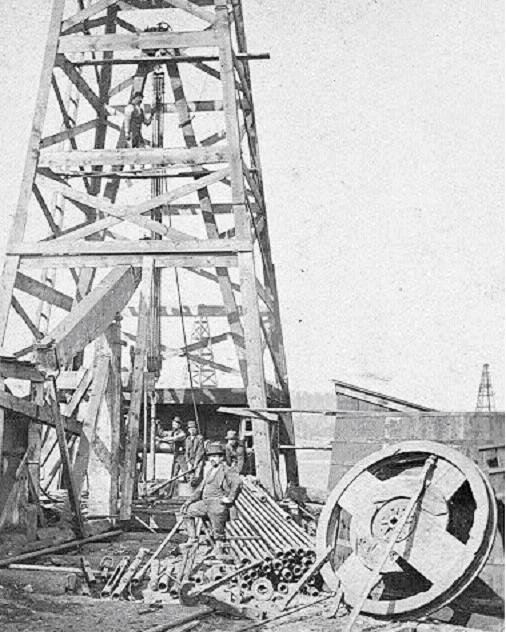
The term fishing came from early percussion drilling using cable tools. When the derrick’s manila rope or wire-line rope broke, a crewman lowered a hook and attempted to pull out the well’s heavy iron bit. Photo courtesy Library of Congress.
Among the fishing tools at the man’s feet are 3.5-inch iron poles, each 20 feet in length and weighing 500 pounds. To fish for stuck tools, these were lowered in well, armed at their end with a “die” with a left-hand thread cut in it. This die fit over the end of the stuck tool, tapered inward slightly, and when turned to the left, cut a thread on the cable tool.
The bull wheel, driven by the well’s steam-powered drilling engine, exerted a tremendous strain on the assembled poles. Since that strain was always to the left, the die gradually cut a thread in the stuck cable tool. One of the cable tool sections would eventually “yield, unscrew, and be removed.”
The operation repeated until the lowest piece was reached. A “spud” was then employed. Drilling usually would continue into the night, illuminated by two-wicked “yellow dog” lanterns.
Knives and Whipstocks
“Well fishing tools are constantly being improved and new ones introduced,” explained David T. Day in his A Handbook of the Petroleum Industry in 1922. Describing cable tool operations, he explained that the basic principle of well fishing tools often involved milled wedges — on a spear or in a cylinder — for recovering lost tubing or casing.
As drillers gained experience with deeper wells, patent applications included hundreds of designs for catching some tool or part that had been broken or lost in the borehole. Many of these “fishing tools” could be created on-site since most cable-tool rigs already had a forge for sharpening bits on the derrick floor.
Day noted that the simpler types of fishing tools comprised “horn sockets, corrugated friction sockets, rope grabs, rope spears, bit hooks, spuds, whipstocks, fluted wedges, rasps, bell sockets, rope knives, boot jacks, casing knives and die nipples.”
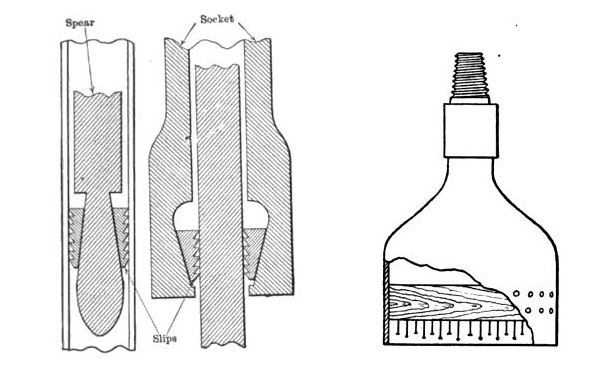
Basic fishing tools include the spear and socket, each with milled edges. Using nails and wax, an impression block helps determine what is stuck downhole. Image from A Handbook of the Petroleum Industry, 1922.
These and other devices, when used with an auger stem in various combinations called jars, can secure a powerful upward stroke or “jar” and thus dislodge and recover the tool being sought, Day explained in his 1922 book.
“The jars, essentially and universally used in fishing with cable tools, consist off two heavy forged-steel links, interlocking as the links of a cable chain, but fitting together more snugly,” he added.
“Many lost tools that cannot be recovered are drilled up or ‘side-tracked” (driven into or against the wall) and passed in drilling,” Day explained. Much depended upon “the skill and patience of the driller.”
Once all well fishing tools failed, a final resort was a whipstock, which allowed the bit to angle off and bypass the fish to leave the operator with a deviated hole. This was sometimes unpopular where wells were closely spaced.
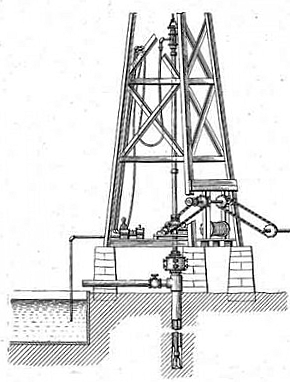
By the early 1900s, rotary drilling introduced the hollow drill stem that enabled broken rock debris to be washed out of the borehole. It led to far deeper wells.
As drilling with rotary rigs became more common in the early 1900s, fishing methods adapted. “In rotary drilling, the only tools ordinarily used in the well are the drill pipe and bits,” Day noted, adding that the rotary fishing tools, “were comparatively free from the complexities of cable-tool work.”
Most rotary fishing jobs were caused by “twist offs” (broken drill pipe), although the bit, drill coupling or tool joints may break or unscrew. As in cable-tool fishing, an impression block often was needed to determine the proper fishing tool.
But even back then — and especially now with wells miles deep and often turned horizontally — when a downhole problem occurred, the well could be lost for good.
Elk City, Deep Gas Capital
The Anadarko Basin extends across western Oklahoma into the Texas Panhandle and into southwestern Kansas and southeastern Colorado. It includes the Hugoton-Panhandle field, the Union City field and the Elk City field and is among the most prolific natural gas-producing areas in North America.
In 1980, the Oklahoma Historical Society and Oklahoma Petroleum Council dedicated a granite monument at Third and Pioneer streets in Elk City, Oklahoma. The Washita County marker notes:
The Deep Anadarko Basin of Western Oklahoma is one of the most prolific gas provinces of North America. Wells drilled here have been among the world’s deepest. The Bertha Rogers No. 1 in Washita County, drilled in 1971 to 31,441 feet, was then the world’s deepest well. In 1979 the No. 1 Sanders well near Sayre became Oklahoma’s deepest gas producer at 24,996 feet.
When controls on gas prices were lifted, Anadarko justified the faith and perseverance of The GHK Company and other operators who pioneered in deep drilling. The shallow horizons of Greater Anadarko account for much of this nation’s proved gas reserves. Deeper sediments below 15,000 feet remain virtually unexplored. Renewed assessment of some 22,000 cubic miles of deep sediments may carry over into the 21st Century.
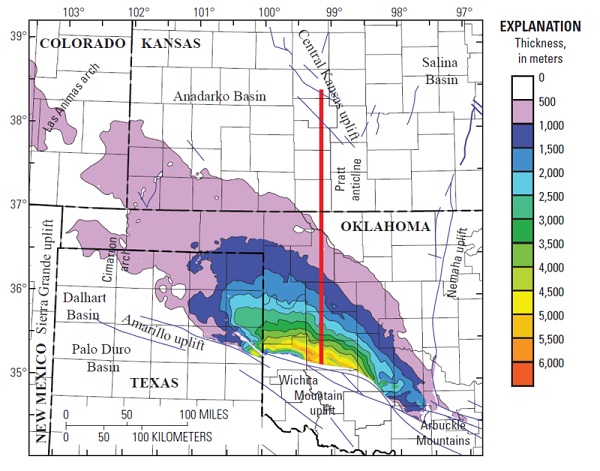
A 2014 geologic map of 50,000 square mile Anadarko Basin showing thickness of strata courtesy U.S. Geological Survey.
For the 20th century’s final quarter, the Basin remains the frontier of deep drilling technology centered on Elk City, “Deep Gas Capital of the World”. As gas prices equate more closely to value, the nation’s needs may be met increasingly from this massive sedimentary basin, a focal point in drilling innovation and geological interpretation.
In re-energizing America, Anadarko will not yield its gas easily or briefly. Promised rewards lying beyond the threshold of drilling techniques demand massive investment. In challenging the inventive enterprise of America’s energy industry, this Basin will remain the heartland of technology in penetrating the earth’s crust.
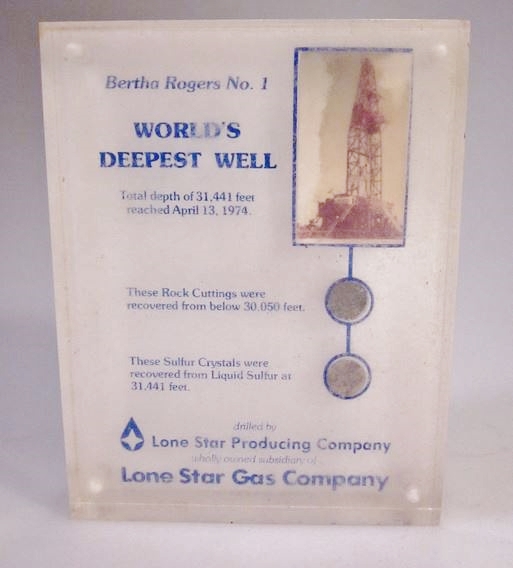
A 1974 souvenir of the Bertha Roger No. 1 well, which sought natural gas almost six miles deep in Oklahoma’s Anadarko Basin.
Until the 1960s, few companies could risk millions of dollars and push rotary rig drilling technology to reach beyond the 13,000-foot level in what geologists called “the deep gas play.”
The great expense and technological expertise necessary to complete ultra-deep natural gas wells at these depths made the Anadarko Basin “the domain of the major petroleum corporations,” explained Bobby Weaver, oil historian and frequent article contributor to the Oklahoma Historical Society.
GHK Company and partner Lone Star Producing Company believed ultra-deep wells in Oklahoma’s Anadarko Basin could produce massive amounts of natural gas. They began drilling wells more than three miles deep in the late 1960s.
South of Burns Flat in Washita County, their Bertha Rogers No.1 would reach almost six miles deep in 1974 — after a deep fishing trip.
Deep Fishing in Oklahoma
In March 1974 in far western Oklahoma, after 16 months of drilling and almost six miles deep, the Bertha Rogers No. 1 rotary rig drill stem sheared, leaving 4,111 feet of pipe and the drill bit stuck downhole. Spudded in November 1972 and averaging about 60 feet per day, the Bertha Rogers had been heading for the history books as the world’s deepest well at the time.
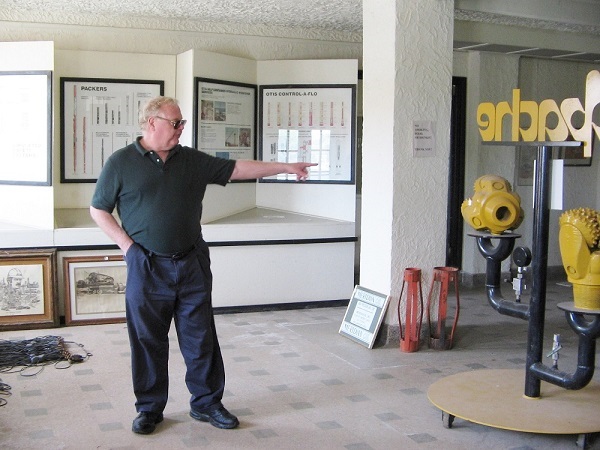
Independent producer John West in 2006 preserved artifacts in the closed Anadarko Basin Museum of Natural History in Elk City, Oklahoma. Photo by Bruce Wells.
It was March 1974 and the enormous investment of Lone Star Producing Company of Dallas, and partner GHK Company of Oklahoma City, was about to be lost. Desperate GHK executives turned to a “fishing” company in Texas.
Millions of dollars hung in the balance when Houston-based Wilson Downhole Service Company, was called and tool-fishing expert Mack Ponder sent to the rescue.
Against all odds and employing the latest 1970s technology, Ponder was able to retrieve the pipe sections and drill bit from 30,019 feet down, bringing operations back online and enabling drilling to continue even deeper into Oklahoma’s Anadarko Basin, at a site about 12 miles west of Cordell.
Although the remarkable deep fishing achievement was celebrated, the Bertha Rogers No. 1 had to be completed at just 14,000 feet after striking molten sulfur at 31,441 feet. The equipment could not take the abuse at total depth. The well set a world record and remains one of the deepest ever drilled.
Completed at a depth of almost 25,000 feet, the Beckham County well would become Oklahoma’s deepest natural gas producer (also see Anadarko Basin in Depth`).
Oil Well Fishing Tool Technician
The U.S. Labor Department describes an “Oil Well Fishing Tool Technician” (Occupational Title 930.261-010) as an occupation that “analyzes conditions of unserviceable oil or gas wells and directs use of special well-fishing tools and techniques to recover lost equipment and other obstacles from boreholes of wells,”
The government description adds that the technician plans fishing methods, selects tools, and “directs drilling crew in applying weights to drill pipes, in using special tools, in applying pressure to circulating fluid (mud), and in drilling around lodged obstacles or specified earth formations, using whipstocks and other special tools.”
_______________________
Recommended Reading: History Of Oil Well Drilling (2007); The Prize: The Epic Quest for Oil, Money & Power (1991); The Extraction State, A History of Natural Gas in America (2021). Your Amazon purchase benefits the American Oil & Gas Historical Society. As an Amazon Associate, AOGHS earns a commission from qualifying purchases.
_______________________
The American Oil & Gas Historical Society (AOGHS) preserves U.S. petroleum history. Please become an AOGHS supporter and help maintain this energy education website and expand historical research. For more information, contact bawells@aoghs.org. Copyright © 2024 Bruce A. Wells. All rights reserved.
Citation Information – Article Title: “Fishing in Petroleum Wells.” Authors: B.A. Wells and K.L. Wells. Website Name: American Oil & Gas Historical Society. URL: https://aoghs.org/petroleum-art/high-flying-trademark. Last Updated: December 28, 2024. Original Published Date: June 1, 2006.
by Bruce Wells | May 31, 2021 | Petroleum History Almanac
Links to a few of the many milestones of U.S. exploration and production history (a work in progress).
Although early pioneers who drilled brine wells sometimes found oil instead, the U.S. petroleum industry began with an 1859 Pennsylvania well drilled specifically for oil for refining into kerosene lamp fuel. This oil and natural gas history chronology is a limited sample of the industry’s milestones — exploration, production, technologies, products, transportation, etc.
The petroleum industry history timeline is part of an on-going project of the American Oil & Gas Historical Society (everyone is invited to join the research effort). Petroleum history provides a context for understanding modern energy challenges.
The U.S. petroleum industry began on August 27, 1859, with a Pennsylvania well drilled specifically for oil.
“Any survey of the natural resources used as sources of energy must include a discussion about the importance of oil, the lifeblood of all industrialized nations.” — Daniel Yergin, bestselling author and winner of the Pulitzer Prize.
_______________________
1817 Public street lamp (fueled by manufactured, Illuminating gaslight, lit in Baltimore, Maryland.
1821 First U.S. natural gas well dug near Fredonia, New York.
1829 A spring-poled well seeking brine found oil instead (bottled for medicine) from Kentucky’s Great American Oil Well.
1836 Manufactured “coal gas” street lighted Philadelphia streets.
1846 Canadian Abraham Gesner refined illuminating fuel from coal and named it kerosene (trademarked in 1855).
1850 Samuel Kier distilled oil into “carbon oil” for medicine in Pittsburgh.
1855 George Bissell studied oil seeps, organized Pennsylvania Rock Oil Company.
1859 Edwin L. Drake completed first U.S. oil well on August 27, at Titusville, Pennsylvania, launching the U.S. petroleum industry.
1859 On August 30, John Grandin drills first “dry hole” exploring for oil.
1863 Confederates raided oilfield in western Virginia, burning derricks and storage tanks.
1863 First oilfield pipeline (2.5 miles, 2-inch cast iron) operated in Pennsylvania.
1864 Union Col. E.A.L. Roberts uses down-hole explosives to fracture oil-bearing sands, “shooting” the well.
1866 First Texas oil well drilled in Nacogdoches County by Lyne Taliaferro Barret.
1876 First major California oil well competed in Pico Canyon after limited production in 1850s.
1878 Haymaker brothers well discovered massive natural gas field, making headlines, “Natural Gas is King in Pittsburgh.”
1882 John D. Rockefeller established Standard Oil Trust.
1885 Lima Oilfield discovered in Ohio.

1886 Indiana’s Trenton natural gas field proved to be 5,000 square miles (13,000 km).
1886 “Great Karg Well” natural gas discovery made in Findlay, Ohio.
1892 First Kansas oil well drilled at Neodesha.
1894 New rotary method used for drilling discovered first major Texas oilfield at Corsicana, Texas.
1896 Piers used for offshore drilling on California beaches.
1897 First Oklahoma oil well drilled at Bartlesville, Indian Territory.
1900 New York City hosted first U.S. auto show.
1901 Giant Spindletop oilfield revealed by “Lucas Gusher.”
1901 First Louisiana oil well revealed giant Jennings oilfield.
1902 First Alaska oil well drilled in rugged territory known for oil seeps.
1903 Drilled for natural gas near Dexter, Kansas, a well produced “the gas the wouldn’t burn” — Helium.
1905 Glenn Pool oilfield discovered in Oklahoma, helping Tulsa to become “Oil Capital of the World.”
1908 First Model T “Tin Lizzy” produced by Ford Motor Company in Detroit.
1909 Sharp-Hughes dual-cone drill bit patented, soon nicknamed the “rock eater.”
1911 Supreme Court ordered Standard Oil broken up into 34 companies.
1911 Lakewood oil gusher in California (uncapped for 18 months).
1911 667,000 automobiles registered in United States (8.5 million by 1920).
1912 USS Texas launched, last American battleship built with coal-fired boilers.
1913 First gas station opened by Gulf Oil in Pittsburgh.
1913 Carl Baker organized the Baker Casing Shoe Company in California.
1917 “Roaring Ranger” oil discovery in North Texas.
1917 American Association of Petroleum Geologists (AAPG)
1919 American Petroleum Institute (API) was founded
1920 Permian Basin oilfield discovered in West Texas.
1920 Huntington Beach oilfield discovered in California.
1921 El Dorado, Arkansas, oilfield discovered, boosting career of H.L. Hunt.
1921 First seismograph geologic experiments made near Oklahoma City.
1922 First New Mexico oil well brought more discoveries.
1923 Permian Basin Big Lake oilfield revealed by Santa Rita No. 1.
1923 Anti-knock leaded gasoline patented.
1923 First Tulsa International Petroleum Exposition (last in 1979).
1923 Standard Oil Co. of New Jersey first used Esso trademark.
1926 Patent for electric submersible pump, leading to Reda service company.
1926 Greater Seminole oilfield discovered in Oklahoma.
1927 Schlumberger brothers invent down-hole electronic “logging tool” in France.
1927 Phillips Petroleum high-octane aviation powers Woolaroc, winner of air race from California to Hawaii.
1929 Independent Petroleum Association of America (IPAA) founded in Tulsa, Oklahoma.
1929 First recorded true horizontal oil well, drilled near Texon, Texas.
1930 Headline-making “Wild Mary Suddik” oil well erupted in Oklahoma City oilfield.
1930 East Texas oilfield discovered, proved to be 43 miles long and 12.5 miles wide.
1930 George E. Failing invented first portable rotary rig (used at Conroe, Texas).
1930 Society of Exploration Geophysicists (SEG) founded; 14,000 members in 2018.
1931 Ram-type blow-out preventer patent by James Abercrombie.
1933 Sinclair Oil’s marketing icon “Dino” debuted at the Chicago Century of Progress Fair.
1933 Hughes Tool Company patents tri-cone bit patent.
1937 Tragic New London school explosion in East Texas.
1938 DuPont Corp. introduces “Nylon.”
1939 Young geologist helps discover first Mississippi oil well.
1940 First Nebraska oil well completed after 57 years of dry holes.
1941 Frank Christensen and George Christensen developed diamond bit.
1943 First Florida oil well completed after state offers $50,000 bounty.
1943 World War II top-secret mission sent Oklahoma roughnecks to drill in Sherwood Forest.
1944 First Alabama oil well completed by wildcatter H.L. Hunt.
1947 Gulf of Mexico offshore oil industry began.
1949 First commercial hydraulic fracturing of oil well (Oklahoma).
1951 The first North Dakota oil well endured blizzards on Cliff Iverson’s farm northeast of Williston.
1951 Association of Desk & Derrick Clubs (ADDC) of North America organized.
1953 Outer Continental Shelf Lands Act became law.
1954 Shell Oil Company completed the first Nevada oil well.
1954 “Mr. Charlie” launched, world’s first practical mobile offshore drilling unit.
1955 American Association of Petroleum Landmen (AAPL) founded in Fort Worth, Texas.
1956 Federal-Aid Highway Act created “system of interstate and defense highways.”
1957 Swanson River oilfield discovered in Alaska Territory.
1957 Society of Petroleum Engineers (SPE) founded.
1958 First down-hole drilling motors used.
1960 Organization of Petroleum Exporting Countries (OPEC) founded in Baghdad, Iraq.
1960 Shell Oil and Hughes Aircraft modified a Manipulator Operated Robot (MOBOT) for offshore.
1967 Hall of Petroleum opened at the Smithsonian Museum of History and Technology.
1967 U.S. government tests nuclear “fracking” of natural gas wells.
1968 Prudhoe Bay oilfield discovered.
1969 Oil spill occurred six miles off Santa Barbara, California.
1970 Environmental Protection Agency established.
1974 Construction began on 800-mile Alaska pipeline system.
1975 Petroleum Museum opened in Midland, Texas.
1977 Improved diamond-tungsten carbide drilling bits.
1979 Exxon experimental subsea structure led to “Rigs to Reefs” program.
1980 Hydraulic fracturing used in horizontal wells in the Barnett Shale, Ft. Worth, Texas.
1988 Deadly fire at Piper Alpha platform in North Sea; 167 workers died.
1989 Exxon Valdez ran aground on Bligh Reef, Prince William Sound, Alaska.
1999 Exxon and Mobil corporations merged.
2006 Horizontal drilling and hydraulic fracturing in Haynesville Shale led to “shale revolution.”
2008 Production begins from Eagle Ford Shale.
2010 Deepwater Horizon oil spill disaster began 41 miles off the Louisiana coast.
2013 Average time to drill 21,000-foot-deep well falls to 18 days or less.
2016 Energy companies agreed to reduce methane emissions from natural gas operations.
2018 Shale oil and natural gas production made U.S. energy independent.
2018 United States became the world’s largest crude oil producer.
2019 United States became top petroleum producer in world.
_______________________
The American Oil & Gas Historical Society preserves U.S. petroleum history. Please become an AOGHS supporter and help maintain this energy education website and expand historical research. For more information, contact bawells@aoghs.org. Copyright © 2025 Bruce A. Wells. All rights reserved.
Citation Information – Article Title: “Milestones of American Petroleum History.” Authors: B.A. Wells and K.L. Wells. Website Name: American Oil & Gas Historical Society. URL: https://aoghs.org/oil-almanac/oil-riches-of-merriman-baptist-church. Last Updated: June 6, 2021. Original Published Date: October 15, 2019.