by Bruce Wells | Apr 3, 2026 | Petroleum Transportation
Densmore brothers advanced oil industry infrastructure — and helped create “QWERTY” typewriter keyboard.
As Northwestern Pennsylvania oil production skyrocketed following the Civil War, railroad oil tank cars fabricated by two brothers improved shipment volumes from oilfields to kerosene refineries. The tank car designed by James and Amos Densmore would not last, but more success followed when Amos invented a new keyboard arrangement for typewriters.
Flatbed railroad cars with two wooden oil tank cars became the latest advancement in oilfield infrastructure after the Densmore brothers patented their design on April 10, 1866.
The inventors from Meadville, Pennsylvania, had developed an “Improved Car for Transporting Petroleum” one year earlier in America’s booming oil regions. The first U.S. oil well had been drilled just seven years earlier along Oil Creek in Titusville.
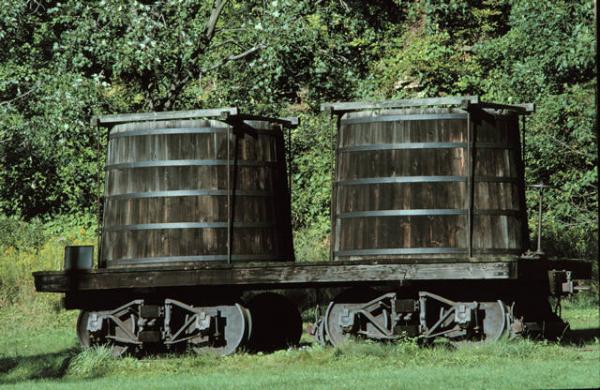
The first practical petroleum railway tank car was invented in 1865 by James and Amos Densmore at the Miller Farm along Oil Creek, Titusville, Pennsylvania. Photo courtesy Drake Well Museum.
Using an Atlantic & Great Western Railroad flatcar, the brothers secured two tanks to ship oil in bulk. The patent (no. 53,794) described and illustrated the railroad car’s design.
The nature of our invention consists in combining two large, light tanks of iron or wood or other material with the platform of a common railway flat freight-car, making them practically part of the car, so as they carry the desired substance in bulk instead of in barrels, casks, or other vessels or packages, as is now universally done on railway cars.
The development of railroad tank cars came when traditional designs, including the flatcar, hopper, and boxcar, proved inadequate for large amounts of oil — often shipped in 42-gallon barrels.
New designs were born out of necessity, as the fledgling oil industry demanded a better car for the movement of its product, according to American-Rails.com.
“Before the car was developed, railroads used a combination of boxcars, flatcars, and gondolas to haul everything from lumber and coal to crude oil, molasses, and water (by use of barrels),” noted Adam Burns in 2022. “One of the most prolific car types you will find moving within a freight train today is the tank car.”
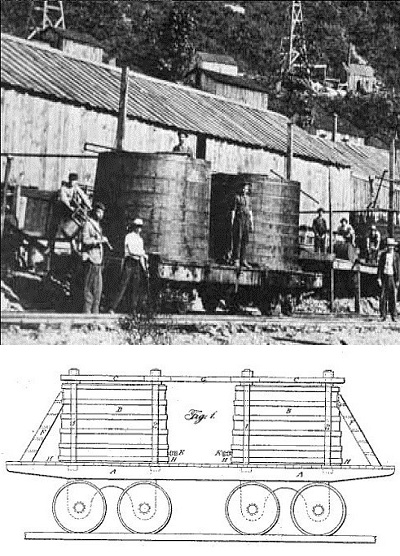
Although top heavy and prone to leaks, the Densmore tank cars provided a vital service — if only for a few years before single, horizontal tanks replaced them.
According to transportation historian John White Jr., the Densmore brothers’ oil tank design essentially consisted of a flat car with wooden vats attached. “The Central Pacific is known to have used such specialized cars to transport water,” he noted in his 1995 book, The American Railroad Freight Car.
“However, prior to the discovery of oil by Colonel Edward (sic) Drake near Titusville, Pennsylvania, on August 27, 1859, the tank car was virtually non-existent,” added White, a former curator of transportation at the Smithsonian Institution.
Dual Tank Design
The brothers further described the use of special bolts at the top and bottom of their tanks to act as braces and “to prevent any shock or jar to the tank from the swaying of the car while in motion.”

A Pennsylvania Historical Commission marker on U.S. 8 south of Titusville commemorates the Densmore brothers’ significant contribution to petroleum transportation technology. Dedicated in 2004, the marker notes:
The first functional railway oil tank car was invented and constructed in 1865 by James and Amos Densmore at nearby Miller Farm along Oil Creek. It consisted of two wooden tanks placed on a flat railway car; each tank held 40-45 barrels of oil. A successful test shipment was sent in September 1865 to New York City. By 1866, hundreds of tank cars were in use. The Densmore Tank Car revolutionized the bulk transportation of crude oil to market.
The benefit of such railroad cars to the early petroleum industry’s infrastructure was immense, especially as more Americans eagerly sought oil-refined kerosene for lamps.
Despite design limitations that would prove difficult to overcome, independent producers took advantage of the opportunity to transport large amounts of petroleum. Other transportation methods required teamsters hauling barrels to barges on Oil Creek and the Allegheny River to get to kerosene refineries in Pittsburgh.
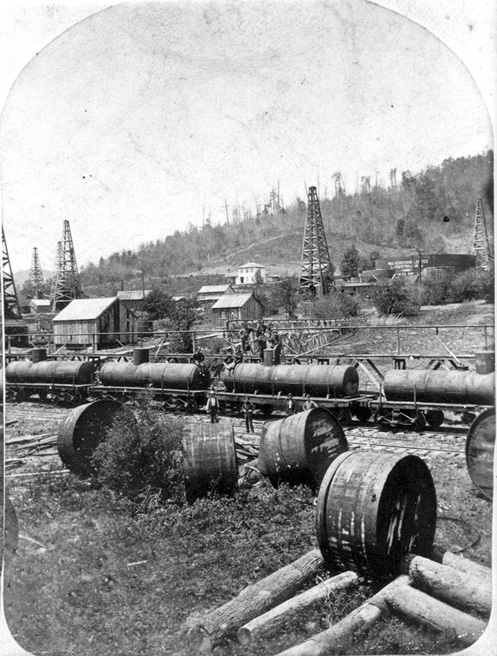
Riveted cylindrical iron tank cars replaced the Densmore brothers’ dual wooden tanks — seen here discarded. Photo courtesy Drake Well Museum.
As larger refineries were constructed, it was found that it cost $170 less to ship 80 barrels of oil from Titusville to New York in a tank car instead of individual barrels. But the Densmore cars had flaws, notes the Pennsylvania Historical Commission.
They were unstable, top heavy, prone to leaks, and limited in capacity by the eight-foot width of the flatcar. Within a year, oil haulers shifted from the Densmore vertical vats to larger, horizontal riveted iron cylindrical tanks, which also demonstrated greater structural integrity during derailments or collisions.
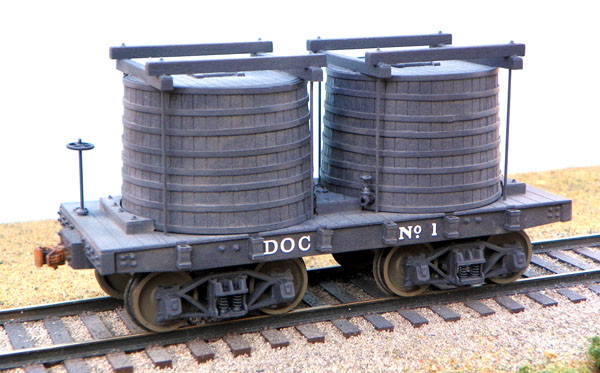
A model railroad Densmore Oil Company tank car “laser-cut wood kit with plastic and lost-wax brass details.” Photo courtesy Model Railroader, May 2012.
The same basic cylindrical design for transporting petroleum can be seen as modern railroads load products from corn syrup to chemicals — all in a versatile tank car that got its start in the Pennsylvania oil industry.
The largest tank car ever placed into regular service was Union Tank Car Company’s UTLX 83699, rated at 50,000 gallons in 1963 and used for more than 20 years. A 1965 experimental car built by General American Transportation, the 60,000-gallon “Whale Belly,” GATX 96500, is now on display at the National Museum of Transportation in Saint Louis.
1863 Tank Car Patents
Although not manufactured, other inventors came up with new ways for transporting oil from booming oilfields. John Scott of Lawrenceville, Pennsylvania, on January 20, 1863, patented (No. 37,461) a rectangular design for his “car for carrying petroleum, etc.”

John Clark of Canandaigua, New York, on November 3, 1863, was awarded a patent (No. 40,458) for another “improvement in cars for carrying petroleum.” His design put a long and flat sheet-metal tank under an ordinary freight car.
Finally, a “petroleum car” design with a cylindrical shape similar to modern railroad tank cars was patented (No. 38,765) on June 2, 1863, by Samuel J. Seely of Brooklyn, New York. The Seely patent might be the first design for a petroleum car shaped like those in use today.
Oil Tanks to Typewriters
Although the Densmore brothers left the oil region by 1867 — their inventiveness was far from over. In 1875, Amos Densmore assisted Christopher Sholes in rearranging the “type writing machine” keyboard so that commonly used letters no longer collided and got stuck. The “QWERTY” arrangement vastly improved Shole’s original 1868 invention.
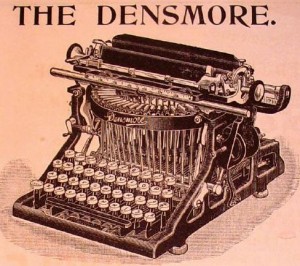
Amos Densmore helped invent an efficient typewriter.
Following his brother’s work with Sholes, inventor of the first practical typewriter, James Densmore’s oilfield financial success helped the brothers establish the Densmore Typewriter Company, which produced its first model in 1891. Few historians have made the oil patch to typewriter keyboard connection — including Densmore biographers.
The Pennsylvania Historical Commission reported that biographies of the Densmore brothers — and their personal papers at the Milwaukee Public Museum — all refer to their innovative typewriters, “but make no mention of their pioneering accomplishment in railroad tank car design.”
_______________________
Recommended Reading: The American Railroad Freight Car (1995); Early Days of Oil: A Pictorial History of the Beginnings of the Industry in Pennsylvania (2000); Story of the Typewriter, 1873-1923 (2019); Myth, Legend, Reality: Edwin Laurentine Drake and the Early Oil Industry
 (2009). Your Amazon purchase benefits the American Oil & Gas Historical Society. As an Amazon Associate, AOGHS earns a commission from qualifying purchases.
_______________________
The American Oil & Gas Historical Society (AOGHS) preserves U.S. petroleum history. Please support this energy education website, subscribe to our monthly email newsletter, and help expand historical research. Contact bawells@aoghs.org. Copyright © 2026 Bruce A. Wells.
Citation Information – Article Title: “Densmore Oil Tank Cars.” Authors: B.A. Wells and K.L. Wells. Website Name: American Oil & Gas Historical Society. URL: https://aoghs.org/transportation/densmore-oil-tank-car. Last Updated: April 1, 2026. Original Published Date: April 7, 2013.
by Bruce Wells | Feb 26, 2026 | Offshore History
Thousands of offshore petroleum platforms provide energy and create marine habitats.
Offshore petroleum platforms act as artificial reefs, creating multiple marine habitats, according to scientists. Beginning in 1979 with an Exxon (ExxonMobil) experimental subsea structure, the U.S. government’s “Rigs to Reefs” program established the largest artificial habitat in the world.
The Gulf of Mexico, both onshore and offshore, has continued to be a key contributor to U.S. oil and natural gas resources and energy infrastructure. Federal offshore oil production in 2023 accounted for 15 percent of total U.S. crude oil and five percent of natural gas production, according to the U.S. Energy Information Administration (EIA).
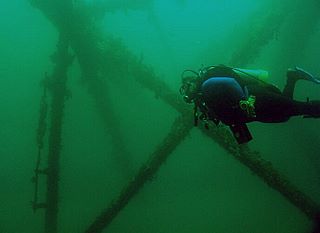
Offshore platforms make good artificial reefs. The open design attracts fish — and divers — where they can swim easily through the circulating water. Photo courtesy U.S. Bureau of Safety and Environmental Enforcement.
(more…)