by Bruce Wells | Aug 4, 2026 | Petroleum History Almanac
A simple forum for sharing ideas and research — and preserving history.
The American Oil & Gas Historical Society (AOGHS) established this oil history forum page to help share research. For oilfield-related family heirlooms, the society also maintains an Oil & Gas Families page to locate suitable museum collections for preserving these unique histories. Information about old petroleum company stock certificates can be found at the popular forum linked to Is my Old Oil Stock worth Anything?
Our forum below offers a simple way to share personal or academic research, subject ideas, comments, and other details about petroleum history. You can email the society at bawells@aoghs.org if you would like your research question posted. Please use the comment section at the bottom of this page to answer or make suggestions!
Request: October 11, 2026
1958 Well in San Juan County, Utah
After acquiring a collection of 35mm negatives and color slides, William Frohman has been researching the petroleum history of San Juan County, Utah (see First Utah Oil Wells). His 75 images feature exploration and production — primarily a drilling site, unidentified personnel, terrain geology, and facilities related to Stanolind Oil. The slides and negatives, taken between October and December 1958, include 21 ariel views, a dozen of the company’s rig no. 1 being erected, and many others featuring rare indigenous artwork, dwellings, and landmarks.
Please post your reply in the comments section below or email wmtoddfrohman@gmail.com
Request: August 12, 2026
Oklahoma Oil and Mafia History
“I was tickled to run across my grandfather’s name in the Recollections of Lloyd Unsell,” explains Leigh Anne Van Doren in an August 2026 email. “My grandfather was Lorren Williams, and he is mentioned by Unsell as the mostly deaf city editor of the Tulsa World in 1948.”
Editor’s Note — Unsell cites the incessant racket of the nearby “clacking of a half-dozen AP teletype machines.”
Family lore about Williams says that as the city desk editor of the Tulsa World, “my grandfather ran afoul of the ‘Mafia’ and thus moved to an isolated ranch near Zoe, Oklahoma, in the Ozarks to protect his family. Somehow there were fire bombs or threats of fire involved. The ranch was near Mena, Arkansas, and Heavener, Oklahoma, with mountains on three sides and a river across the 4th. No electricity or running water. He was a much better editor than a rancher, but he lived there the rest of his life.”

Van Doren adds that details of what happened in Tulsa involving the Mafia are now lost. Her grandfather “covered the ‘oil wars’ as part of his Oklahoma City newspaper job in the late 1930s. He was arrested by the military for taking pictures of the governor when the military took over the oilfields about 1937. Fined and released along with his counterpart in the rival Oklahoma City newspaper.”
She concludes her email by asking whether researchers know — “What might have been happening in Tulsa involving the oil business that could have attracted the interest of the Mafia? We are presuming it was a story he wrote and that oil was the industry. It could be anything, of course, or time might have muddied the story. I’m interested in reconstructing this piece of family history. Best Wishes, Leigh Anne Van Doren.”
Please post your reply in the comments section below or email leighanne.vandoren@gmail.com
Request: July 21, 2026
Oil Wells at Cuba, New York
Researcher seeks information about Josiah E. Terwilliger, who in 1857 was part of a company that “sunk by hand drill the first oil well at Cuba, New York.”
While researching the life of Union Civil War soldier Josiah E. “Edward” or “J.E.” Terwilliger (85th Regiment, New York Volunteer Infantry), Ben DiMatteo came across a reference to the first company to hand-drill an oil well at Cuba, New York. “As I understand, there was a well drilled there as early as 1857, though it was never considered successful,” he notes. “I haven’t seen any original sources to support this claim: Josiah Edward, son of Cyrus Terwilliger…was one of the company that combined and sunk by hand drill the first oil well at Cuba, New York.”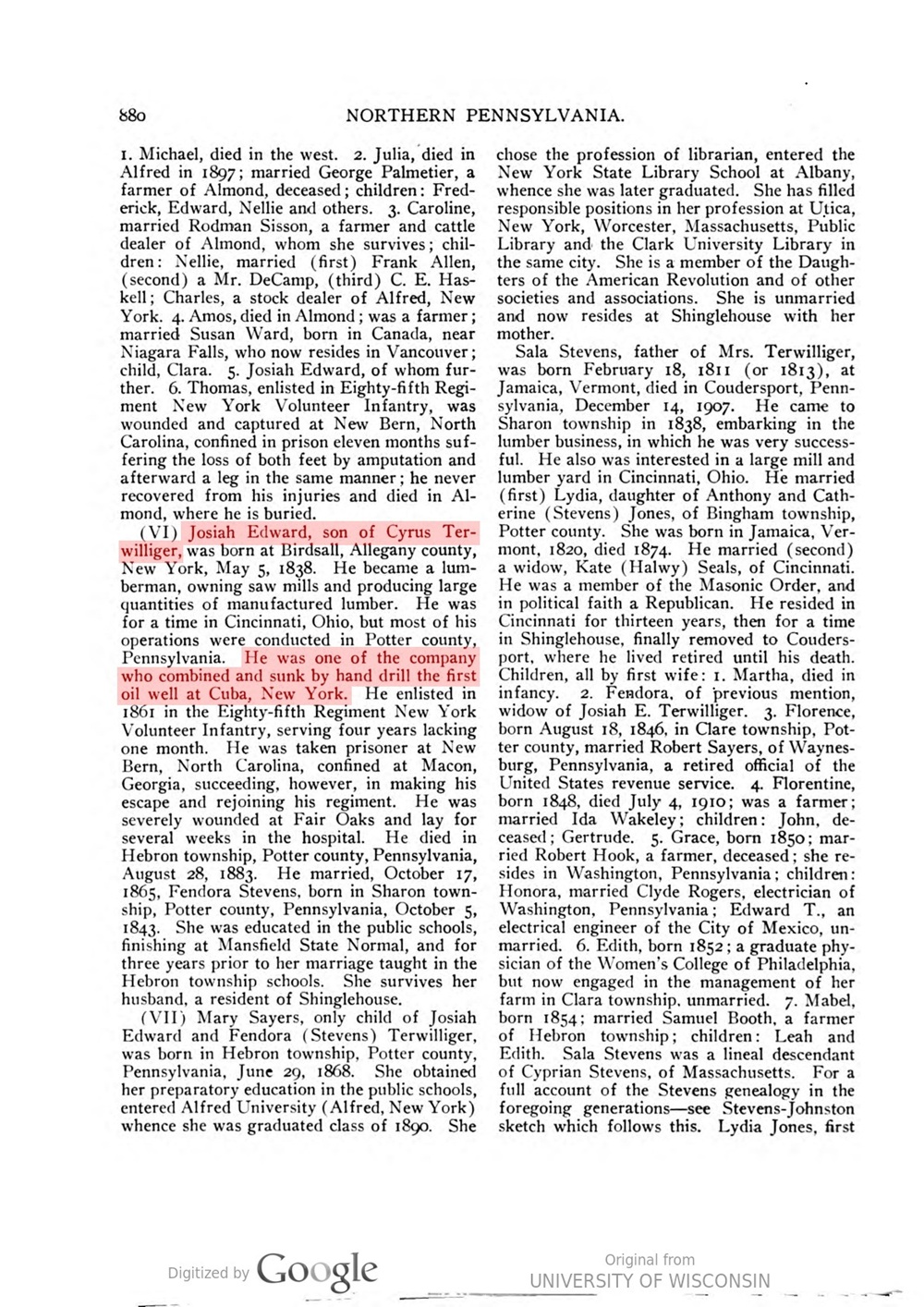
DiMatteo hopes a forum visitor can direct him to the best source for information on that first oil well at Cuba — or any other connection between the Terwilliger name and early petroleum exploration in New York. “I’ve included my source document, which I believe was based on information provided by the soldier’s daughter. If I can find an outside corroborating reference, it would solidify this as a fact.”
— Ben DiMatteo
Please post your reply in the comments section below below or email bendimatteo@gmail.com
Request: January 5, 2026
Sherwood Forest Drilling Photograph
Retired police officer and author Michael Layton of Bromsgrove, Worcestershire, United Kingdom, is working on a sequel to his 2025 local history, Top Secret West Midlands. He seeks suggestions for finding a photo.
“I am obviously at the beginning of my research but have already noticed that Sherwood Forest in Nottingham was home to a secret drilling operation during WW2 involving 42 American drillers. It will not be a huge piece in the book, but I think it highlights a little known and very important piece of WW2 history in Nottinghamshire. Would any AOGHS members or website visitors have access to a photograph of that period which would not be the subject of copyright restrictions?”
I look forward to any suggestions. Kind regards — Michael
Please post your reply in the comments section below or email layton2006@btinternet.com
Request: November 21, 2025
1914 Socal Tanker served in WWII
Searching for the SOCAL publication featuring the 1914 launch of the company tanker J.A. Moffett, which served in WWII.
“Hello. I’m trying to find out if American Oil & Gas Historical Society website visitors have any information about the December 1914 Standard Oil Company of California ‘Standard Oil Bulletin.'”
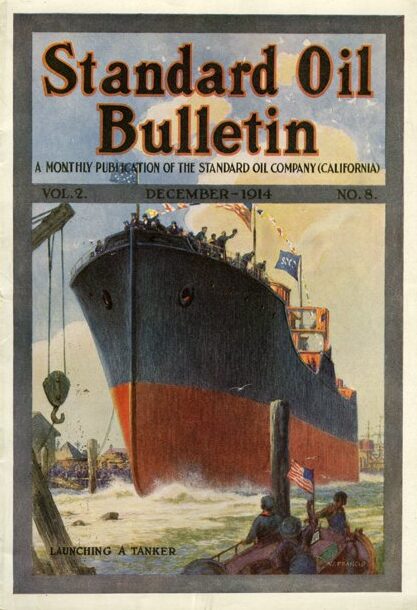
Created with the breakup of Standard Oil in 1911, Standard Oil of California (SOCAL) became Chevron in 1984.
The cover story for that “Standard Oil Bulletin” featured the tanker J.A. Moffett. “My dad was on that tanker in World War II in the Pacific, and I’m trying to find a copy or the J.A. Moffett article. Thank you.”
— Pat
Editor’s Note: Another tanker, the J. A. Moffett Jr., built in 1921, was torpedoed in 1942 in the Florida Keys. Please post your reply in comments section below or email bawells@aoghs.org
Research Request: November 16, 2025
Hand-cranked Bowser Pump
Scottish researcher seeks details about a salvaged pump manufactured by S.F. Bowser & Company.
“I have an old hand-crank petrol pump that I salvaged from a demolition site. The body can be closed and locked by swinging a curved door round. It’s possible to just make out the word Bowser on a part. It has a light bulb holder up top where a glass globe could be fitted and two other bulb holders to shine downwards. It can be set to serve a pint, a quart, a half gallon or a gallon.
“I’d love to know more about it but can’t find an image anywhere showing the same appliance.”
Douglas Robertson
Please post oil history forum replies in the comments section below or email douglasinscotland@gmail.com
Research Update: November 12, 2025
Antique Calculator: The Slide Rule
Searching for the history of a Tulsa refining supply company pocket calculator.
David Rance of Sassenheim, Netherlands, has collected a lot of slide rules. Some of the calculators in his collection came from the petroleum industry, including a circa 1950 one made in West Germany for an Oklahoma-based refinery supply company. He seeks any information about it.
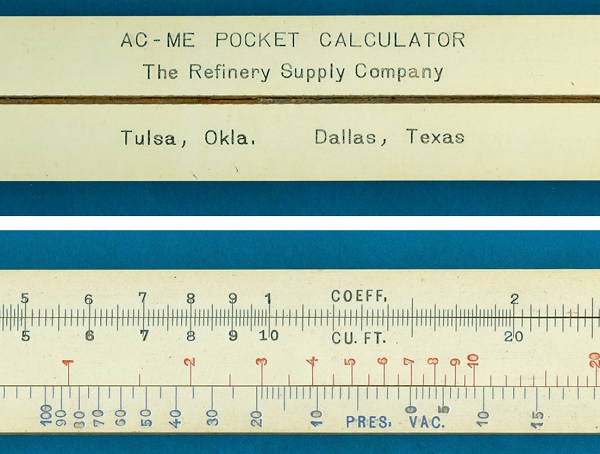
An “AC-ME Pocket Calculator,” of the Refinery Supply Company, Tulsa, Oklahoma, preserved by David Rance of the Netherlands.
“I look forward to hearing anything your knowledgeable AOGHS community can tell me about my rather mysterious AC-ME Pocket Calculator,” he optimistically noted in 2016 — see the updated Refinery Supply Company Slide Rule.
Please post oil history forum replies in the comments section below or email bawells@aoghs.org.
Research Update: October 28, 2025
Ohio Oil Rush
Exploring Ohio petroleum history from 1885 to about 1930.
Does anyone have recommendations for doing research on the great oil rush of Ohio that occurred from 1885 to ~1930, and peaked in 1897? Are there any good reference books that anyone can recommend? I am trying to research this oil boom and its effect on the construction of an interurban rail connection from Toledo to Lima.
Dave Weber
Also see Oil History Books. Please post your reply in comments section below or email bawells@aoghs.org.
Research Update: August 18, 2025
California Adventures in Oil
City Planning Associate for Los Angeles shares research resources.I’m a subscriber to your “Oil & Gas History News.” It’s great content to review and learn about the oil industry’s history. I work in Los Angeles on land use/zoning regulations for oil wells in the city, and I’m currently reading a couple of older publications from the public library. Among the images is offshore drilling at the Summerland field that you recently highlighted in your newsletter.
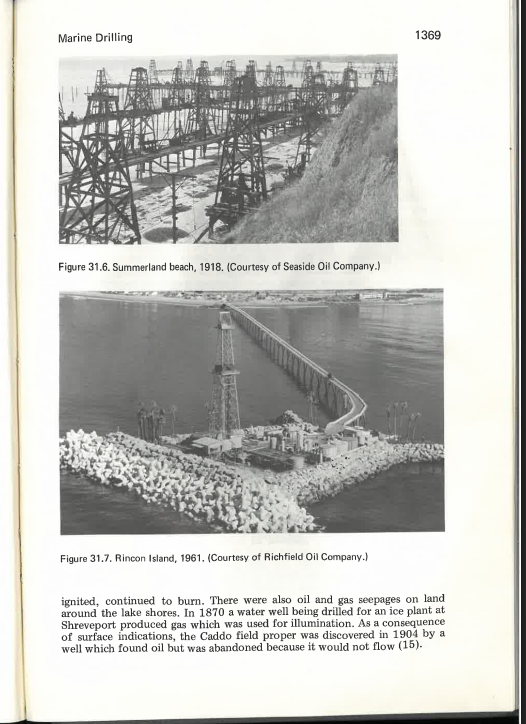
Coastal California oilfields are featured among the 1,500 pages of History of Oil Well Drilling by John E. Brantly.
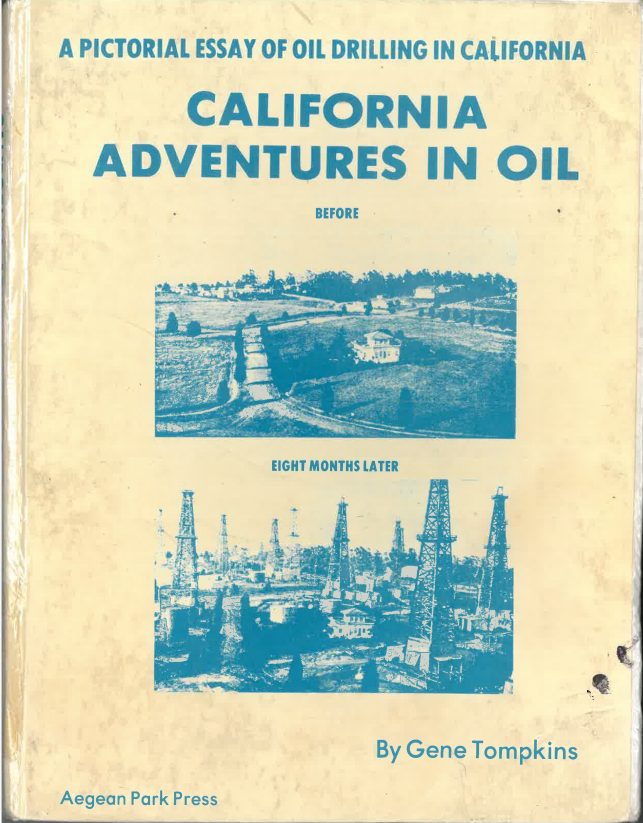
Before retiring as an independent producer in 1963, Eugene Thompkins founded several oilfield service companies, including one that operated at Signal Hill for two decades.
I just thought to share a few PDFs of Summerland photos from History of Oil Well Drilling (1971) by John E. Brantly, pages 1366-1369, and more images from California Adventures in Oil, A Pictorial Essay of Oil Drilling in California (1981) by Gene Tomkins, which might be of interest to your readers. Keep up the great content; much appreciated. — Edber Macedo, City Planning Associate, Office of Zoning Administration, Los Angeles City Planning
Please post your reply in comments section below or email bawells@aoghs.org
Research Request: July 9, 2025
Desdemona Oil & Refining Company
Editor for International Bond and Share Society seeks source material for circa 1920 Texas company established during the North Texas drilling booms at Electra (1911), Ranger (1917), and Burkburnett (1918).
I’ve been subscribing for a few months and want to thank you for revealing so many obscure technologies and historical artifacts. I collect vintage stocks and bonds (all businesses, not just oil) and have always found it difficult to research these often obscure gas and oil companies. So far, I’ve not been successful in linking a certificate to any of the outfits you’ve mentioned, but it’s just a matter of time.
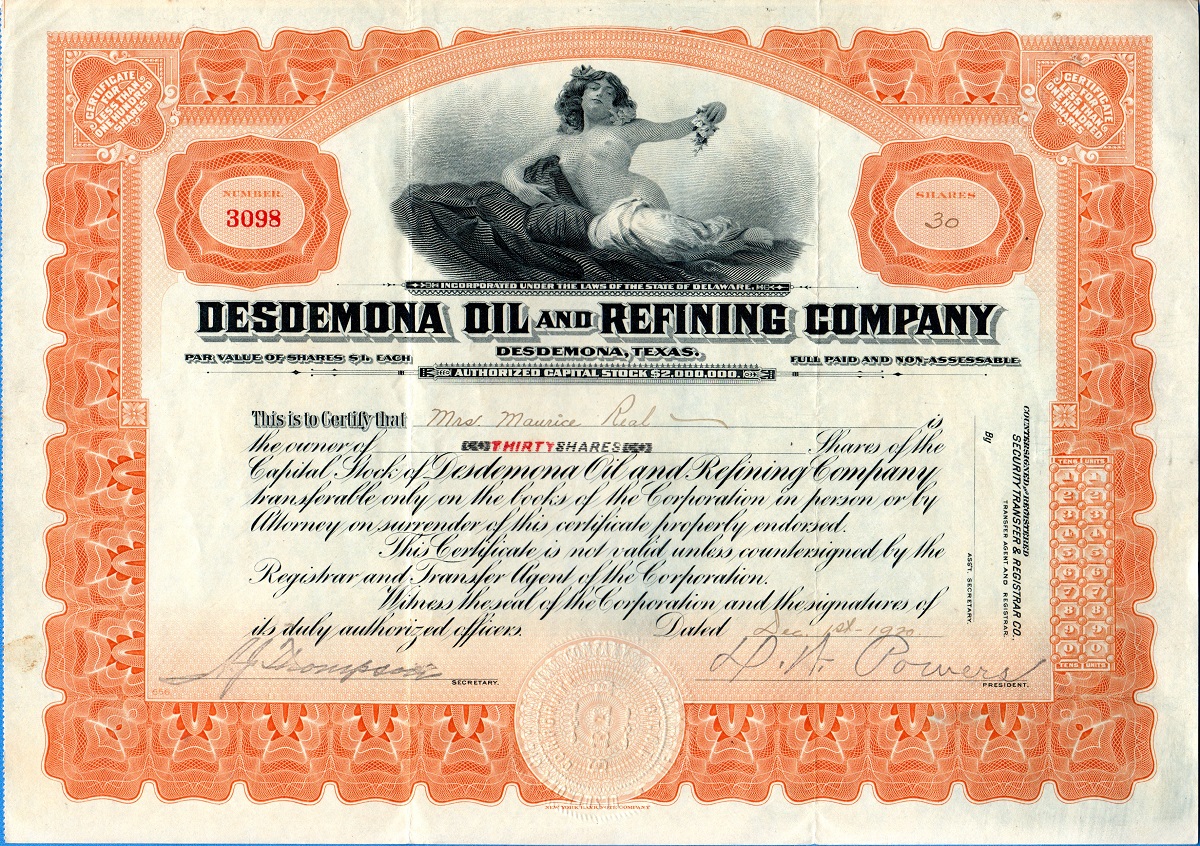
I recently wrote an article on the Indian Territory Illuminating Oil Co. that was published in the magazine I edit for the International Bond and Share Society, Scripophily. A stock I’ve been trying to research — without much luck — is the Desdemona Oil & Refining Company. If your members have any source material on this outfit, I’d be grateful.
Keep up the good work. — Max Hensley
Please post your reply in the comments section below or email maxdhensley@yahoo.com
Research Request: April 4, 2025
Standard Oil Public Relations Movie
Looking into 1947 film “A Farm In The Valley.”
Hello. My name is Carrie. My family is looking for a film that Standard Oil Company made in Virginia in 1947. It was titled “A Farm In The Valley.” I have several news articles but am looking for the film and/or any information that may be out there as part of the film was filmed on our farm (owned by the Rosen family at the time). I am hoping that maybe your group may have information or contact information for someone who may have information!
— Carrie
Please post your reply in comments section below or email bawells@aoghs.org
Research Request: November 14, 2024
Looking for The Gargoyle of Mobiloil
Pennsylvania researcher seeks a 1920s company magazine featuring her grandfather, “The Mobiloil King.”
I am in search of a copy of The Gargoyle magazine published by the Vacuum Oil Company from 1923. My great-grandfather, William I. Schreck was proprietor of the Keystone Service Station in Sayre, Pennsylvania, in the 1920’s and was locally dubbed “The Mobiloil King.”
I found an article on Newspapers.com — September 15, 1923 issue of the Sayre Evening Times, which states he was featured in The Gargoyle magazine, with two photos of his service station and an article written by him. I’m guessing it’s maybe the August 1923 or September 1923 issue. Any help locating this would be appreciated!
— Raquel
Please post your reply in comments section below or email bawells@aoghs.org
Research Request: November 8, 2024
Early Oilfield Production Technology
Artist seeks jerker/shackles for 2026 exhibition.
I am interested in the jerker/shackle lines used in early oil production for an exhibition I am planning for 2026. Does this oilfield equipment (entire assemblies or parts) ever come up for sale or auction? Perhaps there are private collectors or oil museums that might be interested in renting or lending some temporarily?
Best,
Aislinn
Please post your reply in comments section below or email bawells@aoghs.org (also see Eccentric Wheels and Jerk Lines).
Research Request: October 7, 2024
Researching Tidewater Oil Company
Researcher from Lancaster, Pennsylvania, seeks more about 1930s publication.
Hello: My grandfather authored an article in “The Tidewater World” in September 1932 (Vol. 2, No. 2). I have one complete issue. He worked in the Research and Development area of Tidewater Oil in Bayonne, New Jersey, 1928-1933.
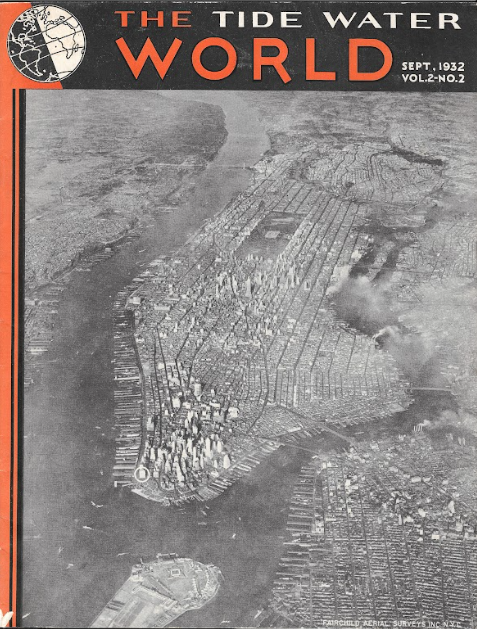
Founded in 1887 in New York City, Tidewater Oil Company became a major refiner that sold its Tydol brand petroleum products on the U.S. East Coast. Photo courtesy Mark O’Neill.
I am looking for archives who may have additional issues in the series or who has a research focus on Tidewater Oil. Thank you.
— Mark O’Neill
Please call Mark at (717) 803-9918 or post reply in the comments section below.
Research Request: April 20, 2024

Wayne Canada Gasoline Pump
Preserving a rare 1930s Wayne Canada pump.
I recently saved an uncommon Wayne 50A “showcase” gas pump from a metal recycling facility here in Canada. I didn’t have much time for details as it was literally standing in the scrap yard beside the metal chipping machine. I paid the asking price and loaded it into my truck.
Upon arriving home I noticed that the I.D tag was a Wayne Canada, which was a surprise because the odds of it being a Canadian Showcase pump are significantly smaller than American as Canada had far fewer of the 50 and 50A pumps for obvious reasons. The I.D tag got me curious however, as it is stamped 1001-CJXA.
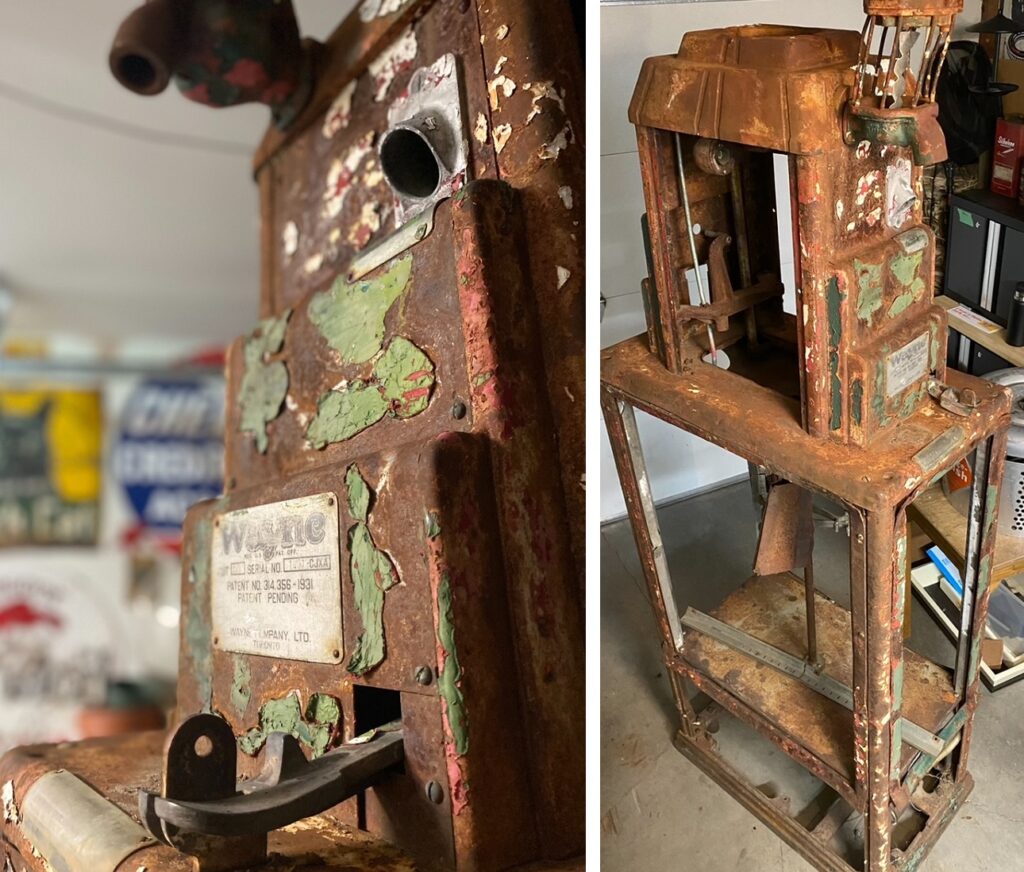
Canadian researcher seeks information about a rare 1930s Wayne Company pump 1001-CJXA.
Is there any way to determine which company ordered this exact gas pump? Is it true that the “1001” number would indicate that this is serial number 1 in Canada for this gas pump? I was told once that Wayne pumps in the 1930s began with the number 100 meaning 100.1 would be serial number 1. I’m not sure if that’s true.
Thanks very much for any help. I’m aware of the pumps rarity and historical significance, hence why I’m trying to find more information on it. Have a great day.
— Jonathan Rempel
Note: The Wayne Oil Tank and Pump Company of Ft. Wayne, Indiana, in 1892 manufactured a hand-cranked kerosene dispenser later converted for gasoline (see Wayne’s Self-Measuring Pump). Primarily Petroleum (oldgas.com) includes research posts with service station histories and gas pump collections; other resources include community oil and gas museums and the Canadian oil patch historians at the Petroleum History Society (PHS).
Please email jrrempel123@gmail.com or post reply in the comments section below.
Research Request: April 20, 2024
Name of Offshore Drilling Rig
Seeking the name of ODECO platform from 1970s.
I’m doing research on my late father, James R. Reese Sr., who worked in the Gulf of Mexico in the early 1970s and into the 1980s, and I’m trying to find the name of a rig he worked on for ODECO. We believe it may have been called the Ocean Endeavour, and we have a photo from my father’s 10th anniversary at the company with “Odeco 7” written on the back. My research points to the Endeavour, but I’m not confident of that. Has anyone heard of the platform and any other name it might have had?
Thank you for any help.
— James Reese Jr.
Note: ODECO (Ocean Drilling & Exploration Company) was founded in 1953. It was acquired by Diamond Offshore Drilling in 1992.
Please email tepapa@hotmail.com or post reply in the comments section below.
Research Request: March 29, 2024
Eastern Oklahoma History
Writer looking to connect petroleum exploration and railroad growth.
I’m writing a memoir that touches on Oklahoma, where I’m from originally, and I would like to learn more about what role did oil and gas exploration played in the expansion of the railroads into the Cherokee Nation in eastern Oklahoma in the late 1800s.
— Dave
Please post reply in comments section below or email bawells@aoghs.org.
Research Request: February 22, 2024
Threatt Filling Station on Route 66
Architectural history of potential National Historic Landmark.
Established in the early 1920s, the Threatt Filling Station in Luther, Oklahoma, is considered the first – and potentially only – African American owned and operated gas station on Route 66. I am under contract with the National Park Service to perform a study to determine whether the the station is eligible to become a National Historic Landmark.
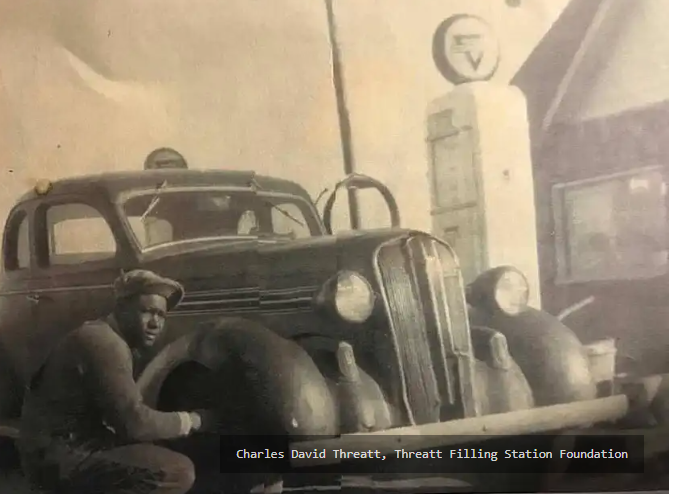
Constructed circa 1915 in Luther, Oklahoma, by Allen Threatt Sr., the Threatt Filling Station sold Conoco products for at least a portion of its many decades of service life, according to the Threatt Filling Station Foundation. Photo courtesy threattfillingstation.org.
What I am looking for is an Oklahoma contact, who has knowledge of the history of gas-oil distribution in the Sooner State in the 1920s-40s period. It appears that at one point, the Threatts were associated with Conoco. I would like to better understand how those supply-branding operations worked and whether there is historical paperwork that would cover this station.
Any assistance will be appreciated. Thank you,
— John
Please email john@archhistoryservices.com or post reply in the comments section below.
Research Request: January 2, 2024
Oil Refinery and R.R. Trackside Building Photos
Model railroader seeks detailed images of facilities in Santa Fe Springs and Los Angeles.
Thank you for sharing most interesting and valuable information. I use your society to help me with prototype research for my model railroading.
I am looking for information on the Powerine Oil Refinery at Santa Fe Springs circa 1950s and the trackside Hydril Oil Field Equipment buildings on approach to Los Angeles Union Passenger Terminal, and photos and dimensions of buildings/building interiors for model railroading purposes.
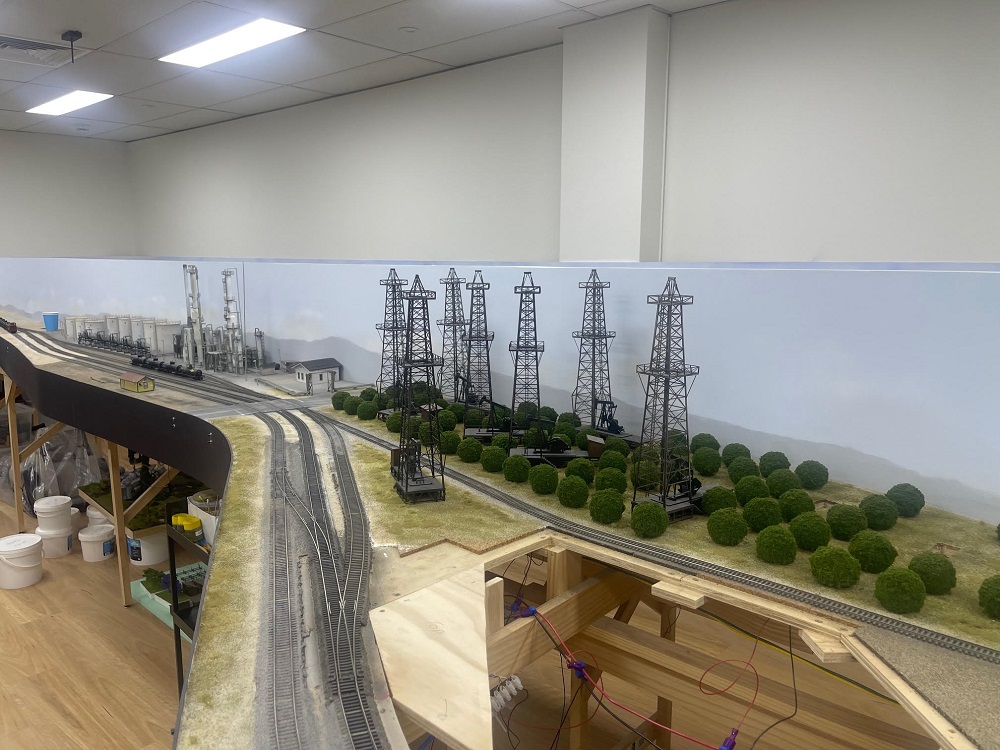
A model railroad scene of the southern California petroleum industry in the 1950s includes oil derricks, “each with an operating horsehead style oil pump underneath.”
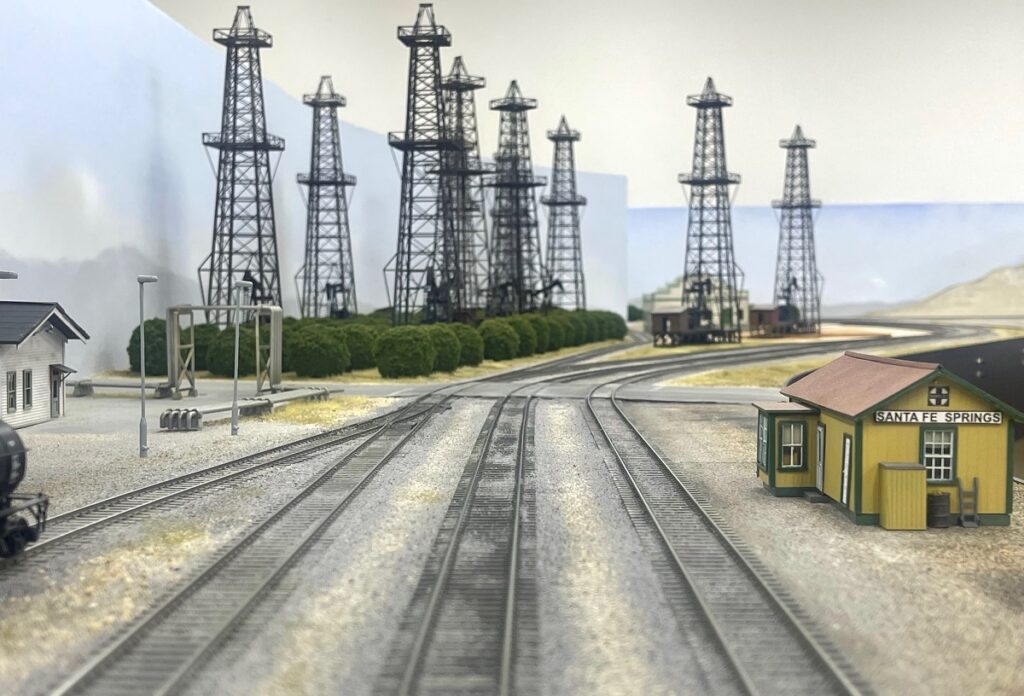
Justin Mitchell has recreated trackside oilfield derricks at Santa Fe Springs and researched oilfield engine audio files, “so I can add sound to the layout to match the operating pumps.”
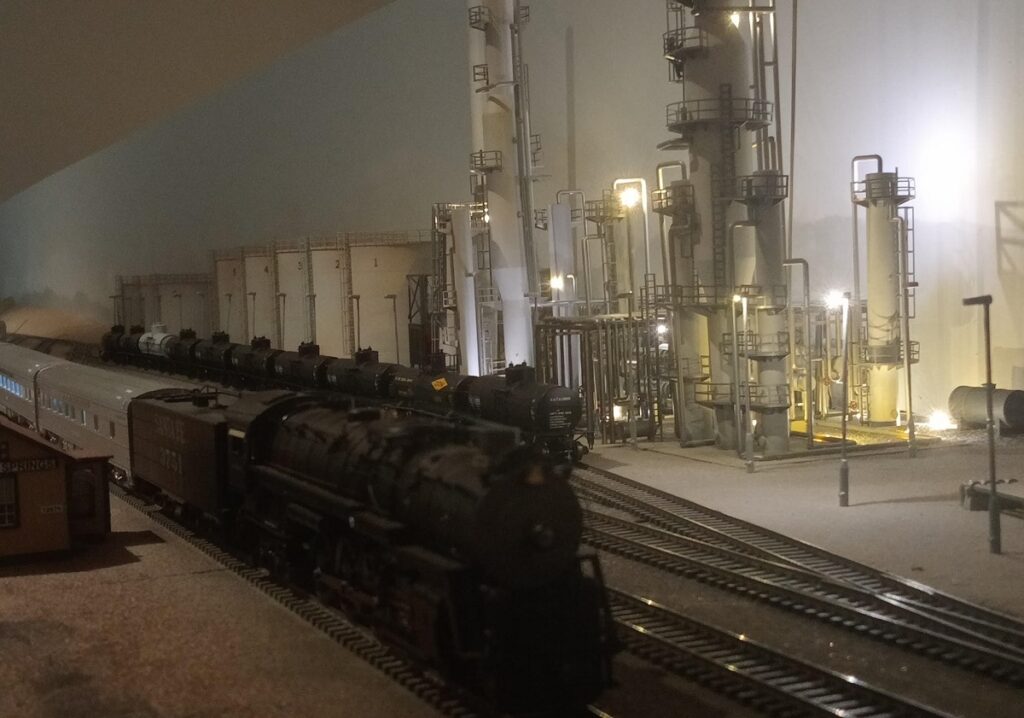
The Powerine Oil Refinery at Santa Fe Springs closed in 1995. Skilled model railroaders prize detail and historical accuracy.
Best regards from Sydney, Australia
— Justin Mitchell
Please post reply in comments section below or email bawells@aoghs.org.
Research Request: December 26, 2023
Cities Service in Wichita
Seeking service station photos.
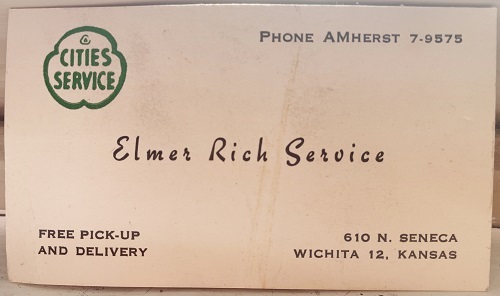
I am looking for photographs of a Cities Service Station located at 610 N. Seneca Street in Wichita, Kansas, in the 1950s, maybe early 60s. I have my father’s business card from that station. I remember the service station even though I was only 4 years old. Any assistance is greatly appreciated.
— Pamela
Please post reply in comments section below or email bawells@aoghs.org.
Research Request: September 25, 2023
Circa 1930 Driller from Netherlands
From a researcher investigating a great-great uncle’s role in the Texas oil patch.
A family history researcher in the Netherlands seeks help adding to her limited information about a great-great uncle who worked for J. Barry Fuel Oil Company in Texas oilfields from the 1920s to the early 1930s. The petroleum-related career of Ralph “Dutch” Weges included traveling on an early oil tanker later sunk during World War I.
Learn more and share research in Driller from Netherlands.

Research Request: July 13, 2023
How and Where Standard Oil produced Naphtha
From a writer working on a history of the lighting of New York City.
In the late 19th century, Standard Oil gained control of all of the gas lighting companies in New York. My understanding is that they did so in part because the gas companies at the time produced something called water gas, which relied on the use of naphtha, and Standard Oil produced almost all of the naphtha in the United States.
How and where Standard Oil produced its naphtha around 1890-1900 and how it would have transported it to the NYC gas companies? Would it have been produced in the Midwest and shipped east by pipeline? Railcar? Did they ship crude oil east and refine it into naphtha somewhere on the East Coast?
Also, any suggestions for where I could find info on how much naphtha Standard Oil produced around that time and, perhaps, how much of it was shipped to New York? I have looked in all the standard histories and tried every Google and newspaper searches. Can anyone offer suggestions? Thanks very much.
— Mark
Please post reply in comments section below or email bawells@aoghs.org.
Reply
August 26, 2023, from Reference Services, American Heritage Center
The American Heritage Center at the University of Wyoming does hold a set of records for the Standard Oil Company of New Jersey, 1874-1979. The online guide is posted here. This is one of our older guides not yet converted to the online format, and it includes many handwritten notes about the removal of items from this manuscript collection to other collections.
— American Heritage Center, University of Wyoming
Research Request: June 23, 2023
Houston Petrol Filler
From an Australian “petrol bowser” researcher
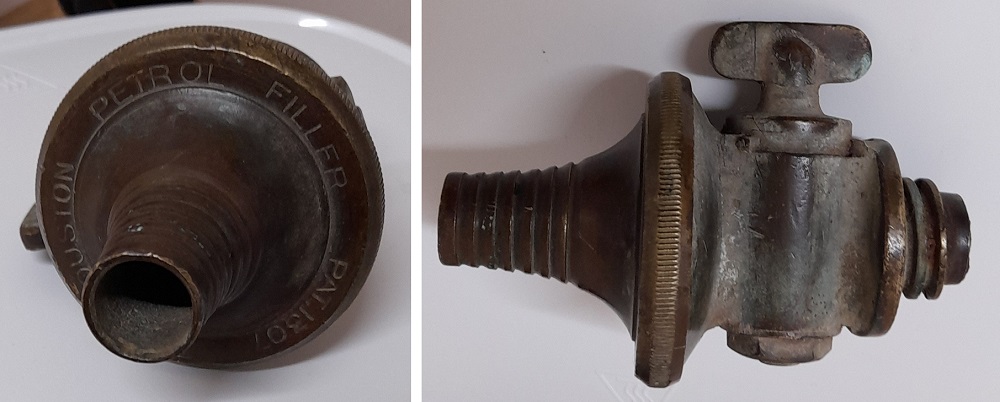
I recently came across this brass fitting which is clearly marked THE HOUSTON PETROL FILLER Pat 1307. The patent number is extremely early. I am assuming it is part of an early petrol pump or as we call them here in Australia, a petrol bowser. Is there any chance anyone can identify what this was originally part of. Many thanks for your help. Regards.
— Justin
Please post reply in comments section below or email bawells@aoghs.org.
Reply
October 18, 2023 (also from Australia)
Hello Justin,
I have one of these that has turned up in my late father’s stuff. Identical to yours except for the screwed end which has a strangely shaped protrusion. I’ll send you a pic if you are interested. Did you ever find out anything about it? I’m looking for somewhere to donate it — where it will be appreciated.
Regards, David
Please post reply in comments section below or email bawells@aoghs.org.
Research Request: April 12, 2023
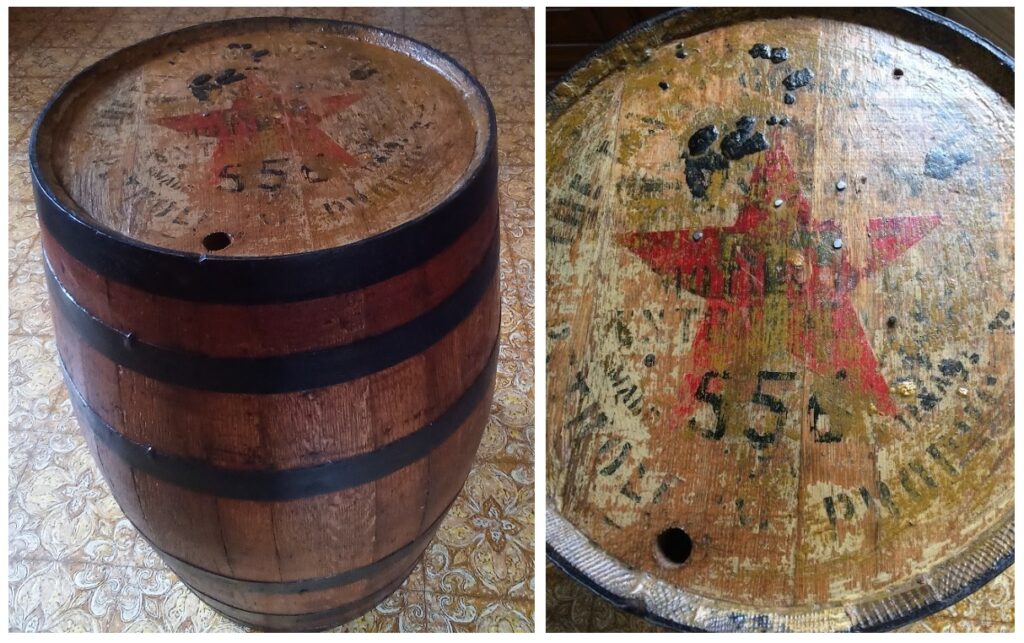
Information about Wooden Barrel
From researcher who has a barrel with a red star and
I have got this old oil barrel. I’m trying to find out more information about it. I’m guessing around the 1920’s but I really have no clue. I was hoping someone there could shed some light on it. I’m not interested in selling it just some information. Much appreciated!
— Robert
Please post reply in comments section below or email bawells@aoghs.org.
Reply
November 25, 2023
To Robert,
Your wood barrel is clearly “The Texas Company” (i.e., Texaco) container for “Petroleum Products.” Except for the red star with big green T, the rest of the lithography on your barrel is harder to interpret. My source for reference is Elton N. Gish’s self-published 2003 book Texaco’s Port Arthur Works. Unfortunately, the book does not have an index, but it has a lot of company photographs in it surrounded by narratives. Most of the photos of product containers are for metal cans and drums, but one group photo of a product display dated 1932 shows wood barrels still in use although metal drums predominate by that time. The only wood barrels discussed by Gish are for “slack barrels” used for asphalt, and it looks like you have some asphalt residue on your barrel top. Gish indicates that the “Red star-green T” trademark lithography began to be used by 1909 and continued to be used to present in various renditions, but a 1920s date range for you barrel seems reasonable. I hope this helps.
— Andy
Research Request: September 3, 2022
Identifying a Circa 1915 Gas Pump
From the lead mechanic at San Diego Air & Space Museum
I’m hoping someone visiting the American Oil & Gas Historical Society’s website can help me identify the gas pump we are restoring here at the San Diego Air and Space Museum. I believe it’s a Gilbert and Barker from 1915 or so.
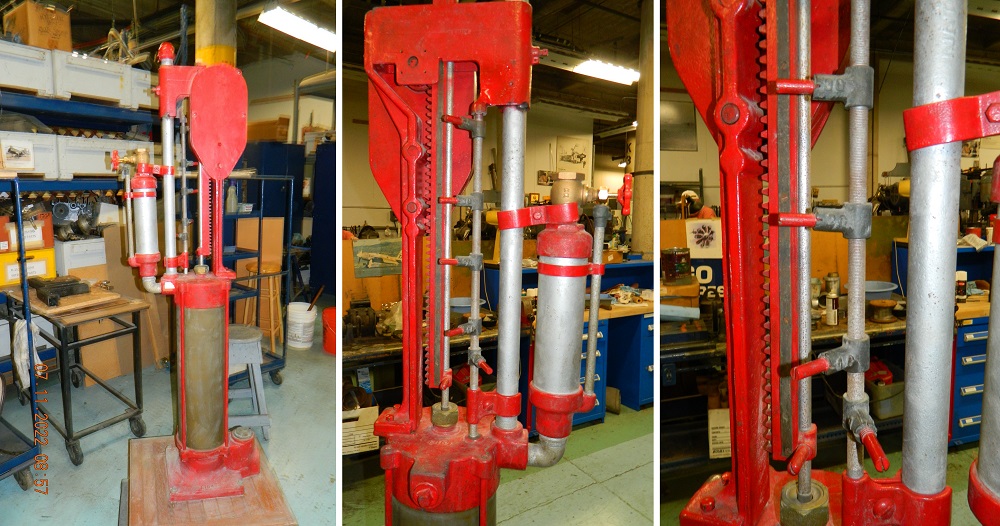
The data plate is missing and I’ve been having trouble finding a similar one in my online search. Thanks!
— Gary Schulte, Lead Mechanic, SDASM
Please email Gary engshop@sdasm.org or post your reply in the comments section below.
Learn more history about early kerosene and gasoline pumps in First Gas Pump and Service Station; a collector’s rare 1892 pump in Wayne’s Self-Measuring Pump; and the 24-hour Gas-O-Mat in Coin-Operated Gas Pumps.
Research Request: August 11, 2022
Gas Streetlights in the Deep South
From a professor, author and “history detective”
I am doing historical research on gas streetlights in the Deep South. Any suggestions will be much appreciated. My big problem at the moment is Henry Pardin. He bought the patent rights to a washing machine in Washington, DC, in 1856 and was in Augusta, Georgia, in 1856. Pardin set up gas streetlights in Baton Rouge, Holly Springs, Natchez, and Shreveport in 1857-1860. I have failed to find him in any of the standard research sources.
Any help on gas street lights in the south before the Civil War is appreciated. Thank you for your time.
— Prof. Robert S. “Bob” Davis, Blountsville, Alabama, Genws@hiwaay.net
Please email Bob or post your reply in the comments section below.
Research Request: August 5, 2022
Drop in Stop Action Film
From a stop action film researcher:
“Your website is doing good things for education. It is a gold mine for STEM high school teachers — and also for people like me, who like stop motion oil industry films, Bill Rodebaugh noted in an August 2022 email to the American Oil & Gas Historical Society.

Researcher seeks the origin of stop action film (oil?) drops.
Rodebaugh, who has researched many stop motion archives (including AOGHS links at Petroleum History Videos), seeks help finding the source of an unusual character — a possible oil drop with a face and arms. The purpose of the figures remains unknown.
“I am discouraged about finding that stop motion film, because I have seen or skimmed through many of those industry films, which are primarily live action,” Rodebaugh explained. He knows the puppet character is not from the Shell Oil educational films, “Birth of an Oil Field” (1949) or “Prospecting for Petroleum” (1956). He hopes a website visitor can assist in identifying the origin of the hand-manipulated drops. “I am convinced that if this stop motion film can be found, it would be very interesting.”
— Bill Rodebaugh, brodebaugh@suddenlink.net
Please email Bill or post your reply in the comments section below.
Research Request: July 2022
Gas Station Marketplace History
From an automotive technology writer:
I’m looking for any information on the financial environment during the early days of the automotive and gasoline station industry. The idea is to compare and contrast the market-driven forces back then to the potential for government subsidies/investments etc. to pay for electric vehicle charging stations today.
At this point, I have not found any evidence but I wanted to be thorough and ask the petroleum history community. From what I have seen, gas stations were funded privately by petroleum companies and their investors and shareholders.
I’m not talking about gas station design or the impact on the nation/communities, but the market forces behind the growth of the industry. Please let me know of any recommended sources. I have already read The Gas Station in America by Jackie & Sculle.
— Gary Wollenhaupt, gary@garywrites.com
Please email Gary or post your reply in the comments section below.
Research Request: April 2022
Seeking Information about Doodlebugs
From a Colorado author, consulting geologist and engineer:
I am trying to gather information on doodlebugs, by which I mean pseudo-geophysical oil-finding devices. These could be anything from modified dowsing rods or pendulums to the mysterious black boxes. Although literally hundreds of these were used to search for oil in the 20th century, they seem to have almost all disappeared, presumably thrown out with the trash. If anyone has access to one of these devices, I would like to know.
— Dan Plazak
Please post reply in comments section below or email bawells@aoghs.org. Dan Plazak is a longtime AOGHS supporting member and a contributor to the historical society’s article Luling Oil Museum and Crudoleum.
Research Request: February 2022
Know anything about W.L. Nelson of University of Tulsa?
From an associate professor of history at the Massachusetts Institute of Technology, Cambridge, Massachusetts:
I am doing research on the role of the University of Tulsa in the education of petroleum refining engineers and in particular am seeking information about a professor who taught there named W.L. Nelson, author of the textbook Petroleum Refinery Engineering, first published in 1936. He taught at Tulsa until at least the early 1960s. He was also one of the founders of the Oil and Gas Journal and author of the magazine’s “Q&A on Technology” column. If anyone has any leads for original archival sources by or about Nelson and UT, I would appreciate hearing from you.
Thank you and best wishes, M.G.
Please post reply in comments section below or email bawells@aoghs.org.
Emailed response to “Seeking Information about W.L. Nelson of University of Tulsa.”
My late father was a 1943 graduate of the University of Tulsa with a degree in petroleum engineering with an emphasis in refining. By the time my late uncle graduated in 1948, his degree had become chemical engineering with an emphasis in refining. Both had high regard for Wilbur L. Nelson. Both had long careers in the refining at Murphy Oil Corporation and Sun Oil Company. My father would pass along to me his obsolete Petroleum Refinery Engineering, as Nelson periodically updated his book. I will check my father’s papers for any Nelson relics. Let me know how your inquiry goes.
— Professional Engineer, El Dorado, Arkansas
————————
Oil History Forum
Research requests from 2021:
Star Oil Company Sign
Looking for information about an old porcelain sign from the Star Oil Company of Chicago.
Learn more in Seeking Star Oil Company.
Bowser Gas Pump Research
I have a BOWSER, pump #T25988; cut #103. This is a vintage hand crank unit. I can’t seem to find any info on it! Any help would be appreciated, Thank You. (Post comments below) — Larry
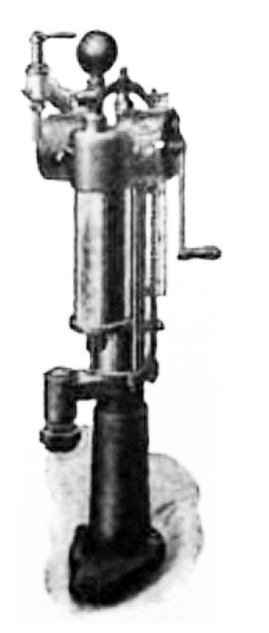
Hand-cranked Bowser Cut 103 Pump.
Originally designed to safely dispense kerosene as well as “burning fluid, and the light combustible products of petroleum,” early S.F. Bowser pumps added a hose attachment for dispensing gasoline directly into automobile fuel tanks by 1905. See First Gas Pump and Service Station for more about these pumps and details about Bowser’s innovations.
Bowser company once proclaimed its “Cut 103” as “the fastest indoor gasoline gallon pump ever made” with an optional “hose and portable muzzle for filling automobiles.”
Collectors’ sites like Oldgas.com offer research tips for those who share an interest in gas station technological innovations.
Circa 1900 California Oilfield Photo
My grandfather worked the oilfields in California in the early 1900’s.
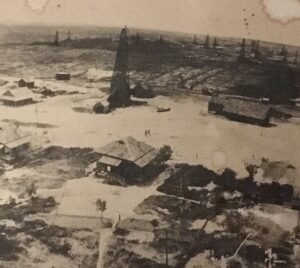
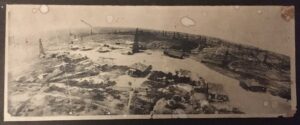
He worked quite a bit in Coalinga and also Huntington Beach. He had this in his old pictures. I would like to identify it if possible. The only clue that I see is the word Westlake at the bottom of the picture. What little research I could do led me to believe it might be the Los Angeles area?
I would appreciate any help you can provide. (Post comments below.) — B.
Cities Service Bowling Teams and Oil History
I was wondering if there are any records or pictures of bowling leagues and teams for Cities Service in the late 1950s and early 1960s in Houston, Texas, or Lafayette, Louisiana. I would appreciate any information. My dad was on the team. (Post comments below.) — Lisa
Oilfield Storage Tanks
My family has a farm in western PA and once had a small oil pump on the land. I’m trying to learn how the oil was transported from the pump. I know a man came in a truck more than once each week to turn on the pump and collect oil, but I don’t know if there was a holding tank, how he filled his truck, etc. (My mother was a child there in the ’40s and simply can’t recall how it all worked.) Can anyone point me at a resource that would explain such things? I’m working on a children’s book and need to get it right. Thank you. — (Post comments below.) Lauren
Author seeking Historical Oil Prices
Can anyone at AOGHS tell me what the ballpark figures are in the amount of petroleum products so far extracted, versus how much oil-gas is left in the world? Also: the price per barrel of oil every decade from the 1920s to the present. And the resulting price per gallon during the decades from 1920 to the present year? I have almost completed my book about an independent oilman. Please post reply in comments section below or email bawells@aoghs.org.
— John
Painting related to Standard Oil History
I am researching an old oil painting on canvas that appears to be a gift to Esso Standard Corp. Subject: Iris flowers. There is some damage due to age but it is quite interesting. The painting appears to be signed in upper right corner: Hirase?

On the back, along each side, is Japanese writing that I think translates to “Congratulations Esso Standard” and “the Tucker Corporation” or “the Naniwa Tanker Corporation.” Date unknown, possibly 1920s.
I am not an expert in art nor Japanese culture, so some of my translation could be incorrect. I was hoping you or your colleagues might shed some light on this painting.
— Nancy
Please post oil history forum replies in the comments section below or email bawells@aoghs.org.
Early Gasoline Pumps
For the smaller, early stations from around 1930, was the gas stored in a tank in the ground below the dispenser/pump? — Chris Please ad comment below.
Oilfield Jet Engines
I was wondering about a neat aspect of oil and natural gas production; namely, the use of old, retired aircraft jet engines to produce power at remote oil company locations, and to pump gas/liquid over long distances in pipelines. Does anyone happen to recall what year a jet engine was first employed by the industry for this purpose? Nowadays, there is an interesting company called S&S Turbine Services Ltd. (based at Fort St. John, British Columbia) that handles all aspects of maintenance, overhaul and rebuilding for these industrial jets.
— Lindsey
Please post reply in comments section below or email bawells@aoghs.org.
Natalie O. Warren Propane Tanker Memorabilia
My father spent his working life with Lone Star Gas, he is gone many years now I am getting on. Going through a few of his things. A little book made up that he received when he and my mother attended the commissioning of the Natalie O. Warren Propane Tanker. I am wondering if it is of any value to anyone. Or any museum.
— Bill
Please post reply in comments section below or email bawells@aoghs.org.
Elephant Advertising of Skelly Oil
My grandfather owned a Skelly service station in Sidney, Iowa in the 1930s and 1940s. I have a photo of him with an elephant in front of the station. I recall reading somewhere that Skelly had this elephant touring from station to station as an advertising stunt. Does anyone have any more history on the live elephant tour for Skelly Oil? I’d love to find out more. — Jeff Please ad comment below.
Tree Stumps as Oilfield Tools
I am a graduate student at the Architectural Association in London working on a project that looks at the potential use of tree stumps as structural foundations. While researching I found the following extract from an article on The Petroleum Industry of the Gulf Coast Salt Dome Area in the early 20th century: “In the dense tangle of the cypress swamp, the crew have to carry their equipment and cut a trail as they go. Often they use a tree stump as solid support on which they set up their instruments.” I have been struggling to find any photos or drawings of how this system would have worked (i.e. how the instruments were supported by the stump) I was wondering if you might know where I could find any more information?
— Andrew
Post oil history forum replies in the comments section below or email bawells@aoghs.org.
Texas Road Oil Patch Trip
“Hi, next year we are planning a road trip in the United States that starts in Dallas, Texas, heading to Amarillo and then on to New Mexico and beyond. We will be following the U.S. 287 most of the way to Amarillo and would like to know of any oil fields we could visit or simply photograph on the way. From Amarillo we plan to take the U.S. 87. We realise this is quite a trivial request but you help would be much appreciated.”
— Kristin
Please post oil history forum replies in the comments section below or email bawells@aoghs.org.
Antique Calculator: The Slide Rule
Here’s a question about those analog calculating devices that became obsolete when electronic pocket calculators arrived in the early 1970s…Learn more in Refinery Supply Company Slide Rule.
Please post oil history forum replies in the comments section below or email bawells@aoghs.org.
—————
The American Oil & Gas Historical Society (AOGHS) preserves U.S. petroleum history. Please become an AOGHS annual supporter and help maintain this energy education website and expand historical research. Contact the society at bawells@aoghs.org if you would like a research question added. © 2025 Bruce A. Wells.
.
by Bruce Wells | Jun 15, 2026 | Petroleum Art
The 1950s advertising character that became a prestigious petroleum industry award.
Joe Roughneck’s rugged, square-jawed face first appeared in the 1950s as print advertisements for a tubular goods manufacturer. His helmeted visage in bronze became a petroleum industry award annually handed out to wildcatters “whose accomplishments and character represent the highest ideals of the oil and natural gas industry.”
Presented from 1955 to 2019 during conventions of a national oil and gas industry trade association, Joe’s Chief Roughneck statue symbolized the “leadership and integrity of individuals who have made a lasting impression on the energy industry.”
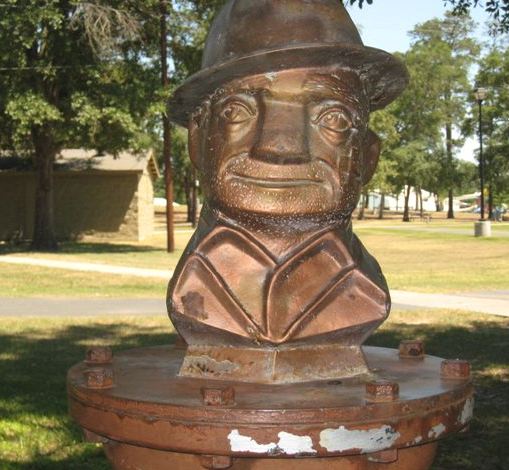
Torg Thompson, who drew the original Joe Roughneck bandaged-faced character in the 1950s, sculpted him for an annual industry award — and for display in Texas parks.
The award’s bronze bust began with Texas artist Torg Thompson (1905-1998) and the Lone Star Steel Company, later U.S. Steel Tubular Products, a subsidiary of United States Steel. Thompson’s busts, sculpted from his character created for newspaper and magazine advertisements, also would be dedicated in Texas parks.
“Lone Star Steel doffs its tin hat to Joe Roughneck as a salute to those pioneers of yesterday, today and tomorrow, whose perseverance and courage have made, and will continue to make our nation the world’s leader in petroleum,” declared a 1959 Lone Star Steel magazine ad.
Recipients of the pipe manufacturer’s “Chief Roughneck Award” — first presented to independent producer R.E. (Bob) Smith in 1955 — included Harold Hamm, George Mitchell, Dean McGee, H.L Hunt, and W.A. “Monty” Moncrief (see Chief Roughneck Award Winners to view all recipients since 1955).
The advertising character’s battered face became popular in America’s oilfields, prompting Lone Star Steel executives to proclaim, “Joe doesn’t belong to us anymore. He’s as universal as a rotary rig.”
The character began its career on the scratch pad of Thompson, an artist known for the 124-by-20-foot mural, “Miracle at Pentecost,” at the Biblical Arts Center in Dallas (destroyed by fire in 2005). For Lone Star Steel Company ads, Thompson portrayed Joe with the countenance of a man who had spent long hours working in the oilfield.
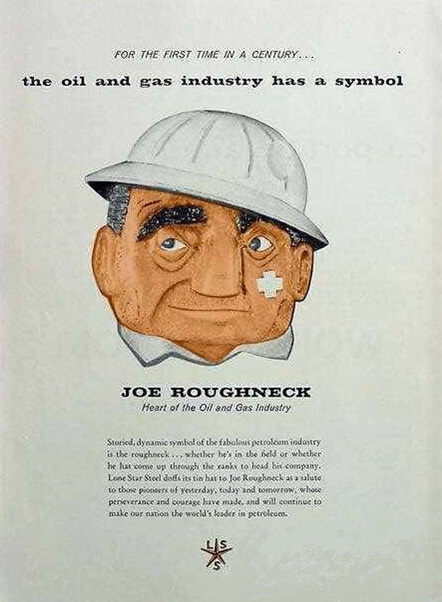
In 1959, Lone Star Steel Company, an oilfield tubular goods manufacturer, produced this magazine advertisement featuring Joe Roughneck, the “Heart of the Oil and Gas Industry.”
“Joe’s jaw was squarely set to denote determination, his nose flattened as a souvenir of the rollicking life of a boom town. His eyes indicate the kindness and generosity of his breed. His mouth wore the trace of a smile, but there was a quizzical expression of one who had to see to believe,” notes a small museum in the heart of the East Texas oilfield.
“When the completed picture came into being on canvas, there was no doubt Joe was the heart of the oil patch,” the Depot Museum in Henderson adds.
Joe has been saluted by two governors of Texas, named “Man of the Month” by a popular magazine, and has been the subject of countless newspaper articles, along with many radio and television commentaries. Joe also became the mascot of the White Oak Roughnecks, a high school football team of another East Texas oilfield community.
“Joe’s likeness has adorned the world’s largest golf trophy and once decorated an international oil exposition,” the Depot Museum concludes.
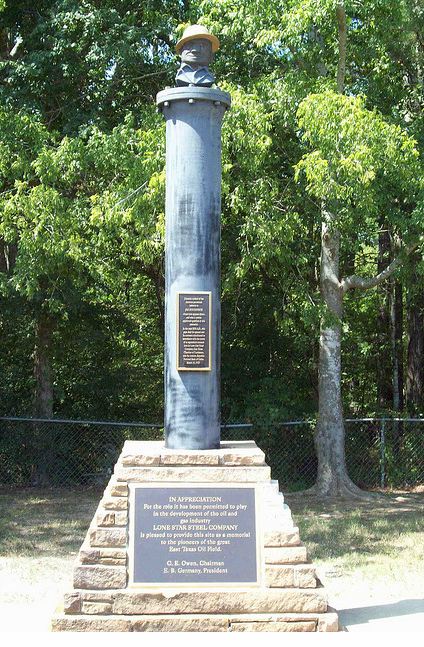
At the Gaston Museum in Joinerville, Texas, a Joe Roughneck memorial was dedicated “to the pioneers of the Great East Texas oilfield.” The 1930 discovery well is just 1.75 miles away, producing for the Hunt Oil Company.
Joe still serves as a symbol for petroleum clubs that “recognize the pioneers of yesterday and today whose perseverance and courage made our nation the world’s leader in petroleum.”
Presented at the annual meeting of the Independent Petroleum Association of America, Joe’s head now sits atop oilfield monuments in Texas: Joinerville (1957), Conroe (1957), Boonsville (1970), and Kilgore (1986) — where he greets visitors to the East Texas Oil Museum.
Joe Roughneck in Joinerville
This, the first Joe Roughneck monument, was erected in Pioneer Park at the Gaston Museum and Community Outreach in Joinerville, seven miles west of Henderson. The monument includes a time capsule sealed at the dedication on March 17, 1957, and to be opened in 2056. The capsule reportedly will tell future generations about the East Texas oilfield discovered by Columbus Marion “Dad” Joiner in early October 1930.

Joiner’s Daisy Bradford No. 3, discovery well for this prolific field, is nearby — less than two miles from the Gaston Museum. Production from the East Texas field exceeded five billion barrels of oil by 1993. Many modern waterflooding technologies were shaped by the giant field, and hundreds of marginal wells continue to produce there.
Joe Roughneck in Conroe
In Conroe, about 40 miles north of Houston, Joe Roughneck rests on a monument in Candy Cane Park at the Heritage Museum of Montgomery County. He commemorates the discovery of a 19,000-acre field by George Strake in 1931 – “and others who envisioned an empire, dared to seek it, and discovered the Conroe oilfield.”
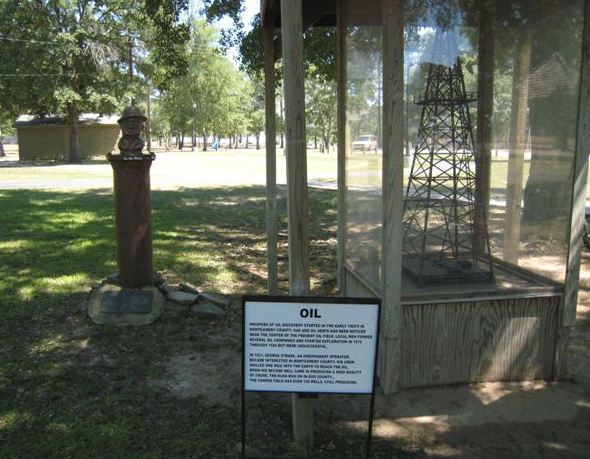
The Joe Roughneck monument in Conroe, Texas, is next to a miniature derrick protected by Plexiglas and details about Montgomery County, where “whispers of oil discovery started in the early 1900s.”
The monument recognizes the completion of Strake’s Conroe oilfield-discovery well in June of 1932. The “Conroe Courier” headlines proclaimed, “Strake Well Comes In. Good for 10,000 Barrels Per Day.”
The Conroe oilfield led to major technology developments after Strake found the oil sands to be natural gas-charged, shallow – and dangerously unstable. By 1993, the 17,000-acre Conroe oilfield will have produced more than 717 million barrels of oil (see Technology and the Conroe Crater).
Joe Roughneck in Boonsville
Governor Preston Smith dedicated Boonsville’s Joe Roughneck on October 26, 1970 — the 20th anniversary of the Boonsville natural gas field discovery.
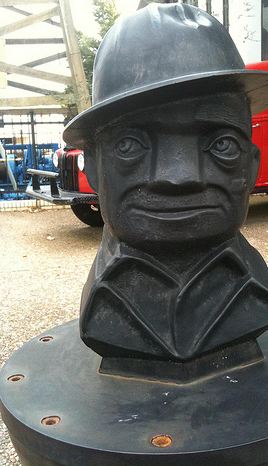
Joe Roughneck at the East Texas Oil Museum, which opened in 1980 in Kilgore.
The field’s 1945 discovery well, Lone Star Gas Company’s B.P. Vaught No. 1, produced 2.5 billion cubic feet of natural gas in its first 20 years. By 2001, the field — located in the Fort Worth Basin in north-central Texas — had produced 3.1 trillion cubic feet of gas and 17 million barrels of condensate from 3,500 wells in the field.
Boonsville’s Joe Roughneck statue can be found on Farm to Market Road 920 about 13 miles southwest of Bridgeport in southwestern Wise County.
Joe Roughneck in Kilgore
Kilgore hosts a Joe Roughneck erected on March 2, 1986, in a downtown plaza, celebrating the “boomers” who settled in Kilgore during the 1930s. When Kilgore’s monument committee first approached Lone Star Steel, it learned the Joe Roughneck cast had been destroyed in a fire. Lone Star Steel allowed use of the original mold to produce the monument.
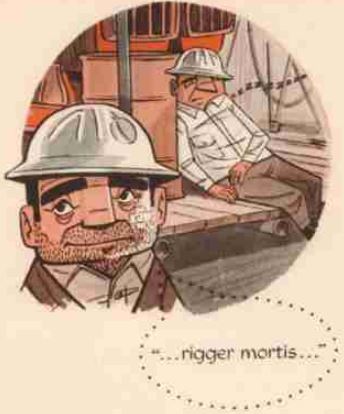
Detail from a 1957 Joe Roughneck advertisement of Lone Star Steel.
During the East Texas boom, Kilgore had the densest number of wells in the world. Today’s World’s Richest Acre Park displays a pumping unit and the city has restored dozens of derricks from Kilgore’s boomtown birth – a story told at the East Texas Oil Museum.
As the Depot Museum’s exhibit concluded, Joe Roughneck has remained: “Rough and tough, sage and salty, capable and reliable, shrewd but honest. Joe has throughout his lifetime symbolized the determination of the American petroleum industry, reaffirming the indomitable spirit of Chief Roughnecks the world over, past, present and future.”

Joe Roughneck’s iconic advertisement creation should also credit former Lone Star Steel Vice President L.D. “Red” Webster, according to Michael Webb, spouse of Webster’s daughter Rebel Webster (1959-2021). Webb emailed the American Oil & Gas Historical Society and explained he was categorizing unique artifacts and other historic items related to the career of his late wife’s father.
In addition to the statues given to the Chief Roughneck Award winners since 1955, Webb reports Joe Roughneck is preserved by artifacts that include “pins, awards, tchotchkes, papers, plaques, photos of Red, and an original plaster bust of Joe Roughneck.”
In Washington, D.C., a 12-inch Joe Roughneck bronze bust is preserved in the collection of the Smithsonian American Art Museum Institution.
_______________________
Recommended Reading: A Wildcatter’s Trek: Love, Money and Oil (2016 by 1995 Chief Roughneck Gene Ames Jr.); Trek of the Oil Finders: A History of Exploration for Petroleum (1975). Your Amazon purchase benefits the American Oil & Gas Historical Society. As an Amazon Associate, AOGHS earns a commission from qualifying purchases.
_______________________
The American Oil & Gas Historical Society (AOGHS) preserves U.S. petroleum history. Support this energy education website, subscribe to our monthly email newsletter, and help expand historical research. Contact bawells@aoghs.org. Copyright © 2026 Bruce A. Wells.
Citation Information: Article Title: “Meet Joe Roughneck.” Authors: B.A. Wells and K.L. Wells, Website Name: American Oil & Gas Historical Society. URL: https://aoghs.org/petroleum-art/joe-roughneck. Last Updated: June 22, 2026. Original Published Date: March 11, 2005.
by Bruce Wells | Mar 9, 2026 | Petroleum Pioneers
Oklahoma journalist who became top voice of independent producers in Washington, D.C.
Lloyd N. Unsell (1923-2007), a founding member of the American Oil & Gas Historical Society, was the long-time president of the Independent Petroleum Association of America in Washington, D.C. In 1986, he received the industry’s prestigious Chief Roughneck Award in 1986 — the only person unaffiliated with an oil company to do so since the award began in 1955.
In December 2004, Unsell gave AOGHS exclusive permission to publish the draft forward and early chapters of his then in-progress memoirs, Recollections of Lloyd N. Unsell. His writing in the forward alone reveals a skilled Oklahoma journalist’s inside view of the tumultuous politics of the industry for half a century.
Unsell., who grew up in Seminole, Oklahoma, duri8ng the Greater Seminole Oil Boom, begins with describing his youthful introduction to the petroleum industry, his early newspaper reporting experiences, meeting (and marrying) the love of his life, Nettie, and his Army service during World War II.
Chapter One: “Oil on My Boots”
It is not true that I left journalism in 1948 to join the staff of the Independent Petroleum Association of America (IPAA) because my wife wanted me to have a day job, which was one of her favorite stories. I took the job because I had done most of my growing up in Seminole, Oklahoma, one of the last and wildest of the oil boom towns in America, and this was where I acquired an appreciation of the oil industry and an affection for its people. Famed Oklahoman Will Rogers said he never met a man he didn’t like. I never met an oilman I didn’t like, and oilmen and women that I knew came in many types and sizes, and found their niche in the business in a wide variety of roles. I also cultivated my interest in journalism, my first choice career, among the colorful characters who worked on The Seminole Producer, the local daily newspaper spudded by James T. Jackson not long after the Greater Seminole oil discovery.
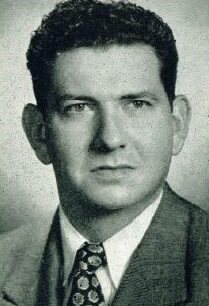
Lloyd Unsell in 1948, soon after joined the staff of Independent Monthly, magazine of the Independent Petroleum Association of America, established in 1929.
Seminole roared to life on July 16, 1926, when a rank wildcatter named Robert F. (Bob) Garland drilled an exploratory well about six miles east of town that flowed 6,000 barrels a day from the Wilcox formation. He had a silent partner named Edward H. Moore, who would later become the first-ever Republican elected to the Senate from Oklahoma. Garland-Moore’s Fixico No. l ushered in the madcap development of the Greater Seminole Field that in the very next year, 1927, accounted for five of every seven barrels of the oil produced in the state of Oklahoma.
Oklahoma had seen oil booms before, at Cushing, Drumright, Glenn Pool in Tulsa County, Earlsoro, Healdton, and others, but none of these measured up to Seminole, not in the quantity of oil found, nor in the instant population growth from sleepy village to 40,000 strangers representing the best and the worst of humanity, all there to somehow get their slice of the pie. The con artists, gamblers, small time crooks, pimps and prostitutes soon established their own sub-culture in a strip of tents and lean-to emporiums called “Bishop’s Alley,” so-named for a local attorney who had owned the land. It was routine for drillers and roughnecks and some even in the oil management echelons, seeking their kicks in Bishop’s Alley, to wind up in a ditch somewhere, doped, and stripped of their possessions. Some of oil’s industrial leaders cut their first swath in Seminole, including two then-future Presidents of the Independent Petroleum Association of America, William M. Vaughey and Harold Decker.
The integrated oil companies, in order to keep competent help around, all established large company “camps” where they put up acceptable housing, built offices and maintenance shops for their trucks and equipment, installed multiple racks for their casing, tubing and drill pipe inventories, and sturdy warehouses where they could lock down all the fittings, valves and wellhead equipment that were frequent targets of oilfield thieves. Most of these compounds were encircled by high chain link fences These well-planned mini-communities were put in place with incredible swiftness by companies such as Gulf, Phillips, Amerada, Pure Oil, Cities Service, Sinclair, the old Standard Oil Co. (N. J.) production affiliate, Carter Oil Co., and others.
I discovered Seminole in the summer of 1933, when my parents moved there from Henryetta, my birthplace, a town unblessed by oil. Henryetta had a half dozen coal mines, a glass plant operated by Pittsburgh Plate, and an Eagle-Picher lead and zinc smelter. All of these enterprises had quickly closed down after the onset of the depression. Jobs were not to be had, and it was a given that in a state afflicted simultaneously by the Great Depression and the Great Dust Bowl, Henryetta had become one of the poorest of the poor towns. An older sister, Cleo, had married a Henryetta native named Herbert G. (Hub) Hazelrigg, who had joined his brother Sid in the oilfield trucking business in Seminole, and she persuaded my father to come there and open a small restaurant amidst the oil and truck camps east of the town.
From the beginning, Seminole was a captivating place to a not quite 12-year-old boy. Most of all, I was fascinated by the oilfield trucking business. Sidney Ross Hazelrigg, one of the most personable men I have ever known, the elder of the two Hazelrigg boys from Henryetta, had formed with O. L. Harvey the H & H Trucking Company, and together these two men literally invented the mechanical means of moving drilling rigs and equipment that elevated oilfield hauling out of the mule-team stage. After some four years together, Hazelrigg and Harvey parted amiably over differences never defined, and became competitors, but Sid Hazelrigg got the oil trucking camp that H & H had established on a 20-acre parcel between Highway 270 and the Frisco railroad, not quite a mile east of Seminole proper.
H & H had emulated the big oil companies. To keep competent drivers, welders and truck mechanics they built or moved in about 15 small “shotgun” houses which bordered the south and west perimeters of the truck camp, all occupied by the families of their best hands for very nominal rent. They bought trucks, mostly GM models, and Whites, that had nothing but the cabs, frames and the wheels underneath. The vehicles with short wheel bases were converted to haul pipe, and the long wheel-based Whites were equipped with heavy duty winches mounted just behind the cabs, under a welded steel structure called a “headache post,” then a long flat bed with a rolling tailgate. These trucks were used to move draw-works for drilling rigs, and the familiar heavy steel “dog houses” in which small tools and fittings were locked down at every drilling site.
In my first few years at Seminole, the Hazelrigg truck camp was my favorite place on this earth. It was a beehive of activity in which welders, mechanics, men adept at shaping thick oak timbers into fifth wheel and trailer bolsters for pipe hauling, and heavy duty oak flatbeds, all constantly innovating to do things better, make winches and draw lines safer, turning out an expanding fleet of trucks that looked good in addition to being equipped for the heaviest duty an often mud-covered oilfield could demand of any vehicle. While the truck yard remained my favorite place, at age 13 I was attracted to the idea of making a little pocket change, so became a carrier for the local newspaper.
After awhile, I began hanging around the newspaper more and more, and came to know all the teletype operators, the printers who ran the old flatbed presses, and the reporters and ad salesman for a small town daily newspaper that had prospered from its beginning. When James T. Jackson decided to start a newspaper in Seminole in 1927, he quickly decided that “good news” in the oilfield was a producing well, bad news a dry hole, so what better name for an oil town newspaper than The Seminole Producer. James T. hadn’t come to town to drill a dry hole, and he didn’t. He was an easy-going, likable man, and a natural promoter who was always thinking of ways to enhance the Producer’s fortunes. In 1936, my 14th year, he decided that Seminole should have a real “blowout” to commemorate the Tenth Anniversary of its discovery well. Among other things, the whole Producer staff set about the task of publishing an oil anniversary edition that had to be printed in eight-page sections, over time. When delivered to the community on July 16, the newspaper was more than 200 pages, comprised mostly of all the true and mythical tales of the Seminole oil patch, and perhaps 150 pages of advertising.
James T. Jackson had given me the “journalism bug” during my service as a carrier of the newspaper, but the Tenth Anniversary edition of his newspaper coincidentally provided me an opportunity to “get published.” I was hanging out at the Hazelrigg truck camp on a Saturday in June, after school was out, when one of Jackson’s ad salesmen came to sell Sid Hazelrigg an ad in the 10th anniversary edition. At that time, two of the dance crazes of the day were “The Big Apple,” and a zany thing called “Truckin’” in which one sort of shuffled along waving the index finger of the right hand in the air. When the Producer ad salesman braced Sid Hazelrigg, the truck operator was putting forth his best resistance. “I have more business than I can handle, I don’t have anything to advertise to your readers, and I don’t know what I’d say in a damned ad anyway,” was the sum of his argument.
Somehow inspired in my age 14 mind, I piped up and said, “I know what you could say.”
Sid looked at me and said, “You stay out of this kid.”
The ad salesman had argued that this was an industry “salute” edition of the newspaper in which all successful oil-connected businesses ought to be represented. Perhaps seeing a chance to press his case, he said “Let’s see what the kid has in mind. What are you talking about, boy?”
I looked sheepishly at Sid, and being a nice guy, he lifted both hands palms up, waved them up and down a time or two, and said, “Okay, what would you say?”
I shrugged my shoulders and said, “Well, I’d say ‘We can’t do The Big Apple, but boy can we truck!’”
The owner of Hazelrigg trucks broke into a wide grin, and said, “Hell, that ain’t bad.” He bought a full-page ad with those eleven words in large type in the center of the page and the company name and phone number at the bottom of the page. I had the notion that somebody should give me a small commission, but that never happened.
Aside from publishing an immensely fat edition of his newspaper, the rest of James T. Jackson’s Tenth Anniversary “blowout” consisted of a 10-mile parade featuring oil company floats, public speeches by oil
industry leaders and politicians, and an “Oilman’s Blast,” in other words a stag affair on the local baseball field, Red Bird Park, south of the town. The park was encircled by an eight-foot wood fence, and by the time the big party got well under way, I (and a dozen other boys of like-age) had found a knothole through which to observe the goings on. Alcohol flowed freely in that part of dry Oklahoma, and after the crowd estimated at 12,000 had gotten itself “properly oiled,” the entertainment commenced, consisting of perhaps a dozen female wrestlers imported from Kansas City. The object of these women, paired off two at a time in the makeshift ring complete with referee, was to reduce each other to stark nakedness as quickly as possible.
One of the up-and-coming young lawyers in Seminole was Richard Bell. He had announced his candidacy for the state legislature, and was considered a shoo-in for the seat in the 1936 fall elections. But James T. Jackson persuaded Dick Bell to be one of the “referees,” and the naive young lawyer abandoned his judgment and took on the chore. In his particular “match,” the two women not only quickly disrobed each other, but then turned on Candidate Bell and removed everything he was wearing except his undershorts. By 1936, Seminole had gotten its raucous years behind it, most of the major church denominations had built places of worship, and the town had progressed from its “Bishop’s Alley” phase into a “Bible Belt” sort of mentality. It took no time for the whole town, and especially the church women, to become aware of the debauchery in which Dick Bell had participated in Red Bird Ball Park, and that was enough to end his political career. Years later, during my newspaper days, Bell and I became friends, but he never again ran for public office. And I don’t think I ever told him that I had watched his attempt at “refereeing” a female wrestling match through a knothole in the fence.
The Seminole Producer, for its first few years, had a very large cadre of reporters committed to putting as much “local color” as possible in each edition. All these reporters were needed because the newspaper had no wire service supplying statewide and national news, so a “stringer” was hired to cover the doings of Seminole county representatives in the state legislature in Oklahoma City, and a reporter was assigned to the Court House at Wewoka, the county seat eleven miles to the east.
The staff worked diligently on developing local “color,” and one example of this occurred during the Holiday Season each year when the paper would publish on page one a huge table of illegal liquor prices, along with the available brands and phone numbers of the bootleggers, most of whom ran taxicab companies for the primary purpose of delivering booze. This was an embarrassment to local police and the county sheriff, which pleaded that they had bigger fish to fry than chasing down every half-pint liquor sale. There were other reasons, of course: Seminole’s kingpin bootleggers were known for their generosity to the local constabulary. But the police chief and sheriff were elected every two years, and nobody knew better than they that if illegal liquor was denied to a town as thirsty as Seminole, they could forget about re-election.
As the decade of the 1930’s was coming to an end, times were improving nominally, and opportunity knocked for many of James T. Jackson’s well-trained reporters. The turnover was chronic by 1940, and though the newspaper had long since acquired the United Press’s wire service, vacancies were frequent. When Danny Harbour, a popular reporter whose beat included high school athletic contests, joined the Kiplinger organization and left for the Nation’s Capital, this left the paper without a sports reporter. My high school journalism teacher, Orville Dee, mentioned this out loud – so I made a deal to report high school football games, providing a box score along with the copy, until Harbour’s replacement could be found. I never got a “byline” for any of this, and felt cheated, but when I finished high school in the spring of 1941, James T. Jackson offered to take me on as a “trainee” reporter at the lofty pay of $12 a week.
I had plans to go to the University of Oklahoma, but knew I had to earn and save some money in order to accomplish this, and when I heard of an opening at the Hinderliter Tool Co., in Tulsa, paying 60 cents an hour, I couldn’t believe my good fortune when they hired me. Saying no to a reporting job, however low paying, was tough, but Hinderliter Tool, whose founder, the legendary Frank Hinderliter, had more than 80 patents for oil tools, offered the best financial opportunity – and put me in touch with another endeavor that was closely related to the oil business. I would hustle steel billets from a vast open air lot stocked with “stalks” of unfinished steel weighing from a few hundred pounds to as much as a ton. Through a system of overhead cranes, it was my job to deliver on order the billets needed by blacksmiths in Hinderliter’s huge forge shop.
This enormous shop, 200 feet long and 80 feet wide, had four blacksmith crews at work in 1941,primarily forging oil tools on order and passing them on to the machinists to be threaded and finished. The lead blacksmith was Walter Prater, a blocky little man with a muscular torso, who wore thick rimmed glasses, had an ever-present cigar in the corner of his mouth, and went about his work with the care and precision of an artist. His crew included Tom Miller, the “heater” who watched a steel billet in the mouth of a gas-fired blast furnace and could tell instinctively when it was ready to shape. Walt Prater would grasp the hot billet with a huge pair of tongs 12 feet long, suspended from an overhead crane at the clamp which held the billet. A steel handle with an oval center was driven by sledge onto the long handles of the tongs, and locked in place with a steel wedge. The blacksmith would then nod to his chain man who would lift the whole thing enough that Prater could swing it out of the furnace and onto the flat shaping surface under a 3600 pound air hammer. With a nod of the head, Prater orchestrated the shaping of the hot steel, letting the hammer driver know with the variation of his gestures, how hard – or how gently – he wanted the hot steel pounded. A ballerina on the fly at the Bolshoi was no more fascinating to watch than Walt Prater at work.
Outside the main gate at its huge plant on North Peoria in Tulsa, Hinderliter had a tool repair shop, equipped with a small (1200 pound) hammer and a coke fire for heating cable bits to be sharpened. An old blacksmith named Harris did this work, and during lunch breaks he would give me instruction on the operation of a blacksmithing hammer, which was operated by two long handles, one to control the air pressure, the other to control the downward stroke of the hammer. Harris had a dollar watch, and could remove the lens, lay it on the hammer block, and close the lens with the 1200 pound hammer. He would stand a Prince Albert tobacco can on the block, its lid open at a 30-degree angle, and close it with the hammer. “A good hammer driver can smash things to hell and gone, or hit whatever is there with a feather touch,” he would say. Simply for the asking, he gave me instruction on the hammer and taught me to finesse the controls to obtain the desired stroke, and on many days I would go to this little repair shop and practice on the air hammer after a very quick lunch from a brown paper bag.
When the Japanese attacked Pearl Harbor, I was in peak physical condition, and knew I could kiss college goodbye until after the war. On Saturday, December 20, 1941, the blacksmith Walt Prater called me at the home of Tom Miller’s cousin where I rented a room. “I understand that you’ve been practicing on the
blackie’s hammer out in the repair shop and have gotten pretty good at it. I need you to run my hammer beginning Monday.”
Walt Prater played polo for relaxation. He boarded four polo ponies at the Tulsa fairgrounds, and several times I had gone with him in the evening to help feed them. I told him I was not good enough for his crew, so he said he would pick me up, we would go feed his horses, then stop for a beer and talk about it. When we finally entered the neighborhood bar not far from his home in East Tulsa, and climbed onto a bar stool, he said the magic words, “I’ll pay you 90 cents an hour.” Such an income was unheard of for a new high school graduate in 1941.
Then he told me why I had to help him. All the hammer drivers at Hinderliter Tool Co. had quit en masse on Friday evening and were headed for the Drop Forge Corp. in Chicago, a company that had a new contract to make cannon barrels for the army. Their Hinderliter pay would be at least doubled, and there were other benefits, including insurance and retirement benefits.
I told Walt Prater I planned to quit work and enlist in the army after the Christmas Holidays… He said, “Well, we have a rush order for a whipstock. A guy has some tools lost in a well in Pontotoc county and is shut down until we can deliver a whipstock.” I agreed to come in Monday and try to operate the hammer for him, but warned him that he would have to be extremely patient with me. The company had promised delivery on the whipstock the following Friday. With luck and the blacksmith’s forbearance, we delivered the whipstock on time. The 90 cents Walt Prater had promised was increased to $1.50, and when he handed me the check on Friday evening, he said, “Don Hinderliter wants you to come by the office. He wants to see you.” The son of the company founder, Donald R. Hinderliter was the general manager of the pioneer oil tool company. When I reported to him, he asked me to take a seat, then grinned across his desk, and said, “Walt Prater tells me you saved us this week, and I wanted to thank you for stepping into the breech. Now, I have some news for you.” He slid a sheaf of papers across the desk. “If you will sign these, we will have a long-term relationship in the making.”
I picked up the papers, and noticed right away that they had come from the Federal Government. “What are these?” I asked.
“Well,” Hinderliter said, “as of today we have a contract to make 75 millimeter gun barrels. This is critical work essential to the war effort. Your signature on these forms will get you a deferral from military service to help us do this essential work.”
“I can’t do it, Mr. Hinderliter,” I said.
“For Heaven’s sake, why not,” he gave me a puzzled look.
I told him the truth. Here I was six feet, one-inch tall, just 19, and the picture of health. Every time I walked down a street, women in their 40’s and 50’s who I felt had sons in the military, would eye me as if wondering why I was not in uniform. More than once, I had been bluntly asked why I was not in the armed services, and my limp explanation was that I had not received a draft notice, which was true. I told Hinderliter that I felt compelled to enlist, and would sign no deferral papers, but would stay until he found a hammer man, but no longer than three months. “I could get a draft notice next week,” I told him.
He argued that working on the fulfillment of the gun barrel contract would be more important to the war effort than military service, but even if true, that did nothing for my personal feelings in the matter. I repeated that I would stay until he could find a hammer driver, or until I was drafted, whichever came first, but I did remember to thank him for the pay increase.
On March 30, 1942, I gave up the job at Hinderliter to decide what service branch would be most to my liking, so I returned home to Seminole to spend some time with my parents before enlisting. But something happened on the way to the recruiting office, and her name was Nettie Marie Rogers. On Saturday, April 10, I walked into the NK Café, Seminole’s better appointed restaurant which was tastefully finished in all respects. The NK had about 30 comfortable stools, and on a single stool sat this beautiful young woman. She was reading the Sunday state edition of Oklahoma’s largest newspaper, The Oklahoman, which was printed first and delivered early state wide. It was summery for April, and she had dressed accordingly, and wore a broadbrimmed white hat, with a multi-colored band set off by a simulated bow at the back. She had cascades of auburn hair, shoulder length, and the most beautiful face I had ever seen, tastefully made up.
Though all the other stools were vacant, I summoned my courage and took one next to this lovely young woman. I ordered coffee, and asked her if I could borrow the comics section, then known as “funny papers.” She glanced at me, smiled, and asked if I was unable to afford a newspaper. I took a wad of bills from my pocket, laid them on the counter, and said, “If I’d have bought a newspaper I wouldn’t have had an excuse to start this conversation.” She looked at me and laughed, and I was hooked for life. It was a short walk to her home, and she agreed to permit me to walk her there. Nettie and I were instantly attracted to each other, and in the summer days to follow we were inseparable, spending as much time as possible together. I knew I would one day marry her, and we discussed this many times, our dilemma the same as that facing countless young people at the time – marry now, or after the war. We decided on the latter, an agreement that would later be abandoned.
The summer of ‘42 passed so quickly. What little money I had saved was going fast, and the inevitability of a draft notice was a constant reality. So in late August, I made a trip to Norman, Oklahoma, to explore whether there may be service-connected educational opportunities available. There were none, but I wandered into an army enlistment office and found a Captain Horn who was trying to put together an all-Oklahoma maintenance (ordnance) battalion for the 13th Armored Division. When he found I had just quit work forging gun barrels, he offered me a T-5 rating (corporal). This didn’t sound very exciting, and I explained that I was hoping to find some means of advancing my education. He asked if I had graduated from high school, and I confirmed that I had.
“Tell you what, I will put in your service record that you have an option to be tested for the Army Specialist Training Program (ASTP). If you pass the test, you’ll be sent to a major University and can choose from four courses.” As I recall, the remainder of the conversation went as follows:
“Does that include journalism?”
“Sure does.”
“Where do I sign?”
The maintenance battalion was the first unit formed in the 13th (Black Cat) Armored Division. I reported to Ft. Sill, where most of those recruited for the battalion were already on the ground. In early September 1942, the battalion was completed and comprised a full train load of troops headed for basic training
at Camp Perry, OH. After that, we took a six-day trip to Camp Beale, California, where we again found not a single new unit of the division had been formed, so we took basic training again. In early summer, I called on my company commander and told him I was ready to take the exam for the ASTP. He agreed, and I had enough right answers, so was shipped to the University of Illinois at Champaign-Urbana.
About 600 ASTP applicants were on campus, and turned out to take further aptitude tests and apply for specific courses, my choice being journalism. Three days later I was called to the Armory office by a first lieutenant who informed me that the journalism course was closed to further applicants, and said the testing indicated that I was more suited to the engineering course anyway. The only other option being to return to Camp Beale, I quickly signed, and the next day began a course that the professor in charged call “mathematics renewal.” It was six hours a day, preceded by an hour of calisthenics, a schedule that lasted until September when 225 privates, of whom I was one, having given up my T-5 rating to enter the ASTP program, were assembled at Kalamazoo College, Michigan, to begin the regular engineering course. Ninety-five percent of the group consisted of raw recruits, 18 years of age. I was a “veteran,” 20 years old, so I was quickly nicknamed “pop.”
The program was not superficial. It consisted of 32 hours of academic class work, plus six hours of physical education including rigorous calisthenics. It was not easy for one whose last math course had been high school algebra, four years in the distant past, so “pop” found himself leaning heavily on the bright young recruits to whom advanced geometry, trigonometry and calculus presented no particular problem. We took mechanical drawing, and the required courses of English, world geography and American history. I would later decide that my continuous cramming experience at Kalamazoo College, added to my Army experience generally, equipped me far better to be a journalist than standard university journalism training; I already knew how to spell and how to write.
From the ASTP program, I transferred directly into the Army’s aviation cadet program, but as in much else that it did, the Army over-subscribed its training programs for pilots, bombardiers and navigators. After I had spent four months of comfort in Miami Beach where the Army Air Corp. had taken all the hotels, Air Corps Commander Gen. Henry “Hap” Arnold shipped all aspiring pilots who were not in or beyond primary training back to the ground forces. More than 40,000 would-be pilots, bombardiers and navigators were moved from their posh hotels, loaded into box cars, and packed off to Ft. Bragg, North Carolina, for reassignment, a letdown never to be forgotten.
By this time I was getting a large guilt complex because I had friends who had been in the thick of the fight for many months, a few paying the ultimate sacrifice in the service of the country. There were times when I wondered if I wouldn’t have contributed more to the war effort making gun barrels at Hinderliter Tool. But the greatest event of my life occurred when the love of my life, Nettie Marie Rogers, caught a train to Atlanta, GA., to become my wife in September 1944 – just 31 days before I was shipped off to Europe. My war experience consisted of delivering Sherman tanks to France, from our largest ordnance center, designated U.S. Depot G-25, near Cheltenham, England. The monster rig for tank transportation, called a prime mover, was powered by five Chrysler engines, and had a cab encased with quarter-inch steel armor. The tank rode on a low-boy trailer sporting 32 wheels, 16 front and back. I would drive this rig to Plymouth or Weymouth, back it aboard a landing ship, and drive it off on a pier constructed by army engineers near LeHarve, on the Normandy coast.
Delivering fresh tanks to Patton’s armored force was not especially dangerous, but I was strafed by German fighter pilots on occasion, and I can still recall their bullets pinging off my hard-shelled rig. When the tank was unloaded, I would head back to G-25 to await another delivery, and as an assignee to the post’s motor pool, I was on call evenings to drive GI’s on pass to Cheltenham, Gloucester or Worcester, certainly not the most glamorous war-time job in the European theater. After Germany surrendered, my ordnance unit was sent to Southeast Asia, and I spent five months after the Japanese capitulation cooling my heels in Manila, the Philippines.
Happiness was getting off a train in Tulsa, at the end of December 1945, to be greeted by a wife who I was convinced was the most beautiful girl in Oklahoma. I was never very good Army material, but the experiences the Army gave me were of immense value. I had the feeling that I had matured, had acquired a broad base of knowledge that equipped me for life, and like most hopeful young men back from the war, I was ready and able to take on anything. After Nettie and I spent my mustering out pay for civilian clothing in downtown Tulsa, (I left my Army uniform with its seven service ribbons on a box at the haberdashery, S. G. Holmes & Sons) we “hid out” for a week before anyone in my family or hers knew I was once again a civilian. After all, we had never had a honeymoon.
When I finally called my parents home in Seminole, my sister was visiting there and answered the phone. After excitedly announcing to the household that her kid brother was home, her first statement to me was, “Hey, get yourself down here. James T. Jackson is advertising for a reporter.” I was about to begin my long-postponed journalism career.
End of Chapter One. Read Chapters Two and Three, and visit AOGHS again for more chapter postings in 2019.
_______________________
The American Oil & Gas Historical Society (AOGHS) preserves U.S. petroleum history. Please support this energy education website, subscribe to our monthly email newsletter, and help expand historical research. Contact bawells@aoghs.org. Copyright © 2026 Bruce A. Wells.