by Bruce Wells | Jan 10, 2026 | Petroleum History Almanac
The North Texas church proclaimed richest in America.
In the fall of 1917 near Ranger, Texas, the cotton-farming town of Merriman was inhabited by “ranchers, farmers, and businessmen struggling to survive an economic slump brought on by severe drought and boll weevil-ravaged cotton fields.”
Everything changed in Eastland County when a wildcat well drilled by Texas & Pacific Coal Company struck oil at Ranger, four miles from Merriman. The J.H. McCleskey No. 1 well produced 1,600 barrels of oil a day.
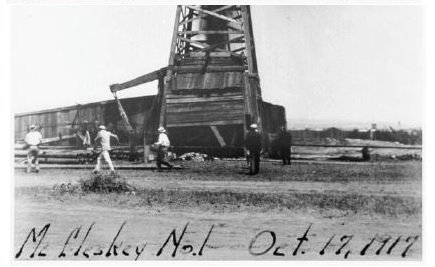
The 1917 headline-making McCleskey No. 1 cable-tool well — called “Roaring Ranger” — brought an oil boom to Eastland County, Texas, about 100 miles west of Dallas.
The rush to acquire leases that followed the oilfield discovery became legendary among drilling booms, even for Texas, home to the legendary 1901 gusher at Spindletop.
WWI Wave of Oil
As drilling continued, the yield of the Ranger oilfield led to peak production reaching more than 14 million barrels in 1919. Production from the “Roaring Ranger” well and its giant North Texas oilfield helped win World War I, with a British War Cabinet member declaring, “The Allied cause floated to victory upon a wave of oil.”
Texas & Pacific Coal Company had taken a great risk by leasing acreage around Ranger, but the risk paid off when lease values soared. The exploration company added “oil” to its name, becoming the Texas Pacific Coal and Oil Company.
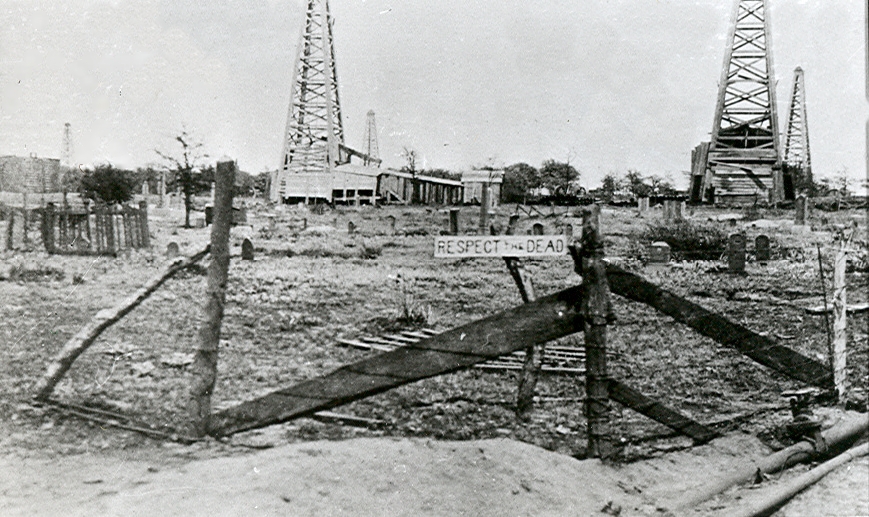
“So as we could not worship God on the former acre of ground, we decided to lease it and honor God with the product,” explained Merriman Baptist Church Deacon J.T. Falls. Photo courtesy Robert Vann, “Lone Star Bonanza, the Ranger Oil Boom of 1917-1923.”
The price of the oil company stock jumped from $30 a share to $1,250 a share as a host of landmen “scanned the landscape to discover any fractions in these holdings. A little school and church, before too small to be seen, now looked like a skyscraper.”
Warren Wagner, driller of the McCleskey discovery well, leased the local school lot and in August 1918 completed a well producing 2,500 barrels of oil a day. Leasing at Merriman Baptist Church proved to be a challenge.

In February, Deacon J.T. Falls complained that drilling new wells “ran us out, as all of the land around our acre was leased, producing wells being brought in so near the house we were compelled to abandon the church because of the gas fumes and noisy machinery.”
Falls added that, “As we could not worship God on the former acre of ground, we decided to lease it and honor God with the product.”
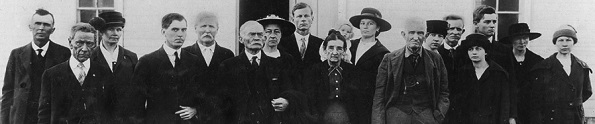
Deacon J.T. Falls (second from left) was not amused when the Associated Press reported in 1919 that his church had refused a million dollars for the lease of the cemetery.
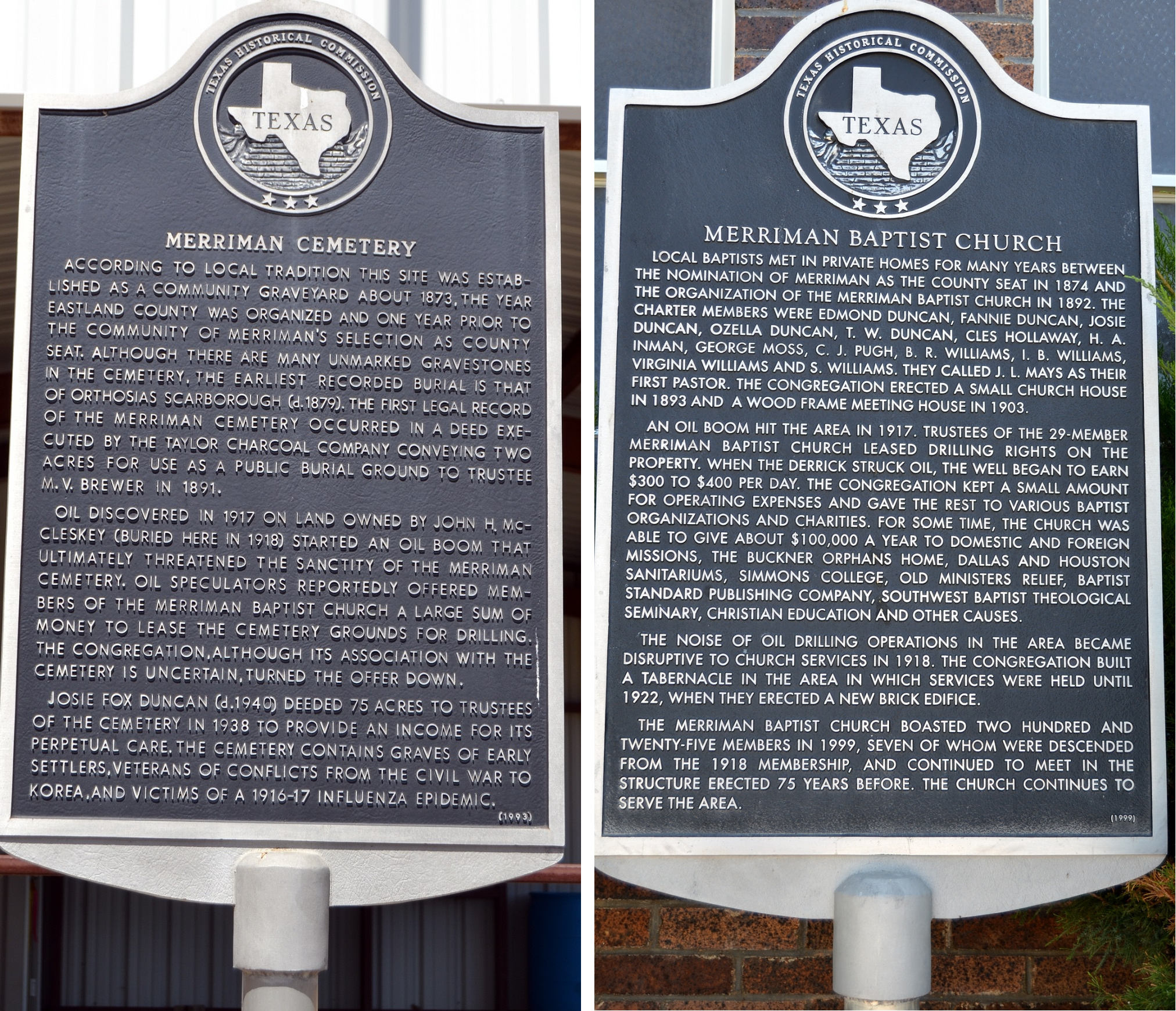
A Texas Historical Commission marker erected in 1999 described when the well on the church’s lease began producing oil, earning the congregation a royalty of between $300 and $400 a day. Merriman Baptist Church “kept a small amount for operating expenses and gave the rest to various Baptist organizations and charities.”
However, drilling in the church graveyard was a different matter. As oil production continued to soar in North Texas, the congregants of Merriman Baptist Church initially resisted one drilling site. As a January 18, 1919, article in the New York Times noted in its headline, “CHURCH MADE RICH BY OIL; Refuses $1,000,000 for Right to Develop Wells in Graveyard.”
Respecting the Dead
At Merriman’s church cemetery, a less seen historical marker erected in 1993 explains the drilling boom’s fierce competition to find property without a well already on it: “Oil speculators reportedly offered members of the Merriman Baptist Church a large sum of money to lease the cemetery grounds for drilling.”
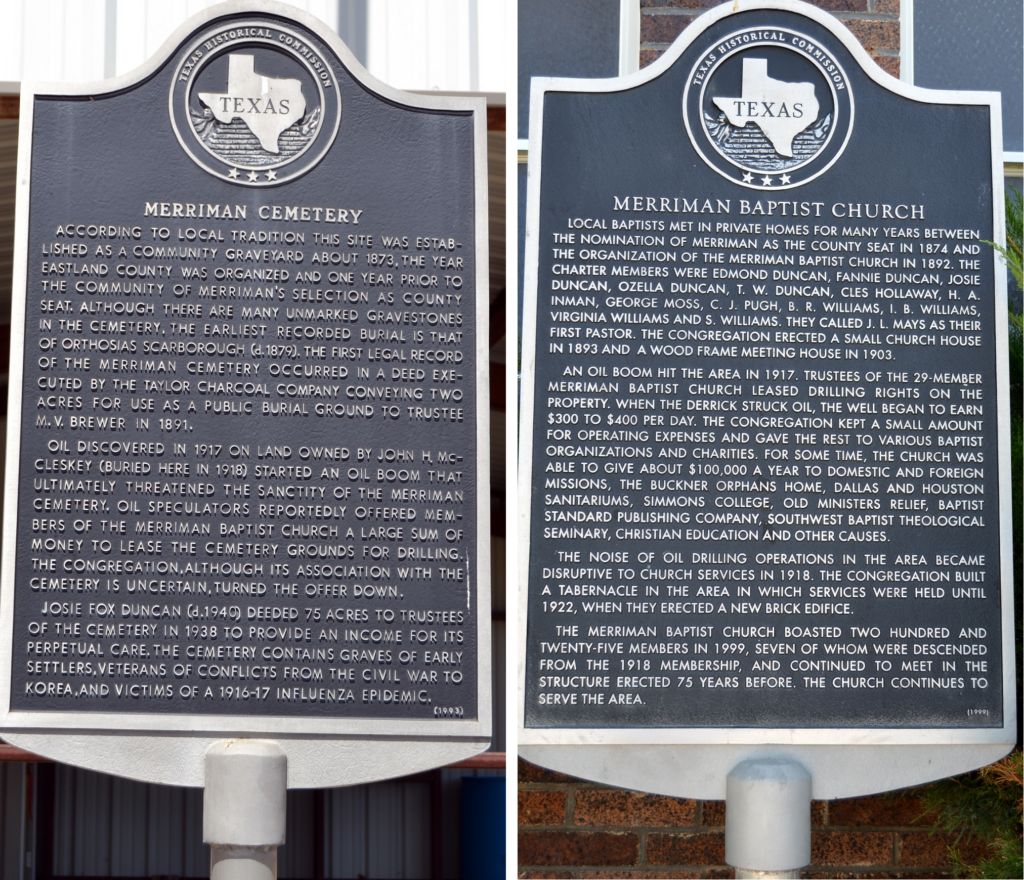
Near Ranger in Eastland County, Texas Historical Commission markers were erected in 1993 (left) and 1999 explaining how members of the Merriman Baptist Church shared their wealth from petroleum royalties. Photos courtesy the Historical Marker Database.
When local newspapers reported the church had refused an offer of $1 million, the Associated Press picked it up, and newspapers from New York to San Francisco ran the story. Literary Digest even featured “the Texas Mammon of Righteousness” with a photograph of “The Congregation That Refuses A Million.”
Deacon J.T. Falls was not amused. “A great many clippings have been sent to us from many secular papers to the effect that we as a church have refused a million dollars for the lease of the cemetery. We do not know how such a statement started,” the deacon opined.
“The cemetery does not belong to the church. It was here long before the church was. We could not lease it if we would, and we would not if we could,” the cleric added.
“If any person’s or company’s heart has become so congealed as to want to drill for oil in this cemetery, they could not — for the dead could not sign a lease, and no living person has any right to do so,” Falls proclaimed.
The church deacon concluded with an ominous admonition to potential drillers, “Those that have friends buried here have the right and the will to protect the graves, and any person attempting to trespass will assume a great risk.”
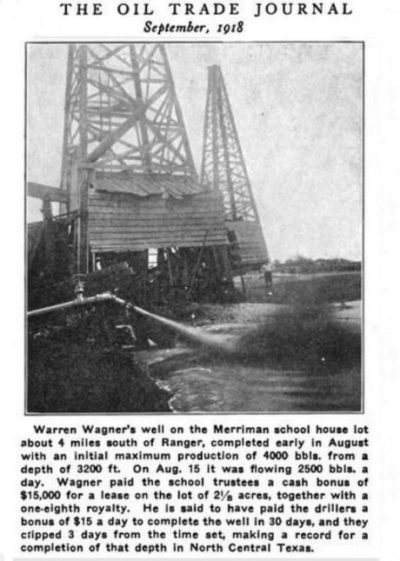
A 1918 article noted a “Merriman school house” oil well drilled to 3,200 feet in record time for North Central Texas.
Roaring Ranger’s oil production dropped precipitously because of dwindling reservoir pressures brought on by unconstrained drilling. Many exploration and production companies failed (including fraudulent ones like Hog Creek Carruth Oil Company).
In the decades since the McCleskey No. 1 well, advancements in horizontal drilling technology have presented more legal challenges to mineral rights of the interred, according to Zack Callarman of Texas Wesleyan School of Law.

In 2014, Callarman wrote an award-winning analysis of laws concerning drilling to extract oil and natural gas underneath cemeteries. “Seven Thousand Feet Under: Does Drilling Disturb the Dead? Or Does Drilling Underneath the Dead Disturb the Living?” was published in the Real Estate Law Journal.
Despite yet another North Texas oilfield discovery at Desdemona, by 1920 the Eastland County drilling boom was over. The faithful still gather at Merriman Baptist Church every Sunday.
_______________________
Recommended Reading: Early Texas Oil: A Photographic History, 1866-1936
 (2000);Texas Oil and Gas, Postcard History (2013);Wildcatters: Texas Independent Oilmen
 (1984). Your Amazon purchase benefits the American Oil & Gas Historical Society. As an Amazon Associate, AOGHS earns a commission from qualifying purchases.
_______________________
The American Oil & Gas Historical Society (AOGHS) preserves U.S. petroleum history. Please become an AOGHS annual supporter and help maintain this energy education website and expand historical research. For more information, contact bawells@aoghs.org. Copyright © 2026 Bruce A. Wells. All rights reserved.
Citation Information – Article Title: “Oil Riches of Merriman Baptist Church.” Authors: B.A. Wells and K.L. Wells. Website Name: American Oil & Gas Historical Society. URL: https://aoghs.org/oil-almanac/oil-riches-of-merriman-baptist-church. Last Updated: January 11, 2026. Original Published Date: January 18, 2019.
by Bruce Wells | Dec 2, 2025 | Petroleum Pioneers
The lucky life of John Steele and America’s earliest oil wealth.
John Washington Steele’s good fortune began on December 10, 1844, when Culbertson and Sarah McClintock adopted him as an infant. The McClintocks also adopted his sister Permelia, bringing both home to the farm along Oil Creek in Venango County, Pennsylvania.
Fifteen years later, the U.S. petroleum industry began with a 69.5-foot-deep oil discovery at nearby Titusville, the first oil well drilled commercially for distilling into kerosene (also called coal oil).
Pennsylvania petroleum reserves revealed at Oil Creek made the widow McClintock a fortune in royalties. When she died in a kitchen fire in 1864, Mrs. McClintock left her oil wealth to her only surviving child, Johnny, who inherited $24,500 at age 20.
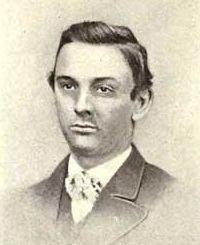
John Washington Steele of Venango County, Pennsylvania, inherited oil riches.
Johnny also inherited his mother’s 200-acre farm along Oil Creek between the now Rynd Farm and the small community of Rouseville, south of 15-miles Titusville. The farm already included 20 producing oil wells yielding $2,800 in royalties every day.
Rouseville was where future muckraking journalist Ida Minerva Tarbell (1857-1944) lived in 1861, when a gushing well erupted into flames — resulting in an early petroleum industry tragedy (see Rouseville 1861 Oil Well Fire).
Legendary Extravagance
“Coal Oil Johnny” Steele would earn his famous name in 1865 — after less than one year of extravagance, according to the New York Times.

“In his day, Steele was the greatest spender the world had ever known,” the newspaper proclaimed. “He threw away $3,000,000 in less than a year.”
Philadelphia journalists coined the name “Coal Oil Johnny” for him, reportedly because of his attachment to a custom carriage that had black oil derricks spouting dollar symbols painted on its red doors. He later confessed in his autobiography:
I spent my money foolishly, recklessly, wickedly, gave it away without excuse; threw dollars to street urchins to see them scramble; tipped waiters with five and ten dollar bills; was intoxicated most of the time, and kept the crowd surrounding me usually in the same condition.
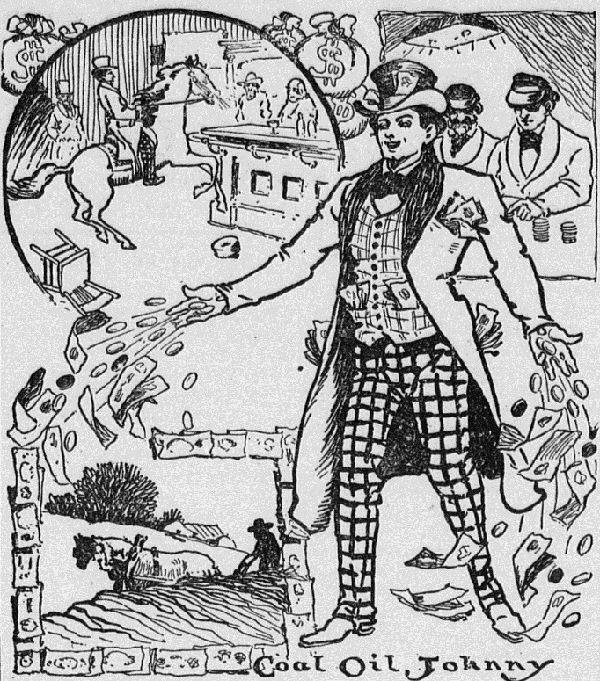
“Before J.R. Ewing, or the Beverly Hillbillies, or even John D. Rockefeller, there was Coal Oil Johnny,” noted a 2010 article in The Atlantic.
Such wealth could not last forever, but the rise and fall of Coal Oil Johnny, who died in modest circumstances in 1920 at age 76, has lingered in America’s petroleum history.
In 2010, The Atlantic magazine published “The Legend of Coal Oil Johnny, America’s Great Forgotten Parable,” an article sympathetic to his riches-to-rags story. It describes the country’s fascination with the earliest economic booms brought by “black gold” discoveries in Pennsylvania.
“Before J.R. Ewing, or the Beverly Hillbillies, or even John D. Rockefeller, there was Coal Oil Johnny,” noted the October 18 feature story. “He was the first great cautionary tale of the oil age — and his name would resound in popular culture for more than half a century after he made and lost his fortune in the 1860s.”
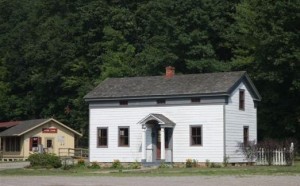
Refurbished boyhood home of “Coal Oil Johnny” at Oil Creek State Park (and train station) north of Rouseville, Pennsylvania. Photo by Bruce Wells.
For generations after the peak of his career, Johnny was still so famous that any major oil strike — especially the January 1901 gusher at Spindletop Hill in Beaumont, Texas — “brought his tales back to people’s lips,” noted the magazine article, citing Brian Black, a historian at Pennsylvania State University.
“It was wealth from nowhere,” Black explained. “Somebody like that was coming in without any opportunity or wealth and suddenly has a transforming moment. That’s the magic and it transfers right through to the Beverly Hillbillies and the rest of the mythology.”
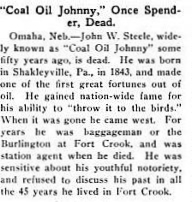
John W. Steele, who “made one of the first great fortunes out of oil,” died in 1920 in Nebraska.
“Coal Oil Johnny” was a legend, and like all legends, “he became a stand-in for a constellation of people, things, ideas, feelings and morals – in this case, about oil wealth and how it works,” he added.
“He made and lost this huge fortune – and yet he didn’t go crazy or do anything terrible. Instead, he ended up living a regular, content life, mostly as a railroad agent in Nebraska,” the 2010 Atlantic article concluded. “Surely there’s a lesson in that for the millions who’ve lost everything in the housing boom and bust.”
John Washington Steele’s Venango County home, relocated and restored by Pennsylvania’s Oil Region Alliance of Business, Industry & Tourism, stands today in Oil Creek State Park, just off Route 8, north of Rouseville.

On Route 8 south of Rouseville is the still-producing McClintock No. 1 oil well. “This is the oldest well in the world that is still producing oil at its original depth,” proclaims the Alliance. “Souvenir bottles of crude oil from McClintock Well Number One are available at the Drake Well Museum, outside Titusville.”
_______________________
Recommended Reading: The Legend of Coal Oil Johnny (2007); Cherry Run Valley: Plumer, Pithole, and Oil City, Pennsylvania, Images of America (2000); Western Pennsylvania’s Oil Heritage (2008). Your Amazon purchase benefits the American Oil & Gas Historical Society. As an Amazon Associate, AOGHS earns a commission from qualifying purchases.
_______________________
The American Oil & Gas Historical Society (AOGHS) preserves U.S. petroleum history. Please become an AOGHS annual supporter and help maintain this energy education website and expand historical research. For more information, contact bawells@aoghs.org. Copyright © 2025 Bruce A. Wells. All rights reserved.
Citation Information – Article Title: Legend of “Coal Oil Johnny.” Authors: B.A. Wells and K.L. Wells. Website Name: American Oil & Gas Historical Society. URL: https://aoghs.org/petroleum-pioneers/legend-of-coal-oil-johnny. Last Updated: December 4, 2025. Original Published Date: April 29, 2013.