by Bruce Wells | Aug 31, 2026 | Energy Education Resources
The importance of preserving history, one story at a time. Adding family petroleum heritage to museum collections.
Millions of Americans have worked in the petroleum industry and many have left family records and photographs of their “oil patch” careers. The AOGHS American Oil & Gas Families project and museums listing offer help in locating suitable homes for preserving the histories of America’s oil families.
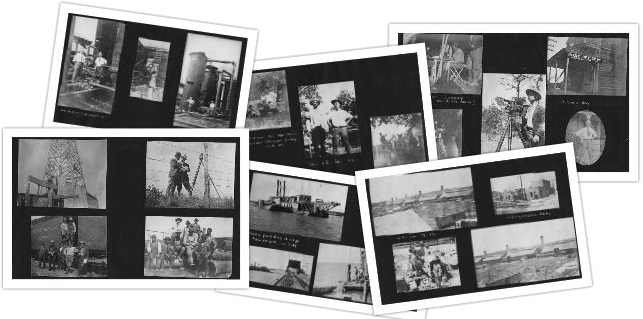
Albert Jeffreys in Texas, Louisiana, Romania, Pennsylvania and England, 1904-1913. Family photography preserved by his granddaughter, Sheila Morshead.
Finding the Right Oil and Gas Museum
In 2016, California resident Sheila Morshead contacted the American Oil & Gas Historical Society about preserving her family’s photo albums — a significant photo collection of petroleum-related images documenting her grandfather’s early 20th century career.
After finishing scanning circa 1910 images, Sheila said she hoped to find a good home for preserving her increasingly fragile originals. Many of her grandfather’s images came from the Beaumont, Texas, region (with others from Louisiana and as far away as England and Romania). She hoped someone would want to preserve the original album pages.
Thanks to Troy Gray, director (2015-2022) of the Spindletop-Gladys City Boomtown Museum at Lamar University in Beaumont, Texas, Sheila accomplished her preservation mission. Her cherished family album is in the collection of the museum.
Some of Sheila’s photos depict early refineries at Beaumont. Others show oil terminals in Galveston Bay, a 1909 pumping station under construction near Moore, Louisiana, and even the apparently good fishing at Port Bolivar in the Gulf of Mexico (a few examples out of more than 120 pages are below).
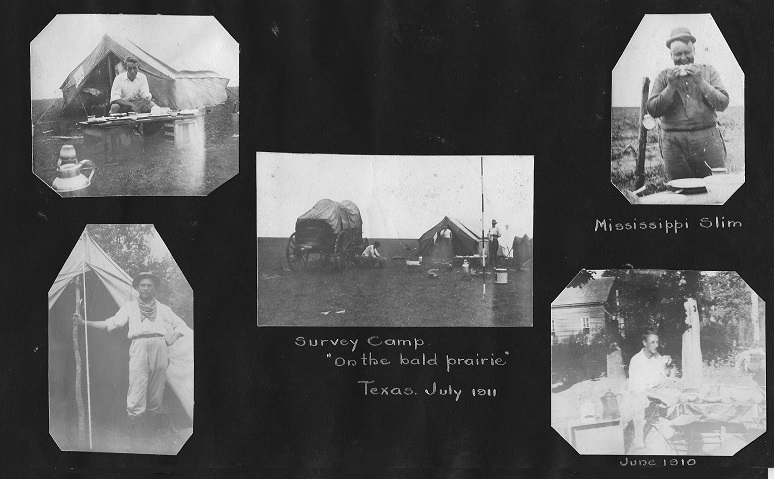
One of the more than 120 family album pages of the petroleum-related career of Albert Jeffreys to be part of the permanent collection of the Spindletop-Gladys City Boomtown Museum thanks to his granddaughter.
One page from the album depicts photos from a survey camp with tents and an equipment wagon on “the bald prairie” of Texas in July 1911. It includes a photo of “Mississippi Slim,” her grandfather’s co-worker.
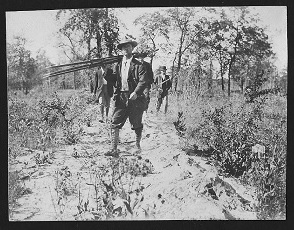
Sheila Morshead continues to research details about her grandfather’s career. She believes this is a 1912 photo of Albert Jeffreys with his surveying tripod.
“My Grandfather was Albert Jeffreys from Great Britain,” Sheila explains about the family images, adding that Albert “Jeff” Jeffreys first arrived in the United States in 1908. The next year he got married in Shreveport, Louisiana. Albert’s wife Florence – “Flo” – also was from Great Britain, Sheila adds. “Their daughter Dorothy Kathleen Jeffreys – my mother – was born in Fort Worth, Texas, in January 1912.”
After a few busy years in Texas, Albert’s oil patch career took him to the Caucasus region of southwestern Russia in 1914. “He was sent there by the British government to work in the oilfields for his service to the country during World War I,” explains Sheila, who studied early chapters of Dan Yergin’s The Prize, to learn petroleum industry history.
“Albert eventually escaped during the Bolshevik revolution by way of Norway and returned to England,” adds his granddaughter. “I am trying to decipher the many stamps on his old passport. Needless to say, I am getting pleasantly lost in looking up British oil companies.”
After talking with Troy about his museum’s collections at the Lamar University, she removed a few original images to keep for siblings. She plans on donating all the rest as she continues to research dates and other family documents.
Albert Jeffreys Family Collection
“Here are some annotations about the scanned pictures,” Shelia noted when she emailed AOGHS seeking help in locating an appropriate oil museum or library to preserve them. “There are lots more pictures, and I can do more exact research on dates, but as you can see most have locations written on them and some dates.”
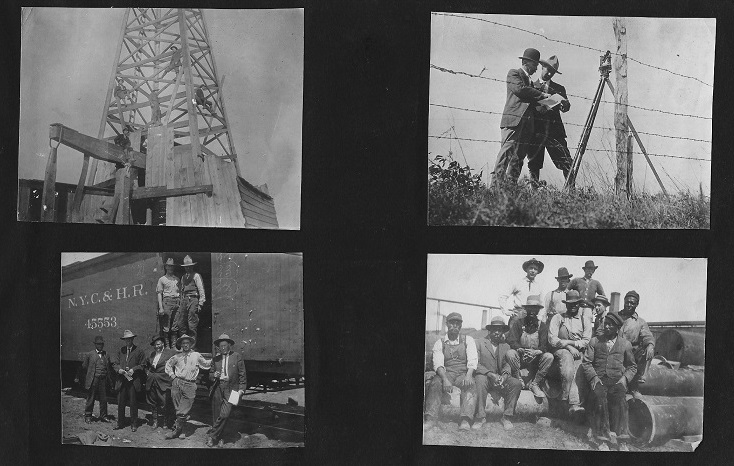
The family album includes a cable-tool oil well (with walking beam). Next to it is a photo of two unidentified men with surveying equipment. A third photo shows men standing in front of a New York Central and Hudson River Railroad car; another depicts a pipeline laying work crew.
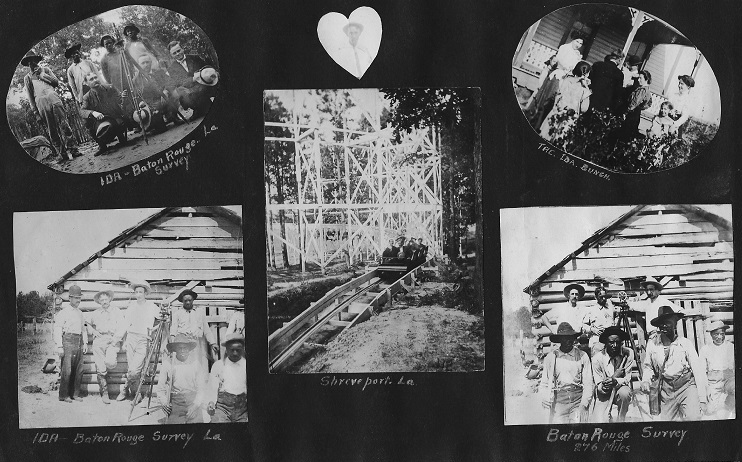
Undated images from Baton Rouge, Louisiana, include Albert Jeffreys (in heart) and his surveying co-workers along with an “Ida Bunch” family photo and riding a roller coaster in Shreveport.
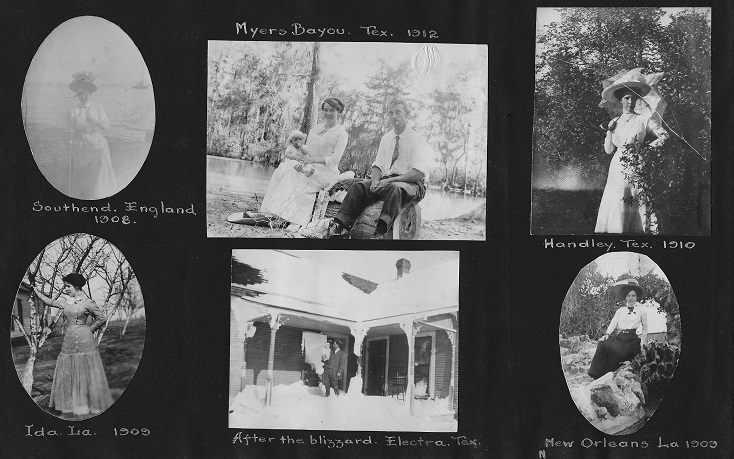
After returning from England to Louisiana oilfields in 1909, the family made stops in Handley and Electra, Texas, which included a rare blizzard, before moving on to New Orleans.
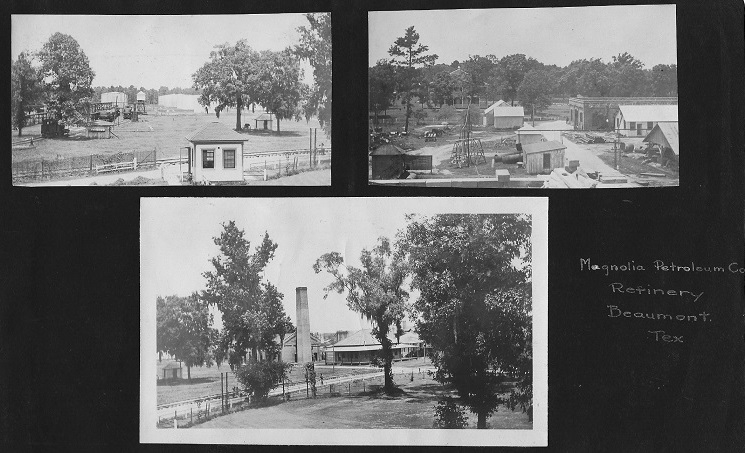
Three of Albert Jeffreys’ images documenting the Magnolia Co. refinery in Beaumont, Texas, circa 1912.
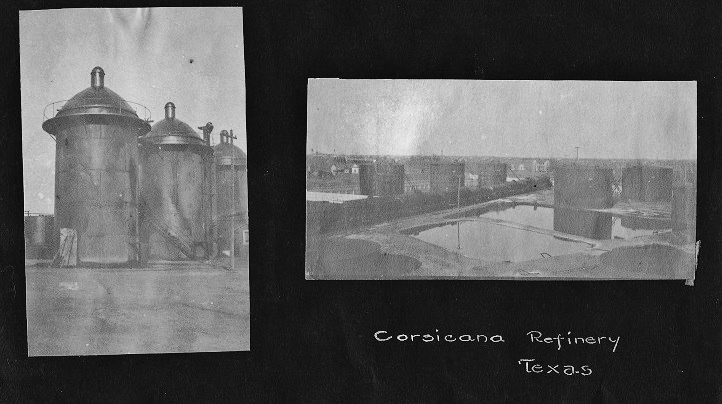
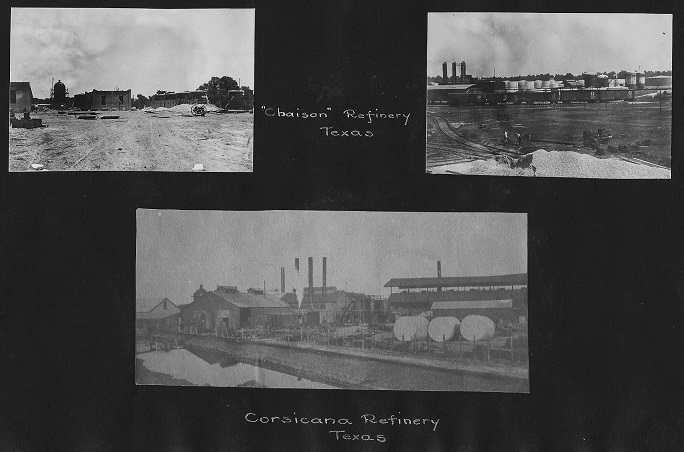
In addition to images of the Magnolia oil refinery, Albert Jeffreys photographed other circa 1910 refineries, including one near Corsicana and the “Chaison Refinery” below.
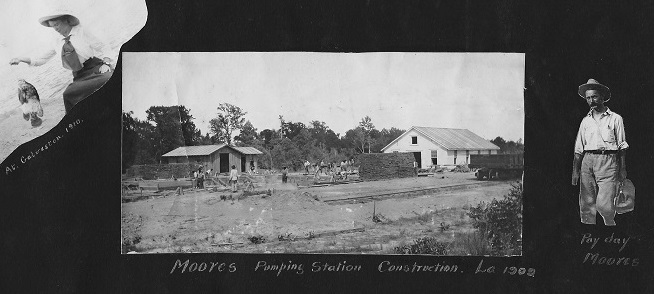
Both Albert and wife Florence enjoyed fishing in Galveston Bay between his frequent surveying trips in Texas in 1910 – and a visit to the pipeline pumping station in Moores, Louisiana.
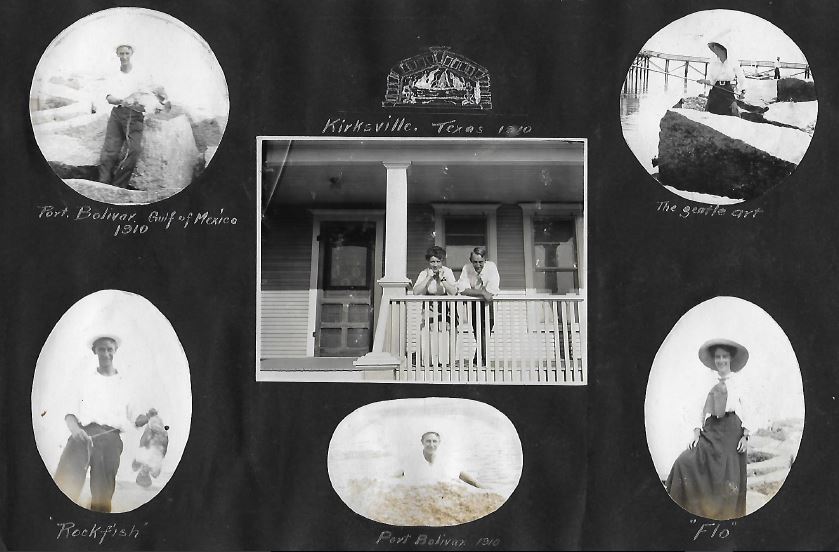
Albert “Jeff” and “Flo” Jeffreys lived in Kirksville, Texas, and fished at Port Bolivar, circa 1911.
With many family photos in the process of being preserved for posterity, Albert “Jeff” Jeffery’s petroleum career continues to fascinate his granddaughter. “I still intend to do more looking as it is a puzzle full of interesting pieces,” says Sheila.
“For example, my grandfather’s father worked for a British oil company and my grandfather’s son Stanley Rex Jeffreys was a geologist with the landmark geology survey of California, which I believe was completed sometime in the 1950s and was part of the concerted effort to identify oil producing areas in California,” Shelia explains. “So, there were three generations of Jeffreys oil men.”
Geologic mapping in California began in 1826 when the first geologic survey in the state was done by a British naval officer, according to History of Geologic Maps of California of the California Geological Survey.
1901 Gusher at Spindletop
Albert Jeffreys worked in Texas oilfields just a few years after a famous oil discovery about three miles south of Beaumont. The January 10, 1901, “Lucas Gusher” at Spindletop Hill would soon lead to southeastern Texas producing more oil in one day than the rest of the world’s oilfields combined. Major petroleum companies like Texaco got started there.
Both the Spindletop-Gladys City Boomtown Museum and the Texas Energy Museum in Beaumont tell the story of the Spindletop well, a “wildcat” discovery that created the greatest petroleum boom in America – far exceeding the first U.S. oil discovery well in 1859 in Pennsylvania.
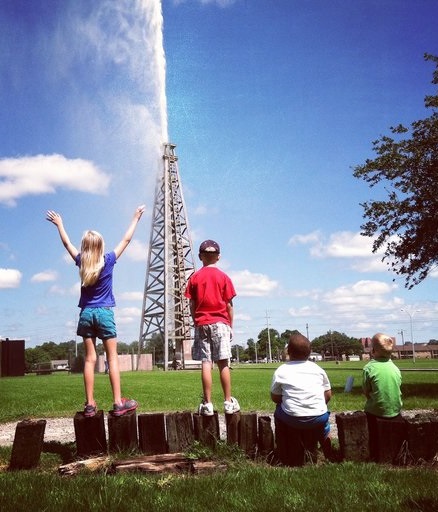
A replica wooden derrick recreates the excitement of a major oil discovery of January 10, 1901. Photo courtesy Spindletop-Gladys City Boomtown Museum at Lamar University in Beaumont, Texas.
Gladys City, now partially recreated on the museum’s grounds, was originally envisioned by Patillo Higgins of the Gladys City Oil, Gas and Manufacturing Company. Known as the Prophet of Spindletop, he predicted oil would be found near the city he designed in 1892. Spindletop launched the modern petroleum industry a few years later.
Learn more about finding a museum to preserve family photos at Oil Families.
_______________________
Recommended Reading: Trek of the Oil Finders: A History of Exploration for Petroleum (1975); History of Oil Well Drilling (2007); Groundbreakers: The Story of Oilfield Technology and the People Who Made it Happen (2015). As an Amazon Associate, AOGHS earns a commission from qualifying purchases.
_______________________
The American Oil & Gas Historical Society (AOGHS) preserves U.S. petroleum history. Please support this website, subscribe to the monthly email newsletter, and help expand our historical research. Contact bawells@aoghs.org. Copyright © 2026 Bruce A. Wells.
Citation Information – Article Title: “Oil & Gas Families – Albert Jeffreys Family Collection.” Authors: B.A. Wells and K.L. Wells. Website Name: American Oil & Gas Historical Society. URL: https://aoghs.org/energy-education-resources/oil-gas-families-albert-jeffreys. Last Updated: September 10, 2026. Original Published Date: July 21, 2016.
by Bruce Wells | May 11, 2026 | This Week in Petroleum History
May 11, 1880 – Dresser patents Oil Well Device –
Solomon Dresser of Bradford, Pennsylvania, patented a rubber “packer” for sealing downhole pressure in wells. The technology behind the patent (no. 227419) helped confine gas, “which enters the well from the lower rocks and utilizes its force or pressure to expel the oil from the well.”
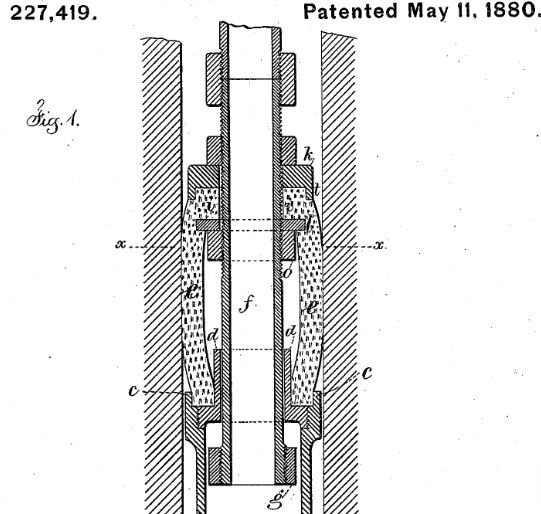
Detail from Solomon R. Dresser’s innovative 1880 patent for a rubber “packer” to seal downhole pressure in wells.
With the success of his Dresser “Cap Packer” in the giant Bradford oilfield, the inventor founded the S.R. Dresser Manufacturing Company. In 1885, he patented a flexible coupling known as a “Dresser Joint,” a widely adopted pipeline coupling method using rubber for tight seals, which permitted long-range transmission of natural gas.
After expanding into manufacturing oilfield pumps, engines, and compressors, Dresser’s company went public in 1928, moving its headquarters from Bradford to Dallas in 1950. Dresser Industries merged with oilfield supply rival Halliburton for about $7.7 billion in stock in 1998 (also see Halliburton cements Wells).
May 11, 1947 — Helicopter used for Oil Survey
A Bell 47B helicopter costing $75 per hour to operate was used for a gravity-meter survey in the Terrebonne Parish area of Louisiana. “The very first helicopter-aided oil survey in the Gulf took place between May 11 and August 12, 1947,” reported a 2009 article in Vertical Rewind, adding that helicopters replaced “marsh buggies used along the mosquito-infested coast of Louisiana.”
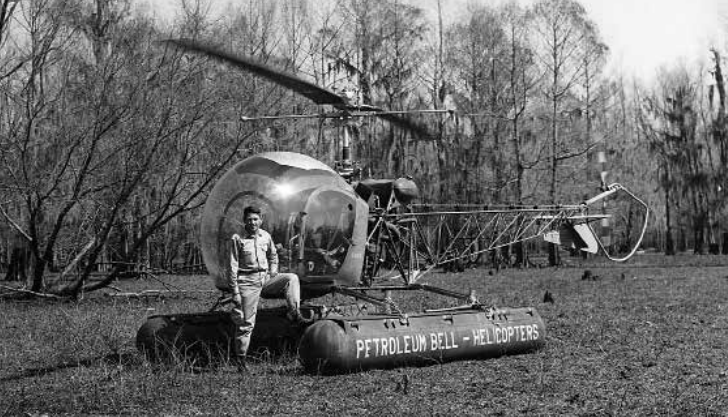
Petroleum-Bell Helicopter pilot Phil Fillingham in front of a Bell 47D-1 in March 1954. Bell 47s were the first helicopters used to transport personnel to oil rigs in the Gulf of Mexico. Photo courtesy Phil Fillingham/Vertical Rewind.
With the Bell helicopter based at Houma Airport, the survey was completed in three months, “while it took a year to do working with marsh buggies,” the article explained (also see First Florida Oil Well). Due to maintenance and repairs, the helicopter flew only 115 hours over the contract’s 93 days. “Even with those problems, this first use of a helicopter in oil exploration was considered a success.” Petroleum-Bell Helicopter Services, known as “Pet Bell,” was established in Lafayette in 1949. Learn more in Offshore Petroleum History.
May 12, 2007 – Oil Museums open in Oklahoma
ConocoPhillips opened two petroleum museums as part of the 2007 Oklahoma statehood centennial celebrations. The company spent $10 million on the museums in Bartlesville and Ponca City. Conoco merged with Phillips Petroleum Company in 2002, after beginning in the 1880s as the Continental Oil Company, a grease and kerosene distributor in Utah. Continental Oil merged with Ponca City-based Marland Oil Company in 1929.
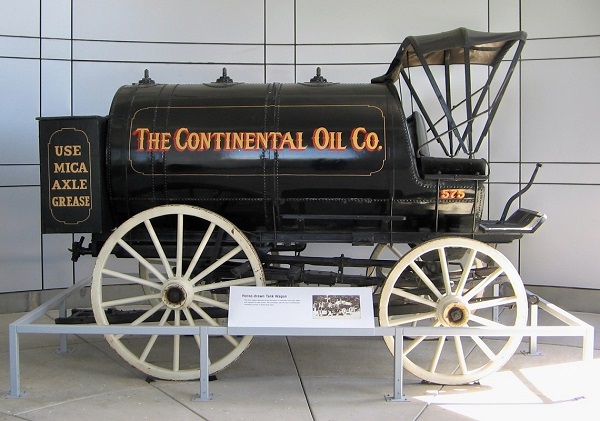
An 1880s tank-wagon exhibit at the Conoco Museum in Ponca City, Oklahoma, today open by appointment only. Photo by Bruce Wells.
ConocoPhillips in 2012 separated its downstream operations into a separate company, Phillips 66, which in 2025 closed the Bartlesville museum, citing a decline in attendance. The Ponca City Conoco Museum has remained open with limited hours and appointments required for visiting. Learn more in ConocoPhillips Petroleum Museums.
May 14, 1906 – Louisiana Law conserves Natural Gas
Joining the growing number of states producing natural gas, Louisiana enacted conservation measures for preventing waste. Lawmakers passed an “Act to Protect the Natural Gas Fields of this State” empowering the governor “to close, cap, or plug offending wells” at the owner’s expense.
Expanded in 1910, the act marked the beginning of legislative control of the state’s petroleum industry, according to the Department of Natural Resources (DNR). Penalties were imposed for “failure to cap out-of-control wells, doing injury to pipe lines, or wastefully burning natural gas from any well into the air.” The conservation law sought to prevent the excessive practices that had depleted fields during the Indiana gas boom.
May 14, 1953 – Golden Driller debuts at Petroleum Exposition
A golden, 76-foot statue of a roughneck first appeared at the 30th annual International Petroleum Exposition in Tulsa, Oklahoma. Sponsored by the Mid-Continent Supply Company of Fort Worth, the giant attracted crowds and returned refurbished for the 1959 exposition. Mid-Continent Supply then donated it to the Tulsa County Fairgrounds, where it was completely rebuilt in 1966. The “golden driller” would be refurbished several more times by 1980.
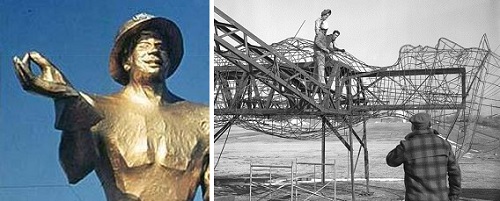
The original Golden Driller of 1953, left, proved so popular that a more permanent version (supported with steel rods) returned for the 1966 Petroleum Expo. Photos courtesy Tulsa Historical Society.
Today a Tulsa tourist attraction, the mustard-shaded driller, weighing 43,500 pounds, is one of the largest freestanding statues in the world, according to city officials. Promotional t-shirts, ties, and scarfs — and in 2020 a Covid-19 mask — have occasionally adorned the statue. Learn more in Golden Driller of Tulsa.
May 14, 2004 – Museum Opens in Oil City, Louisiana
Louisiana’s first publicly funded museum dedicated to the petroleum industry opened in Oil City, about 20 miles north of Shreveport. The Louisiana State Oil and Gas Museum, originally called the Caddo-Pine Island Oil and Historical Museum, opened at a former depot of the Kansas City Southern Railroad.
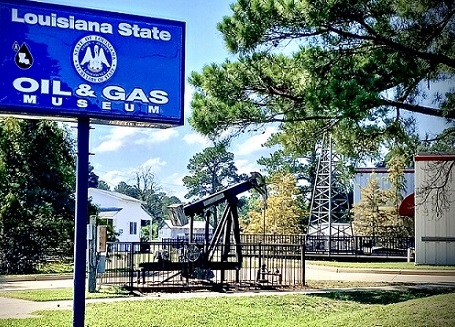
Louisiana’s Caddo Parish petroleum museum includes outdoor exhibits of modern oil production technology.
The museum has since preserved the Caddo Parish oilfield discoveries in 1905, which brought economic prosperity to North Louisiana. Museum exhibits reveal the technologies behind the earliest Louisiana oil wells — and a 1911 well drilled by Gulf Refining Company that is considered one of the earliest “offshore” oil wells. Completed on Caddo Lake, the well produced 450 barrels of oil per day from a depth of 2,185 feet. Learn more in Louisiana Oil City Museum.

May 15, 1911 – Supreme Court mandates Breakup of Standard Oil
After reviewing 12,000 pages of court documents, the Supreme Court issued its majority opinion mandating dissolution of the Standard Oil Company of New Jersey into 34 separate companies. The Justice Department had filed an antitrust lawsuit against Standard Oil in 1909. The Supreme Court’s ruling upheld a circuit court decision that Standard Oil’s practices violated the Sherman Antitrust Act. The company was given six months to spin off its subsidiaries.
May 15, 1940 — Nylon Stockings Go on Sale
One year after being unveiled at the 1939 New York World’s Fair, nylon stockings went on sale for the first time at Gimbels Department Store in Manhattan. Promoted as “strong as steel, as fine as spiderweb,” first-year sales reached about 64 million pairs at $1.35 each for the DuPont Company’s petroleum product, according to ABC News.
“Women’s love affair with nylon stockings has had a long run,” the network proclaimed in 2010. Nylon had been used for toothbrush bristles for “Dr. West’s Miracle-Tuft” as early as February 1938 (see Nylon, a Petroleum Polymer).
May 16, 1817 – U.S. Geology Described and Mapped
Scottish-American geologist William Maclure presented his detailed study of U.S. geology to the Academy of Natural Sciences of Philadelphia. He would be named president of the Academy, a post he would hold for 22 years, and become known as the “father of American Geology.”
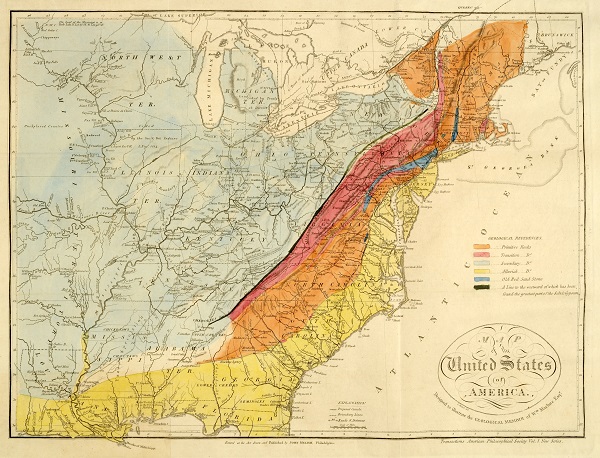
An 1818 map by William Maclure provided a more detailed version of a geological map he published in 1809. Image courtesy the Historic Maps Collection, Princeton Library.
The American Philosophical Society published Maclure’s detailed study in 1818 as “Observations on the Geology of the United States of North America.”
May 16, 1934 – National Stripper Well Association established
The National Stripper Well Association (NSWA) organized in Tulsa, Oklahoma, to represent operators of stripper wells — marginal wells that produce less than 15 barrels of oil a day or less than 90 thousand cubic feet of natural gas a day. In 2024, about 400,000 oil stripper wells accounted for more than 7.4 percent of U.S. oil production, according to NSWA. About 360,000 natural gas stripper wells accounted for 8.2 percent of gas production.
May 16, 1961 – Museum opens over Natural Gas Field
In southwestern Kansas, the Stevens County Gas & Historical Museum in Hugoton opened above a natural gas-producing formation extending 8,500 square miles into the Oklahoma and Texas panhandles. The town’s museum has since educated visitors about one of the largest natural gas fields in North America — the Hugoton field. A well drilled in 1945 still produces natural gas outside the small museum.
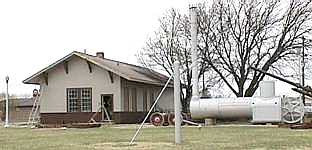
A Stevens County natural gas museum in Hugoton, Kansas, preserves the history of a giant natural gas field.
Although the Hugoton field’s once-dominant natural gas production gave way to gas shale and coalbed methane regions, including production from Fayetteville, Arkansas (2004), and Haynesville, Louisiana (2008), the Hugoton-Panhandle gas continues to be a leading source of helium. Learn more in Hugoton Natural Gas Museum.
May 17, 1882 – Mystery Well Production revealed
The true oil production of a closely guarded discovery well in the Warren County, Pennsylvania, township of Cherry Grove was revealed to be 1,000 barrels of oil a day. News about Jamestown Oil Company’s “Mystery Well” sent shock waves through petroleum market centers.
“The excitement in the oil exchanges was indescribable,” noted Paul H. Giddens in his 1938 classic, The Birth of the Oil Industry. “Over 4,500,000 barrels of oil were sold in one day on the exchanges in Titusville, Oil City and Bradford.”
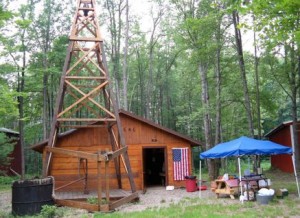
Cherry Grove, Pennsylvania, oil patch historians and volunteers built a derrick to celebrate their historic 1882 “Mystery Well.”
Although the Cherry Grove discovery demoralized the market and drove oil prices down to less than 50 cents per barrel, hundreds of derricks appeared around Cherry Grove, and thousands of people moved there while the boom lasted. It was short-lived, according to volunteers of the Cherry Grove Old Home and Community Day Committee, which has kept the “Oil Excitement” alive. Learn more in Cherry Grove Mystery Well.
May 17, 1901 – Gulf Oil begins at Spindletop Hill
James M. Guffey organized Guffey Petroleum Company to buy the famous “Lucas Gusher” well drilled the previous January at Spindletop Hill near Beaumont, Texas. Guffey purchased about half of the oilfield discovery well’s production (the Mellon family of Pittsburgh owned the remainder). Guffey created the Gulf Refining Company to refine and market the oil produced by Guffey Petroleum. In 1907, Andrew Mellon acquired J.M. Guffey Petroleum and Gulf Refining companies of Texas and reorganized them as Gulf Oil.

May 17, 1973 – Last Nuclear fracturing of Natural Gas Well
Atomic Energy Commission scientists conducted the last experiment of the Plowshare Program with a nearly simultaneous detonation of three 33-kiloton devices in a Colorado natural gas well. Project Rio Blanco was the third and final underground detonation to test nuclear fracturing of gas wells.
The first had been Project Gasbuggy in 1967 when a 29-kiloton nuclear device fractured a New Mexico well. A second experiment, Project Rulison, detonated a 40-kiloton device in a Colorado well in 1969. All three projects improved production, but the natural gas proved too radioactive.
_______________________
Recommended Reading: Groundbreakers: The Story of Oilfield Technology and the People Who Made it Happen (2015); Conoco: 125 Years of Energy (2000); Phillips, The First 66 Years
 (1983); Louisiana’s Oil Heritage, Images of America
 (2012); Oil in Oklahoma
 (1976); Titan: The Life of John D. Rockefeller, Sr.
 (2004); The Extraction State, A History of Natural Gas in America (2021); Cherry Run Valley: Plumer, Pithole, and Oil City, Pennsylvania
 (2000); Trek of the Oil Finders: A History of Exploration for Petroleum (1975); The Birth of the Oil Industry (1938); Ohio Oil and Gas, Images of America
 (2008); History Of Oil Well Drilling (2007); Drilling Technology in Nontechnical Language
 (2012). Your Amazon purchase benefits the American Oil & Gas Historical Society. As an Amazon Associate, AOGHS earns a commission from qualifying purchases.
_______________________
The American Oil & Gas Historical Society (AOGHS) preserves U.S. petroleum history. Support this energy education website, our monthly email newsletter, This Week in Oil and Gas History News, and help expand historical research. Contact bawells@aoghs.org. Copyright © 2026 Bruce A. Wells. All rights reserved.
by Bruce Wells | Dec 11, 2023 | Petroleum Companies
Texas Oil boom brings shady searchers for petroleum riches.
It was the greatest petroleum exploration and production since the birth of the U.S. oil industry in 1859. Hundreds of new companies formed in the wake of the spectacular 1901 “Lucas Gusher” at Spindletop Hill near Beaumont, Texas. Few had experience in the highly competitive and risky business of exploring for oil.
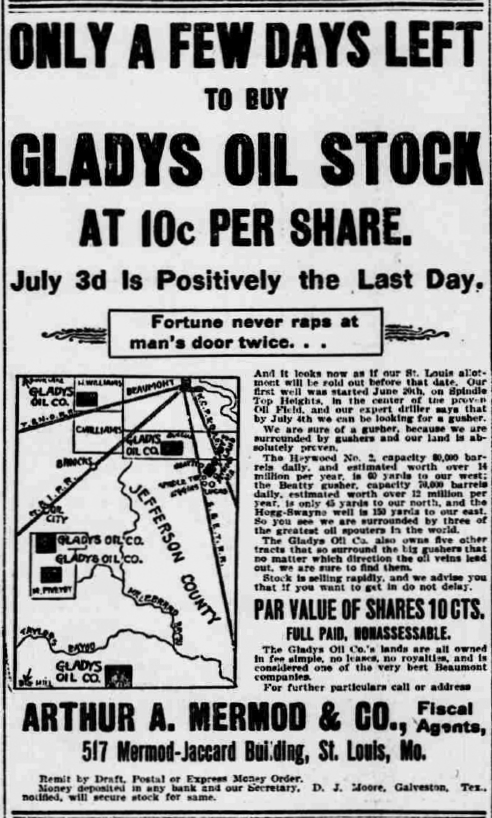
Among those ready to make fortunes for investors were two new “Gladys Oil” companies. One was from Beaumont, the other from Galveston. Contemporary maps show the Gladys Oil Company of Beaumont to have drilled a successful well very close to the famous January 10, 1901, “Lucas Gusher” well at Spindletop Hill that launched the modern U.S. petroleum industry.
Also in 1901, after 29 days of drilling in block 37, the company reported production from “Gusher No. 67” at a depth of 1,025 feet. Locating the “black gold” did not necessarily promise success.
“Swindletop”
By 1903 the Texas Secretary of State reported that Gladys Oil Company of Beaumont had “forfeited its right to do business in the state of Texas” due to a failure to pay franchise taxes. In a scenario that would repeat itself in other oilfields in coming decades, production from the giant field soon brought a collapse in oil prices.
By January 1902, stocks of both Gladys Oil companies were trading for less than 10 cents a share. The company was sued, lost, and United States Investor magazine reported it to be worthless two years later. Meanwhile, because some cash-strapped and desperate companies made questionable claims, newspapers began referring to the historic 1901 discovery as “Swindletop.”
In 1907, Success Magazine named the company in its “Fools and their Money” expose of fraudulent promotion schemes perpetrated by the New York, Chicago, and Beaumont Security Oil Trust. The Gladys Oil Company of Galveston lasted a little longer than its Beaumont twin, but not without controversy.
The trust had proclaimed, “it was impossible to lose” with an investment Gladys Oil Company of Galveston. In 1911 R.M. Smythe’s, Obsolete American Securities and Corporations, reported the stock to be worthless. Read about Pattillo Higgins, the man behind the great Spindletop discovery — and his Gladys City Oil, Gas & Manufacturing Company — see Prophet of Spindletop.
The stories of exploration and production companies joining petroleum booms (and avoiding busts) can be found updated in Is my Old Oil Stock worth Anything?
_______________________
The American Oil & Gas Historical Society (AOGHS) preserves U.S. petroleum history. Please become an AOGHS supporter and help maintain this website and expand historical research. For more information, contact bawells@aoghs.org. Copyright © 2024 Bruce A. Wells. All rights reserved.
Citation Information – Article Title: “Gladys Oil Company — Oil Shale Pioneer.” Authors: B.A. Wells and K.L. Wells. Website Name: American Oil & Gas Historical Society. URL: https://aoghs.org/old-oil-stocks/gladys-oil-company. Last Updated: December 4, 2024. Original Published Date: September 11, 2013.
 oilfield discovered in Pennsylvania by a well drilled by the United States Petroleum Company — reportedly located by using a witch-hazel dowser. The discovery well, which initially produced 250 barrels of oil a day, made headlines and created the