by Bruce Wells | Jan 4, 2019 | Petroleum Companies
Old Oil Stocks in progress H will not lead to lost riches – see Not a Millionaire from Old Oil Stock. The American Oil & Gas Historical Society, which depends on your support, simply does not have resources to provide free research of corporate histories.
However, AOGHS continues to look into forum queries as part of its energy education mission. Some investigations have revealed little-known stories like Buffalo Bill’s Shoshone Oil Company; many others have found questionable dealings during booms and epidemics of “black gold” fever like Arctic Explorer turns Oil Promoter.
Visit the Stock Certificate Q & A Forum and view company updates regularly added to the A-to-Z listing at Is my Old Oil Stock worth Anything? AOGHS will continue to look into forum queries, including these “in progress.”
Hale Petroleum Company
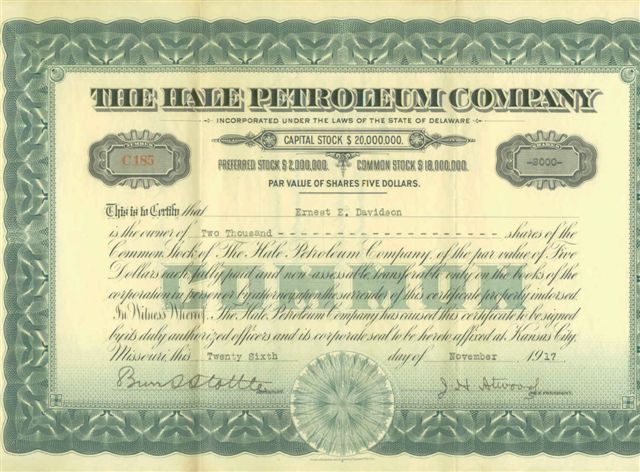 The Hale Petroleum Company from 1917 is not related to today’s Hale Petroleum Company of Columbus, Kansas. It also has no relation to the Standard Oil-affiliated Frank Hale Oil Company in Louisiana. In a 1918 text published by the Kansas City Testing Laboratory, Hale Petroleum is identified as having a refinery in Wichita, Kansas, and pipelines to Wichita from nearby El Dorado – site of Butler Country’s Kansas Oil Museum.
A Hale Petroleum is identified as part of Sterling Oil & Refining Company. Sterling Oil was created by Ross Shaw Sterling, the founder and president of the Humble Oil and Refining Company, which eventually became the Exxon, now ExxonMobil. In the 1920s, he sold his interests in Humble, although he served as president of Sterling Oil & Refining Company until 1946. (more…)
by Bruce Wells | Oct 20, 2017 | Petroleum Companies
Years of unsuccessful pursuit of oil in Michigan led Petroleum Magazine to give up on the state’s potential by 1920. “Oil Hunt In Michigan Is Hopeless – Oil projects in Michigan are but dreams which fail to materialize, in the opinion of those connected with the state geological survey, and that conclusion is base on its scientific research,” the trade magazine explained. Then, the 1928 discovery of the Mt. Pleasant oilfield suddenly enabled Michigan to become a significant oil producer – and attract new exploration companies. More oilfields would be discovered, including one in 1957 almost 30 miles long.
According to the Clarke Historical Library of Central Michigan University: Mt. Pleasant became a hub of Michigan petroleum activity, first as an accident of geology and later as a convenience of geography. The community lies close to the geographical center of the “mitten”, thus located equal distance from anywhere in the Lower Peninsula. Primary oil and gas explorationists, petroleum supply and service companies, geologists (and later geophysicists), drilling contractors all headquartered in Mt. Pleasant.
Similar to earlier oil booms in Texas, the 1928 Michigan oil well attracted new and often inexperienced companies. Among those seeking Michigan’s oil riches was Charles Van Keuren, who in 1933 established the Morris-Van Keuren Oil and Gas Syndicate. The 1902 graduate of Michigan University and former member of the Michigan House of Representatives had earlier been a partner in a Detroit securities investment firm.
Van Keuren’s syndicate spudded its first well on November 14, 1933, in Vernon Township of Isabella County on a 340-acre lease near the Ann Arbor Railroad. A cable-tool rig reached a total depth of 3,750 feet and the well was completed April 17, 1934, producing an “initial flow of 130 barrels per hour.” Three days later, the Clare Sentinel newspaper reported the Bowman Heirs No. 1 well was producing 3,000 barrels a day. Morris-Van Keuren Oil and Gas Syndicate planned three additional wells nearby to tap into the prospect.
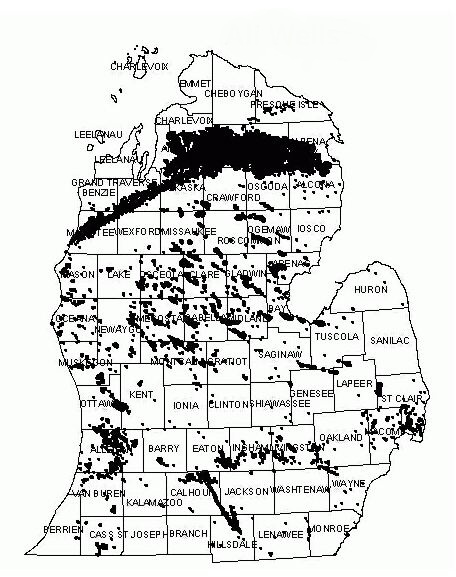
Michigan oil and natural gas fields.
However, the syndicate’s Bowman Heirs No. 2 well proved to be a dry hole at 3,788 feet deep. When two additional wells left no indications of production, exploration efforts moved to the challenges of Michigan’s Upper Peninsula. Intermittently drilled since 1903, the “U.P” had never produced commercial quantities of oil.
“Recent rumors of a large ‘play’ to test the oil possibilities of the contact area of Michigan’s sedimentary and outcrop area in the upper peninsula took substantial form this week when it was announced that Charles Van Keuren, oil operator of this city, has leased lands of the Hiawatha Sportsmen’s club for oil prospecting,” noted the Republican-News and St. Ignace Enterprise on May 21, 1936.
The newspaper reported the syndicate had leased tracts comprising more than 26,000 acres covering most of Garfield township, Mackinac county, and extending into Pentland township in Luce county.
However, a 1937 lawsuit alleging “fraud in the sale of certain syndicate certificates” delayed drilling operations. The syndicate’s Hiawatha Club No. 1 well, drilled between August 15, 1936 and June 9, 1937, proved to be a dry hole at 1,500 feet. The well had reportedly “showed oil saturation in the Trenton and underlying formations, but did not develop into commercial production.”
Undeterred, the company soon began to drill a followup well. By August of 1938, the Detroit Free Press noted, “After a series of arduous labors, including the building of a road through virgin forest and swamp land and the clearing of a site in ‘cutover,’ Charles Van Keuren’s north land explorative campaign on the 12,000-acre Hiawatha Club tract in Mackinac County of the Upper Peninsula, is in the active drilling state.”
The new well was in Section 17, Township 44 North, Range 8 West. “The production possibilities are thought to be somewhat like those of the Texas Gulf Coast field, where similar geological conditions obtain,” one newspaper proclaimed. “The development of commercial production would substantially advance the expectancy of deep drilling to these stratas along the ‘highs’ now producing in the central part of the State.”
Two months later, the Escanaba Daily Press reported, “Oil Outlook Is Favorable – Trace Of Petroleum Is Found In Well In Mackinac County” and “Indications in Garfield township have proved so good that, in case the first Van Keuren well does not prove productive, others are likely to be drilled in the adjacent area.”
Despite the optimism, Morris-Van Keuren Oil and Gas Syndicate, like many to follow, did not find oil in Michigan’s Upper Peninsula. In 1939, the company undertook exchanges of Syndicate stock to support continued operations, but apparently to no avail. The Robert D. Fisher Manual of Valuable and Worthless Securities records Morris-Van Keuren Oil and Gas Syndicate No. 1 as dissolved on September 1, 1943. No commercial quantities of oil have ever been found on Michigan’s Upper Peninsula.
The largest Michigan oil and natural gas field was discovered in January 1957 on the dairy farm of Ferne Houseknecht. Her first oil well revealed Michigan’s golden gulch of oil that proved to be 29 miles long.
___________________________________________________________________________________
The stories of exploration and production companies joining petroleum booms (and avoiding busts) can be found updated in Is my Old Oil Stock worth Anything? The American Oil & Gas Historical Society preserves U.S. petroleum history. Please support this AOGHS.ORG energy education website. For membership information, contact bawells@aoghs.org. © 2018 Bruce A. Wells.
by Bruce Wells | May 17, 2017 | Petroleum History Almanac
Chickaloon Oil Company sought to be part of Alaska petroleum history, which includes milestones beginning with the territory’s first oil well in 1902, an important oilfield discovery in July 1957, and completion of the 800-mile Trans-Alaska Pipeline in 2007. Many small, independent exploration companies tried to become part of state’s oil producing history, and many failed, including Chickaloon Oil.
Seeking investors, Chickaloon Oil’s first advertisement appeared in the Fairbanks Daily News-Miner of January 31, 1953. The new company proclaimed it had chosen an area near Chickaloon, about 75 miles northeast of Anchorage, “as one of the most promising drill sites” for petroleum exploration.
“Not only do our studies show a favorable structure in this area, but United States government geologists have marked this area as a probable oil producing land,” added the company, which claimed to have obtained leases for four sections of land, “where we can drill more than 300 wells if oil is found.”
Chickaloon was a coal-mining ghost town in the Alaska Territory. It had mostly perished in the 1920s after the U.S. Navy converted to oil-fired boilers for its ships (see Petroleum and Sea Power). The remains of Chickaloon were on federal property and later became part of Roosevelt’s New Deal community farming experiment, the “Matanuska Valley Colony.”
Around 1930, the U. S. Navy drilled an exploratory oil well in the Matanuska Valley. It was a “dry hole” and capped, but the U.S. Geological Survey cited reports on several other efforts. “A well drilled near Chickaloon in the Matanuska Valley is reported to have struck gas in association with coal,” the USGS noted. In 1929, the Peterson Oil Association had also drilled, but failed to find any oil.
Almost 25 years later, Chickaloon Oil and other exploration companies, returned to the Matanuska-Nelchina area in search of Alaska’s first major oilfield. To find investors for its highly speculative wildcat drilling, Chickaloon Oil advertised as far away as Oregon, offering $250,000 in stock to fund operations. In its ads, the company advised investors that the “veteran oilman from Texas,” Frank Dillard, would supervise the drilling of a 5,000-foot-deep test well in the summer of 1953.
In June 1953, a competitor, Alaska Oil & Gas Development Company, spudded a well just 50 miles down the Matanuska Valley near the Eureka Roadhouse. That well and several later ones would not strike oil.
However, Chickaloon Oil Company could find sufficient funds to actually launch drilling operations. The Alaska Oil and Gas Conservation Commission has no record of the company and it would be another four-years before Richfield Oil Corporation (today’s ARCO) completed its Swanson River Unit No. 1 well, which produced 900 barrels of oil per day and changed Alaska’s future.
Chickaloon Oil Company, Alaska Oil & Gas Development Company, and many other small exploration ventures ultimately became small footnotes in Alaskan petroleum history.
___________________________________________________________________
The stories of exploration and production companies trying to join petroleum booms (and avoid busts) can be found updated in Is my Old Oil Stock worth Anything? The American Oil & Gas Historical Society preserves U.S. petroleum history. Please support this AOGHS.ORG energy education website. For membership information, contact bawells@aoghs.org. © 2018 Bruce A. Wells.
___________________________________________________________________
by Bruce Wells | Aug 3, 2016 | Petroleum Companies
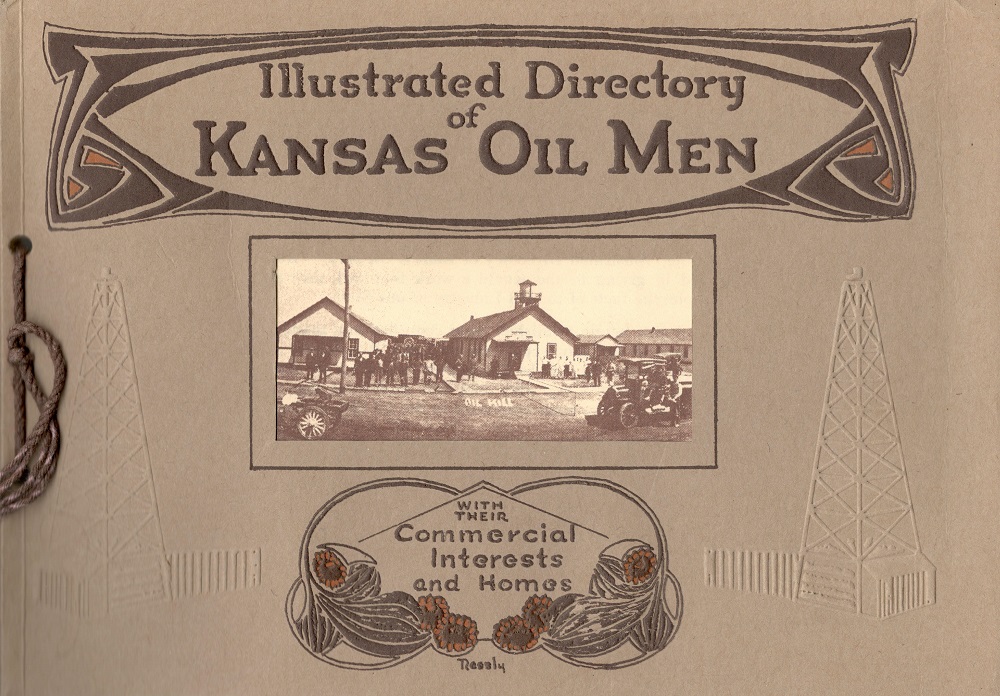
A 1918 directory praised Otter Creek Oil & Gas Company executive W.M. Jamieson.
A Mid-Continent oil discovery in 1915 revealed the giant El Dorado field and launched a Kansas oil boom. A subsidiary of Cities Service Company completed the Stapleton No. 1 well on October 5, 1915, in Butler County.
The discovery attracted many new and established companies to El Dorado and nearby Wichita, including Otter Creek Oil & Gas Company. According to the Kansas Oil Museum, the El Dorado oilfield, which proved to be 34-square-miles, was the first ever found using the science of petroleum geology.
“Before 1915, geologists were seen in the same vein as witching and doodlebugs. They were just charlatans,” explains Warren Martin in a 2015 Butler County Times-Gazette article on the centennial of the Stapleton No. 1 well. “It fundamentally transformed it from that point going forward. Geology was established as one of the great science industries.”
The earliest geological map of North America had been made in 1809. Geologic mapping in California began as early as 1826. Petroleum geology in the United States first gained status as a profession in 1917, when the American Association of Petroleum Geologists was organized.
Kansas oil discoveries (including an 1892 well at Neodesha), and gushers in North Texas, demonstrated existence of a petroleum-producing geologic region in the central and southwestern United States. Production from the Mid-Continent today includes hundreds of oilfields reaching from Kansas, Oklahoma and Texas into parts of Louisiana and Missouri.
Otter Creek Oil & Gas Company
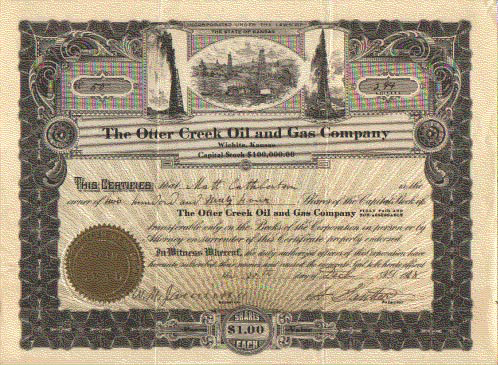
Otter Creek Oil & Gas Company was formed in the summer of 1917 by three Wichita businessmen: A. Sautter, A.J. Engler and W.M. Jamieson. Sautter was associated with Piedmont Petroleum Company, which reportedly had drilled wells near Tussy, Oklahoma. Jamieson was among those featured in the Illustrated Directory of Kansas Oilmen in 1918:
 “In writing up Mr. W.M. Jamieson, secretary of Otter Creek Oil and Gas Company, it is unnecessary to resort to flower epigrams and dig up camouflage sensations,” noted the booklet featuring selected leaders of Butler County exploration companies and refineries, “with their commercial interests and homes.”
Otter Creek Oil & Gas Company had incorporated with a declared a capital par value of $1 per share and offered 100,000 shares. The company recorded 43 stock holders and holdings of 580 acres in Greenwood County, Kansas, Otter Creek township. Greenwood County borders Butler County to the east.
Although the company’s establishment corresponded with a surge in demand for petroleum that had begun at the start of World War I, production from a series of oilfield discoveries, including the “Roaring Ranger” in Texas, brought the industry’s familiar boom and bust cycle in prices.
Contemporary periodicals intermittently reported on Otter Creek Oil & Gas drilling operations in Greenwood County. Some reports included section-township-range descriptions, but records about the company’s exploratory wells have been elusive; reporting errors at the time also were frequent. There were other similarly named exploration companies in the region, too.
In November 1918, when the trade publication Oil & Gas News reported an Otter Creek Oil & Gas well to be shut down, company President Sautter demanded a correction. “I do not know where you got your information, but whoever gave it to you was wrong,” he declared, adding that “we have never been shut down,” and “for the information of our stockholders and the general public, I ask you to rectify this statement.”
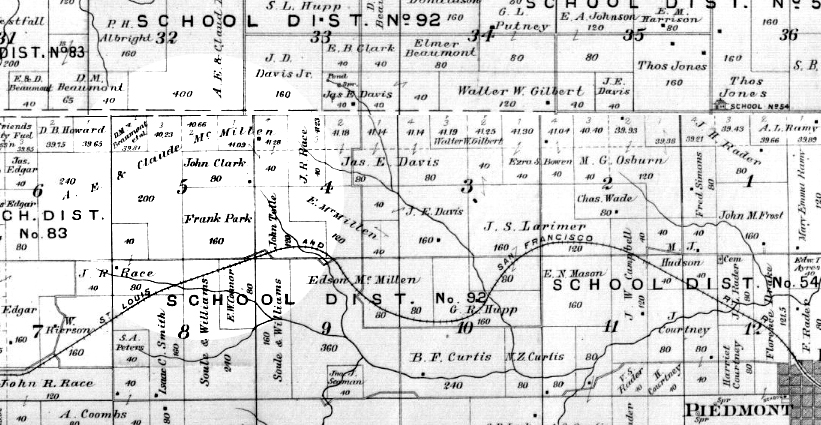 An Otter Creek township map shows properties owned by the McMillen family, who leased their mineral rights to Otter Creek Oil & Gas for oil exploration.
The November 20, 1919, Oil Distribution News reported the company’s well on that property to be shut down at 1,300 feet deep (Section 5, Township 28 South, Range 9 East), Greenwood County. The company’s outlook improved by April 1920, when another well attempt, again on the McMillen lease, drilled to a depth of 2,500 feet and reportedly set casing, indicating some oil production.
However, oilfield fortunes could change suddenly, leaving little explanation as to what happened. Intense competition throughout the Mid-Continent fields made good prospects hard to come by and expensive. Contracted drilling costs typically skyrocketed during booms. Many companies arrived too late, and some went bankrupt without drilling a single well. On August 10, 1921, when the Wichita Beacon newspaper published a list of 37 companies that had failed, Otter Creek Oil & Gas was among them.
Promoting the Kansas Oil Industry
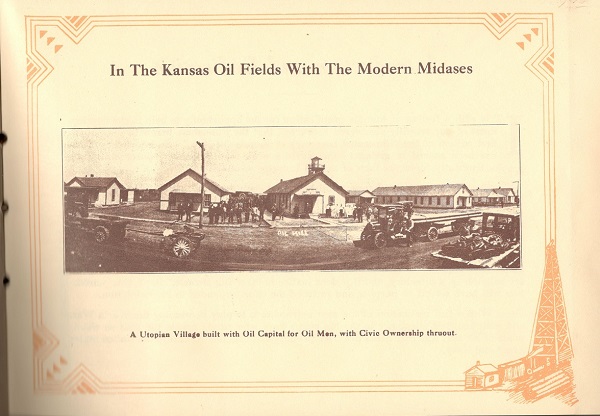
Although it did not resort to “flower epigrams” in its praise of W.M. Jamieson, secretary of Otter Creek Oil and Gas Company, the Illustrated Directory of Kansas Oilmen came close. The booklet, published in 1918 by the Muncipal Publicity Company, was intended to “truthfully depict the facts of the Oil Industry in our State.”
In 96 pages, the directory featured leaders of Wichita and El Dorado-based oil companies, Butler County refinery owners, and “their commercial interests and homes.” It also explained the significance of the giant oilfield’s production, noting it provided Buttler County with $130 million in 1917.
Mr. W.M. Jamieson, featured on page 25, was reported to have first arrived in Kansas in 1883, but left to mine coal in New Mexico. In 1903 Jamieson “served as superintendent of excavation and tracks in building the great filtration plant for the city of Washington, D.C.”
He also worked for a railroad construction company in Cuba and “the swamps of the Amazon” and other parts of South America, where he reportedly drilled oil wells in 1908, according to the directory’s biography. His page notes that returning to Kansas by 1916, he found “some of the choice acreage” in Greenwood County.
The booklet’s final description of Jamieson was the praise and prediction that “he always attempts such big things and, somehow, has a knack of putting them thru – all contribute to the conviction that his association with The Otter Creek Oil and Gas Co. is enough to ensure its success.”
 ____________________________
The stories of many exploration companies trying to join petroleum booms (and avoid busts) can be found in an updated series of research in Is my Old Oil Stock worth Anything?
AOGHS.org welcomes sponsors to help us preserve petroleum history. Please support this energy education website with a tax-deductible donation today. Contact bawells@aoghs.org for information on levels and types of available sponsorships. © 2017 AOGHS.
by Bruce Wells | Jun 2, 2016 | Petroleum Companies
A Canadian, C.C. (Courtney Chauncey) Julian, formed the Julian Petroleum Company in May 1923 in Los Angeles.
After witnessing the excitement created by the state’s booming petroleum industry, Julian created a vast Ponzi scheme camouflaged as an investment opportunity. Julian bilked millions of dollars from eager investors through aggressive sales and a continuous newspaper advertising blitz.
In what became known as the “Julian Pete Scandal,” the con man by April 1927 had peddled almost four million worthless stock certificates. There are many newspaper and magazine articles – and at least one book – about the Julian Petroleum Company and the swindle “that rocked Los Angeles.”
As Julian’s fraud collapsed, a well-known Los Angeles lawyer, Joseph Scott, was appointed by the court to serve as receiver along with H.L. Carnahan, a former California Corporation Commissioner. Scott and Carnahan created Sunset Pacific Oil Company from the remains of Julian Petroleum Company.
Sunset Pacific failed with $12 million in debt to Associated Oil Company and was ultimately reorganized into Sunset Oil Company in 1934. Shareholders of the former company received common stock shares in the new, with the former certificates cancelled. Learn more in The Great Los Angeles Swindle by Jules Tygiel.
The stories of exploration and production companies trying to join petroleum booms (and avoid busts) can be found updated in Is my Old Oil Stock worth Anything?
_______________________
Recommended Reading: The Great Los Angeles Swindle (1994). Your Amazon purchases benefit the American Oil & Gas Historical Society; as an Amazon Associate, AOGHS earns a commission from qualifying purchases.
_______________________
The American Oil & Gas Historical Society (AOGHS) preserves U.S. petroleum history. Become an AOGHS annual supporting member and help maintain this energy education website and expand historical research. For more information, contact bawells@aoghs.org. Copyright © 2023 Bruce A. Wells. All rights reserved.
Citation Information – Article Title: “Sunset Pacific Oil Company.” Authors: B.A. Wells and K.L. Wells. Website Name: American Oil & Gas Historical Society. URL: https://aoghs.org/old-oil-stocks/sunset-pacific-oil-company. Last Updated: December 22, 2018. Original Published Date: June 2, 2016.