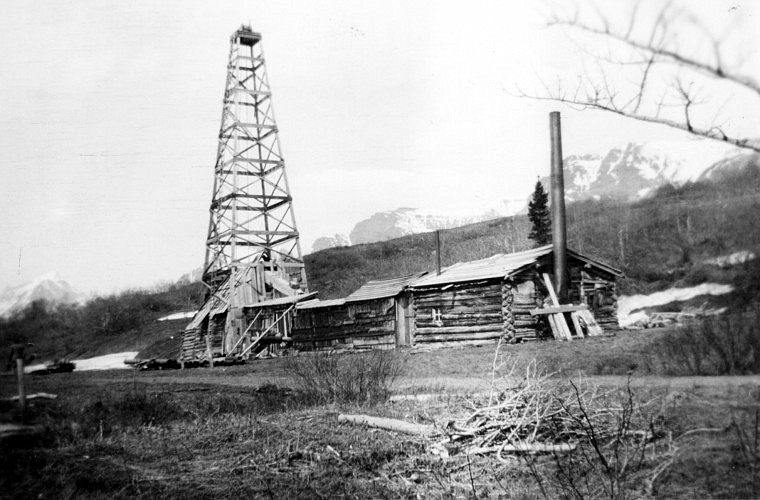
Exploration company’s cable-tool well showed signs of oil as Great Depression began.
Although successful oil wells had been drilled as early as 1901, oil fever arrived in Montana with the October 1915 discovery of the Elk Basin oilfield in Carbon County.
More discoveries came at the Cat Creek oilfield in 1920 and in the Kevin-Sunburst oilfield of 1922, both of which motivated businessmen in Miles City to form the Montana Bell Oil & Gas Company. They filed to do business in the state on March 8, 1924, but their timing was terrible.
Montana’s first oil well was drilled in 1901 in the Kintla Lake area that’s now part of Glacier National Park. Photo courtesy Daily Inter Lake, Kalispell, Montana.
In the last few months of 1924 alone, a financial crisis described by Montana’s superintendent of banks as a “veritable nightmare” closed 191 banks.
Bankrupt in Montana
Between 1921 and 1926, no state had more bankruptcies than Montana. Newspapers reported in 1924 reported “the tremulous activity” of Montana Belle Oil that “may be expected in this country within the year, unless present plans halted.”
Nonetheless, Montana Belle Oil & Gas was able to secure a mineral lease from Adolph F. Loesch west of Miles City in April 1926. The company selected a drilling site for its first well in typically foreboding southeast Montana (see Public Land Survey System, Northeast Quarter of Section 28, Township 8 North, Range 45 East).
Drilling the wildcat well during hard financial times and in a remote location slowed progress. Legal issues also troubled the company, according to reports in the Billings Gazette.
“With the settlement of differences arising without recourse to the courts, the officers of the Montana Belle Oil & Gas company are preparing to proceed,” the newspaper noted in January 1928.
“Drilling in the Montana Belle Oil and Gas company well, located about twelve miles west of this city is proceeding 24 hours a day,” the reporter added.
Using dated cable-tool drilling technology, the company reached a depth of 1,035 feet. The Billings Gazette reported the company’s objective was a depth of 1,750 feet, “in accordance with the report of the geologist who has made a survey and examination of the earth strata, and at which it is expected that results will follow. Gas is also in evidence in the hole.”
Investors and stockholders were encouraged that the well was “showing some light oil though not in commercial quantities.” The drilling continued into deeper formations. On October 24, 1929 — “Black Thursday” — the U.S. stock market crashed, launching the Great Depression.
In December 1929, five years after incorporating, Montana Belle Oil and Gas Company’s only oil well shut down for the winter. It reportedly had reach the impressive depth of 4,562 feet, but drilling never resumed. Montana Belle Oil and Gas Company failed in 1930, as did Miles City’s oil refinery and many other oilfield businesses.
Citation Information – Article Title: “Montana Belle Oil & Gas Company.” Authors: B.A. Wells and K.L. Wells. Website Name: American Oil & Gas Historical Society. URL: https://aoghs.org/old-oil-stocks/montana-belle-oil-amp-gas-company. Last Updated: February 29, 2024. Original Published Date: April 13, 2022.
African American entrepreneurs began their Oklahoma oil venture in 1917.
Discovery of Oklahoma’s giant Healdton oilfield in August 1913 about 20 miles northwest of Ardmore launched years of investment as petroleum companies competed to secure leases and drill. In the African American community, four entrepreneurs formed the Ardmore Lubricating Oil Company.
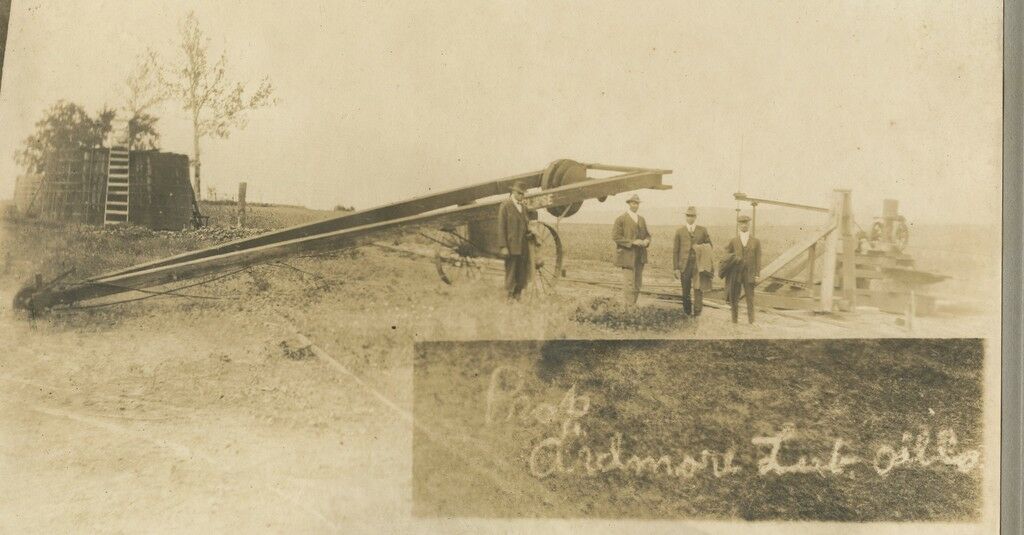
Oklahoma’s Daily Ardmoreite reported on August 15, 1918, that Ardmore Lubricating Oil Company moved a Star Rig to explore for oil on land adjacent to the town of Tatums. Image from online auction sale.
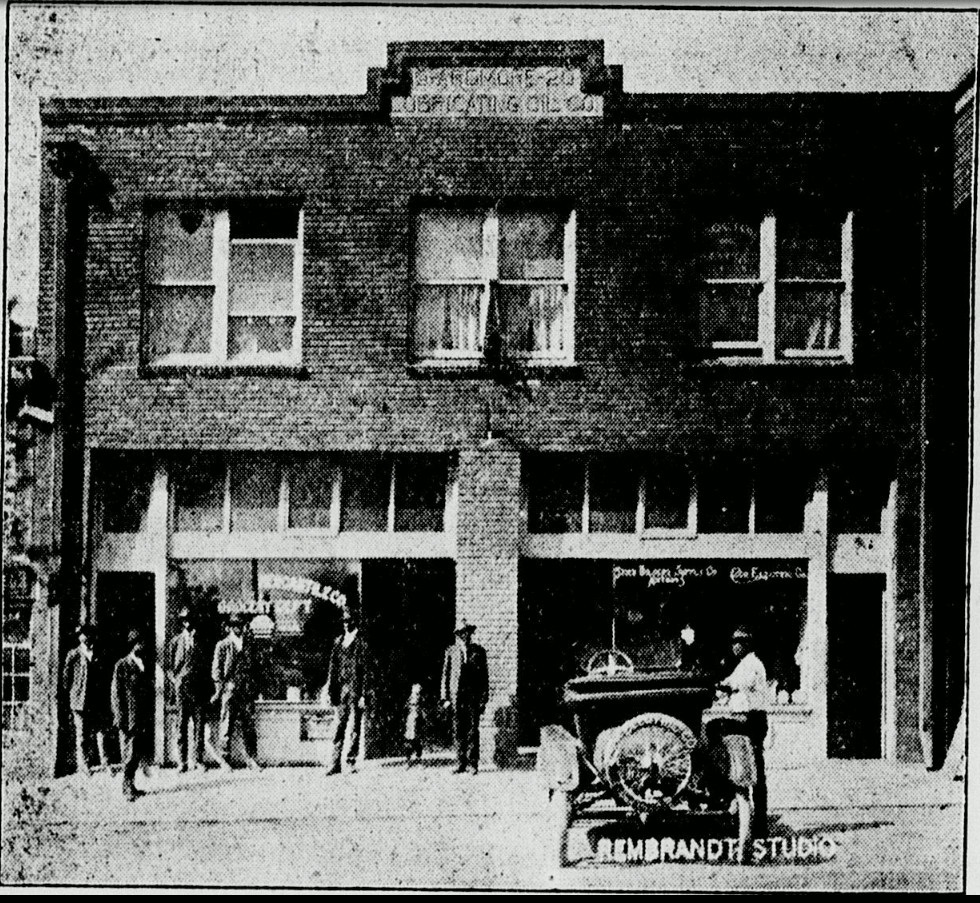
Today, East 2nd Street is the heart of the “Deep Deuce” district and is known for its historic jazz and culture. But in 1917, that part of downtown was exclusively for “coloreds,” segregated to the other side of the Santa Fe railroad tracks. It was the era of Gov. William “Alfalfa Bill” Murray’s Jim Crow laws (the Civil Rights Act was still half a century away), but along East 2nd Street African-American businesses and neighborhoods prospered.
Ardmore Lubricating Oil Company moved into offices at 319 and 321 East 2nd Street, across from the Black Dispatch weekly, established two years earlier by Roscoe Dunjee. Advertised as the “Largest circulation Negro journal in Oklahoma,” the paper soon carried Ardmore Lubricating Oil Company promotions encouraging readers to invest.
“Buy Stock in a Home Company – With Men Whom You Know at its Head…100 acres leased and shallow wells producing the high-grade of oil,” declared one ad. The company announced plans “to deepen our 1,360 foot well to the lower pay.” Early investors could get in for the bargain price of $1 a share.
As Ardmore Lubricating Oil operations continued into June 1919, news reports for stockholders were mixed. The company completed a producing well on its 100-acre lease that yielded one barrel of oil a day of “high grade lubrication oil.” The company’s chemist predicted it would be worth $10 a barrel at a time when ordinary oil was selling for $2 dollars per barrel.
In 1920, Ardmore Lubricating Oil began moving equipment to drill a well just outside Tatums, about 80 miles south of Oklahoma City. The company announced it would build its own refinery there to process its especially valuable oil from the Healdton field. Tatums was one of about 50 all-black towns in the former Indian Territory that grew from post Civil War reconstruction. These self-segregated communities were reflective of the times; they remain as reminders of America’s struggle with race and identity.
With a new lab opened in 1920 upstairs at its Oklahoma City offices, the company’s wells reportedly could produce “high grade lubrication oil” and “Icthyol Oil,” a salve for eczema and other skin conditions. Image from online auction sale.
The superintendent, manager and stock salesman of the Ardmore Lubricating Oil, H.E. Baker, published a telegraphed message about the Tatums well site: “We have three wells producing the highest grade and most valuable oil found in the United States, the great drug Icthyol Oil, one of the most sought for and needed products of the world today.”
“Icthyol” was a popular European skin ointment produced from dry distillation of sulfur-rich oil shale, but Ardmore Lubricating Oil Company executives declared they could refine it from Tatums’ crude oil and process it in their own laboratory. In February 1920, the company announced a four-day grand opening to celebrate their new lab upstairs.
“The general public is cordially invited to come and see Kerosene, Automobile Oil and Icthyol,” noted an Ardmore Lubricating Oil promotion. Other ads proposed mutually beneficial business arrangements with merchants, investors, farmers, and consumers.
Increasingly creative financing and uninterrupted stock sales were needed for Ardmore Lubricating Oil to remain solvent. The Black Dispatch in 1921 praised H.E. Baker, noting his company’s “development grows by leaps and bounds…You can get into this company now on the ground floor, $10 is all that you can invest at this time for each member of the family, this will insure at the outset an equal opportunity for all, later on the hundreds of stock holders can get together and determine as to the larger plan of organization.”
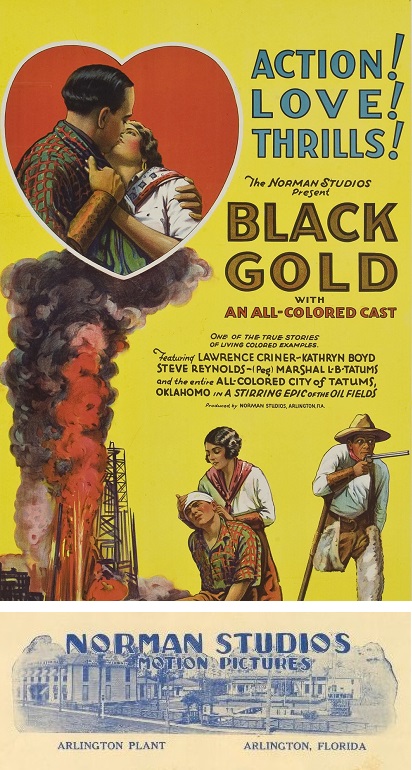
Tatums’ townspeople in 1927 hosted and acted in “Black Gold,” a silent picture produced by Norman Studios and featuring an “All Colored Cast.” Posters courtesy IMDB.com and Norman Studios.org.
However, construction of the Ardmore Lubricating Oil refinery in Tatums still had not begun by August 1921. News about the company’s oil wells grew scarce as Baker sold his own leases. The last appeals for new investors appearing in the Black Dispatch were nevertheless optimistic:
“Wonderful Opportunities In Larger Faith And Deeper Hole,” proclaimed the newspaper. “To anyone with a limited amount of brains it can be seen that a little more faith and a deeper hole will bring into the hands of the Negro landholders in this section the millions of dollars, which their white neighbors all around them are reaping hourly from the derricks that have lunched great holes in the earth and are spouting liquid treasure everywhere.”
A few years later, but too late for Ardmore Lubricating Oil, the area around Tatums did experience an oil boom that was celebrated on the big screen. In 1927, townspeople hosted the making of Black Gold, a silent picture produced by Norman Studios and distributed to all-black theaters the next year. The Florida-based studio described its movie as a “stirring epic of the oil fields” with a cast including, “U.S. Marshall L.B. Tatums. and the entire all-colored City of Tatums, Oklahoma.”
The action-packed melodrama featured Ace Brand, his sweetheart Alice, and a one-legged cowboy (named Peg), who overcame both adversity and injustice in the oil patch. While the film’s happy ending delivered an oil gusher, Ardmore Lubricating Oil Company did not.
Few financial records remain about the company, but Gateway to Oklahoma History and the Black Dispatch’s archives offer more context to this almost forgotten story from U.S. petroleum history.
Citation Information – Article Title: “Ardmore Lubricating Oil Company.” Author: Aoghs.org Editors. Website Name: American Oil & Gas Historical Society. URL: https://aoghs.org/stocks/ardmore-lubricating-oil-company. Last Updated: February 21, 2024. Original Published Date: July 4, 2019.
Ardmore Lubricating Oil Company opened offices in this building on East 2nd Street in a segregated district of downtown Oklahoma City known for its prospering businesses and jazz music nightlife. Photo courtesy The Black Dispatch, Oklahoma City, April 20, 1922, Vol. 7, No. 20.
Decades of production from the Healdton oilfield would yield more than 200 million barrels of oil — but the prolific field left hundreds of forgotten petroleum companies hidden in its exploration and production history.
Oil production from the Healdton field was shallow, averaging about 1,000 feet, and the low cost of drilling attracted many small ventures that operated on capital raised by aggressive stock sales. State “Blue Sky” laws had yet to restrain advertising excesses and promotions. Competition for investors often was fierce (see Homestead Oil Company).
Ardmore Lubricating Oil Company
When a group of foundering Coffeyville, Oklahoma, investors gave up on their 100-acre oil lease in 1917, four African American entrepreneurs bought out the venture and its unfinished 1,360-foot-deep well, which had encountered “several light sands” and a water-filled borehole.
Wilson Newman, J.C. Pratt, S.M. Holland, and Heston Welborn formed the Ardmore Lubricating Oil Company, capitalized at $50,000, and set up offices on East 2nd Street in Oklahoma City.
Oklahoma’s Daily Ardmoreite reported on August 15, 1918, that Ardmore Lubricating Oil Company moved a Star Rig to explore for oil on land adjacent to the town of Tatums. Image from online auction sale.
Today, East 2nd Street is the heart of the “Deep Deuce” district and is known for its historic jazz and culture. But in 1917, that part of downtown was exclusively for “coloreds,” segregated to the other side of the Santa Fe railroad tracks. It was the era of Gov. William “Alfalfa Bill” Murray’s Jim Crow laws (the Civil Rights Act was still half a century away), but along East 2nd Street African-American businesses and neighborhoods prospered.
Ardmore Lubricating Oil Company moved into offices at 319 and 321 East 2nd Street, across from the Black Dispatch weekly, established two years earlier by Roscoe Dunjee. Advertised as the “Largest circulation Negro journal in Oklahoma,” the paper soon carried Ardmore Lubricating Oil Company promotions encouraging readers to invest.
“Buy Stock in a Home Company – With Men Whom You Know at its Head…100 acres leased and shallow wells producing the high-grade of oil,” declared one ad. The company announced plans “to deepen our 1,360 foot well to the lower pay.” Early investors could get in for the bargain price of $1 a share.
As Ardmore Lubricating Oil operations continued into June 1919, news reports for stockholders were mixed. The company completed a producing well on its 100-acre lease that yielded one barrel of oil a day of “high grade lubrication oil.” The company’s chemist predicted it would be worth $10 a barrel at a time when ordinary oil was selling for $2 dollars per barrel.
In 1920, Ardmore Lubricating Oil began moving equipment to drill a well just outside Tatums, about 80 miles south of Oklahoma City. The company announced it would build its own refinery there to process its especially valuable oil from the Healdton field. Tatums was one of about 50 all-black towns in the former Indian Territory that grew from post Civil War reconstruction. These self-segregated communities were reflective of the times; they remain as reminders of America’s struggle with race and identity.
With a new lab opened in 1920 upstairs at its Oklahoma City offices, the company’s wells reportedly could produce “high grade lubrication oil” and “Icthyol Oil,” a salve for eczema and other skin conditions. Image from online auction sale.
The superintendent, manager and stock salesman of the Ardmore Lubricating Oil, H.E. Baker, published a telegraphed message about the Tatums well site: “We have three wells producing the highest grade and most valuable oil found in the United States, the great drug Icthyol Oil, one of the most sought for and needed products of the world today.”
“Icthyol” was a popular European skin ointment produced from dry distillation of sulfur-rich oil shale, but Ardmore Lubricating Oil Company executives declared they could refine it from Tatums’ crude oil and process it in their own laboratory. In February 1920, the company announced a four-day grand opening to celebrate their new lab upstairs.
“The general public is cordially invited to come and see Kerosene, Automobile Oil and Icthyol,” noted an Ardmore Lubricating Oil promotion. Other ads proposed mutually beneficial business arrangements with merchants, investors, farmers, and consumers.
Increasingly creative financing and uninterrupted stock sales were needed for Ardmore Lubricating Oil to remain solvent. The Black Dispatch in 1921 praised H.E. Baker, noting his company’s “development grows by leaps and bounds…You can get into this company now on the ground floor, $10 is all that you can invest at this time for each member of the family, this will insure at the outset an equal opportunity for all, later on the hundreds of stock holders can get together and determine as to the larger plan of organization.”
Tatums’ townspeople in 1927 hosted and acted in “Black Gold,” a silent picture produced by Norman Studios and featuring an “All Colored Cast.” Posters courtesy IMDB.com and Norman Studios.org.
However, construction of the Ardmore Lubricating Oil refinery in Tatums still had not begun by August 1921. News about the company’s oil wells grew scarce as Baker sold his own leases. The last appeals for new investors appearing in the Black Dispatch were nevertheless optimistic:
“Wonderful Opportunities In Larger Faith And Deeper Hole,” proclaimed the newspaper. “To anyone with a limited amount of brains it can be seen that a little more faith and a deeper hole will bring into the hands of the Negro landholders in this section the millions of dollars, which their white neighbors all around them are reaping hourly from the derricks that have lunched great holes in the earth and are spouting liquid treasure everywhere.”
A few years later, but too late for Ardmore Lubricating Oil, the area around Tatums did experience an oil boom that was celebrated on the big screen. In 1927, townspeople hosted the making of Black Gold, a silent picture produced by Norman Studios and distributed to all-black theaters the next year. The Florida-based studio described its movie as a “stirring epic of the oil fields” with a cast including, “U.S. Marshall L.B. Tatums. and the entire all-colored City of Tatums, Oklahoma.”
The action-packed melodrama featured Ace Brand, his sweetheart Alice, and a one-legged cowboy (named Peg), who overcame both adversity and injustice in the oil patch. While the film’s happy ending delivered an oil gusher, Ardmore Lubricating Oil Company did not.
Few financial records remain about the company, but Gateway to Oklahoma History and the Black Dispatch’s archives offer more context to this almost forgotten story from U.S. petroleum history.
Citation Information – Article Title: “Ardmore Lubricating Oil Company.” Author: Aoghs.org Editors. Website Name: American Oil & Gas Historical Society. URL: https://aoghs.org/stocks/ardmore-lubricating-oil-company. Last Updated: February 21, 2024. Original Published Date: July 4, 2019.
“You will feel pretty good some of these fine mornings when your shares jump to 5 or 10 for one.”
With oil booms in North Texas, especially along the Red River border with Oklahoma, Tulsa Producing and Refining Company incorporated to join the action in America’s growing Mid-Continent oil patch. In February 1919, the Texas El Paso Herald carried an advertisement for Tulsa Producing and Refining.
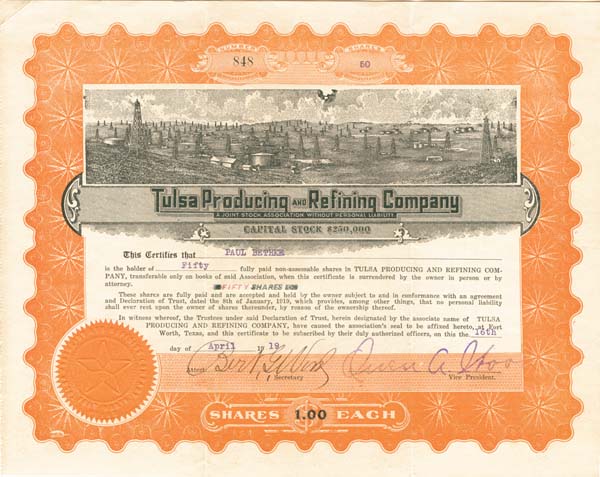
Stock certificate for the now defunct Tulsa Producing and Refining Company.
“A Strong, Solid Company With Two Wells Now Drilling” the advertisement proclaimed. It offered 250,000 shares of stock at $1 per share.
According to the company’s claims, the two wells were drilling in Comanche County, Texas, where Tulsa Producing and Refining reportedly held 1,000 acres under lease. Advertisements appeared in newspapers as far away as Pennsylvania, where America’s petroleum industry had begun in 1859 with the first U.S. oil well.
Frequent references were made to an oil boom in the remote region with 328,098 barrels of oil already produced. Even more enthusiastic advertisements about Texas discoveries followed in the Pittsburgh Gazette Times in May and June 1919.
“If either of these wells come in big, the shareholders of the Tulsa Producing & Refining Company will cash in strong – and do it quickly,” extolled perhaps one of the more conservative claims.
“You will feel pretty good some of these fine mornings when your shares jump to 5 or 10 for one,” added the company. “We believe this is going to happen – and happen soon, too.”
The predicted happiness apparently didn’t happen. All references to the company disappear thereafter.
Popular Certificate Vignette
Seeking investors to chase “black gold” riches led to a surge in printing scenes of derricks on stock certificates.
Drilling booms often lead to many quickly formed (and quickly failed) exploration companies. As company executives rushed to print stock certificates, they often chose this same scene of derricks and oil tanks.
In the rush to promote their drilling plans, new companies had little time or money to find original art. One oilfield vignette from print shops proved particularly popular.
More articles about the attempts to join exploration booms (and avoid busts) can be found in an the updated research atIs my Old Oil Stock worth Anything?
Citation Information – Article Title: “Tulsa Oil and Refining Company.” Authors: B.A. Wells and K.L. Wells. Website Name: American Oil & Gas Historical Society. URL:https://aoghs.org/old-oil-stocks/tulsa-producing-and-refining-company. Last Updated: November 14, 2023. Original Published Date: April 2, 2015.
Although William S. Pratt entered the oil exploration business in Wyoming in 1915, he soon moved to Kansas and organized the Wichita Eagle Oil Company. It and many newly formed “wildcatting” companies would not succeed in risky Mid-Continent drilling and production (see Otter Creek Oil & Gas, formed by Wichita businessmen and the Cahege Oil & Gas Company, at Caney, where a Kansas gas well fire had made headlines.
A major oilfield discovery in North Texas — “Roaring Ranger” — in 1917 also attracted national attention. Pratt launched his Texas United Oil Company there in July 1919. By the last quarter of 1919, the Texas comptroller’s office reported Pratt’s company had produced more than 31,000 barrels of oil.
Promoting Texas United Oil
Texas United Oil Company solicited investment capital with a series of ads placed in newspapers nationwide, including in Spokane, Washington; El Paso, Texas; Troy, Syracuse, and Plattsburgh, New York; and Washington D.C.
From December 1919 through 1920, company marketing efforts promised: For Quick Returns and Unlimited Profits Invest With the Texas United Oil Company…27 Wells Showing Initial Production of 8,700 Bbls. Daily.
But at least one investment magazine described the company as unlikely to prosper, and the assessment proved to be accurate.
By December 1920, Texas United Oil Company entered into receivership and did not emerge until April 27, 1921, reorganized and with a new president, Aldred S. Wright of Philadelphia.
Despite the reorganization, the company did not survive long. United States Investor reported in 1922 that Texas United Oil Company had very little value.
“It is of course not listed on any of the principal exchanges,” the magazine noted, adding that no dividends had been issued since 1920. “The company had about $1,300,000 stock outstanding and there was one public offering by people in Hartford, Connecticut, at $2 per share. Two cents per share is approximately the price now.”
“A Sure and Safe Investment ”
October 1, 1919 – The Texas United Oil Company of Dallas produces 31,541 barrels of oil valued at $10,789 between October 1 and December 31, 1919, according to the Texas comptroller.
December 21, 1919 – In one of its first newspaper appearances, President W. S. Pratt describes the company’s leases and production success in the Northwest Extension of the Burkburnett oilfield.
Pratt announces that the company’s trustees have resolved to increase capital to $5 million and he encourages potential investors to purchase stock at $2 per share to enable “development of our many properties and the purchase of additional production.” — ad in Spokesman-Review, Spokane, Washington
January 3, 1920 – The company is promoted in an open letter advertisement sent from Electra, Texas, “to our stockholders and others” from J. R. Lucore, shareowner, of Olean, New York. Lucore reports very positive on-scene observations of drilling and production in progress. His endorsement follows:
“The Texas United is a sure and safe investment for anyone to buy stock in. No one need be in the least afraid to invest as large as one see fit and his investment will be the safest and surest of any company operating in the State…I expect to arrive home in a few days and will enlarge my stock order to you in the Texas United Oil Company on my arrival.” — ad in Gloversville, N.Y., Morning Herald
January 31, 1920 – The company is reported as formed by a Declaration of Trust filed on July 2, 1919, with trustees L. W. Harrington, Herbert Bingham, H. C. Ralph and J. M. Davis. It receives a poor recommendation:
“Our information as to the management is that it is not as economical as it might be, and that operating costs are likely to be altogether too high because of rather poor judgment in planning the work.” — article in United States Investor
“The King of the Oil Companies”
February 21, 1920 – The Texas United Oil Company of 1209 Half Main Street, Dallas, Texas, asserts that the United States Investor’s bad recommendation refers to another company of the same name whose headquarters is in Wichita and not Dallas. The company protests that “conclusions relative to the Wichita enterprise cannot fairly be applied.” Investigation planned. — article in United States Investor
February 25, 1920 – The company proclaims itself as “The King of the Oil Companies” and promises 30 percent dividends and $5 million in capital stock with 12 producing wells. — ad in Spokesman Review, Spokane, Washington
March 13, 1920 – Company promotion continues, citing “12 producing oil wells – over 3,000 barrels daily” and “30 percent dividends have been paid in 7 months” Shares are offered at $2. Agent is J. S. Miramon, Rensselaer Hotel, Troy “Salesmen wanted: Liberal commission. Phone for appointment.” — ad in Troy (N. Y.) Times
April 17, 1920 – J. S. Miramon, now of Barows Company, 141 Broadway, New York City, advertises “Wise Investors, Increase your income” with company’s “2 percent monthly dividends, with record of 39 percent in dividends past nine months.” — ad in El Paso (Texas) Herald
April 10, 1920 – Analysts confirm poor recommendation after consulting with the company, the New York City based owners of the company. “We cannot do otherwise than classify this as the ordinary type of oil gamble, a quite unproven enterprise, depending for its future upon the skill with which it is managed. — article in United States Investor
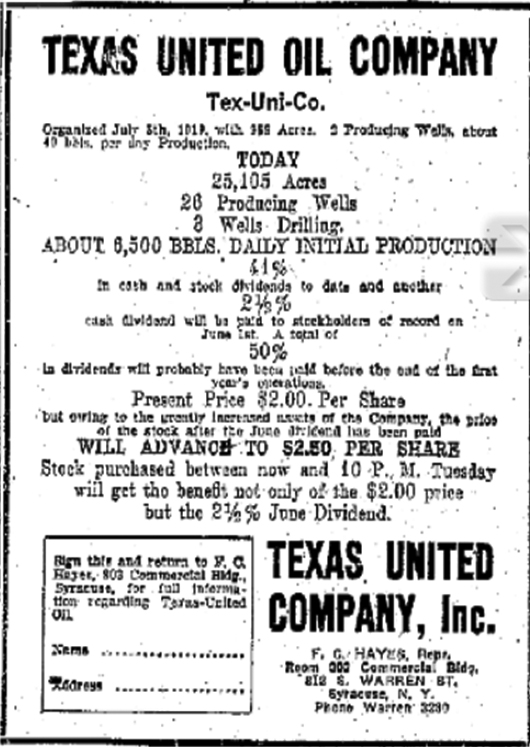
May 15, 1920 – Tex-Uni-Co. (trademark for Texas United Oil Company) advertises 18 producing wells, two ready to come in per April 30 telegram testimonial by Ralph P Reed, president National Investors Protective Corporation.
“These dividends will make a total of 43 ½ percent in cash and stock dividends paid in less than one year.” A. E. Roberts and Co., Washington, D.C. — ad in The Federal Employee, Washington D.C.
May 30, 1920 – The company promotes its self (Tex-Uni-Co.) as having rapidly grown from its origins in July, 1919 with 389 acres and two 2 producing wells, yielding about 42 barrels a day of production grown until. — ad in Syracuse Herald, Syracuse, New York.-
“Quick Returns and Unlimited Profits”
Jun 2, 1920 – “For Quick Returns and Unlimited Profits Invest With The Texas United Oil Company” upstate New York advertisement proclaims “27 Wells Showing Initial Production of 8,700 BBls. Daily.” — ad in Daily Republican, Plattsburgh, New York
December 1920 – Company enters into receivership.
February 25, 1921 – Advertising continues for twelve producing wells 30 percent dividends.” — ad in Spokesman-Review, Spokane, Washington
April 16, 1921 – Value of the company plummets as it is reported to have “been the subject of much litigation of late…Texas United shares have declined to around five cents since their first appearance upon the market at $2 per share.” — article in United States Investor
April 27, 1921 – The company emerges from receivership reorganized and with a new president, Aldred S. Wright of Philadelphia.
November 11, 1922 – The company “is of little value …two cents per share is approximately the price now.” — article in United States Investor
More history ablur U.S. petroleum exploration and production companies joining petroleum booms (and avoiding busts) can be found inIs my Old Oil Stock worth Anything?
Citation Information – Article Title: “Texas United Oil Company.” Authors: B.A. Wells and K.L. Wells. Website Name: American Oil & Gas Historical Society. URL: https://aoghs.org/old-oil-stocks/texas-united-oil-company. Last Updated: October 1, 2023. Original Published Date: January 5, 2013.
Boom and bust of an obscure mid-continent petroleum company began in 1917.
The International Petroleum Register noted formation of Oklahoma-Texas Producing & Refining Company as a Delaware corporation in 1917. With capitalization of $5 million in common stock authorized and more than $734,000 issued, the company obtained leases in Muskogee, Tulsa, Rogers, and Okmulgee counties in Oklahoma, and in Allen County, Kansas.
Major north Texas oilfield discoveries in Electra (1911) and Ranger (1917) attracted petroleum companies to the mid-continent. As oil demand soared during World War I, hundreds of new exploration and productions companies formed — and sought investors. Most of these companies would not survive.
By 1919, Oklahoma-Texas Producing & Refining’s lease ownership had expanded to 10,313 acres with an additional 815 acres from its acquisition of Tulsa Union Oil Company. About this time, all of the company’s petroleum production was sold to Prairie Oil and Gas Company.
Oklahoma-Texas Producing & Refining meanwhile continued drilling for oil in Coffee County, Kansas, and elsewhere, and the company’s estimated production reached 10,000 barrels of oil each month — a promising development for investors. The financial magazine United States Investor added a positive endorsement in May 1920 after Oklahoma-Texas Producing & Refining reported production of 27,000 barrels of oil worth $65,000.
“It appears that this company is further along the road to development that a great many of the new oil companies, though whether its shares at the present offering price of $2.50 on the basis of a $1 par represent an extravagant price, cannot be told until further developments have occurred,” United States Investor reported.
However, six months later, the company’s shares were selling for less than 14 cents. Records of what went wrong are obscure. There are references to a convoluted business venture with another oil company. The deal was orchestrated by New York financier Mrs. Ada M. Barr after Oklahoma-Texas Producing & Refining had failed in January 1921.The next month, after being put in the hands of a receiver, the company’s assets were sold for $87,400.
The buyer was Mrs. Barr, who soon would be enveloped in controversy and litigation of her own.
Acorn Petroleum Corporation, represented by Mrs. Barr, offered bonds in the amount of $150,000 of Acorn Petroleum Corporation on the basis of $250 in bonds for each $1,000 of Oklahoma-Texas Producing & Refining stock held.
“The new company is operating the properties and has twenty-three producing wells, giving about ninety barrels of oil a day. The present low price for oil does not enable the company to earn sufficient income to pay interest on its bonds,” United States Investor noted. “Mrs. A.M. Barr, who arranged the financing of the new company, says that as soon as oil advances to a price that will permit, accrued interest on the bonds and dividends on the stock will be paid.”
But they weren’t.
By March 1923, investor Lewis H. Corbit filed a petition on behalf of a large number of local purchasers of stocks in the Acorn Petroleum Corporation of Tulsa, Oklahoma. The petition in the United States District court sought to determine the value of the local holdings, which represent an investment of approximately $100,000.
According to records, “In his complaint, asking for an investigation, Corbit alleges a stock, fraud in which $ 500,000 is involved. Certificates of shares held here were sold by a Mrs. A. M. Barr, it is disclosed in the petition.”
Further financial records and other details about Oklahoma-Texas Producing & Refining Company, Acorn Petroleum Corporation, and Mrs. Ada M. Barr can be research through the Library of Congress’ online Chronicling America: Historic American Newspapers.
___________________
The stories of exploration and production (E&P) companies joining U.S. petroleum booms (and avoiding busts) can be found updated in Is my Old Oil Stock worth Anything?


 (1976);
  (2014). Your Amazon purchases benefit the American Oil & Gas Historical Society; as an Amazon Associate, AOGHS earns a commission from qualifying purchases.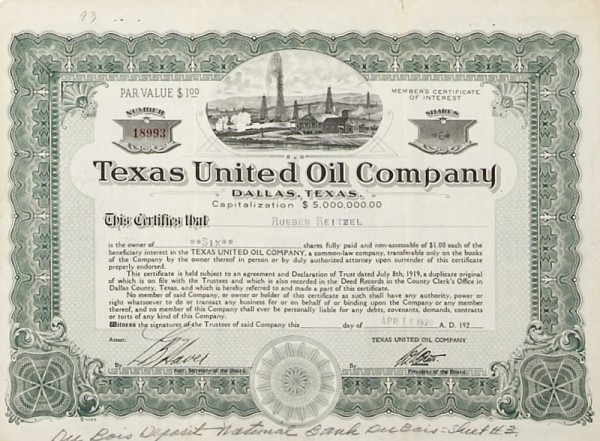
 January 31, 1920 – The company is reported as formed by a Declaration of Trust filed on July 2, 1919, with trustees L. W. Harrington, Herbert Bingham, H. C. Ralph and J. M. Davis. It receives a poor recommendation: