Researching gas stations where the Lincoln Highway and Route 66 meet.
Retired architect Michael Lambert of Plainfield, Illinois, has developed “a fairly complete record of more than 40 stations and operators between 1910 and 1965 that operated at Plainfield, where the Lincoln Highway and U.S. Route 66 share the only common alignment in the nation. ”
In an October 2025 email to the American Oil & Gas Historical Society, Lambert — who has taught college-level archival documentation and is president of the Plainfield Historical Society — wonders whether AOGHS website visitors may shed any light on his community’s petroleum history.
“After a 40-year career, I have retired from my architectural practice, which involved many preservation projects,” Lambert explained. The historical society, established in 1977, is in the process of renovating a two-bay, 1940 Phillips 66 Service Station on Historic Route 66. “In 2026, we will be installing a permanent exhibit: ‘Pumped Up on Plainfield’ that will explore Plainfield’s relationship to the Lincoln Highway and U.S. Route 66, featuring gas stations, diners, tea rooms, tourist homes, and other businesses related to early 20th century automobile travel.”
McCredie Filling Station
In his email to AOGHS, Lambert seeks information about Plainfield petroleum history — especially the McCredie Filling (Gasoline) Station, which distributed Penn Oil gasoline. He believes McCredie Oil was the first purpose-built filling station in the community, which incorporated in 1877.
“I know that one of the early operators was local resident Jacob ‘Jake’ Rausch, a retired farmer who moved ‘into town’ after 1920 and died in 1934 in his mid-seventies,” Lambert noted in his email. “The probable second station at Plainfield was a Standard Oil station and the third was the Newkirk-Overman Texaco station in 1928 (listed in the National Register of Historic Places, erroneously, as a Standard Oil station).”
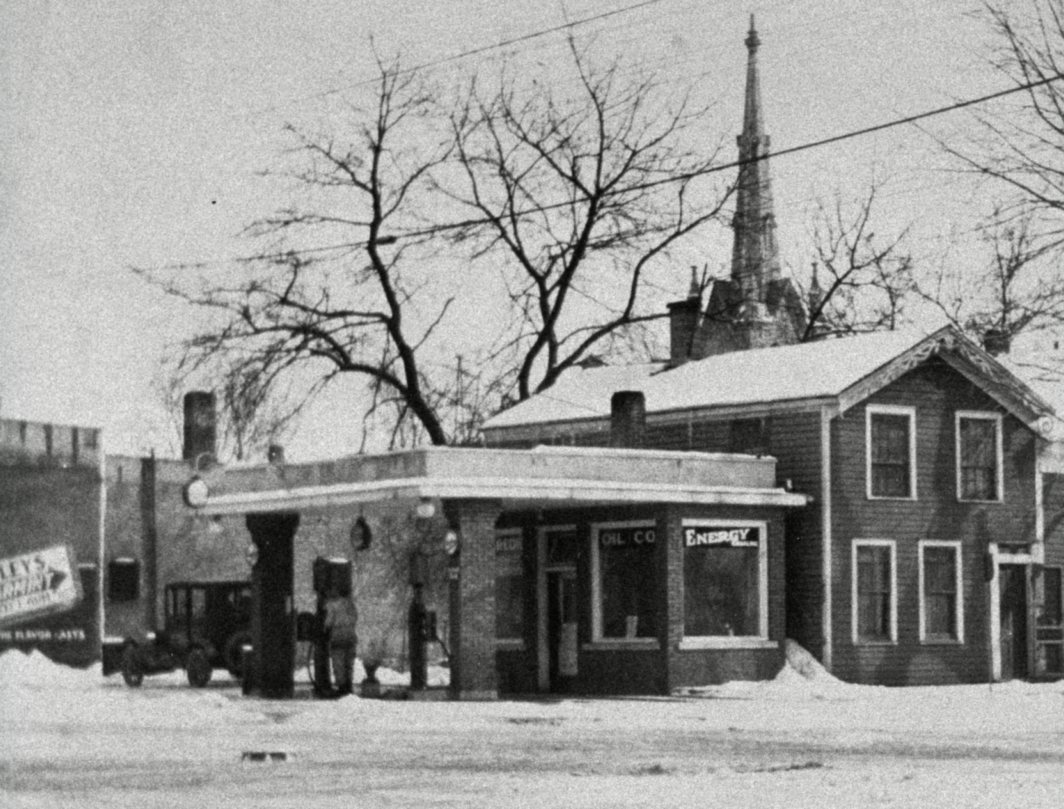
Image of the McCredie Filling (Gasoline) Station, Plainfield, Illinois, dated “about 1924.” It distributed Penn Oil gasoline. Photo courtesy Plainfield Historical Society.
The McCredie Coal and Oil Company was granted a gasoline distribution license from the State of Illinois in February 1920, Lambert continues. Based on that information, “I know that the station at Plainfield was not erected earlier than the spring of 1920. McCredie Coal and Oil was established by James M. McCredie and his son, James David McCredie, at Aurora, Illinois, in 1903.”
Lambert discovered the site of the Plainfield station had been owned by another Aurora businessman, John Knell, “who had intended to erect a hotel and tavern on the site following a fierce battle over the town settling the ‘wet’ or ‘dry’ question between 1908 and 1910,” Lambert explains. The town “went wet” again in 1910, but he notes, “Knell was not granted a liquor license, and McCredie was allowed to erect the gas station eventually.”
Full runs of the local newspaper have not survived for this period, Lambert reports, “although I believe that I have discovered a few previously unknown issues available at the Illinois State Library at Springfield.” With the Lincoln Highway paved through Plainfield between 1921 and 1922, his research suggests the Plainfield McCredie station may have been built during that period.
Background
Lambert’s ongoing research has also revealed:
The McCredie Oil Company operated two service stations at Aurora, Illinois, by 1924 (the first was likely built in 1920) and added two more stations there before 1935.
The McCredie “Penn Oil” station at Plainfield may have been designed by Aurora architect Eugene Malmer, who had a connection to the Knell and McCredie families. The McCredie “Penn Oil” station at Plainfield operated until at least 1936. At that time, a former Aurora resident, Alvin “Al” Morel, took over the Plainfield station and sold Mobiloil products until the summer of 1939, when “Al” Morel opened a new Mobiloil station along the soon-to-be-completed U.S. Route 66 — when that highway was diverted, officially, from Joliet, Illinois, through Plainfield in December 1939.
The former McCredie “Penn Oil” station is believed to have served as a D-X Service Station (under either the Unit Service System company of Joliet or the Huot Oil Co. of Kankakee-Joliet). The D-X station was operated by Walter “Walt” E. Myer between summer 1939 and February 1940, when the station was taken over by William Morgan Klett until he entered military service in early 1942.
Apparently, the station sat vacant afterward (likely due to wartime gas rationing) and was demolished in 1945, when a Ford Agency automobile dealership was built on the site. My father and mother (both deceased) attended Plainfield High School between 1943 and 1949; the school was a short distance from the McCredie station in downtown Plainfield. Neither of my parents could recall the station in operation during their high school years. My father was one of the local “gearheads” that “cruised” downtown Plainfield during his school days.
Key Questions
All of this information is provided as background to my actual questions. I have completed as much research as I know how to do (I taught archival documentation at the college level for several years). I have not been able to answer a few remaining questions.
- Were architectural design books/resources available to local architects to guide the design of early, purpose-built gas stations? I have seen the online image of the 1913 Penn Oil station in Washington, D.C. With its own individual design characteristics, the McCredie Penn Oil station at Plainfield closely resembles many Standard Oil stations in Illinois (particularly the 1918 station at Rochelle, Illinois, along the Lincoln Highway) that were built between 1918 and 1925.
- If such books existed, were any published for Penn Oil stations? I haven’t located any.
- On an outside chance, do any of your members have information about the McCredie Coal and Oil Company of Aurora, Illinois, and its gasoline station history?
Lambert reports the Aurora Historical Society has no additional information, and the local newspapers are available only on microfilm without Optical Character Recognition (OCR) search capabilities.
The Illinois researcher also has been in contact with Archie Bentz, author of the 2021 book Refueling the Past: A History of Service Stations in Batavia, Geneva and St. Charles, Illinois, who has encouraged him to write a book about his community’s historic stations on Route 66 and the Lincoln Highway.
______________________
Recommended Reading: Refueling the Past: A History of Service Stations in Batavia, Geneva and St. Charles, Illinois (2021); Pump and Circumstance: Glory Days of the Gas Station


_______________________
The American Oil & Gas Historical Society (AOGHS) preserves U.S. petroleum history. Please become an AOGHS annual supporter and help maintain this energy education website and expand historical research. For more information, contact bawells@aoghs.org. Copyright © 2025 Bruce A. Wells. All rights reserved.
Citation Information: Article Title: “Gas Stations of Plainfield, Illinois.” Authors: B.A. Wells and K.L. Wells. Website Name: American Oil & Gas Historical Society. URL: https://aoghs.org/transportation/gas-stations-of-plainfield-illinois. Last Updated: August 29, 2026. Original Published Date: October 15, 2025.