This Week in Petroleum History: Sept. 28 – Oct. 4

September 28, 1945 – Truman claims America’s Outer Continental Shelf –

President Harry Truman extended U.S. jurisdiction over the natural resources of the outer continental shelf, including oil and natural gas, under the control of the Secretary of the Interior. In August 1953, Truman’s edict would become the Outer Continental Shelf Lands Act, which affirmed exclusive jurisdiction over the continental shelf and a federal leasing program “to encourage discovery and development of oil.” Also see Offshore Oil & Gas History.

September 30, 2006 – Roughnecks Statue dedicated at Signal Hill

A bronze “Tribute to the Roughnecks” statue was dedicated near the Alamitos No. 1 well, which in 1921 revealed California’s prolific Long Beach oilfield 20 miles south of Los Angeles.
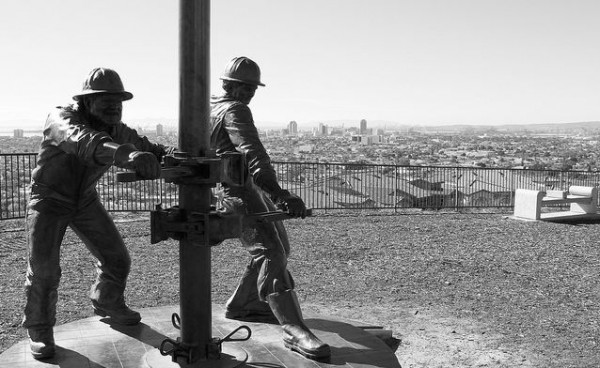
"Tribute to the Roughnecks" statue by Cindy Jackson.

Signal Hill once had so many derricks people called it Porcupine Hill. The city of Long Beach is visible in the distance from the “Tribute to the Roughnecks” statue by Cindy Jackson.

The statue by Cindy Jackson has since commemorated the Signal Hill Oil Boom, serving as “a tribute to the petroleum pioneers for their success here, a success which has, by aiding in the growth and expansion of the petroleum industry, contributed so much to the welfare of mankind.”

October 1, 1908 – Ford Motor Company produces First Model T

The first production Ford Model T rolled off the assembly line in Detroit. Between 1908 and 1927, Ford built about 15 million more, each fueled by inexpensive gasoline. The popularity of the Model T was timely for the U.S. petroleum industry, which faced falling demand for kerosene as consumers switched to electric lighting.
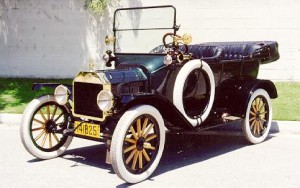
White tires on the Model T Ford.

Ford Model T tires were white until 1910, when the petroleum product carbon black was added to improve durability.

New major oilfield discoveries, especially the 1901 “Lucas Gusher” at Spindletop Hill near Beaumont, Texas, helped meet growing demand for what had been a refining byproduct, gasoline.

October 1, 1920 – Gonzaullas becomes a Texas Ranger

Manuel T. Gonzaullas joined the Texas Rangers — and rowdy Texas boom towns would never be the same. He soon became known as “Lone Wolf” Gonzaullas.

“World’s Richest Acre Park," in Kilgore, Texas, circa 1930, where once stood the world’s greatest concentration of oil wells." Library of Congress photo.

Street scene in Kilgore, Texas, with steel derricks behind downtown stores. Circa 1935 photo by Russell Lee (1903-1986) courtesy Permian Basin Petroleum Museum, Library and Hall of Fame.

In East Texas, when the streets of downtown Kilgore sprouted oil derricks, the population grew from 700 to 10,000 in two weeks. With Depression-era petroleum discoveries multiplying, oil boom towns often attracted criminals. Riding a black stallion named Tony and sporting two pearl-handled .45 pistols, Gonzaullas soon earned a reputation for strictly enforcing the law.

October 1, 1942 – Water Injection begins in East Texas

The East Texas Salt Water Disposal Company drilled the first saltwater injection well in the 12-year-old East Texas oilfield near the towns of Tyler, Longview, and Kilgore. As early as 1929, the Federal Bureau of Mines had determined injecting recovered saltwater into formations could increase reservoir pressures and oil production.
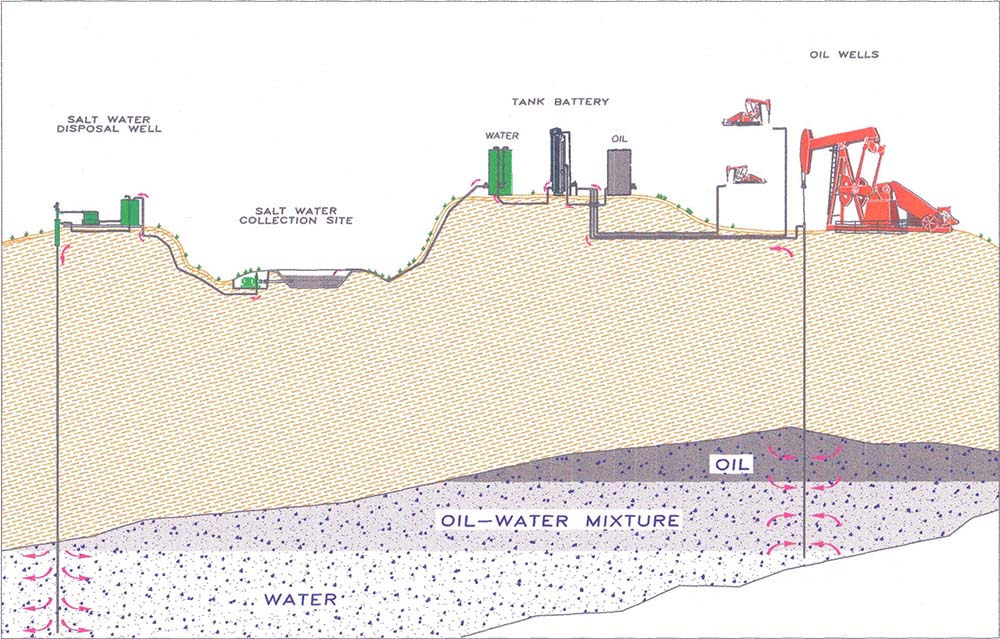
Illustration of saltwater injection wells and oil pumps.

Saltwater injection wells improve oil production and keep marginal East Texas wells viable. Illustration courtesy East Texas Salt Water Disposal Company.

The Texas Railroad Commission established the saltwater disposal company as a public utility to operate in the oilfield. The company treated and reinjected about 1.5 billion barrels of saltwater in its first 13 years, prompting the commission to proclaim saltwater injection as the “greatest oil conservation project in history.”

October 2, 1919 – Future “Mr. Tulsa” incorporates Skelly Oil

Skelly Oil Company incorporated in Tulsa, Oklahoma, with founder William Grove Skelly as president. He had been born in 1878 in Erie, Pennsylvania, where his father hauled oilfield equipment in a horse-drawn wagon.
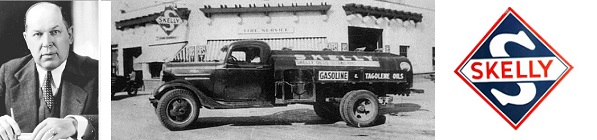
Truck and logo of Skelly Oil Company, Tulsa, Oklahoma, William Grove Skelly, president.

Born near Pennsylvania oilfields, William Skelly founded Skelly Oil Company in 1919 — and led an international petroleum exposition for 32 years, helping to make Tulsa the “Oil Capital of the World.”

Skelly’s success in the El Dorado oilfield east of Wichita, Kansas, helped him launch Skelly Oil and other ventures, including Midland Refining Company, which he founded in 1917. As Tulsa promoted itself as “Oil Capital of the World,” Skelly became known as “Mr. Tulsa.” Skelly served as president of Tulsa’s famous International Petroleum Exposition for 32 years until his death in 1957.

October 3, 1930 – East Texas Oilfield discovered on Widow’s Farm

Ninety-five years ago, with a crowd of more than 4,000 expectant landowners, leaseholders, creditors, and others watching, the Daisy Bradford No. 3 wildcat well was successfully shot with nitroglycerin near Kilgore, Texas.
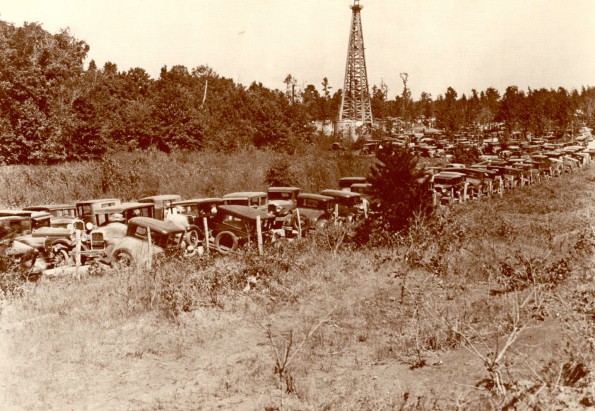
East Texas 1930 oilfield discovery well photo courtesy Jack Elder, The Glory Days.

Spectators gathered on the widow Daisy Bradford’s farm near Kilgore, Texas, to watch the October 3, 1930, “shooting” of the discovery well of what proved to be the largest oilfield in the lower 48 states. Photo courtesy Jack Elder, The Glory Days.

“All of East Texas waited expectantly while Columbus ‘Dad’ Joiner inched his way toward oil,” explained historian Jack Elder in 1986. “Thousands crowded their way to the site of Daisy Bradford No. 3, hoping to be there when and if oil gushed from the well to wash away the misery of the Great Depression.”

Geologists were stunned when it became apparent the remote wildcat well on the widow Daisy Bradford’s farm — along with two other wells far to the north — were part of the same oil-producing formation (the Woodbine) that encompassed more than 140,000 acres. The “Black Giant” would produce billions of barrels of oil in coming decades.

Learn more in East Texas Oilfield Discovery.

October 3, 1980 – Museum opens in East Texas Oilfield

Fifty years after the discovery of the East Texas oilfield, the East Texas Oil Museum at Kilgore College opened as “a tribute to the independent oil producers and wildcatters, the men and women who dared to dream as they pursued the fruits of free enterprise.”
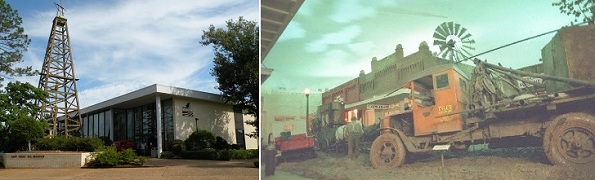
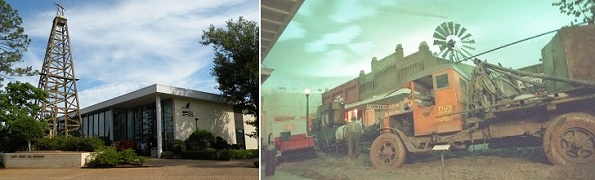
Exterior rig (not gone) and interior truck exhibit of East Texas Oil Museum, Kilgore.

The East Texas Oil Museum since 1980 has hosted events and maintained exhibits preserving the “Black Giant” oilfield discovered during the Great Depression. Photos by Bruce Wells.

Established with funding from the Hunt Oil Company, the museum at Kilgore College recreated a 1930s boom town atmosphere. The museum, which is hosting special events on its 45th birthday, maintains a database that offers keyword search and advanced search options — along with a “random Images” button to browse photography from a wide assortment of online records.
Registration link for AOGHS email newsletter.

October 4, 1866 – Oil Fever spreads to Allegheny River Valley

Just 15 miles east of Titusville, Pennsylvania, site of the first U.S. oil well, an oilfield discovery at Triumph Hill sparked another wild rush of speculators and new drilling. America’s petroleum industry was barely seven years old when wooden cable-tool derricks and engine houses replaced hemlock trees along the Allegheny River.

October 4, 1901 – Drake Memorial dedicated in Pennsylvania

More than 2,500 people, including his widow, Laura Dowd Drake, attended the unveiling of a monument to the “father of the petroleum industry,” Edwin L. Drake, who had died in relative obscurity in 1880. Standard Oil Company executive Henry Rogers commissioned the marble, semi-circle memorial in Titusville, Pennsylvania.
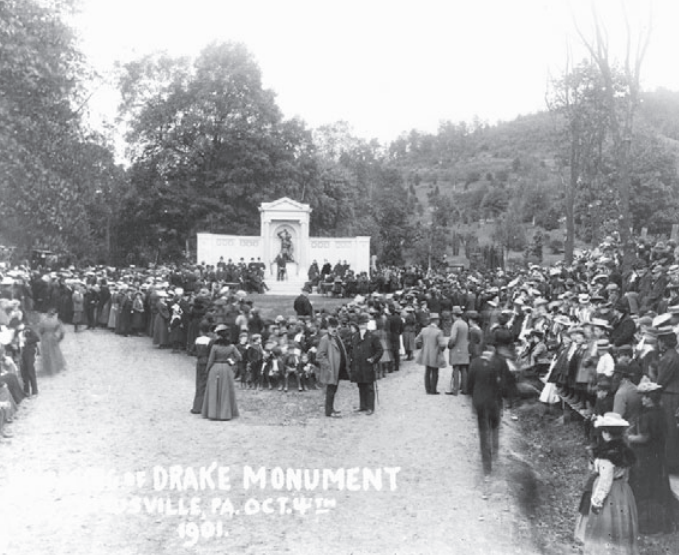
Hundreds attended the October 4, 1901, dedication of the Edwin Drake memorial in Titusville, Pennsylvania.

Unveiling of the Drake Monument in Titusville, Pennsylvania, on October 4, 1901. Thousands attended the dedication in Woodlawn Cemetery. Photo by John Mather courtesy Drake Well Museum.

East Texas Oil Museum,

The monument, which includes a bronze statue by Charles Henry Niehaus, was dedicated in Woodlawn Cemetery. Learn more by visiting Titusville’s Drake Well Museum and Park.

_______________________

Recommended Reading: The Extraction State, A History of Natural Gas in America (2021); History Of Oil Well Drilling (2007); The American Highway: The History and Culture of Roads in the United States (2000); Signal Hill, California – Images of America (2006); From Here to Obscurity: An Illustrated History of the Model T Ford, 1909 – 1927 (1971); Artificial Lift-down Hole Pumping Systems (1984); An adventure called Skelly: A history of Skelly Oil Company through fifty years, 1919-1969 (1970); The Black Giant: A History of the East Texas Oil Field and Oil Industry Skullduggery & Trivia (2003); Early Texas Oil: A Photographic History, 1866-1936 (2000); Western Pennsylvania’s Oil Heritage (2008); Myth, Legend, Reality: Edwin Laurentine Drake and the Early Oil Industry (2009). Your Amazon purchase benefits the American Oil & Gas Historical Society. As an Amazon Associate, AOGHS earns a commission from qualifying purchases.

_______________________

The American Oil & Gas Historical Society (AOGHS) preserves U.S. petroleum history. Please support this website, subscribe to the monthly email newsletter, This Week in Oil and Gas History News, and help expand our historical research. Contact bawells@aoghs.org. Copyright © 2026 Bruce A. Wells. All rights reserved.
 

East Texas Oilfield Discovery

A 1930 wildcat well — and two drilled miles away — revealed the largest oilfield in the lower 48 states.


During the Great Depression, as farmers scratched out a living on drought-tormented land in East Texas, Columbus Marion “Dad:” Joiner, a 70-year-old Bible-quoting entrepreneur, and A.D. “Doc” Lloyd, a self-proclaimed geologist and former patent oil salesman, convinced them oil could be found.

A crowd of more than 4,000 landowners, leaseholders, stockholders, creditors, and others gathered in Rusk County, Texas, on October 3, 1930, to watch the well-shooting spectacle of the Daisy Bradford No. 3 well erupting a column of oil.

East Texas oilfield crowd gathers at Daisy Bradford well for a planned "shooting" to start production in 1930.

“Thousands crowded their way to the site of Daisy Bradford No. 3, hoping to be there when and if oil gushed from the well to wash away the misery of the Great Depression.” Photo courtesy Jack Elder and Caleb Pirttelli, The Glory Days.

The well on the widow Daisy Bradford’s farm near Kilgore was the first of three wells that revealed one of the greatest petroleum discoveries in United States history. A second wildcat well came in to the north on December 28, 1930 — to the astonishment of most geologists.

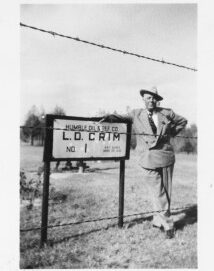
The Lou Della Crim No. 1 was drilled by Malcolm Crim on his mother’s farm. “The well was only nine miles from Daisy Bradford No. 3, yet no one was aware that the two wells were part of what was then a geological phenomenon — an incredible deposit of oil in the Woodbine formation had “pinched out” as it tilted upward against the Sabine Uplift creating the massive East Texas Oil Field,” explains the East Texas Oil Museum at Kilgore College. 

About 15 miles north of that well, the Lathrop No. 1, a Gregg County well spudded in December 1931 by W.A. “Monty” Moncrief, delivered yet another gusher on January 26, 1931.

J. Malcolm Crim of Kilgore standing at his wildcat well.

J. Malcolm Crim, owner of a general store in Kilgore, named his well after his mother, Lou Della.

At the time, the great distance between these “black gold” discoveries convinced virtually all of the major oil companies that separate oilfields had been found. But to the delight of the hundreds of struggling farmers who owned the land, the three wells were all part of one giant field, the Great East Texas oilfield.

H.L. Hunt and Oklahoma Wildcatters

In 1905, when Haroldson Lafayette “H.L.” Hunt was just 16 years old, he left his Illinois farm family and headed west. Along the way, he worked as a dishwasher, mule team driver, logger, and farmhand — and even tried out for semi-pro baseball (also see Oilfield of Dreams — Gassers, Oilers and Drillers). 

East Texas oilfield with a young H. L. Hunt at a well.

H.L. Hunt’s oil career began in Arkansas and East Texas and spanned much of the industry’s history, notes Hunt Oil Company. Photo circa 1911.

During his travels, young H.L. Hunt learned to gamble and played cards in bunkhouses, hobo camps, and saloons. But his life changed when an Arkansas wildcat well, the Busey-Armstrong No. 1, erupted oil on January 10, 1921. Hunt joined the speculative rush and drilling frenzy that followed. He began with $50 in his pocket.

The Arkansas oilfield discovery catapulted the population of El Dorado from 4,000 to over 25,000 (learn more in First Arkansas Oil Wells). 

“Dad” and “Doc”

While Hunt was pursuing oil in Arkansas, an unlikely pair was doing the same in Oklahoma. Sixty-five-year-old Columbus Marion Joiner was a former lawyer and Tennessee legislator who had spent years making a living as an oil lease broker in Oklahoma. He had lost a $200,000 fortune in the financial panic of 1907 — and began pursuing the wealth a successful wildcatter and promoter might find.

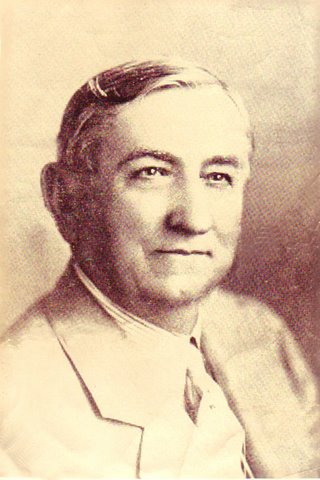
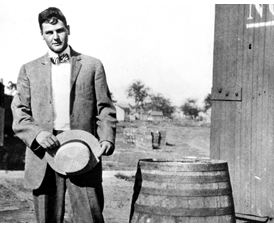
Portrait of Columbus Marion Joiner, discoverer of the East Texas oilfield.

Columbus Marion Joiner (1860 – 1947) believed in geologist A.D. Lloyd, especially after Lloyd located wells in Seminole, Oklahoma, oilfields.

A friend of Joiner, Joseph Idelbert Durham, had studied medicine and worked as a government chemist in the Idaho gold rush. Durham had also prospected for gold in the Yukon and Mexico before peddling patent oil medicines in “Dr. Alonzo Durham’s Great Medicine Show.”

Taking the name “A.D. Lloyd,” Durham proclaimed, “I’m not a professional geologist…but I’ve studied the earth more and know more about it than any professional geologist now alive will ever know.”

Joiner believed in “Doc” Lloyd, and his confidence was reinforced when Lloyd accurately located the rich Seminole oilfield. Joiner drilled to within 200 feet of discovering this previously untapped reserve — but stopped short when his money ran out. Empire Gas & Fuel Company brought in the field’s discovery well on a nearby lease.

After a similar near miss in Oklahoma’s Cement field and a stretch of bad luck, the broke but optimistic Joiner headed to Dallas, where oilmen and oil money were plentiful. Meanwhile, A.D. Lloyd was off to Mexico, promoting new oil ventures.

Meanwhile, H.L. Hunt’s success in Arkansas enabled him to investigate other investment possibilities, and with El Dorado oilfield production diminishing, he was lured to Florida real estate. He sold his interests to the Louisiana Oil and Refining Company, retaining a few wells in the El Dorado and Smackover fields.

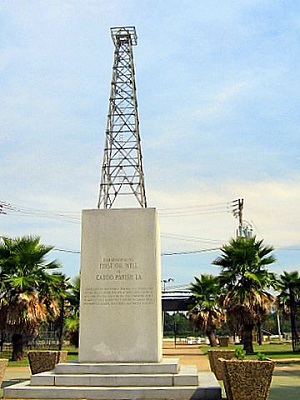
Louisiana oil monument in Caddo Parrish with steel rig on top.

Dedicated in 1955, a monument in Shreveport, Louisiana, commemorates the state’s rich petroleum heritage. Photo by Bruce Wells.

Hunt ultimately abandoned the Florida real estate market and returned to Arkansas, where in 1934 he formed H.L. Hunt, Inc. He was back in the oil business, the no-limit game he loved. Hunt traveled to Shreveport, Louisiana, and checked into the Washington-Youree Hotel, where the marble lobby hosted crowds of competing oil operators, promoters, and “lease hounds” — all looking for an edge in petroleum exploration.

Speculators and promoters often profited where the true wildcatters could not (see Is My Old Oil Stock Worth Anything?). Not far to the west of Shreveport, Rusk County in northeastern Texas had seen its share of lease trading, despite the widely held conviction that there was no oil to be found there.

Registration link for AOGHS email newsletter.

Geologists from major oil companies found no petroleum-rich salt domes (as in the 1901 Spindletop gusher at Beaumont to the south), anticlines, or other indications of oil. Seventeen wildcat wells had been dry holes.

Wildcatting in Rusk County

Columbus Marion Joiner was undeterred. In 1927, he was 66 years old. He had just $45 in his pocket when he left Dallas to pursue opportunities in Rusk County. To poor farmers scratching out a living on drought-tormented land, Joiner seemed larger than life — a Bible-quoting genuine oil entrepreneur from Dallas who neither drank, smoked, nor cursed.

Within a few months, the affable but shrewd Joiner had acquired leases on several thousand acres and resumed his collaboration with A.D. “Doc” Lloyd.

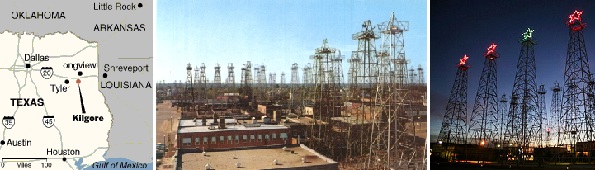
Map of Rusk County, Texas and a row of derricks displayed at Kilgore with Christmas lights.

Investments from hopeful farmers and merchants brought historic results — and made Kilgore, Longview, and Tyler boom towns during the Great Depression. Kilgore celebrates by decorating derricks that once dominated its skyline.

Joiner formed a “Syndicate” from 500 of his lease block acres and began selling one-acre interest certificates to anyone who could scrape together $25. Joiner could be quite charming to the ladies and persuasive to gentlemen.

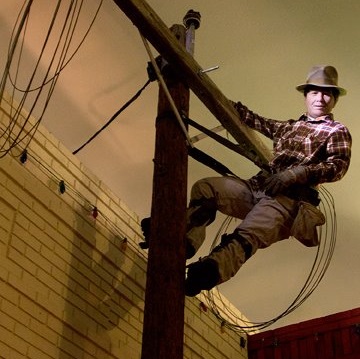
"Animatronic" rural electric lineman Buddy inside the oil museum.

“Animatronic” rural electric lineman Buddy has welcomed visitors to “Boomtown, USA,” since 2012. Photo courtesy East Texas Oil Museum.

Small investments from hopeful Rusk County farmers and merchants provided Joiner just enough month-to-month money to get by and sometimes pay on his considerable lease rental debt. Promoting oil certificates in an area largely dismissed by professionals called for a slick pitch, and Joiner’s self-taught geologist friend, “Doc” Lloyd, could help.

While Humble Oil Company geologists and geophysicists were reporting that Rusk County offered no possibilities, Joiner was mailing his own report to potential investors: “Geological, Topographical and Petroliferous Survey, Portion of Rusk County, Texas, Made for C.M. Joiner by A.D. Lloyd, Geologist and Petroleum Engineer.”

East Texas oilfield energy education books by AOGHS.

The East Texas Oil Museum in Kilgore is “a tribute to the men and women who dared to dream as they pursued the fruits of free enterprise,” according to Joe White, who founded the museum in 1980 — the 50th anniversary of the oil field’s discovery. Photo by Bruce Wells.

Using clear and correct scientific terminology, “Doc” Lloyd’s document described Rusk County anticlines, faults, and a salt dome — all geologic features associated with substantial oil deposits and all completely fictitious. Equally imaginary were the “Yegua and Cook Mountain formations” and the thousands of seismographic registrations ostensibly recorded.

The impressive-looking but fabricated report was accompanied by a map depicting a “salt dome” and a fault running squarely through the widow Daisy Bradford’s farm, the exact site of the 500-acre Syndicate lease block that “Dad” Joiner was promoting.

Dry Hole, Dry Hole

“Doc” Lloyd’s assessment had the desired effect, and the increased sales of certificates enabled Joiner to patch together a rusty, worn-out rig and begin drilling the Daisy Bradford No. 1 in August 1927.

Support the American Oil & Gas Historical Society link.

To sustain operations and in pursuit of new investors, Joiner created more syndicates and sold far more certificates than he could possibly redeem, in one case selling the same certificate to eleven different investors. This didn’t present a problem unless Joiner actually brought in a producing well, but if he did, finding oil was the kind of “problem” wildcatters wished for.

In February 1928, the Daisy Bradford No. 1 well failed at 1,098 feet when the drill pipe became irretrievably stuck. Joiner continued overselling certificates to finance drilling.

In March 1929, his Daisy Bradford No. 2 suffered a like fate at 2,518 feet — far deeper than the hodgepodge of old equipment was thought capable.

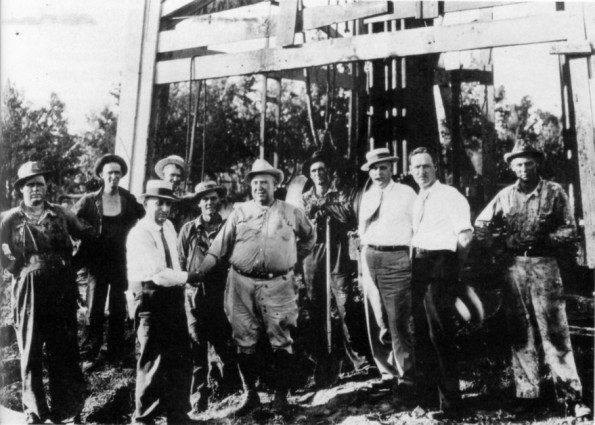
Columbus "Dad" Joiner, Haroldson Lafayette “H. L.” Hunt and others in front of famous Daisy Bradford oil well.

Haroldson Lafayette “H. L.” Hunt (third from right) is a former dishwasher, mule team driver, logger, farmhand, and semi-pro baseball tryout. C. M. “Dad” Joiner (third from left) shakes the hand of geologist A. D. “Doc” Lloyd at the 1930 discovery well of the East Texas oilfield. Recognizing the significance of the discovery before his competitors, H. L. Hunt will move quickly — and take significant risk — by purchasing the discovery well and nearby leases from Joiner.

Daisy Bradford No. 3 was spudded just 375 feet from the failed second attempt at a site determined when broken equipment prevented moving any farther. Before long, Joiner’s “poor boy” operation was down to burning used tires in the old boiler to gain a few pounds of steam pressure and drill a few feet at a time.

In September 1930, Hunt and Joiner met for the first time when Daisy Bradford’s brother invited Hunt to observe a drill stem test at Joiner’s third well (drill stem tests can determine if oil is present in a formation and the rate at which it can be produced).

Hunt —  always on the lookout for new opportunities — drove to the site on the widow Bradford farm with his friend from El Dorado, merchant and clothier P.G. “Pete” Lake.

The Woodbine Sand

The well test was done on September 3, 1930. When the drill stem test brought a surge of mud, oil, and natural gas, Hunt was impressed. He raised enough money to lease three tracts to the east and one to the south of Joiner’s well as the news spread and the scramble for a piece of the action began. The Woodbine sand formation will make petroleum history.

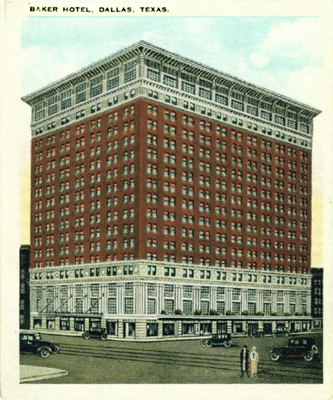
Vintage postcard of Baker Hotel in Dallas.

In legal trouble, Columbus M. “Dad” Joiner met with H.L. Hunt at the Baker Hotel in Dallas and sold him 5,580 acres of leases for $1.34 million.

In two weeks, more than 2,000 land deals were recorded; two weeks later, Daisy Bradford No. 3 blew in as a gusher in front of about 5,000 spectators who cheered madly, celebrated their newfound fortunes, and congratulated “Dad” Joiner. It wasn’t long, however, before the greatly oversold Syndicate certificates created a convoluted legal nightmare of immense proportions for the now famous “Dad” Joiner.

On the 31st of October, a Dallas court put Joiner’s holdings into receivership. Seventy-year-old Columbus Marion Joiner took refuge in a Dallas hotel as swarms of claimants and creditors looked for him.

Following the drill stem test and aware of previous dry holes drilled to the east, H.L. Hunt became convinced that a substantial oilfield lay to the west. His conviction was reinforced when dry holes were drilled both southeast and northeast of Daisy Bradford No. 3, abruptly chilling the lease market.

Nighttime scene of a lightning strike among derricks in Hobbs, New Mexico, oilfield with white text of "Preserve petroleum history. Support AOGHS."

Meanwhile, just a mile west of Joiner’s find and surrounded by his leases, Deep Rock Oil Company was drilling a test well on the Claude Ashby farm. Hunt believed that if this well came in, it would confirm that Daisy Bradford No. 3 was part of a much larger oilfield. A dry hole would prove the major oil companies’ belief that Joiner’s Woodbine sand reservoir was a fluke.

Hunt assigned three oil scouts to closely monitor and report to him on the progress of the Ashby No. 1 well. Since his own credit was exhausted, he tried to interest Deep Rock and others in deals to buy out Joiner, but Daisy Bradford No. 3 was by then flowing intermittently. It would yield only about 200 barrels of oil and stop altogether for an agonizing 18 to 20 hours before resuming.

Hunt remained convinced Joiner’s contested leases sat atop an oilfield, but just how big an oilfield was beyond Hunt’s or anybody else’s imagination. He later wrote, “Joiner was a true wildcatter and was much more interested in drilling wildcat wells than developing proven or semi-proven oil acreage. He was becoming weary of all the carrying on which was being made against him.”

Hunt’s “Business Coup”

Hunt borrowed $30,000 from his old El Dorado clothier friend, P.G. Lake, and set about to convince the harried and hiding “Dad” Joiner to sell. They met in Dallas’ Baker Hotel on November 25-26, 1930, while Hunt’s scouts continued to watch the Deep Rock well’s progress.

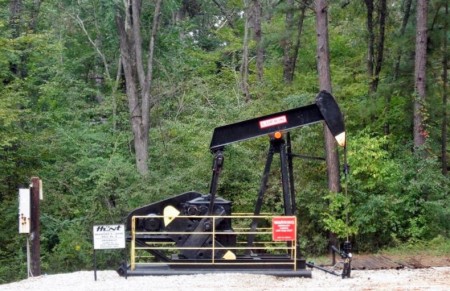
East Texas oilfield's Daisy Bradford well with modern pump jack.

By the summer of 1931, about 900,000 barrels of oil per day are being produced from 1,200 wells in Rusk County. H. L. Hunt’s purchase of Daisy Bradford No. 3, above, provided the financial base for Hunt Oil Company.

At about 8:30 p.m. on November 26, Hunt’s scouts reported that the Deep Rock well had found the oil-rich Woodbine sand, confirming his belief in the oilfield. Four hours later, Joiner sold all his holdings (including about 5,000 leased acres) to Hunt for $1,335,000, including all the $30,000 in cash Hunt had borrowed. It was far more money than Joiner had ever seen and provided him a way out of the legal mess of oversold certificates and competing claims.

It was for Hunt — as he later described — his “greatest business coup,” despite the 300 lawsuits that followed. As presiding District Judge R.T. Brown said, “If you want a successful gathering of long-lost kinfolks, just manage to find oil on the old homestead. They will come out from under logs, down trees, from out of the blue, and down every road and byway, but they’ll get there — even some nobody ever suspected were kinfolks.”

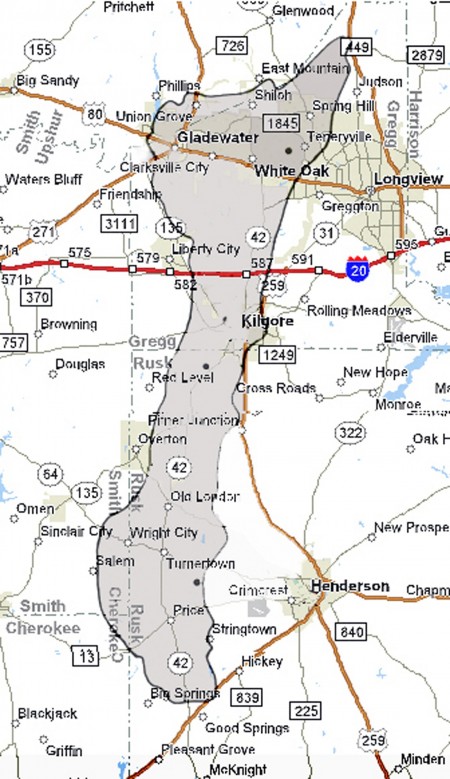
East Texas oilfield map with town showing its extent of 43 miles long and 12.5 miles wide.

The East Texas oilfield, 43 miles long and 12.5 miles wide, has produced more than six billion barrels of oil by 2025.

In the 10 years of litigation that followed, Hunt sustained every title. Eighteen days after his deal with Joiner, Deep Rock’s Ashby No. 1 came in at 3,000 barrels of oil a day.

The “Black Giant”

On a Sunday two weeks later, Lou Della Crim No. 1 came in 13 miles to the north, near Kilgore, Texas, flowing at over 22,000 barrels of oil a day. In January 1931, the similarly petroleum-rich Lathrop No. 1 well came in about 15 miles farther north, in Gregg County. Remarkably, the Ashby, Lou Della Crim, and Lathrop wells were all part of the same gigantic field, covering over 140,000 acres!

Registration link for AOGHS email newsletter.

Hunt’s deal had put him in the midst of the unprecedented “Black Giant” known as the East Texas oilfield. In 1972, James A. Clark and Michel T. Halbouty published The Last Boom, noting, “The fortune Hunt built in East Texas served as the foundation for one much larger, for he could no more stop hunting for oil than could Joiner — and he seemed to find it as often as not.”

Production from the giant oilfield yielded five billion barrels of oil by 1980, and thanks to Dallas-based Hunt Oil Company, that was the year the East Texas Oil Museum opened at Kilgore College, not far from the Daisy Bradford No. 3 well. 

_______________________

Recommended Reading: The Last Boom (1972);The Black Giant: A History of the East Texas Oil Field and Oil Industry Skullduggery & Trivia (2003); The Big Rich: The Rise and Fall of the Greatest Texas Oil Fortunes (2009); Texas Oil and Gas, Postcard History(2013). Your Amazon purchase benefits the American Oil & Gas Historical Society. As an Amazon Associate, AOGHS earns a commission from qualifying purchases.
_______________________

The American Oil & Gas Historical Society (AOGHS) preserves U.S. petroleum history. Please support this energy education website, subscribe to our free monthly newsletter, and help expand historical research. Contact bawells@aoghs.org. Copyright © 2026 Bruce A. Wells. 

Citation Information – Article Title: “East Texas Oilfield Discovery.” Authors: B.A. Wells and K.L. Wells. Website Name: American Oil & Gas Historical Society. URL: https://aoghs.org/petroleum-pioneers/east-texas-oilfield. Last Updated September 25, 2025. Original Published Date: October 22, 2012.

Pin It on Pinterest