by Bruce Wells | Feb 1, 2026 | Petroleum Technology
Camouflaged wells on man-made islands and world-renowned technologies save a sinking California city.
Reversing an earlier ban, voters in Long Beach, California, in February 1962 approved petroleum exploration in their harbor. They wanted to save a community that had become known as “America’s Sinking City.” Five major oil companies formed a company called THUMS and built four artificial islands to produce the oil.
California’s headline-making 1921 oil discovery at Signal Hill launched a drilling boom that transformed the quiet residential area. So many derricks sprouted it became known as “Porcupine Hill.”
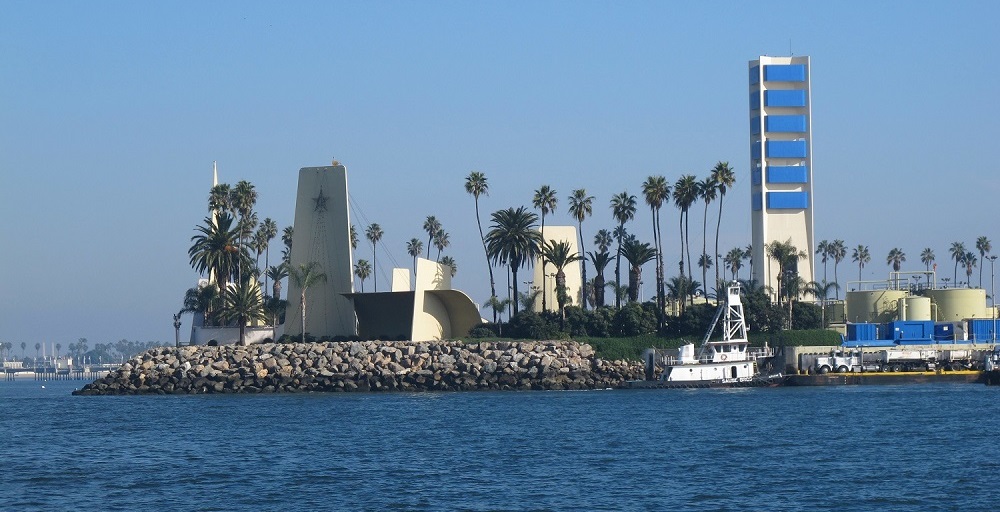
Island Grissom, one of the four THUMS islands at Long Beach, California, was named after astronaut Virgil “Gus” Grissom, who died in the 1967 Apollo fire. Photo courtesy U.S. Department of Energy.
With many homeowners aspiring to become drillers and oilfield speculators, much of Signal Hill’s land was sold and subdivided into real estate lots of a size described as “big enough to raise chickens.”
Derricks were so close to one cemetery that graves “generated royalty checks to next-of-kin when oil was drawn from beneath family plots,” noted one local historian. Neighboring Long Beach joined the drilling boom.
By 1923, oil production reached more than one-quarter million barrels of oil per day. When Long Beach instituted a per-barrel oil tax, Signal Hill residents voted to incorporate in 1924.
At the time, “the law of capture” for petroleum production ensured the formerly scenic landscape would be transformed. Competing exploration and production companies crowded around newly completed wells and chased any signs of oil to the Pacific Ocean.
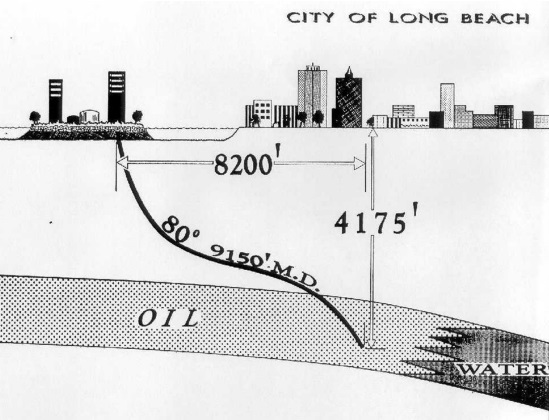
The islands are among the most innovative oilfield designs in the world. Circa 1965 illustration courtesy Oxy Petroleum.
By the early 1930s, the massive Wilmington oilfield extended through Long Beach as reservoir management concerns remained in the future. Naturally produced California oil seeps had led to many discoveries south of the 1892 Los Angeles City field.
Onshore and offshore tax revenues generated by the production of more than one billion barrels of oil and one trillion cubic feet of natural gas helped underwrite much of the Los Angeles area’s economic growth. But not without consequences.
Long Beach: A Sinking City
The U.S. Army Corps of Engineers reported, “Subsidence, the sinking of the ground surface, is typically caused by extracting fluids from the subsurface.”

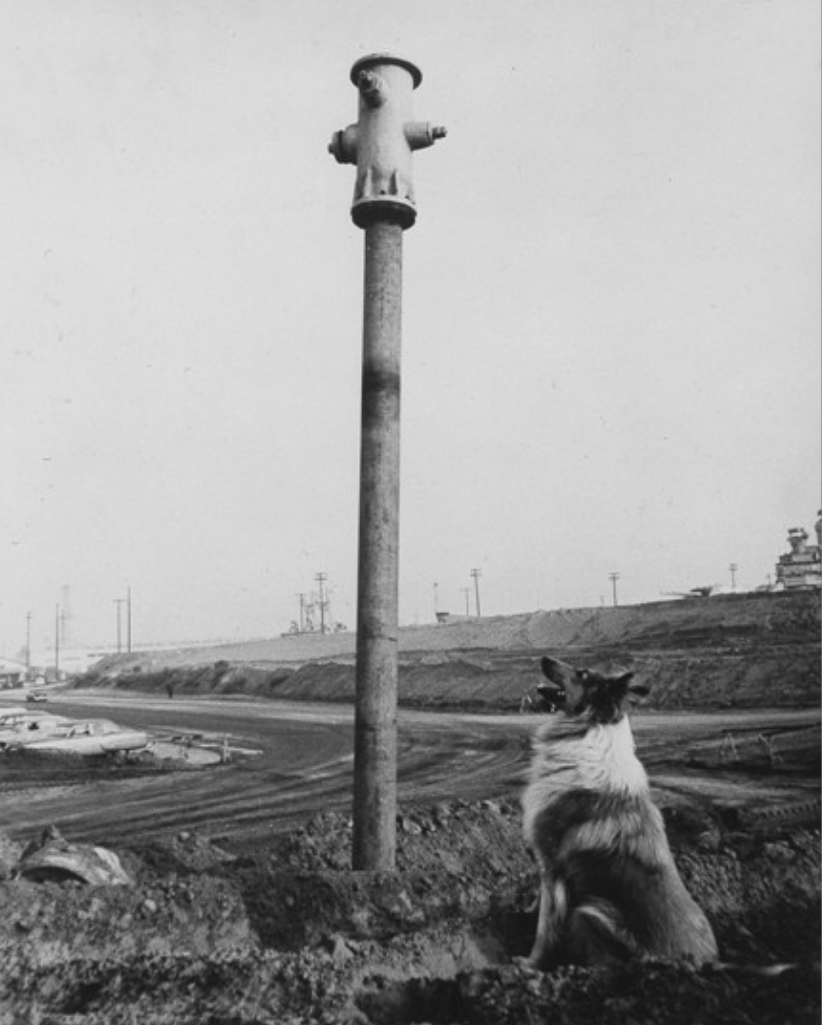
Southern California’s oilfield production in 1923 reached more than one-quarter million barrels of oil per day from Signal Hill, seen in the distance. Photo courtesy Library of Congress.
Californians had a lot of experience dealing with groundwater-induced subsidence and the building damage it caused, but by 1951, Long Beach was sinking at the alarming rate of about two feet each year.
Earth scientists noted that between 1928 and 1965, the community sank almost 30 feet. A TIME magazine headline called the bustling port “America’s Sinking City.”

After decades of prospering from petroleum production, the city prohibited “offshore area” drilling to slow the subsidence as the community looked for a solution.
On February 27, 1962, Long Beach voters approved “controlled exploration and exploitation of the oil and gas reserves” underlying their harbor. The city’s charter had prohibited such drilling since a 1956 referendum. Advancements in oilfield technologies enabled Long Beach to stay afloat.
Directional drilling and water injection opened another 6,500 acres of the Wilmington field — and saved the sinking city.
THUMS: Texaco, Humble, Union, Mobil, and Shell
Five oil companies formed a Long Beach company called THUMS: Texaco (now Chevron), Humble (now ExxonMobil), Union Oil (now Chevron), Mobil (now ExxonMobil), and Shell Oil Company. They built four artificial islands at a cost of $22 million in 1965 (more than $200 million in 2024 dollars).
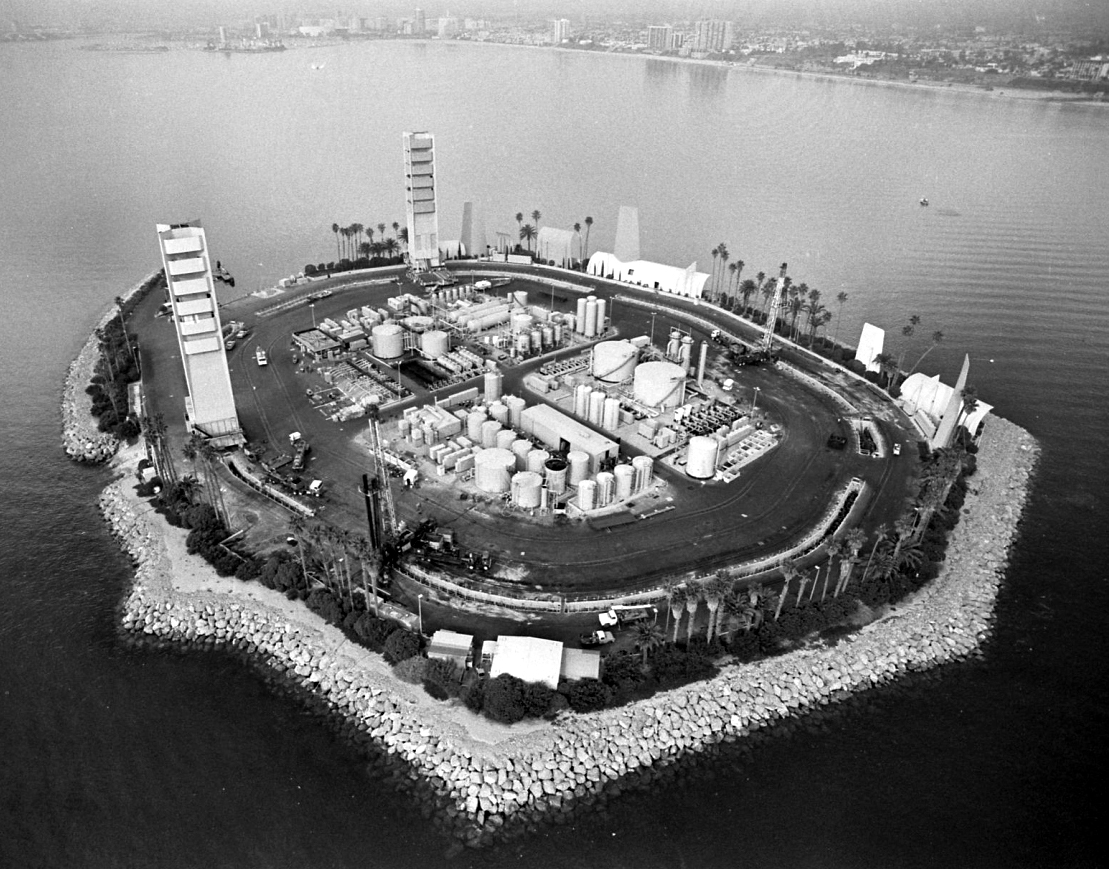
The islands — named in 1967 Grissom, White, Chaffee, and Freeman in honor of lost NASA astronauts — would include 42 acres for about 1,000 active wells producing 46,000 barrels of oil and 9 million cubic feet of natural gas a day.
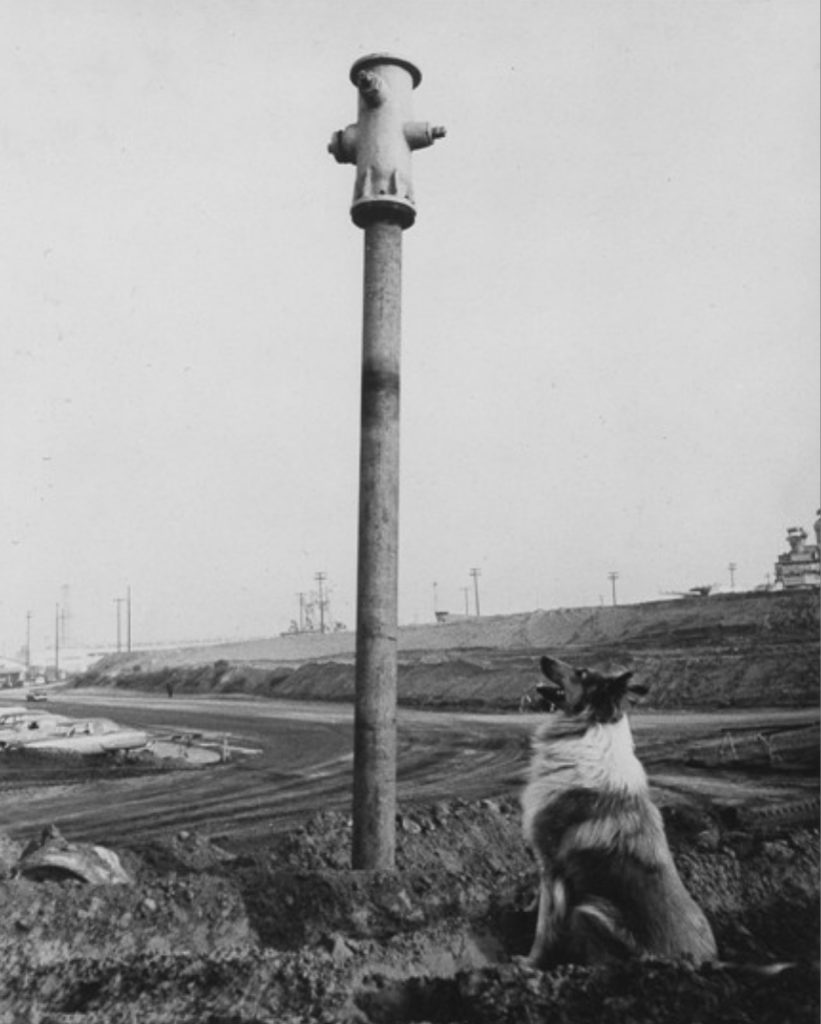
The prospering but “sinking city” of Long Beach would solve its subsidence problem with four islands and advanced drilling and production technologies. Photo by Roger Coar, 1959, courtesy Long Beach Historical Society.
To counter subsidence, five 1,750-horsepower motors on White Island drive water injection pumps to offset extracted petroleum, sustain reservoir pressures, and extend oil recovery. The challenge was once described as “a massive Rubik’s Cube of oil pockets, fault blocks, fluid pressures, and piping systems.”
Meanwhile, all of this happens amidst the scenic boating and tourist waters in Long Beach Harbor.
The California Resources Corporation operates the offshore part on the islands of the Wilmington field, the fourth-largest U.S. oilfield, according to the Los Angeles Association of Professional Landmen, whose members toured the facilities in November 2017.
Producing in Plain Sight
“Most interestingly, the islands were designed to blend in with the surrounding coastal environment,” explained LAAPL Education Chair Blake W.E. Barton of Signal Hill Petroleum. “The drilling rigs and other above-ground equipment are camouflaged and soundproofed with faux skyscraper skins and waterfalls.”
Most people simply do not realize the islands are petroleum production facilities. From the shore, the man-made islands appear occupied by upscale condos and lush vegetation. Many of the creative disguises came courtesy of Joseph Linesch, a pioneering designer who helped landscape Disneyland.

The THUMs islands required exceptional designs, and “the people who were involved at the time were very creative visionaries,” said Frank Komin, executive vice president for southern operations of the California Resources Corporation (CRC), owner of the islands.
About 80 percent of the company’s properties would overlie the Wilmington oilfield, according to CRC, noting that from 2003 to 2018, CRC operations generated over $5.2 billion in revenues, taxes, and fees for the City of Long Beach and the state.
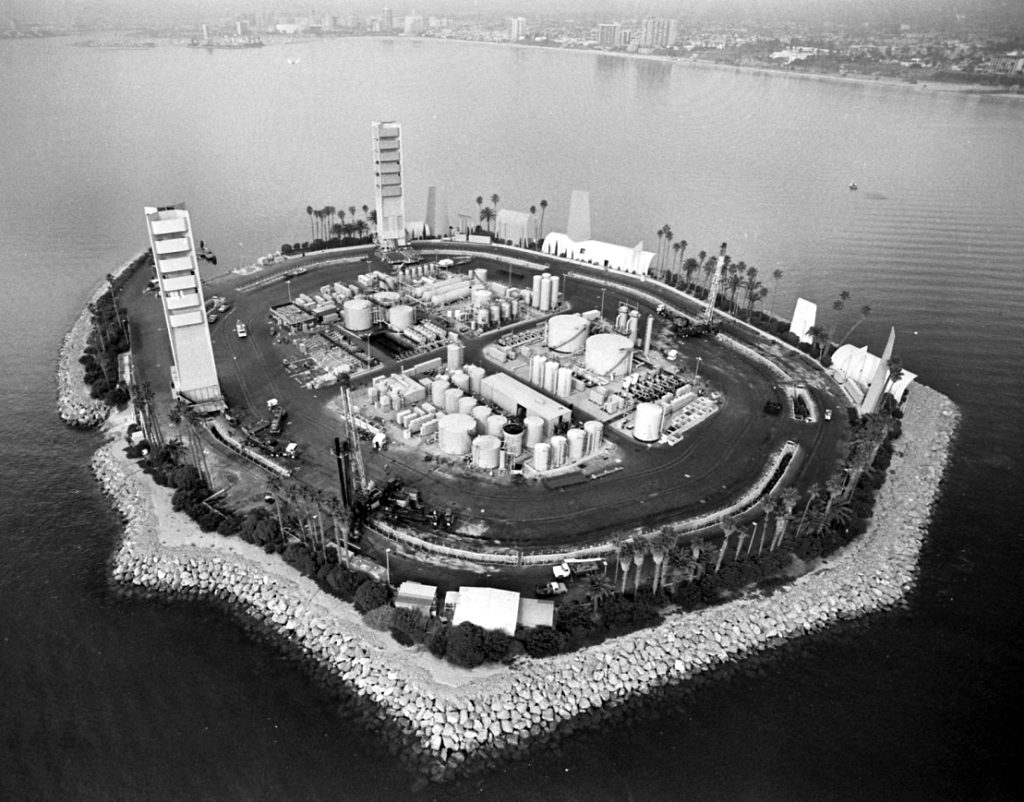
THUMS Island White, named for Edward White II, the first American to walk in space, who died in 1967 with astronauts “Gus” Grissom and Roger B. Chaffee. A fourth island was named for NASA test pilot Ted Freeman, a fellow astronaut who died in 1963. Photo courtesy UCLA Library Digital Collections.
“Even today, those islands are viewed as one of the most innovative oil field designs in the world,” CRC executive Komin declared in a 2015 Long Beach Business Journal article. “The islands have grown to become icons in which the City of Long Beach takes a great deal of pride.”
The Journal explained that 640,000 tons of boulders, some as large as five tons, were mined and placed to build up the perimeters of the islands. “Concrete facades constructed for aesthetic purposes also divert industrial noise away from nearby residents,” the article added. For more noise abatement, electricity has provided nearly all the power for the islands.
The THUMS aesthetic integration of 175-foot derricks and production structures has been described by the Los Angeles Times as “part Disney, part Jetsons, part Swiss Family Robinson.”
_______________________
Recommended Reading: An Ocean of Oil: A Century of Political Struggle over Petroleum Off the California Coast (1998); Black Gold in California: The Story of California Petroleum Industry  (2016); Early California Oil: A Photographic History, 1865-1940
 (1985). Your Amazon purchases benefit the American Oil & Gas Historical Society. As an Amazon Associate, AOGHS earns a commission from qualifying purchases.
_______________________
The American Oil & Gas Historical Society (AOGHS) preserves U.S. petroleum history. Please support AOGHS to help maintain this energy education website, a monthly email newsletter, This Week in Oil and Gas History News, and expand historical research. Contact bawells@aoghs.org. Copyright © 2026 Bruce A. Wells.
Citation Information – Article Title: “THUMS – California’s Hidden Oil Islands.” Authors: B.A. Wells and K.L. Wells. Website Name: American Oil & Gas Historical Society. URL: https://aoghs.org/technology/thums-california-hidden-oil-islands. Last Updated: February 12, 2026. Original Published Date: March 8, 2018.
by Bruce Wells | Jan 21, 2026 | Offshore History
Exploring the 1969 offshore disaster and the geology of ancient natural petroleum seeps.
A 1969 oil spill from a California offshore platform transformed the public’s view of the U.S. petroleum industry and helped launch the modern environmental movement — and the Environmental Protection Agency. Ancient natural seeps continue to produce thousands of tons of oil every day.
On January 28, 1969, after drilling 3,500 feet below the ocean floor, a Union Oil Company drilling platform six miles off Santa Barbara suffered a blowout. Between 80,000 and 100,000 barrels of oil flowed into the Pacific Ocean and onto beaches, including at Summerland, where the U.S. offshore industry began in 1896 with drilling on oil well piers. (more…)
by Bruce Wells | Dec 25, 2025 | Petroleum Companies
The Batista government stripped United Cuban Oil of its Cuban operations in 1959.
In July 1953, Fidel Castro’s revolutionaries first challenged the government of Fulgencio Batista with organized guerrilla resistance and revolution. Three years later, United Cuban Oil incorporated with Ted Jones as president and offices in Los Angeles. The investment banking firm of S.D. Fuller & Company underwrote the venture, investing $534,694 to control 66 percent of United Cuban Oil stock.
The new petroleum company’s objective was “to consolidate production, development and exploration of oil and gas on concession rights (38 leases) in Cuba.” Jones had existing but independent ventures working on the north coast of the island, including Companie de Fomento Petrolero.
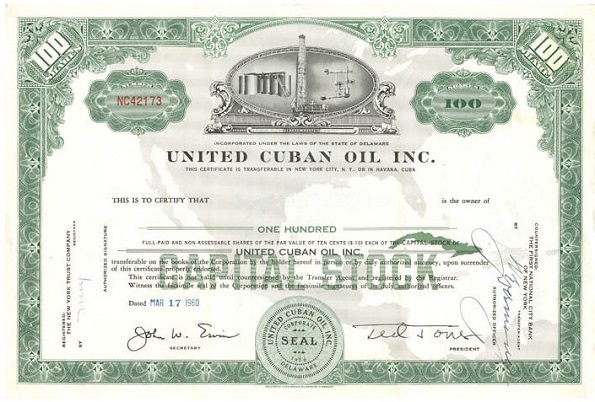
United Cuban Oil filed with the U.S. Securities and Exchange Commission to register 2,573,625 common stocks and an initial public offering of 2,000,000 shares at $1.25 a share. The company exchanged 573,625 shares of stock one-for-one to absorb Jones’ Companie de Fomento Petrolero and make it a subsidiary.
Jones’ holdings in Cuba also became subsidiaries: Empresas Petroleras Jones de Cuba and Compania Perforadora Jones de Cuba. A group headed by James J. McBride bought 1,200,000 shares to be held in escrow for three years.
On June 13, 1957, United Cuban Oil announced plans to drill in California. The selected site was on the 111 acre Muller ranch, about three miles west of La Honda. Drilling of the Muller No. 1 well began on June 29. Interviewed by the Santa Cruz Sentinel, company president Jones took the opportunity to promote United Cuban Oil’s prospects with its six producing wells in Cuba.
Six weeks later, Jones, “reportedly stated that oil was struck at 2,610 feet in 45 feet of oil sand. Officials would only say that it was producing a ‘couple of hundred barrels.’” Regardless of production, by the end of August 1957, United Cuban Oil had plugged and abandoned the Muller well after water intrusion and a failed re-drilling effort.

In Texas, United Cuban Oil completed its No. 1A Coker well in Coleman County, five miles northeast of Novice. But the wildcat well turned out to be just a brief producer. It too was abandoned. At the time, United Cuban Oil was selling for about 56 cents a share on the American Stock Exchange, but for any business operating in Cuba, everything changed on January 1, 1959. Fidel Castro seized power, dictator Fulgencio Batista fled the island, and the Cold War became more dangerous.
Back in the United States, United Cuban Oil was reorganized by three wealthy entrepreneurs from El Paso, Texas. In May 1959, they merged Balcones Corporation, Dell City Gas Company, and United Cuban Oil to form a new company while retaining the United Cuban Oil name and Ted Jones as president. The company planned to move its headquarters to El Paso.
Although United Cuban Oil’s underwriters, S.D. Fuller & Company, offered analysis of prospects to potential investors in the Commercial and Financial Chronicle, few were willing to gamble on Cuba’s uncertain future. By November 1959, the Law 635 of the Batista government effectively stripped United Cuban Oil of its Cuban operations.
The stories of exploration and production companies joining petroleum booms (and avoiding busts) can be found updated in Is my Old Oil Stock worth Anything? The American Oil & Gas Historical Society preserves U.S. petroleum history.
_______________________
Trek of the Oil Finders: A History of Exploration for Petroleum (1975); History of Oil Well Drilling (2007);The Prize: The Epic Quest for Oil, Money & Power (1991); The Birth of the Oil Industry (1938); Groundbreakers: The Story of Oilfield Technology and the People Who Made it Happen (2015). As an Amazon Associate, AOGHS earns a commission from qualifying purchases.
_______________________
The American Oil & Gas Historical Society (AOGHS) preserves U.S. petroleum history. Please support AOGHS to help maintain this energy education website, a monthly email newsletter, This Week in Oil and Gas History News, and expand historical research. Contact bawells@aoghs.org. Copyright © 2026 Bruce A. Wells.
Citation Information – Article Title: “United Cuban Oil Inc.” Authors: B.A. Wells and K.L. Wells. Website Name: American Oil & Gas Historical Society. URL: https://aoghs.org/old-oil-stocks/united-cuban-oil-inc. Last Updated: February 8, 2026. Original Published Date: December 6, 2018.
by Bruce Wells | Jan 22, 2025 | Petroleum Companies
Rise and fall of a California oil exploration company.
A new “black gold” rush in California took off in 1886 after William Rowland and partner William Lacy completed several producing oil wells at Rancho La Puente. Their company, Rowland & Lacy (later called the Puente Crude Oil Company), helped reveal the Puente oilfield.
The exploration venture — and a more successful one with a similar name, the Puente Oil Company — were among those seeking oil in southern California at the turn of the century. By 1912, many inexperienced companies had drilled more than 100 wells in the Fullerton area southeast of the Los Angeles field. Two expensive “dry holes” were completed by the Puente Crude Oil Company.
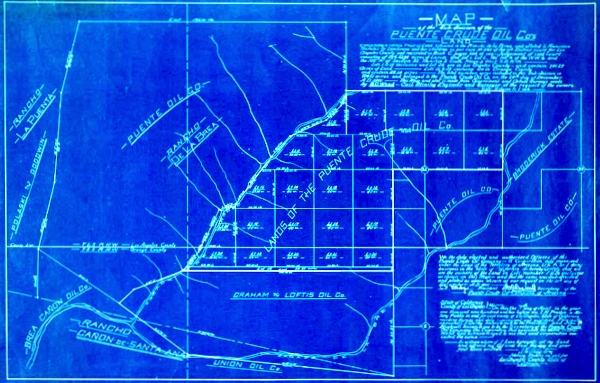
Puente Crude Oil Company was one of many small early 20th-century ventures hoping to find oil in southern California’s prolific oilfields at Brea Canyon and Fullerton.
Initially capitalized with $500,000, Puente Crude Oil offered stock to the public at 10 cents a share in 1900, but its two unsuccessful wells in the Puente field’s eastern extension brought the company to a quick financial crisis.
One well was lost to a “crooked hole” and the other found only traces of oil and natural gas as enthusiastic advertisements continued to solicit investment. Some ads referred to the widely known Sunset oilfield, discovered in 1892 in Kern County to the north.

By May 1901 company stock was offered at two cents per share to relieve indebtedness and enable further drilling on the company’s 870 acres in Rodeo Canyon. One year later, San Bernardino newspapers reported the company in trouble.
“This history of misadventure has not been pleasing to the stockholders of the Puente Crude Oil Company,” noted one article. “An auditing committee was appointed for the purpose of examining the books and accounts of the company,” it added.
Further reports in 1902 noted the company had issued no statements, “financial or otherwise,” for a year. Puente Crude Oil Company is absent from records thereafter.
South of Los Angeles, in Orange County, the Brea Museum and Heritage Center tells the story of the Olinda Oil Well No. 1 well of 1898 – one of many important California petroleum discoveries. Visit the Olinda Oil Museum and Trail at 4025 Santa Fe Road in Brea.
Much of Puente Oil’s former oil-producing land would later be managed by the Puente Hills Landfill Native Habitat Preservation Authority. In 2022, the Port of Los Angeles handled more than 220 million metric tons — 20 percent of all incoming cargo for the United States.
The stories of exploration and production (E&P) companies joining U.S. petroleum booms (and avoiding busts) can be found updated in Is my Old Oil Stock worth Anything?
_______________________
Recommended Reading: Los Angeles, California, Images of America (2001). Your Amazon purchase benefits the American Oil & Gas Historical Society. As an Amazon Associate, AOGHS earns a commission from qualifying purchases.
_______________________
The American Oil & Gas Historical Society (AOGHS) preserves U.S. petroleum history. Please become an AOGHS annual supporter and help maintain this energy education website and expand historical research. For more information, contact bawells@aoghs.org. Copyright © 2025 Bruce A. Wells. All rights reserved.
Citation Information – Article Title: “Puente Crude Oil Company.” Authors: B.A. Wells and K.L. Wells. Website Name: American Oil & Gas Historical Society. URL: https://aoghs.org/old-oil-stocks/puente-crude-oil-company. Last Updated: January 30, 2025. Original Published Date: July 2, 2013.