by Bruce Wells | Sep 30, 2025 | Petroleum Companies
Wildly optimistic promotions during WW I and some drilling, but no gushers.
“Oil Excitement at Rocky Ford Field Near Sundance,” proclaimed a front page of the Moorcroft (Wyoming) Democrat on September 14, 1917, describing a “big drill” of the Wyoming-Dakota Company.
“Rocky Ford, the seat of the oil activities in Crook County is about the busiest place around,” the newspaper continued. “Cars come and go, people congregate, and the steady churning of the two big rigs continues perpetually.”
Not finished with its enthusiastic reporting, the Moorcroft Democrat noted: “Excitement has reached the zenith of tension, and with each gush of the precious fluid, oil stock climbs another notch. The big drill of the Wyoming-Dakota Co. has been pulled from their deep hole until spring. The drill reached 600 feet and was in oil.”
North Texas oilfield discoveries had made national headlines, adding to the excitement in Wyoming, where the giant Salt Creek-Midwest field was revealed in 1908. Even showman Col. William F. Cody would catch oil fever (see Buffalo Bill Shoshone Oil Company).
Wyoming-Dakota Oil
The Rapid City, South Dakota, petroleum exploration company Wyoming-Dakota Oil — reportedly having one producing well and three more drilling — was capitalized at $500,000 with a par value of 25 cents per share. All of its leases were in Crook County, including 3,200 acres in Lime Butte field, 10,000 acres in Rocky Ford field, and 4,000 acres in Poison Creek field.
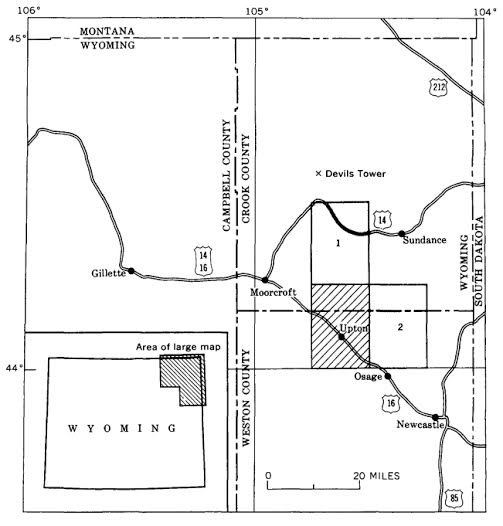 Since Wyoming would not pass its first “Blue Sky” law to prevent fraudulent promotions until 1919, Wyoming-Dakota Oil’s newspaper ads often rivaled patent medicine exaggerations. Potential investors were enticed with “Geologists claim this showing indicates alone 500,000 barrels to the acre” and “Your Chance Has Come if you want to make money in Oil.”
In Sioux Falls, South Dakota, the Sells Investment Company offered Wyoming-Dakota Oil Company stock reportedly after “a careful selection of conservative issues from among the thousand prospects, offering same to you before higher prices prevail or its present substantial position has been discounted by professional traders. A good clean cut speculation of this character may mean a fortune. Watch this company for sensational developments.”
The United States had entered World War I in April 1917; by November newspapers reported Francis Peabody, chairman of the Coal Committee of the Council of National Defense, was telling the U.S. Senate Public Lands Committee that the country was not producing enough oil to win the war.
“He said if nothing were done to develop new wells the reserve supply would be exhausted in twelve months and production would be 50,000,000 barrels less than requirements,” one newspaper noted. Wyoming-Dakota Oil Company executives took advantage of the opportunity while more Texas discoveries like “Roaring Ranger” made headlines.

“The (war) situation outlined leads us to suggest that you investigate Wyoming-Dakota Oil. ‘We are doing our bit’ by drilling night and day. Ours is an investment worth while. The allotment of Treasury stock at 25 cents is almost sold out and the Directors will advance the price of stock to 50 cents a share (100 per cent on your present investment) on December 15th, 1917.”
The Wyoming-Dakota Oil promotion continued: “By that time our newspaper announcement in the Eastern cities, pointing out the enormous acreage, present production and negotiations for additional valuable holdings will be made known to millions of seasoned investors in New York, Philadelphia, Chicago, Boston and Pittsburgh. We feel confident this will result in a demand for this stock that will send the present market price skyward. We trust you will see the wisdom of prompt action before all available stock at 25 cents per share has been purchased by other investors.”
In early 1918, Wyoming-Dakota Oil Company had drilled wells in the Upton-Thornton oilfield and was “holding out high hope of bringing in a gusher in a few days.” In July, the Laramie Daily Boomerang reported the company had “two rigs going steadily in Crook County’s Rocky Ford field” — but no oil gushers.
Growing investor pessimism was reflected in Wyoming-Dakota Oil Company’s stock prices, which fell in over-the-counter markets from 75 cents bid in June 1919 to 50 cents bid at the end of September. By March 1920, brokers offered 5,000 shares or any part thereof at 5 cents a share.

A final blow to the company was reported in the Laramie Republican of July 25, 1921: “Wyoming-Dakota…has completed pulling the casing from the well which it has been drilling north of town, after having struck a formation said to be granite, at a depth of 715 feet.”
The Laramie newspaper remained optimistic. “While this has a tendency to retard the activities of other interests, it is by no means stopping them entirely and it is to be hoped that another well will be started this summer.”
That did not happen. Reports on Wyoming-Dakota Oil Company disappeared for the next 24 years, until a court summons was published in the January 25, 1945, Sundance (Wyoming) Times.
The summons said Wyoming-Dakota Oil — address or place of residence to plaintiff unknown — was being sued in the Sixth District Court of Wyoming. The exploration company then faded into history; its stock certificates valued only by scripophily collectors.
_______________________

_______________________
The American Oil & Gas Historical Society (AOGHS) preserves U.S. petroleum history. Please become an AOGHS annual supporter and help maintain this energy education website and expand historical research. For more information, contact bawells@aoghs.org. Copyright © 2025 Bruce A. Wells.
Citation Information: Article Title – “Wyoming-Dakota Company” Authors: B.A. Wells and K.L. Wells. Website Name: American Oil & Gas Historical Society. URL https://aoghs.org/old-oil-stocks/wyoming-dakota-oil-company. Last Updated: March 31, 2025. Original Published Date: January 14, 2016.
by Bruce Wells | Sep 29, 2022 | Petroleum Companies
Elk Basin United Oil Company incorporated in 1917 seeking oil riches in Wyoming’s booming Elk Basin oilfield. Oilfields found in North Texas, including a 1911 gusher at Electra, already had resulted in a rush of new exploration ventures – and created boom towns like Burkburnett.
Wherever found, America’s newly discovered oilfields led to the founding of many exploration ventures that competed against more established companies.
Newly formed companies frequently struggled to survive as competition for financing, leases, and drilling equipment intensified, especially as exploration moved westward.
Wyoming Oilfields
In a remote, scenic valley on the border of Wyoming and Montana, a discovery well opened Wyoming’s Elk Basin oilfield on October 8, 1915. Wyoming’s earliest oil wells had produced quality, easily refined oil as early as 1890.
Drilled by the Midwest Refining Company, the wildcat well produced up to 150 barrels of oil a day of a high-grade, “light oil.” Credit for oil discovery is given to geologist George Ketchum, who first recognized the Elk Basin as a likely source of oil.
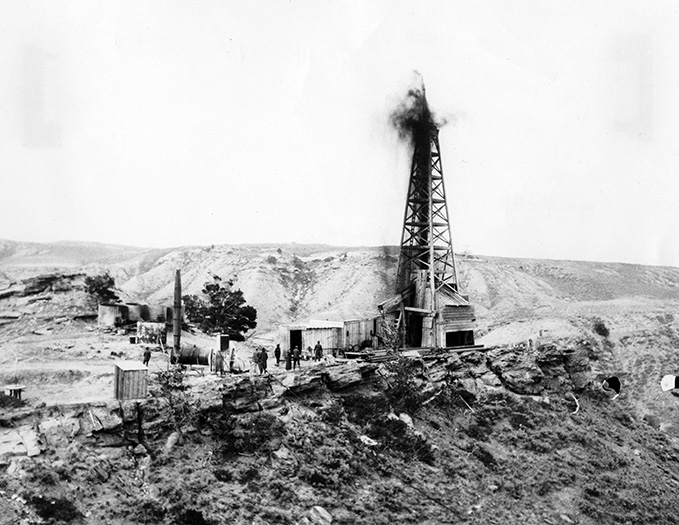
“Gusher coming in, south rim of the Elk Basin Field, 1917.” Photo courtesy American Heritage Center.Ketchum, a farmer from Cowly, Wyoming, in 1906 had explored the area with C.A. Fisher, who had been the first geologist to map a region within the Bighorn Basin southeast of Cody, Wyoming, where oil seeps were discovered in 1883.

The Elk Basin, which extends from Carbon County, Montana, into northeastern Park County, Wyoming, attracted further exploration after the 1915 well. More successful wells followed.
Once again, petroleum discoveries in unproved territory attracted speculators, investors, and new companies – including the Elk Basin United Oil Company.
Established petroleum companies like Midwest Refining — and the Ohio Oil Company, which would become Marathon Oil — came to the Elk Basin. These oil companies had the financial resources to survive a run of dry holes or other exploration hazards.
The exploration industry’s many smaller and under-capitalized companies would prove especially vulnerable.
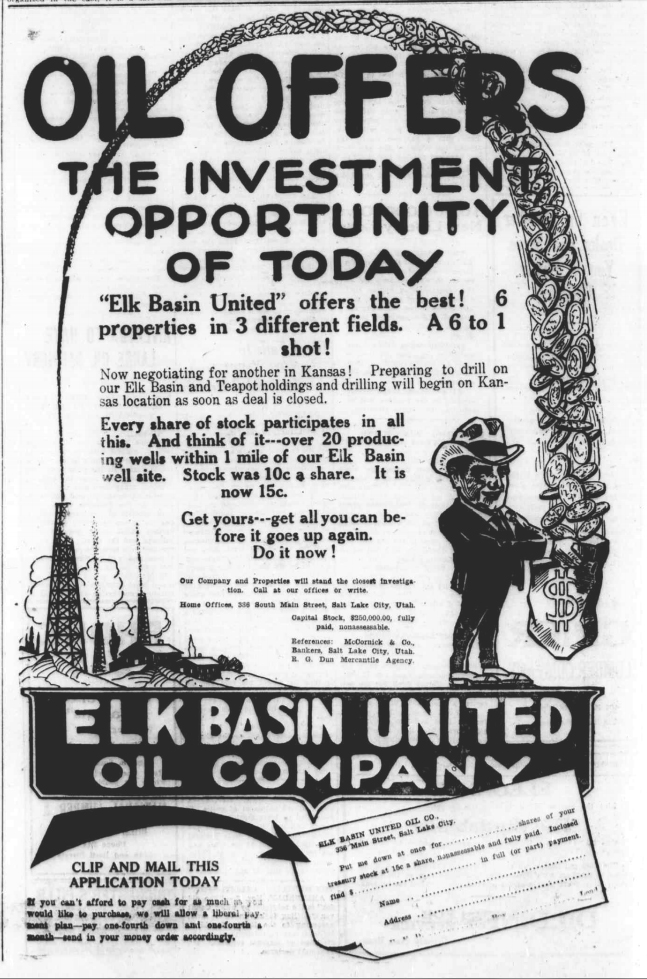
Audacious advertising claims helped Elk Basin United Oil Company compete for investors.
Is My Old Oil Stock Worth Anything features several such small players in Wyoming’s petroleum history, including the notorious Dr. Frederick Albert Cook (Arctic Explorer turns Oil Promoter). Even Wyoming’s famous showman, Col. William F. Cody, got caught up in the state’s oil fever (Buffalo Bill Shoshone Oil Company).
Elk Basin United Oil Company
Elk Basin United Oil Company of Salt Lake City, Utah, incorporated on July 30, 1917, and acquired a lease of 120 acres in Wyoming’s Elk Basin oilfield. By February 1918, company stock sold for 12 cents a share.
Enthusiastic newspaper ads promoted its “6 properties in 3 different fields…A 6 to 1 shot!” Twenty producing wells were reputed to be within one mile of Elk Basin United Oil’s Wyoming well site.
Meanwhile, Elk Basin United Oil reported expansion plans underway in a growing Kansas Mid-Continent oilfield. The company secured leases near Garnett and completed four producing oil wells, yielding a total of about 500 barrels of oil a month. It added an additional 112 acres and planned a fifth well.
Prairie Pipe Line Company (later Sinclair Consolidated) completed pipelines into the Garnett field through which several companies looked to transport their oil production.
However, growing competition from better funded exploration ventures and low crude oil prices ranging between $1.10 and $1.98 per barrel of oil in 1917 and 1918 drove many small companies into consolidations, mergers or bankruptcy.
Elk Basin United Oil, exploring back in Wyoming by March 1919, sought a lease on the property of the First Ward Pasture Company bordering the Utah line, “with a view of prospecting the property declare the surface showing to be very favorable for an oil deposit.” But financial issues continued to burden the company.
In December 1919, Oil Distribution News reported Basin United Oil Company was negotiating mergers with the Anderson Oil Company and the Kansas-United Oil Company, with a proposed capitalization of $1 million. With no results of the planned combination documented, Elk Basin United Oil Company disappeared from financial records soon thereafter.
_______________________
The stories of exploration and production companies joining petroleum booms (and avoiding busts) can be found updated in Is my Old Oil Stock worth Anything? Become an AOGHS annual supporting member and help maintain this energy education website and expand historical research. For more information, contact bawells@aoghs.org. Copyright © 2022 Bruce A. Wells. All rights reserved.
Citation Information – Article Title: “Elk Basin United Oil Company.” Authors: B.A. Wells and K.L. Wells. Website Name: American Oil & Gas Historical Society. URL: https://aoghs.org/old-oil-stocks/elk-basin-united-oil-company. Last Updated: September 29, 2022. Original Published Date: October 1, 2021.
by Bruce Wells | May 23, 2015 | Petroleum Companies
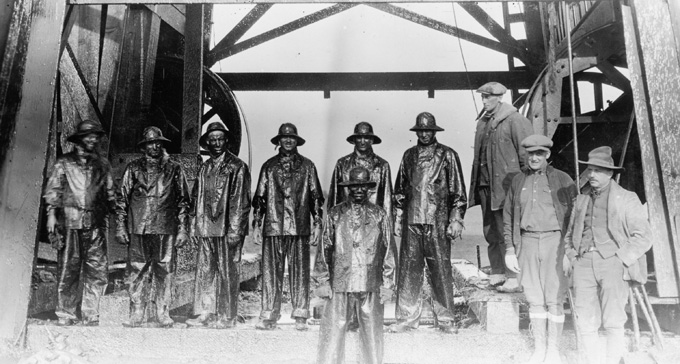
Roughnecks after capping an oil well in Wyoming’s Salt Creek field, circa 1920s. American Heritage Center, University of Wyoming.
Petroleum exploration in Wyoming had gone on since reports of oil seeps in 1832 when Wyoming Prairie Oil & Gas Company joined the search in 1917.
Fur trappers in Wyoming Territory first reported finding oil seeps near Salt Creek. Tales of a “Great Tar Spring” had led to the earliest hand-dug oil wells there during the Civil War.
“The first recorded oil sale in Wyoming occurred along the Oregon Trail when, in 1863, enterprising entrepreneurs sold oil as a lubricant to wagon-train travelers” explains Wyohistory.org. “The oil came from Oil Mountain Springs some 20 miles west of present-day Casper.”
By 1884, six years before statehood, Mike Murphy, an oilman from Pennsylvania, used a steam-powered cable-tool rig to drill 300 feet deep and complete Wyoming’s first official oil well. Read more in First Wyoming Oil Wells.
With modest capitalization of $36,000 in 1917, Wyoming Prairie Oil & Gas Company incorporated in Cheyenne, Wyoming. The company soon had 640 acres under lease in the state’s Big Muddy oilfield. (more…)
by Bruce Wells | Apr 11, 2015 | Petroleum Companies
Women entrepreneurs have been part of America’s petroleum industry since the earliest Pennsylvania oil wells.
In Bradford, Pennsylvania, home of the first “billion dollar oilfield,” a leading service company was run by a woman as early as 1884. Read about her in Mrs. Alford’s Nitro Factory.
Although Texas oilfields fueled the Allies to victory in World War I, Wyoming discoveries also played a part. The state’s drilling boom had begun in 1908 with the No. 1 Salt Creek well. It revealed a giant, often shallow oilfield. One well produced oil from 22 feet deep.
The Salt Creek field in the Powder River Basin proved to be one of the most significant in the Rocky Mountains (learn more in First Wyoming Oil Wells). Maybell B. Remore was among the “wildcatters” there. Her Women’s National Oil & Development Company incorporated in 1917. (more…)