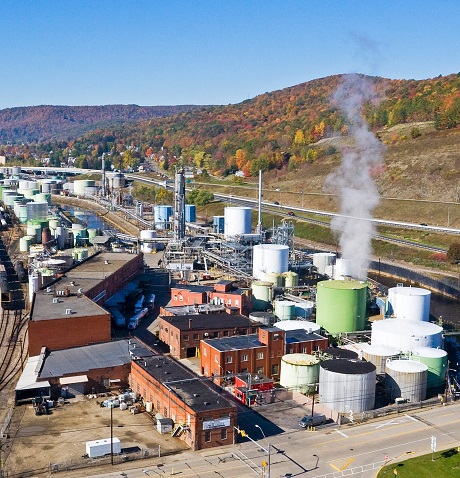
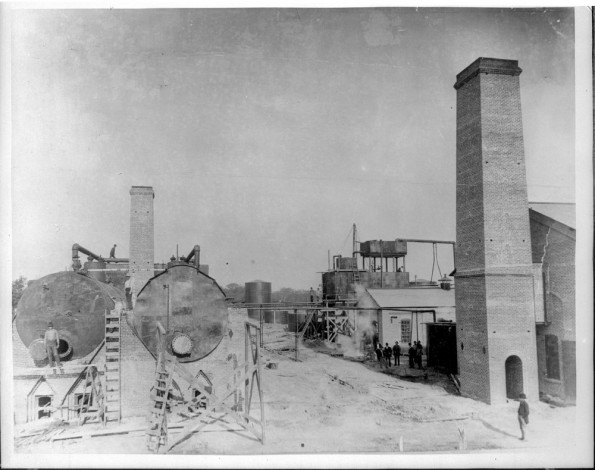
A giant Mid-Continent oilfield revealed in 1915 by the emerging science of petroleum geology.
Desperate for their town to live up to its name, community leaders of El Dorado, Kansas, sought petroleum riches after natural gas discoveries at nearby Augusta and at Paola, south of Kansas City. But it would be oil, not natural gas, that brought prosperity east of Wichita. (more…)
A 1930 wildcat well — and two drilled miles away — revealed the largest oilfield in the lower 48 states.
During the Great Depression, as farmers scratched out a living on drought-tormented land in East Texas, Columbus Marion “Dad:” Joiner, a 70-year-old Bible-quoting entrepreneur, and A.D. “Doc” Lloyd, a self-proclaimed geologist and former patent oil salesman, convinced them oil could be found.
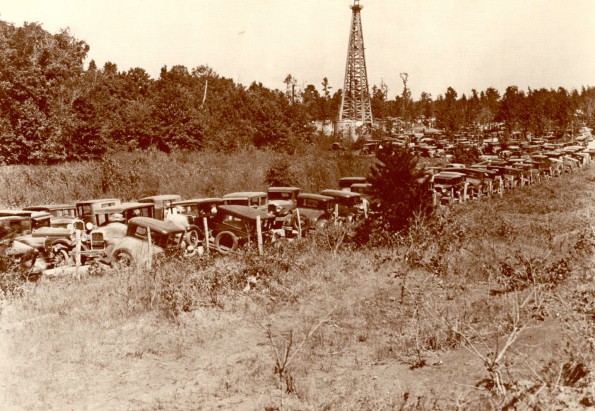
A crowd of more than 4,000 landowners, leaseholders, stockholders, creditors, and others gathered in Rusk County, Texas, on October 3, 1930, to watch the well-shooting spectacle of the Daisy Bradford No. 3 well erupting a column of oil.
“Thousands crowded their way to the site of Daisy Bradford No. 3, hoping to be there when and if oil gushed from the well to wash away the misery of the Great Depression.” Photo courtesy Jack Elder and Caleb Pirttelli, The Glory Days.
The well on the widow Daisy Bradford’s farm near Kilgore was the first of three wells that revealed one of the greatest petroleum discoveries in United States history. A second wildcat well came in to the north on December 28, 1930 — to the astonishment of most geologists.
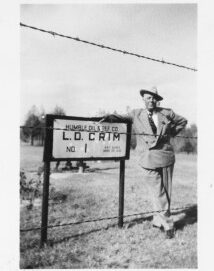
The Lou Della Crim No. 1 was drilled by Malcolm Crim on his mother’s farm. “The well was only nine miles from Daisy Bradford No. 3, yet no one was aware that the two wells were part of what was then a geological phenomenon — an incredible deposit of oil in the Woodbine formation had “pinched out” as it tilted upward against the Sabine Uplift creating the massive East Texas Oil Field,” explains the East Texas Oil Museum at Kilgore College.
About 15 miles north of that well, the Lathrop No. 1, a Gregg County well spudded in December 1931 by W.A. “Monty” Moncrief, delivered yet another gusher on January 26, 1931.
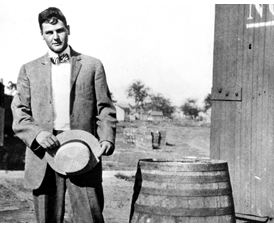
J. Malcolm Crim, owner of a general store in Kilgore, named his well after his mother, Lou Della.
At the time, the great distance between these “black gold” discoveries convinced virtually all of the major oil companies that separate oilfields had been found. But to the delight of the hundreds of struggling farmers who owned the land, the three wells were all part of one giant field, the Great East Texas oilfield.
H.L. Hunt and Oklahoma Wildcatters
In 1905, when Haroldson Lafayette “H.L.” Hunt was just 16 years old, he left his Illinois farm family and headed west. Along the way, he worked as a dishwasher, mule team driver, logger, and farmhand — and even tried out for semi-pro baseball (also see Oilfield of Dreams — Gassers, Oilers and Drillers).
H.L. Hunt’s oil career began in Arkansas and East Texas and spanned much of the industry’s history, notes Hunt Oil Company. Photo circa 1911.
During his travels, young H.L. Hunt learned to gamble and played cards in bunkhouses, hobo camps, and saloons. But his life changed when an Arkansas wildcat well, the Busey-Armstrong No. 1, erupted oil on January 10, 1921. Hunt joined the speculative rush and drilling frenzy that followed. He began with $50 in his pocket.
The Arkansas oilfield discovery catapulted the population of El Dorado from 4,000 to over 25,000 (learn more in First Arkansas Oil Wells).
“Dad” and “Doc”
While Hunt was pursuing oil in Arkansas, an unlikely pair was doing the same in Oklahoma. Sixty-five-year-old Columbus Marion Joiner was a former lawyer and Tennessee legislator who had spent years making a living as an oil lease broker in Oklahoma. He had lost a $200,000 fortune in the financial panic of 1907 — and began pursuing the wealth a successful wildcatter and promoter might find.
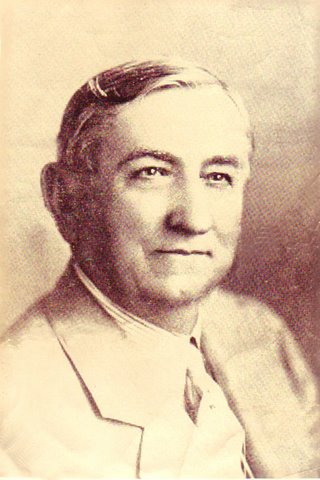
Columbus Marion Joiner (1860 – 1947) believed in geologist A.D. Lloyd, especially after Lloyd located wells in Seminole, Oklahoma, oilfields.
A friend of Joiner, Joseph Idelbert Durham, had studied medicine and worked as a government chemist in the Idaho gold rush. Durham had also prospected for gold in the Yukon and Mexico before peddling patent oil medicines in “Dr. Alonzo Durham’s Great Medicine Show.”
Taking the name “A.D. Lloyd,” Durham proclaimed, “I’m not a professional geologist…but I’ve studied the earth more and know more about it than any professional geologist now alive will ever know.”
Joiner believed in “Doc” Lloyd, and his confidence was reinforced when Lloyd accurately located the rich Seminole oilfield. Joiner drilled to within 200 feet of discovering this previously untapped reserve — but stopped short when his money ran out. Empire Gas & Fuel Company brought in the field’s discovery well on a nearby lease.
After a similar near miss in Oklahoma’s Cement field and a stretch of bad luck, the broke but optimistic Joiner headed to Dallas, where oilmen and oil money were plentiful. Meanwhile, A.D. Lloyd was off to Mexico, promoting new oil ventures.
Meanwhile, H.L. Hunt’s success in Arkansas enabled him to investigate other investment possibilities, and with El Dorado oilfield production diminishing, he was lured to Florida real estate. He sold his interests to the Louisiana Oil and Refining Company, retaining a few wells in the El Dorado and Smackover fields.
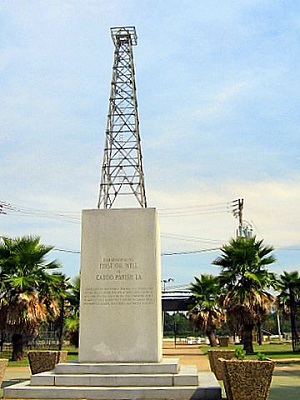
Dedicated in 1955, a monument in Shreveport, Louisiana, commemorates the state’s rich petroleum heritage. Photo by Bruce Wells.
Hunt ultimately abandoned the Florida real estate market and returned to Arkansas, where in 1934 he formed H.L. Hunt, Inc. He was back in the oil business, the no-limit game he loved. Hunt traveled to Shreveport, Louisiana, and checked into the Washington-Youree Hotel, where the marble lobby hosted crowds of competing oil operators, promoters, and “lease hounds” — all looking for an edge in petroleum exploration.
Speculators and promoters often profited where the true wildcatters could not (see Is My Old Oil Stock Worth Anything?). Not far to the west of Shreveport, Rusk County in northeastern Texas had seen its share of lease trading, despite the widely held conviction that there was no oil to be found there.
Geologists from major oil companies found no petroleum-rich salt domes (as in the 1901 Spindletop gusher at Beaumont to the south), anticlines, or other indications of oil. Seventeen wildcat wells had been dry holes.
Wildcatting in Rusk County
Columbus Marion Joiner was undeterred. In 1927, he was 66 years old. He had just $45 in his pocket when he left Dallas to pursue opportunities in Rusk County. To poor farmers scratching out a living on drought-tormented land, Joiner seemed larger than life — a Bible-quoting genuine oil entrepreneur from Dallas who neither drank, smoked, nor cursed.
Within a few months, the affable but shrewd Joiner had acquired leases on several thousand acres and resumed his collaboration with A.D. “Doc” Lloyd.
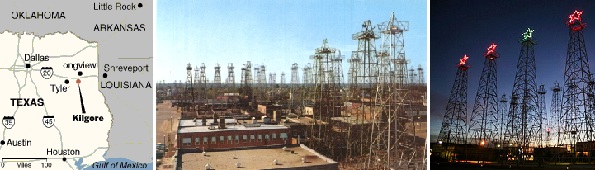
Investments from hopeful farmers and merchants brought historic results — and made Kilgore, Longview, and Tyler boom towns during the Great Depression. Kilgore celebrates by decorating derricks that once dominated its skyline.
Joiner formed a “Syndicate” from 500 of his lease block acres and began selling one-acre interest certificates to anyone who could scrape together $25. Joiner could be quite charming to the ladies and persuasive to gentlemen.
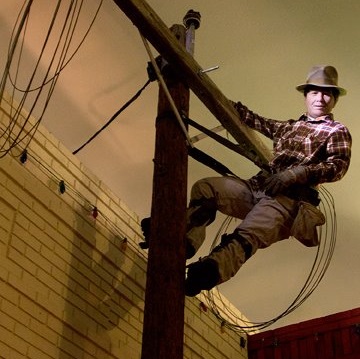
“Animatronic” rural electric lineman Buddy has welcomed visitors to “Boomtown, USA,” since 2012. Photo courtesy East Texas Oil Museum.
Small investments from hopeful Rusk County farmers and merchants provided Joiner just enough month-to-month money to get by and sometimes pay on his considerable lease rental debt. Promoting oil certificates in an area largely dismissed by professionals called for a slick pitch, and Joiner’s self-taught geologist friend, “Doc” Lloyd, could help.
While Humble Oil Company geologists and geophysicists were reporting that Rusk County offered no possibilities, Joiner was mailing his own report to potential investors: “Geological, Topographical and Petroliferous Survey, Portion of Rusk County, Texas, Made for C.M. Joiner by A.D. Lloyd, Geologist and Petroleum Engineer.”
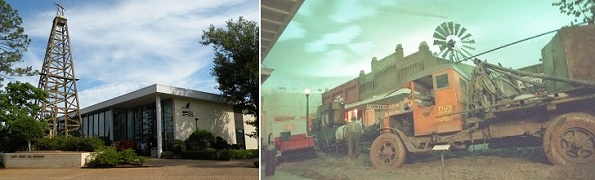
The East Texas Oil Museum in Kilgore is “a tribute to the men and women who dared to dream as they pursued the fruits of free enterprise,” according to Joe White, who founded the museum in 1980 — the 50th anniversary of the oil field’s discovery. Photo by Bruce Wells.
Using clear and correct scientific terminology, “Doc” Lloyd’s document described Rusk County anticlines, faults, and a salt dome — all geologic features associated with substantial oil deposits and all completely fictitious. Equally imaginary were the “Yegua and Cook Mountain formations” and the thousands of seismographic registrations ostensibly recorded.
The impressive-looking but fabricated report was accompanied by a map depicting a “salt dome” and a fault running squarely through the widow Daisy Bradford’s farm, the exact site of the 500-acre Syndicate lease block that “Dad” Joiner was promoting.
Dry Hole, Dry Hole
“Doc” Lloyd’s assessment had the desired effect, and the increased sales of certificates enabled Joiner to patch together a rusty, worn-out rig and begin drilling the Daisy Bradford No. 1 in August 1927.
To sustain operations and in pursuit of new investors, Joiner created more syndicates and sold far more certificates than he could possibly redeem, in one case selling the same certificate to eleven different investors. This didn’t present a problem unless Joiner actually brought in a producing well, but if he did, finding oil was the kind of “problem” wildcatters wished for.
In February 1928, the Daisy Bradford No. 1 well failed at 1,098 feet when the drill pipe became irretrievably stuck. Joiner continued overselling certificates to finance drilling.
In March 1929, his Daisy Bradford No. 2 suffered a like fate at 2,518 feet — far deeper than the hodgepodge of old equipment was thought capable.
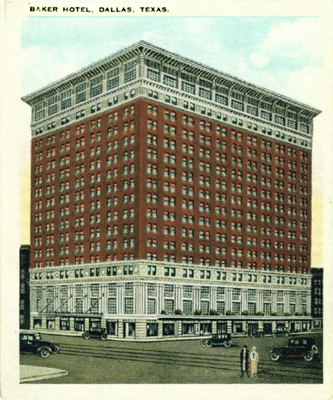
Haroldson Lafayette “H. L.” Hunt (third from right) is a former dishwasher, mule team driver, logger, farmhand, and semi-pro baseball tryout. C. M. “Dad” Joiner (third from left) shakes the hand of geologist A. D. “Doc” Lloyd at the 1930 discovery well of the East Texas oilfield. Recognizing the significance of the discovery before his competitors, H. L. Hunt will move quickly — and take significant risk — by purchasing the discovery well and nearby leases from Joiner.
Daisy Bradford No. 3 was spudded just 375 feet from the failed second attempt at a site determined when broken equipment prevented moving any farther. Before long, Joiner’s “poor boy” operation was down to burning used tires in the old boiler to gain a few pounds of steam pressure and drill a few feet at a time.
In September 1930, Hunt and Joiner met for the first time when Daisy Bradford’s brother invited Hunt to observe a drill stem test at Joiner’s third well (drill stem tests can determine if oil is present in a formation and the rate at which it can be produced).
Hunt — always on the lookout for new opportunities — drove to the site on the widow Bradford farm with his friend from El Dorado, merchant and clothier P.G. “Pete” Lake.
The Woodbine Sand
The well test was done on September 3, 1930. When the drill stem test brought a surge of mud, oil, and natural gas, Hunt was impressed. He raised enough money to lease three tracts to the east and one to the south of Joiner’s well as the news spread and the scramble for a piece of the action began. The Woodbine sand formation will make petroleum history.
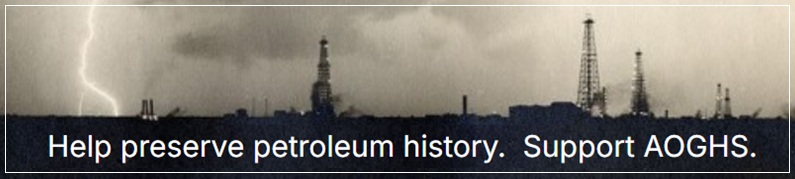
In legal trouble, Columbus M. “Dad” Joiner met with H.L. Hunt at the Baker Hotel in Dallas and sold him 5,580 acres of leases for $1.34 million.
In two weeks, more than 2,000 land deals were recorded; two weeks later, Daisy Bradford No. 3 blew in as a gusher in front of about 5,000 spectators who cheered madly, celebrated their newfound fortunes, and congratulated “Dad” Joiner. It wasn’t long, however, before the greatly oversold Syndicate certificates created a convoluted legal nightmare of immense proportions for the now famous “Dad” Joiner.
On the 31st of October, a Dallas court put Joiner’s holdings into receivership. Seventy-year-old Columbus Marion Joiner took refuge in a Dallas hotel as swarms of claimants and creditors looked for him.
Following the drill stem test and aware of previous dry holes drilled to the east, H.L. Hunt became convinced that a substantial oilfield lay to the west. His conviction was reinforced when dry holes were drilled both southeast and northeast of Daisy Bradford No. 3, abruptly chilling the lease market.
Meanwhile, just a mile west of Joiner’s find and surrounded by his leases, Deep Rock Oil Company was drilling a test well on the Claude Ashby farm. Hunt believed that if this well came in, it would confirm that Daisy Bradford No. 3 was part of a much larger oilfield. A dry hole would prove the major oil companies’ belief that Joiner’s Woodbine sand reservoir was a fluke.
Hunt assigned three oil scouts to closely monitor and report to him on the progress of the Ashby No. 1 well. Since his own credit was exhausted, he tried to interest Deep Rock and others in deals to buy out Joiner, but Daisy Bradford No. 3 was by then flowing intermittently. It would yield only about 200 barrels of oil and stop altogether for an agonizing 18 to 20 hours before resuming.
Hunt remained convinced Joiner’s contested leases sat atop an oilfield, but just how big an oilfield was beyond Hunt’s or anybody else’s imagination. He later wrote, “Joiner was a true wildcatter and was much more interested in drilling wildcat wells than developing proven or semi-proven oil acreage. He was becoming weary of all the carrying on which was being made against him.”
Hunt’s “Business Coup”
Hunt borrowed $30,000 from his old El Dorado clothier friend, P.G. Lake, and set about to convince the harried and hiding “Dad” Joiner to sell. They met in Dallas’ Baker Hotel on November 25-26, 1930, while Hunt’s scouts continued to watch the Deep Rock well’s progress.
By the summer of 1931, about 900,000 barrels of oil per day are being produced from 1,200 wells in Rusk County. H. L. Hunt’s purchase of Daisy Bradford No. 3, above, provided the financial base for Hunt Oil Company.
At about 8:30 p.m. on November 26, Hunt’s scouts reported that the Deep Rock well had found the oil-rich Woodbine sand, confirming his belief in the oilfield. Four hours later, Joiner sold all his holdings (including about 5,000 leased acres) to Hunt for $1,335,000, including all the $30,000 in cash Hunt had borrowed. It was far more money than Joiner had ever seen and provided him a way out of the legal mess of oversold certificates and competing claims.
It was for Hunt — as he later described — his “greatest business coup,” despite the 300 lawsuits that followed. As presiding District Judge R.T. Brown said, “If you want a successful gathering of long-lost kinfolks, just manage to find oil on the old homestead. They will come out from under logs, down trees, from out of the blue, and down every road and byway, but they’ll get there — even some nobody ever suspected were kinfolks.”
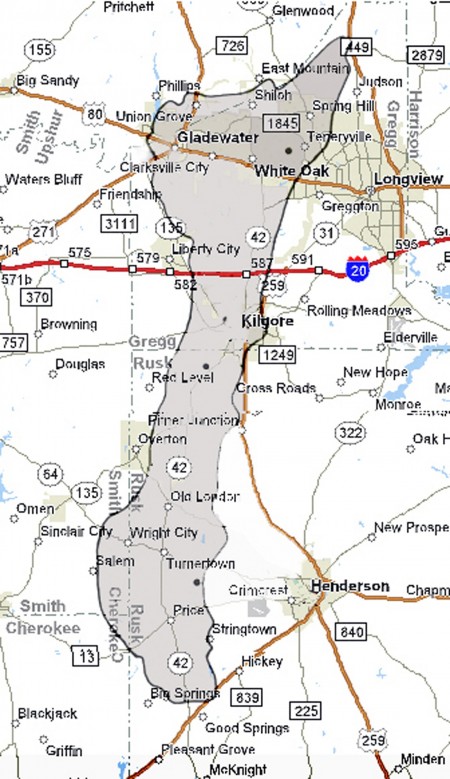
The East Texas oilfield, 43 miles long and 12.5 miles wide, has produced more than six billion barrels of oil by 2025.
In the 10 years of litigation that followed, Hunt sustained every title. Eighteen days after his deal with Joiner, Deep Rock’s Ashby No. 1 came in at 3,000 barrels of oil a day.
The “Black Giant”
On a Sunday two weeks later, Lou Della Crim No. 1 came in 13 miles to the north, near Kilgore, Texas, flowing at over 22,000 barrels of oil a day. In January 1931, the similarly petroleum-rich Lathrop No. 1 well came in about 15 miles farther north, in Gregg County. Remarkably, the Ashby, Lou Della Crim, and Lathrop wells were all part of the same gigantic field, covering over 140,000 acres!
Hunt’s deal had put him in the midst of the unprecedented “Black Giant” known as the East Texas oilfield. In 1972, James A. Clark and Michel T. Halbouty published The Last Boom, noting, “The fortune Hunt built in East Texas served as the foundation for one much larger, for he could no more stop hunting for oil than could Joiner — and he seemed to find it as often as not.”
Production from the giant oilfield yielded five billion barrels of oil by 1980, and thanks to Dallas-based Hunt Oil Company, that was the year the East Texas Oil Museum opened at Kilgore College, not far from the Daisy Bradford No. 3 well.
Citation Information – Article Title: “East Texas Oilfield Discovery.” Authors: B.A. Wells and K.L. Wells. Website Name: American Oil & Gas Historical Society. URL: https://aoghs.org/petroleum-pioneers/east-texas-oilfield. Last Updated September 25, 2025. Original Published Date: October 22, 2012.
Making commercial “wet gas” in early 20th-century Oklahoma oilfields.
When Robert Galbreath and Frank Chesley completed their Ida Glenn No. 1 well on November 22, 1905, they revealed another giant oilfield south of Tulsa. The discovery well, drilled with cable-tool technology, struck oil-bearing sands at a depth of only 1,450 feet. (more…)
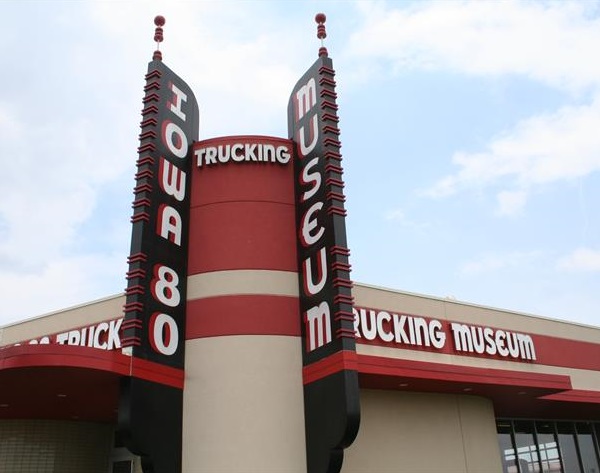
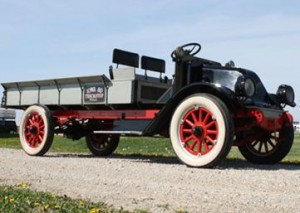
Beginning after its 1979 opening day, the Iowa 80 Trucking Museum has hosted an annual Jamboree attended by thousands. The museum in Walcott preserves more than 100 antique trucks — with most on display, including a rare 1890 Standard Oil triple wagon; a 1903 Eldridge; a 1910 Avery tractor/gasoline farm wagon; and a 1911 Walker Electric Model 43.
The trucking collection off Interstate 80 at the “World’s Largest Truck Stop” began thanks to truck stop founder Bill Moon, who had a passion for trucks and truck history. Every summer, the museum at exit 284 on I -80 outside Walcott, Iowa, hosts a variety of events for truckers and other travelers, teachers, students — and transportation history buffs.
“Bill had a passion for collecting antique trucks and other trucking memorabilia,” notes the Iowa 80 Trucking Museum. “We are pleased to be able to share this collection with the general public. Every truck has a story to tell and can provide a unique glimpse back in time. Many rare and one-of-a-kind trucks are on display.”
“If you are the least bit into cars you will find the museum interesting and well worth the stop,” notes a visitor from Legendary Collector Cars. “From what we could tell, it looks like this I-80 Exit at Walcott, Iowa, is about to become the over-the-road truckers Disneyland in a few years.”
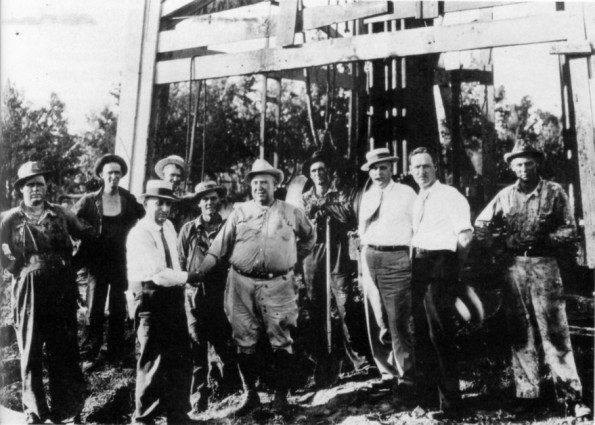
In 2024, the Iowa museum celebrated U.S. trucking history by showcasing its 1924 White Model 40 Wrecker, now on permanent display (and featured in the 1991 film Fried Green Tomatoes). The Model 40’s four-cylinder, 371-cubic-inch engine was produced at the White factory in Cleveland, Ohio, factory.
The museum, which offers short films about trucking history, attracts all kinds of visitors, from those interested in antique trucks to those wanting to learn the history of modern, big rigs. Exhibit spaces, greatly expanded in 2012, today include free smartphone apps with audio narratives.
Since its inception in 197. an annual Iowa 80 Truckers Jamboree has celebrated the U.S. trucking industry. Special events include programs about trucking history — and those big rigs.
The descriptions provide additional details about each truck not found on the limited space of exhibit signs. Visitors can scan a “QR” code at the welcome desk to download the app. Upcoming museum visitors can download it from the website. The innovation — increasingly found at museums — allows both virtual and actual visitors to scan and download exhibit information.
Celebrating Trucking History
“The Iowa 80 Trucking Museum’s mission is to celebrate trucking and to preserve and share its history,” noted Marketing Director Heather DeBaillie in 2012. The smartphone apps, give visitors even more information about the exhibits, “and also give those who are unable to visit the museum the opportunity to learn more about trucking history,” she said.
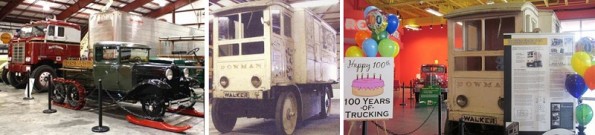
A century of trucking technology is on exhibit at the Iowa 80 Trucking Museum, which on July 15, 2011, celebrated the birthday of its rare 1911 Walker electric truck, which once delivered dairy products.
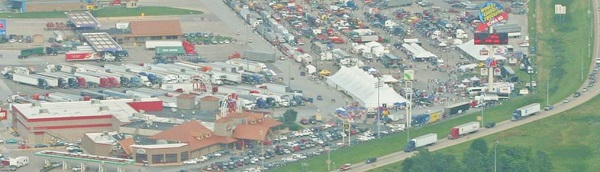
The annual Jamborees in July host nearly 30,000 drivers and their families from 23 different states and Canada, according to the marketing director. During two days guests enjoyed 175 exhibits — and a Super Truck Beauty Contest with 59 contestants.
In 2011, the trucking museum hosted a birthday party for its Walker electric truck — with the party coinciding with the 32nd annual Walcott Truckers Jamboree at its next-door neighbor, the Iowa 80 Truck Stop, DeBaillie noted.
The antique truck display included more than 200 vehicles. Thousands also enjoyed an Iowa pork chop cookout; a Trucker Olympics; carnival games; a concert and fireworks display.
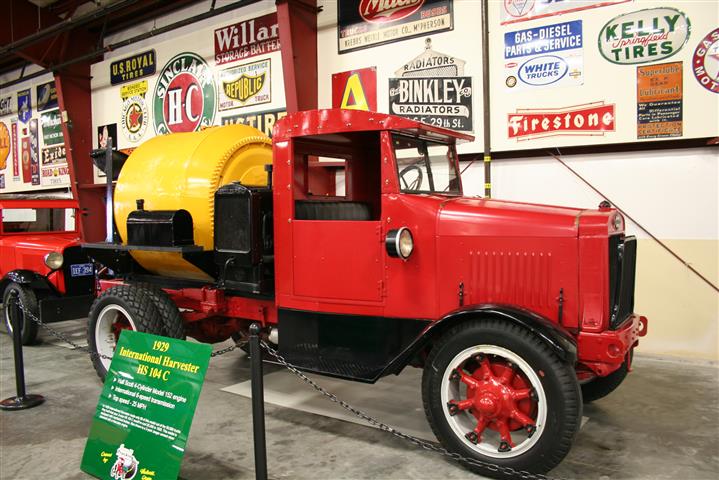
A 1929 International Harvester. Photo courtesy Legendary Collector Cars, which notes: “If you are the least bit into cars you will find the museum interesting and well worth the stop.”
Trucking Museum 1901 Electric Truck
The Walker truck’s 2011 centennial birthday party at the Iowa 80 Trucking Museum celebrated an electric manufactured by the Walker Vehicle Company of Chicago.
The company produced electric vehicles until late 1941. Walker trucks were used mainly as delivery trucks in major cities — delivering ice cream and other dairy products, baked goods and dry goods.
Although the 1919 International Harvester’s four-cylinder gasoline engine provided a top speed of just 17 mph, it was the first truck to climb Pike’s Peak.
The Iowa 80 Trucking Museum’s 1911 Walker electric truck was owned by Bowman Dairy and used to deliver milk to hospitals, restaurants and hotels, according to curator Dave Meier. It is one of only a handful of Walker Electric trucks known to still exist.
“Many people think that electric vehicles are a recent invention, when in fact they were in production over 100 years ago,” explained Meir.
Electric vehicles were popular in the late 19th century and early 20th century – until advances in internal combustion engine technology and mass production of cheaper gasoline vehicles led to a decline in their use (also see Cantankerous Combustion — 1st U.S. Auto Show).
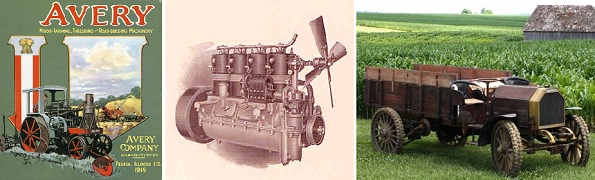
Among the exhibits at the trucking museum is one of the few surviving examples of an Avery gasoline-powered tractor. Avery Company of Peoria, Illinois, began producing coal (and straw)-burning steam tractors in 1891 — and became the world’s largest tractor supplier. It was also one of the first companies to manufacture gasoline tractors.
Avery tractors brought new efficiency to rural America — and the world. The Iowa 80 Trucking Museum’s 1910 Avery “Tractor-Gasoline Farm Wagon” (at right) was promoted with the slogan, “Makes Power Farming Possible on the Average Sized Farm.”
Created by his family, the Iowa 80 Trucking Museum was a dream of Bill Moon, who founded the Iowa 80 truck stop. Standard Oil originally built the stop in 1964 – when Interstate 80 was still under construction. In September 1965, Moon took over management and purchased it from Amoco in 1984. He managed its growth until his death in 1992.
Preserving personal artifacts and oilfield stories is important. Oil & Gas Families complements the extensive work of community museum staff and volunteers finding new ways to preserve artifacts, photographic, written and oral histories.
Citation Information – Article Title: “Iowa 80 Trucking Museum.” Authors: B.A. Wells and K.L. Wells. Website Name: American Oil & Gas Historical Society. URL: https://aoghs.org/oil-almanac/oil-riches-of-merriman-baptist-church. Last Updated: September 30, 2026. Original Published Date: April 18, 2012.
Pico Canyon oilfield brought pipelines, refineries, and Chevron.
Following the 1859 first commercial U.S. oil discovery in Pennsylvania, the earliest petroleum exploration companies were attracted to California’s natural oil seeps. Small but promising discoveries after the Civil War led to the state’s first gusher in 1876 — and the launching of a new California industry.
Pico Canyon, less than 35 miles north of Los Angeles, produced limited amounts of oil as early as 1855, but there was no market for the petroleum found near natural oil seeps. The first California drilling boom arrived a decade later in the northern part of the state with an oilfield also found near seeps.
Humboldt County Oil
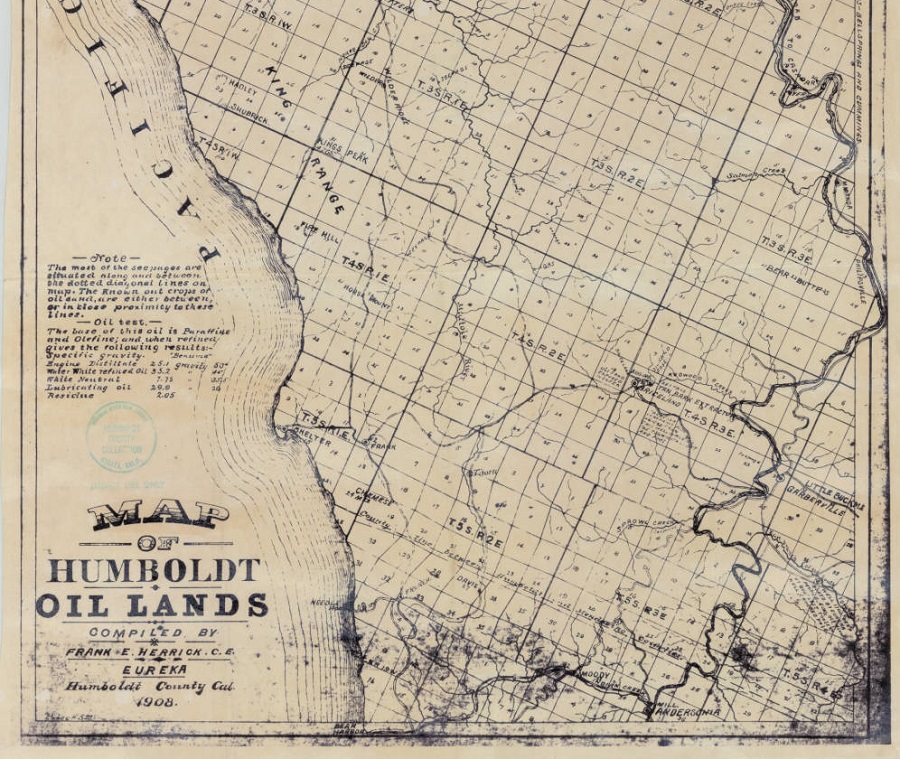
Completed in 1865 by the Old Union Matolle Oil Company, the Humboldt County well produced oil near the aptly named Petrolia. The oilfield discovery quickly attracted some of America’s earliest exploration companies.
Detail of a 1908 “Map of Humboldt County Oil Lands” includes post-Civil War commercial oil wells that attracted more drilling to northern California. Map courtesy Humboldt County Map Collection, Cal Poly Humboldt Library Special Collection.
A California historical marker (no. 543) dedicated on November 10, 1955, declared:
California’s First Drilled Oil Wells — California’s first drilled oil wells producing crude to be refined and sold commercially were located on the north fork of the river approximately three miles east of here. The Old Union Mattole Oil Company made its first shipment of oil from here in June 1865 to a San Francisco refinery. Many old wellheads remain today.
Although the “Old Union well” initially yielded about 30 barrels of high-quality oil, production declined to one barrel of oil per day, and the prospect was abandoned, according to K.R. Aalto, a geologist at Humboldt State University.
The Humboldt County well in what became the oilfield “attracted interest and investment among oilmen because of the abundance of oil and gas seeps throughout that region,” Aalto noted in his 2011 article in Oil-Industry History. But the California petroleum industry truly began to the south, at Pico Canyon Oilfield, a few miles west of Newhall.
Pico Canyon Well No. 4
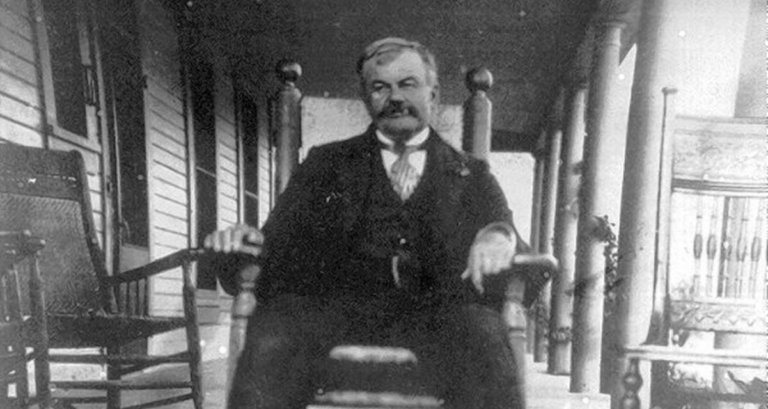
In Pico Canyon of the Santa Susana Mountains, Charles A. Mentry (1847-1900), who had formed a partnership establishing the California Star Oil Works Company, drilled three exploratory wells between 1875 and 1876. All showed promise, and the first West Coast oil gusher arrived with his fourth well. The oilfield discovery would lead to the creation of a major oil company.
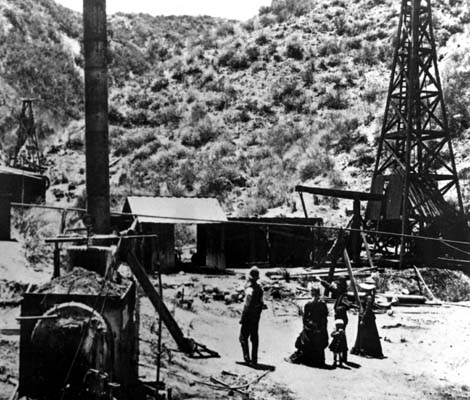
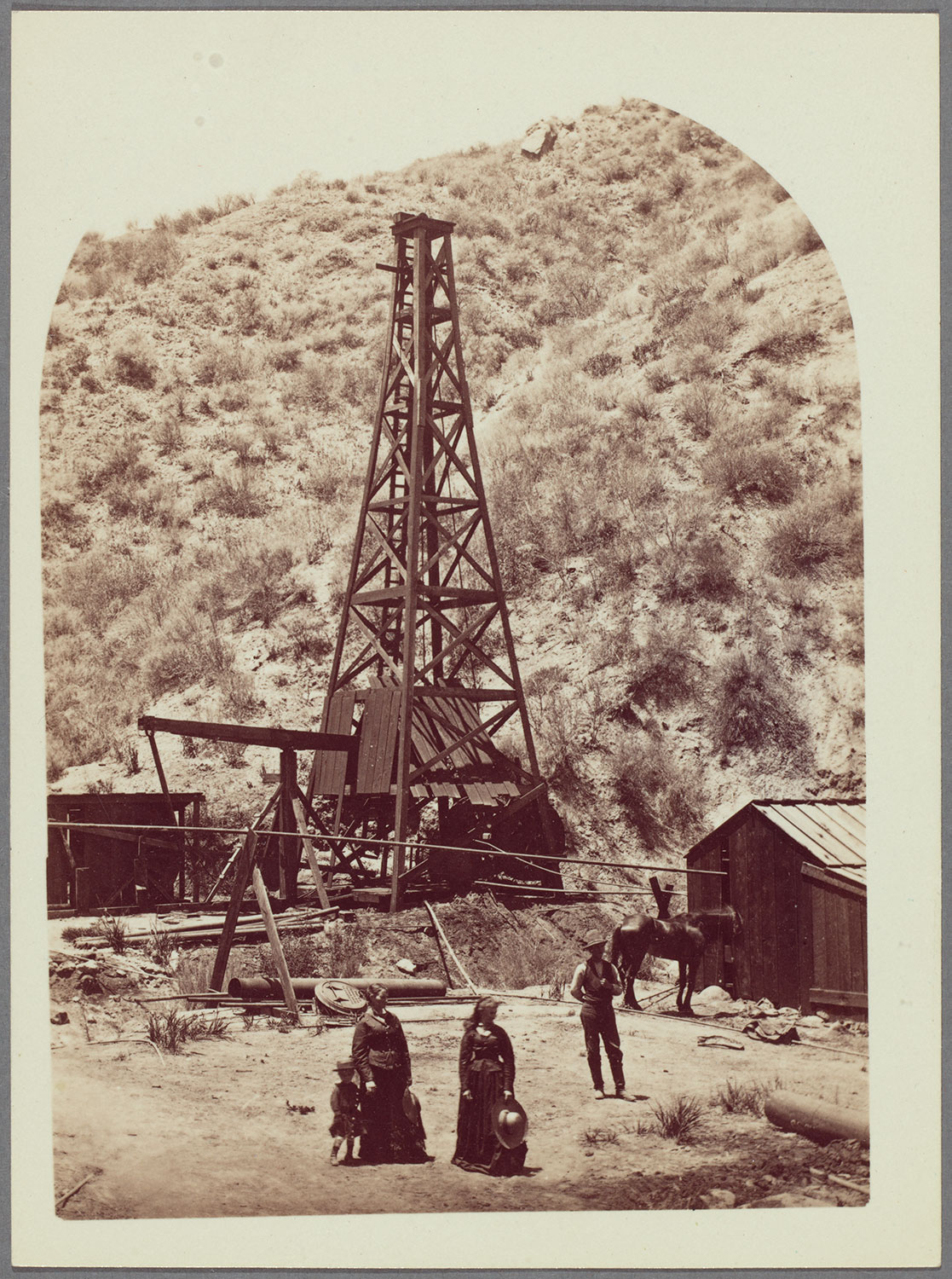
The steam boiler and cable tools, including the “walking beam,” of Pico Well No. 4 in 1877. Photo by Carleton E, Watkins courtesy Los Angeles Public Library Photo Collection.
Drilling with a steam-powered cable-tool rig in an area known for its many oil seeps, Mentry discovered the Pico Canyon oilfield north of Los Angeles. California’s first truly commercial oil well, the Pico Well No. 4 gusher of September 26, 1876, prompted more development, including pipeline construction and an oil refinery for producing kerosene.
Stereo view cards were made from the same negative of this circa 1877 Star Oil Works oil well in California’s Pico Canyon, San Fernando District by western photographer Carleton E. Watkins (1829 – 1916). Photo courtesy The Huntington Library, Carletonwatkins.org.
According to an article in the Los Angeles Times, the well initially produced 25 barrels a day from 370 feet. Mentry improvised many of his cable tools, including making a drill stem out of old railroad car axles he welded together.
“The railroad had not then been completed, there was no road into the canyon, water was almost unattainable, and there were no adequate tools or machinery to be had,” noted the Times article.
Charles Mentry had already successfully drilled 42 wells near Titusville, Pennsylvania, before exploring in the Santa Clara Valley — and launching California’s petroleum industry. Photo courtesy KHTS Radio, Santa Clara.
Mentry persevered, and his success in Pico Canyon led to the founding of “Mentryville,” the onetime drilling boom town that is today the site of Stevenson Ranch.
“Although his life was tragically cut short by illness on October 4, 1900, from typhoid fever, Mentry’s legacy as a pioneer in California’s oil industry endures,” noted KHTS Radio, Santa Clara. “His work in Pico Canyon not only made him a key figure in the region’s development but also set the stage for California’s future as an oil-rich state,” KHTS reported in 2025.
California Star Oil Works deepened the well to 560 feet, increasing daily production by 125 barrels, and constructed its pipeline from Pico Canyon to the newly built refinery in Newhall, just south of Santa Clarita.
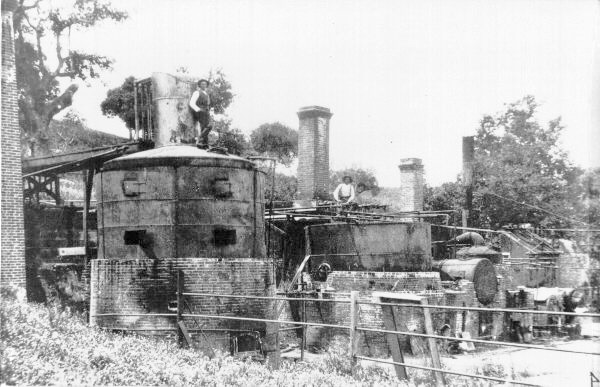
By 1880, California’s first commercial refinery processed oil from its first commercial oil well to make kerosene and other products. Photo courtesy the Santa Clarita Valley Historical Society.
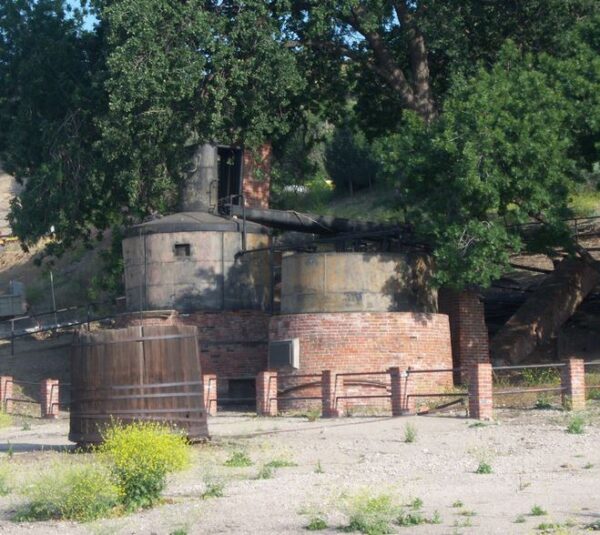
Producing kerosene and lubricants, Newhall’s Pioneer Refinery on Pine Street would become the first successful commercial refinery in the West. Giant stills set on brick foundations included two capable of producing 150 barrels a day each. The city of Santa Clarita received California’s first successful refinery as a gift from Chevron in 1997.
The Santa Clarita refinery, today preserved as a tourist attraction, is among the oldest in the world. The major oil company can trace its beginnings to the 1876 Pico Canyon oil well, which has been designated a historic site by the California Office of Historic Preservation.
Chevron Corporation, once the Standard Oil Company of California, in 1900 acquired Pacific Coast Oil Company. Pacific Coast had become majority owner of California Star Oil Works in 1879.
Santa Clarita acquired California’s first refinery as a gift from Chevron in 1997. It is one of the oldest existing oil refinery sites in the world. Photo by Konrad Summers.
Refining Kerosene for Lamps
California’s commercial refineries were among the first in America, where the industry began with small refineries in Pittsburgh, Pennsylvania, producing kerosene for lamps. The oil came from Titusville area oilfields — and a giant 1871 field discovered at Bradford, about 70 miles to the northeast.
The Bradford oilfield, which became known as America’s “first billion-dollar oilfield,” launched many Pennsylvania refineries, including the still-operating American Refining Group. The field’s first well produced just 10 barrels a day from 1,110 feet.
By 1875. Bradford leases reached as high as $1,000 per acre. A decade later, a sudden decline in the oilfield’s production led to a technological breakthrough. Pioneers in the new science of petroleum geology suggested that water pressure on oil sands could be used to increase oil production — “waterflooding” the geologic formation.
The oldest operating U.S. oil refinery began in 1881 in Bradford, Pennsylvania.
In Neodesha, Kansas, the Norman No. 1 well of 1892 revealed a petroleum-rich geologic region that would extend across Oklahoma, Texas, and Louisiana. Standard Oil built a refinery in Neodesha in 1897 that refined 500 barrels of oil a day. Standard was the first to process oil from the giant Mid-Continent field (learn more in Kansas Well reveals Mid-Continent).
In 2024, there were 134 operable petroleum refineries in the United States, according to the Energy Information Administration (EIA). The newest refinery with significant downstream capacity — a facility in Garyville, Louisiana — came online in 1977.
Built in 1897, a Standard Oil refinery in Neodesha, Kansas, refined 500 barrels of oil per day – the first to process oil from the Mid-Continent field. From “Kansas Memory” collection of the Kansas Historical Society.
For an investigation into which California oil well was the first, see this 2011 SearchReSearch blog of Dan Russell.
Citation Information: Article Title: “First California Oil Well.” Authors: B.A. Wells and K.L. Wells. Website Name: American Oil & Gas Historical Society. URL: https://aoghs.org/petroleum-pioneers/first-california-oil-well. Last Updated: September 22, 2026. Original Published Date: September 9, 2015.


 (2013). Your Amazon purchase benefits the American Oil & Gas Historical Society. As an Amazon Associate, AOGHS earns a commission from qualifying purchases.