by Bruce Wells | Sep 21, 2026 | This Week in Petroleum History
September 21, 1901 – First Louisiana Oil Well –
Nine months after the headline-making January 1901 “Lucas Gusher” in Texas, another giant oilfield was revealed 90 miles east in Louisiana. W. Scott Heywood — already successful thanks to wells drilled at Spindletop Hill — completed a wildcat well that produced 7,000 barrels of oil a day on the farm of Jules Clement.
Drilled six miles northeast of Jennings, the Clement No. 1 found oil at a depth of 1,700 feet. “The well flowed sand and oil for seven hours and covered Clement’s rice field with a lake of oil and sand, ruining several acres of rice,” noted the Jennings Daily News.
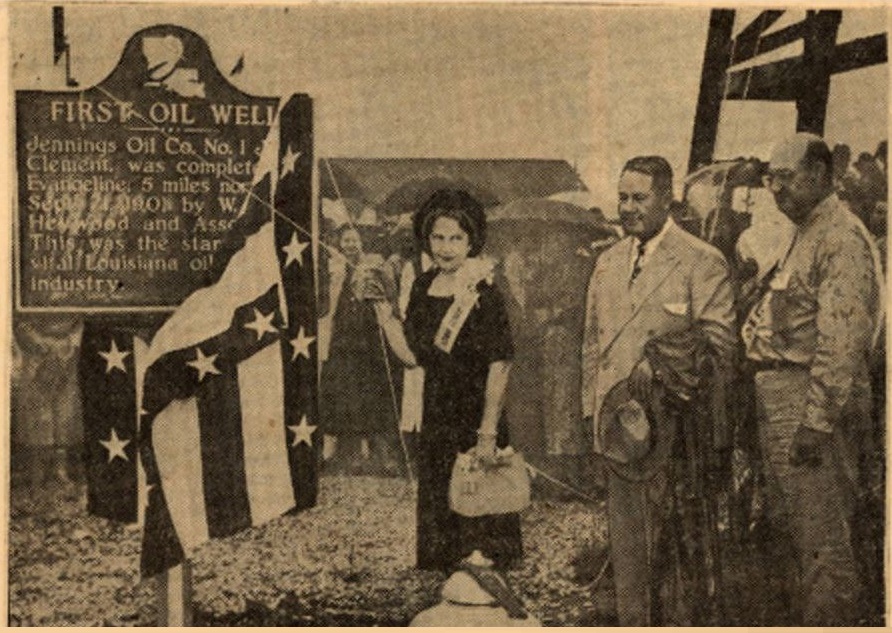
Mrs. Scott Heywood unveiled a marker as part of the Louisiana Golden Oil Jubilee in 1951. Times-Picayune (New Orleans) image courtesy Calcasieu Parish Public Library.
The discovery led to the state’s first commercial oil production by opening the prolific Jennings field, which Haywood further developed by building pipelines and storage tanks. The oilfield reached peak production of more than nine million barrels of oil in 1906.
Learn more in First Louisiana Oil Wells.
September 22, 1955 – End of Signal Oil “The Whistler” Radio Show
Sponsored since 1942 by the largest independent oil company on the West Coast, the last episode of the radio drama “The Whistler” aired on CBS Radio. Samuel Mosher in 1921 had established the Signal Oil Company as the Signal Gasoline Company during California’s Signal Hill oil boom.
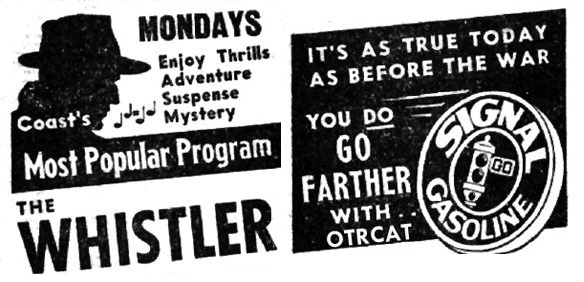
Signal Oil Company sponsored the West Coast CBS Radio mystery program “The Whistler” from 1942 to 1955.
The company’s 1931 partnership with Standard Oil of California (Socal) led to sponsorship of many radio programs, according to Media Heritage. All 692 weekly episodes of Signal Oil’s popular radio mystery began with echoing footsteps and an eerie whistle, followed by “That whistle is your signal for the Signal Oil program.”
September 23, 1918 – Wood River Refinery goes Online
The Roxana Petroleum Company Wood River (Illinois) facility began refining crude oil — processing more than two million barrels of oil from Oklahoma oilfields in its first year of operation. Roxana Petroleum was the 1912 creation of the Royal Dutch/Shell Group, which also founded the American Gasoline Company in Seattle to distribute the fuel on the West Coast.
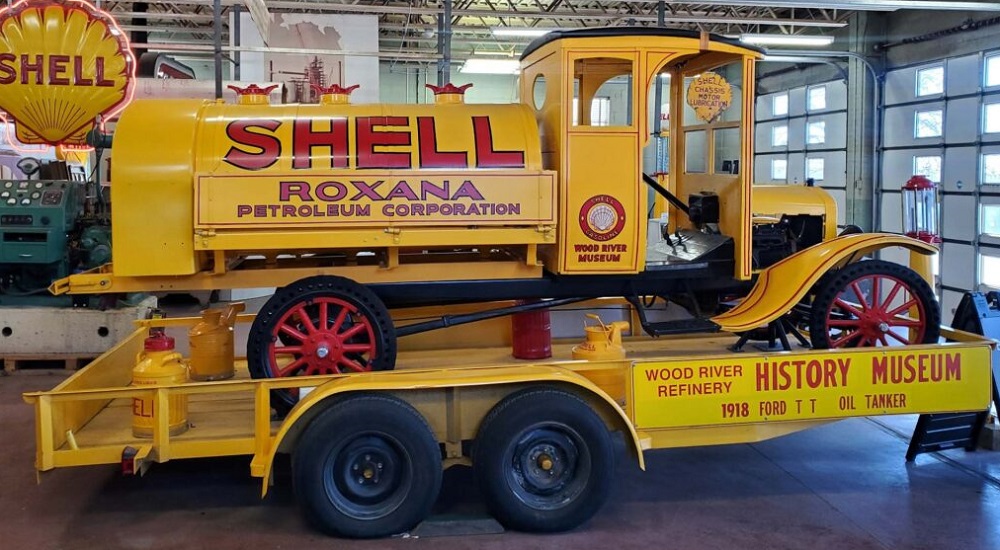
A small group of retirees in 1986 established the Wood River Refinery History Museum in three former Shell research laboratory buildings at Roxana, Illinois. Museum exhibits include a restored 1918 Shell tank truck and other large equipment in Building Two.
Roxana Petroleum produced high-quality oil from Oklahoma oilfields to be refined at the Wood River plant 15 miles northeast of St. Louis, today the largest refinery operated by Phillips 66. In 1928, Roxana Petroleum built an experimental oil storage reservoir in West Texas (see Million Barrel Museum).
September 23, 1933 – Standard Oil of California visits Saudi Arabia
Invited by Saudi Arabian King Abdel Aziz, geologists from Standard Oil Company of California arrived at the Port of Jubail in the Persian Gulf. Searching the desert for petroleum and “kindred bituminous matter,” they discovered a giant oilfield. The Saudi Arabia and Standard Oil partnership would become the Arabian American Oil Company (Aramco), later joined by other major U.S. companies.
September 23, 1947 – New Patent for “Hortonspheres”
Horace E. Horton’s Chicago Bridge & Iron Company (CB&I) received a patent for improvements to a spherical storage vessel he had invented in the 1920s. Designed to efficiently store natural gas, butane, propane, and other volatile petroleum products, the large spheres were among the most important storage innovations to come to the U.S. oil and natural gas industry.
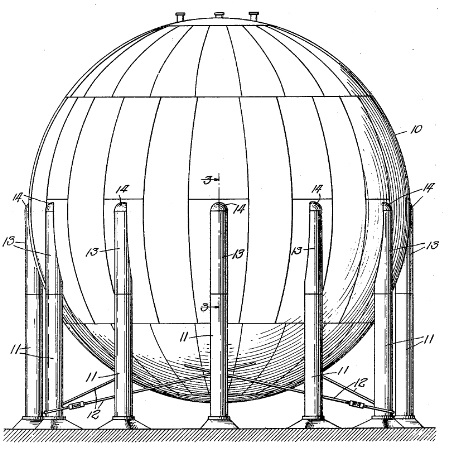
Horace Ebenezer Horton (1843-1912) founded the company that would build the world’s first “field-erected spherical pressure vessel.”
CB&I named its “Hortonspheres” after the engineer who had started the company in 1889 to build bridges across the Mississippi River. In 1892, CB&I erected its first elevated water tank in Fort Dodge, Iowa.
“The elevated steel plate tank was the first built with a full hemispherical bottom, one of the company’s first technical innovations,” CB&I noted, adding that the company built “the world’s first field-erected spherical pressure vessel” in 1923 at Port Arthur, Texas.
Learn more in Horace Horton’s Spheres.
September 24, 1951 – Perforating Wells with Bazooka Technology
When World War II veteran Henry Mohaupt applied to patent his “Shaped Charge Assembly and Gun,” he brought anti-tank technology to the petroleum industry — a downhole bazooka. Mohaupt, a Swiss-born chemical engineer, during the war had conducted a secret U.S. Army program to develop an anti-tank weapon. His idea of using a conically hollowed-out explosive charge to focus detonation energy led to the rocket grenade used in bazookas.
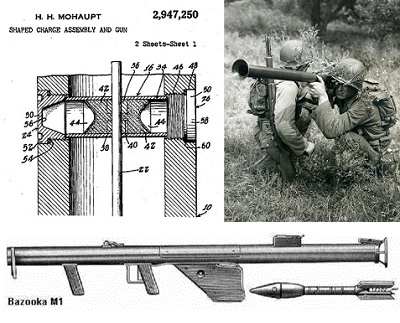
The patented “Shaped Charge Assembly and Gun” of Henry Mohaupt brought to the petroleum industry his World War II anti-tank “bazooka” technology.
After the war, the potential of using anti-tank rocket grenades to facilitate flow from oil-bearing strata was recognized by the Well Explosives Company of Fort Worth, Texas. The company employed Mohaupt to develop new technologies for safely perforating cement casing and pipe.
Learn more in Downhole Bazooka.
September 25, 1922 – First New Mexico Oil Well
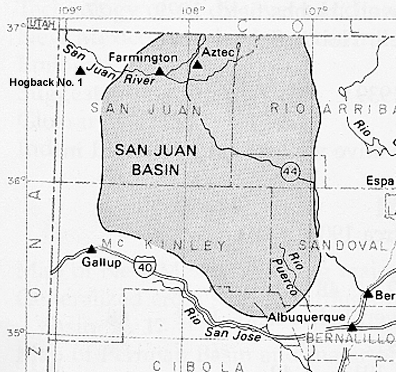
Midwest Refining Company launched the New Mexico petroleum industry by completing the state’s first commercial oil well. Drilled near Shiprock on the Navajo Indian Reservation, the Hogback No. 1 well produced 375 barrels of oil per day.
Following the oilfield discovery, Midwest completed 11 more wells to establish the Hogback field as a major producer of the San Juan Basin. Two years later, a pipeline was built to Farmington, where oil was shipped by rail to refineries in Salt Lake City, Utah.
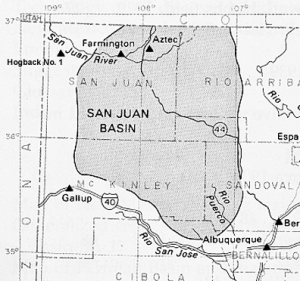
Midwest Refining Company discovered the Hogback oilfield in New Mexico’s San Juan Basin.
Production from the Hogback oilfield encouraged further exploration in New Mexico, leading to discoveries in 1928 at Hobbs in Lea County.
Learn more in First New Mexico Oil Wells.

September 26, 1876 – First Commercial California Oil Well
After three failed attempts, Charles Mentry’s California Star Oil Works Company discovered the Pico Canyon oilfield north of Los Angeles — California’s first commercial oil well. Drilled in a region known for natural oil seeps, the Pico No. 4 well produced 25 barrels of oil per day from a depth of 370 feet.
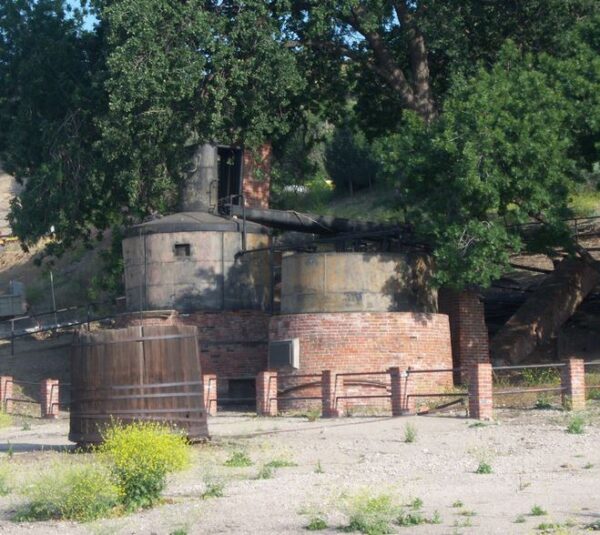
Preserved by the Santa Clarita Valley Historical Society, California’s first refinery includes riveted stills on brick foundations. Photo courtesy Konrad Summers.
Pico Canyon oilfield production would lead to construction of California’s first oil pipeline and the state’s first commercially successful oil refinery for making kerosene lamp fuel and lubricants. Riveted stills set on brick foundations had a refining capacity of 150 barrels of oil a day.
California Star Oil Works was acquired by Pacific Coast Oil Company in 1879, and the Pico Canyon oilfield discoverer became part of the Standard Oil Company of California (Socal) in 1906. Socal acquired Gulf Oil, the nation’s fifth-largest petroleum company at the time, in 1984 and adopted the brand name Chevron.
Learn more in First California Oil Wells.
September 26, 1933 – King Ranch Lease sets Record
Despite the reservations of Humble Oil and Refining Company’s president, geologist Wallace Pratt convinced the company to lease the almost million-acre King Ranch in Texas for almost $128,000 per year with a one-eighth royalty on any discovered oil.
Although Humble Oil and Refining, a Houston company founded in 1917, had not found oil on the ranch, the lease deal was the largest oil lease contract ever negotiated in the United States.
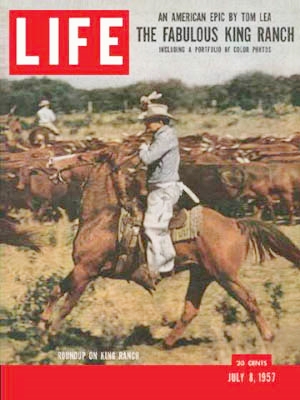
A 1933 King Ranch oil lease set a record.
Subsequent leases on nearby ranches gave Humble Oil & Refining nearly two million acres of mineral rights between Corpus Christi and the Rio Grande River. By 1947, Humble operated 390 producing oil wells on the King Ranch lease alone. The company became ExxonMobil, which has regularly extended its 1933 King Ranch lease agreement.
Learn more in Oil Reigns at King Ranch.
September 26, 1943 – First Florida Oil Well
Near a watering stop on the Atlantic Coast Line Railroad in southwestern Florida, the Humble Oil and Refining Company completed the state’s first commercial oil well, the Sunniland No. 1. The company had spent $1 million drilling to a depth of about 11,600 feet to complete the discovery well, located 12 miles south of Immokalee, near Big Cypress Preserve and the resort city of Naples.
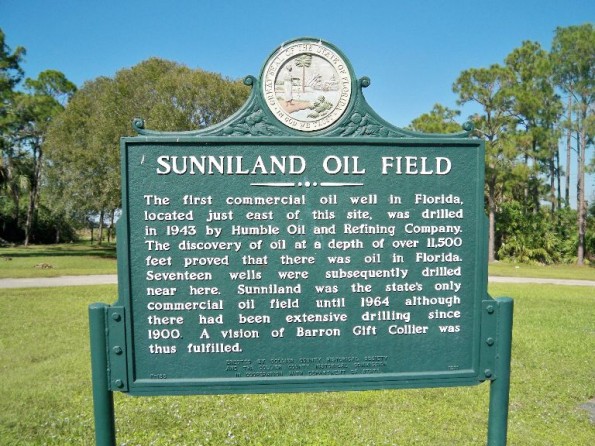
Humble Oil and Refining Company donated $60,000 to the University of Florida and the Florida State College for Women.
Florida oilfields had eluded discovery for decades. With almost 80 “dry holes” drilled by 1939, Florida legislators offered a $50,000 bounty for the first oil discovery. The Sunniland oilfield brought more drilling, and by 1954 the field was producing 500,000 barrels of oil per year from 11 wells.
Texas-based Humble Oil accepted the $50,000 prize offered by the state legislature, added $10,000 — and donated the $60,000 equally between the University of Florida and the Florida State College for Women. Humble later became ExxonMobil.
Learn more in First Florida Oil Well.
September 27, 1915 – Deadly Explosion in Ardmore, Oklahoma
A railroad car carrying casinghead gasoline exploded in Ardmore, Oklahoma, killing 43 people and injuring others. The car, which had arrived the day before, was waiting to be taken to a refinery. Casinghead gasoline (also called natural gasoline) at the time was integral to the state’s petroleum development, with 40 processing plants in operation.
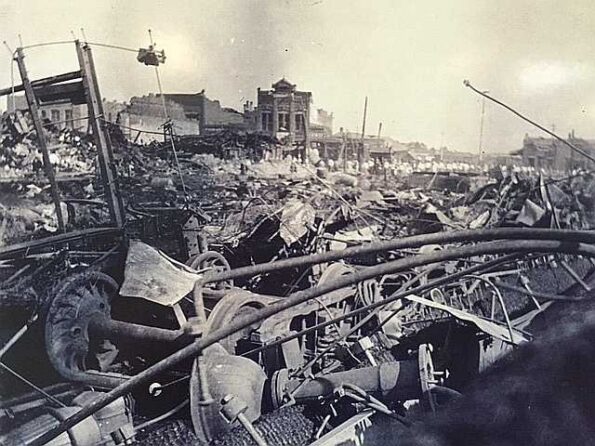
A casing gas explosion destroyed most of downtown Ardmore, Oklahoma, in 1915. Photo courtesy Oklahoma Historical Society.
According to the Oklahoma Historical Society (OHS), the disaster began when rising afternoon temperatures activated a valve to release the car’s gas pressure. “The Ardmore Refining Company then sent a representative, who removed the dome from the top of the car, filling the air with gas and vapors.”
Triggered by an unidentified source, the explosion destroyed much of downtown Ardmore. The Atchison, Topeka & Santa Fe Railway was found responsible for the explosion and paid 1,700 claims totaling $1.25 million, OHS reported, adding, “Oil companies changed and improved the extraction and transportation methods for natural gasoline.”
______________________
Recommended Reading: Louisiana’s Oil Heritage, Images of America (2012); Early Louisiana and Arkansas Oil: A Photographic History, 1901-1946 (1982); Signal Hill, California, Images of America (2006); Black Gold in California: The Story of California Petroleum Industry
  (2016); Handbook of Petroleum Refining Processes
 (2016);The Bazooka
 (2012); The Extraction State, A History of Natural Gas in America (2021); The Bazooka (2012); Wireline: A History of the Well Logging and Perforating Business in the Oil Fields
 (1990); The story of oil in New Mexico – Scenic trips to the geologic past (1989); Black Gold in California: The Story of California Petroleum Industry (2016); Kings of Texas: The 150-Year Saga of an American Ranching Empire
  (2003); Oil in the Deep South: A History of the Oil Business in Mississippi, Alabama, and Florida, 1859-1945
 (1993); Oil in Oklahoma (1976). Your Amazon purchase benefits the American Oil & Gas Historical Society. As an Amazon Associate, AOGHS earns a commission from qualifying purchases.
_______________________
The American Oil & Gas Historical Society (AOGHS) preserves U.S. petroleum history. Please support this website, subscribe to the free, monthly email newsletter This Week in Oil and Gas History News, and help expand our historical research. Contact bawells@aoghs.org. Copyright © 2026 Bruce A. Wells. All rights reserved.
by Bruce Wells | Jun 8, 2026 | This Week in Petroleum History
June 8, 1969 – First LNG Export from Alaska –
Richfield Oil Company, predecessor of ARCO, exported liquefied natural gas to Japan from the Kenai Peninsula, where Richfield discovered the Swanson River oilfield in July 1957 (see First Alaska Oil Wells). Until it stopped exporting in 2015, the Kenai Peninsula plant was the longest, continuously operating LNG terminal in the world.
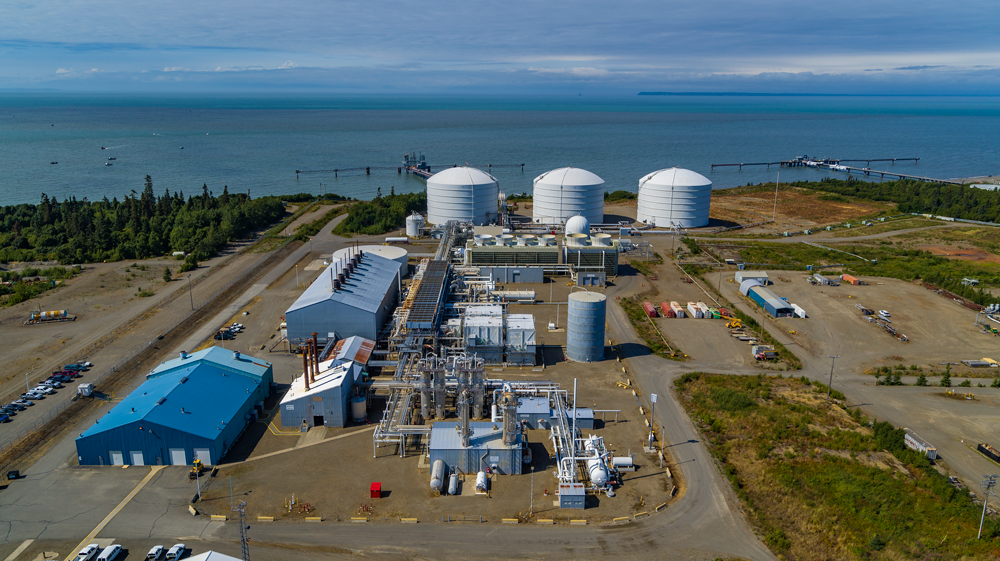
Marathon Petroleum mothballed the Kenai Peninsula plant in 2017 because of a lack of LNG buyers.
When ARCO was acquired by BP in 2000, federal antitrust concerns led to the sale of the Kenai Peninsula LNG plant to Phillips Petroleum (ConocoPhillips), which in 2017 mothballed the facility after failing to find LNG buyers, according to Global Energy Monitor (GEM). Marathon Petroleum acquired the Kenai LNG plant one year later.
Although the Federal Energy Regulatory Commission in 2020 approved modifying the facility to import LNG, Houston-based Harvest Midstream and Marathon in 2025 agreed to reconvert the facility to an LNG export terminal by December 2028. The ARCO brand remains the property of Marathon Petroleum.
June 9, 1894 – Water Well finds Oil in Corsicana, Texas
A contractor hired by the town of Corsicana to drill a water well on 12th Street found oil instead, launching the Texas petroleum industry seven years before the more famous Spindletop Hill gusher hundreds of miles to the southeast. Corsicana’s well produced just 2.5 barrels of oil a day from a depth of 1,035 feet but inspired a rush of exploration companies.
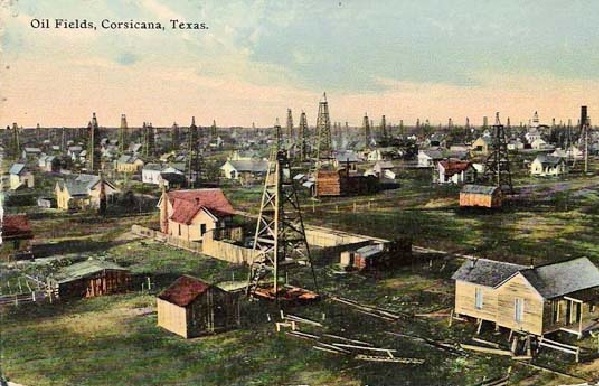
A colorized postcard depicts the Corsicana oilfield circa 1910. The boom town, which became an oilfield service and manufacturing center, today annually celebrates its oil patch heritage.
By 1898, about 300 produced oil in and around the boom town, which also became a center for technological innovation. A Corsicana company patented and manufactured the rotary rig that drilled the 1901 Spindletop discovery well near Beaumont.
Despite Corsicana’s oilfield discovery well bringing petroleum riches and a drilling boom, city officials paid the contractor only half of the $1,000 fee, citing the agreement for completing a water well. Corsicana has hosted an annual Derrick Days since 1976.
Learn more in First Texas Oil Boom.
June 9, 2023 — California Pump Jack added to Historic Register
An eccentric-wheel oilfield pumping unit that operated in California’s largest oilfield joined the National Register of Historic Places, thanks to research by Mark Smith, who submitted the application. Installed by the Engineers Oil Company in 1913, the Kern County jack plant’s eccentric wheels pumped oil until 1990.
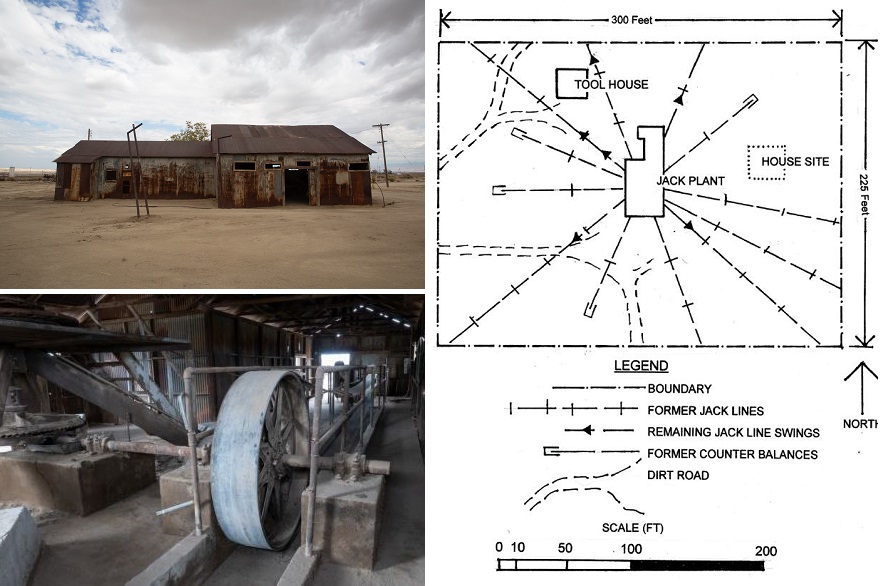
In operation until 1990, California’s Midway-Sunset Jack Plant used eccentric-wheel technologies from the late 19th century. The Kern County plant pumped more than 1.5 million barrels of oil. Photos courtesy John Harte. Illustration courtesy San Joaquin Geological Society.
“The Midway-Sunset Jack Plant is an extremely rare example of central power and ‘jack-line’ oil pumping technology on its original site and housed in its original building,” Smith noted in his 45-page draft application to the State Historical Resources Commission and later approved by the National Park Service. “Its design and operational history reflect significant advancements in oil extraction technology.”
June 11, 1816 – Manufactured Gas lights Art Museum in Baltimore
The first commercial gas lighting of residences, streets and businesses began when Rembrandt Peale impressed Baltimore civic leaders by illuminating a room in his Holliday Street Museum by burning “manufactured gas.” His display (using gas distilled from coal, tar or wood) dazzled them with a “ring beset with gems of light.”
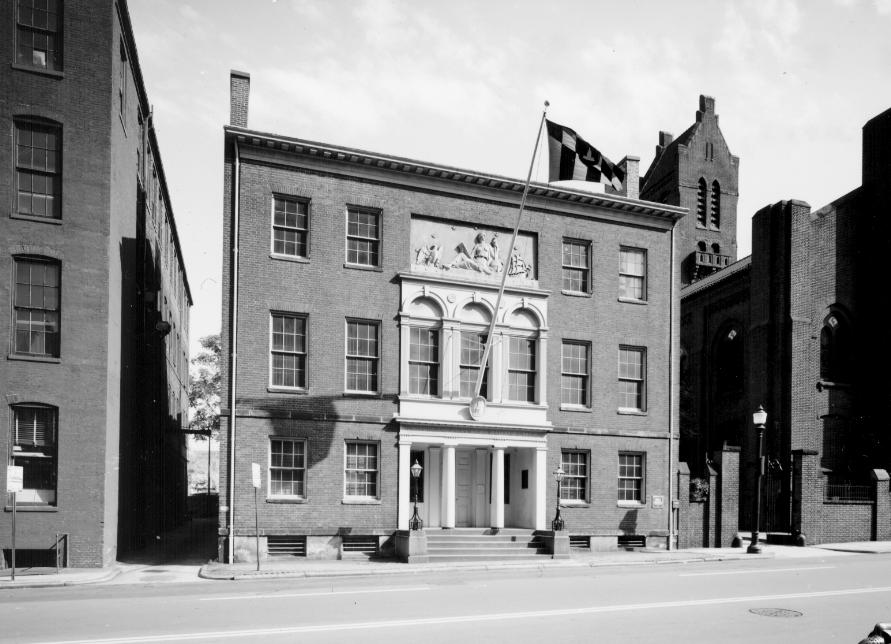
Lighted with manufactured gas, this Baltimore museum opened in 1814, America’s first building erected as a museum. Photo courtesy Maryland Historical Trust.
The Baltimore museum became the first U.S. public building to use gas lighting, according to the Maryland Historical Trust. Within a week, the city council approved plans to illuminate the city’s streets. Peale and a group of investors founded the Gas Light Company of Baltimore — the first gas company in America (today Baltimore Gas and Electric).
Learn more about “town gas” in Illuminating Gaslight.
June 11, 1911 – E.W. Marland discovers Ponca Nation Oilfield
Ernest W. Marland, founder of the 101 Ranch Oil Company in 1908, discovered an oilfield near Ponca City, Oklahoma, after reorganizing the company in his hometown of Pittsburgh, Pennsylvania. Almost broke after drilling eight uneconomical wells, Marland had turned to childhood friend John McCaskey of Pittsburgh, known as the “Sauerkraut King.”
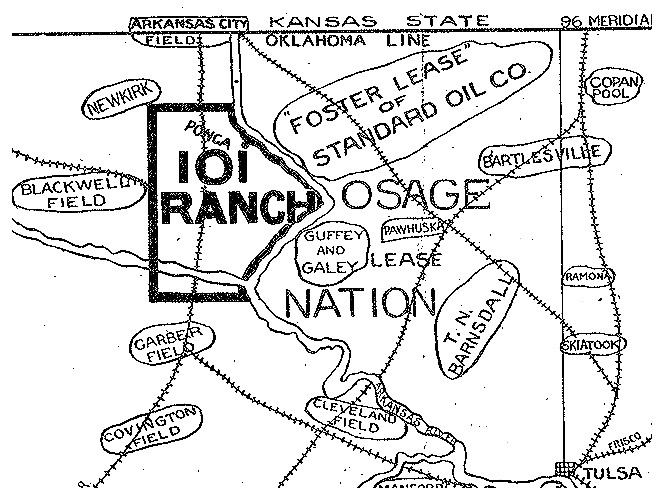
Circa 1910 newspaper promotion of the 101 Ranch Oil Company following discoveries near Ponca (City), west of Osage Nation leases and oilfields.
Partnered with McCaskey and the owners of the 101 Ranch, Marland received permission from White Eagle, chief of the Ponca Nation, to drill near a reservation burial ground. The oilfield discovery well and many that followed produced oil on a reservation allotment owned by Willie-Cries-For-War, age 19, who had leased his 160 acres to Marland for $1,000 a year and 12.5 cents per barrel of oil produced.
Marland would found Marland Oil Company in 1917, merge it with Continental Oil in 1928, and become governor of Oklahoma in 1935. ConocoPhillips opened a Conoco Museum in Ponca City in 2007.
June 11, 1929 – Independent Producers get Organized
Ninety-five years ago, Wirt Franklin of Ardmore, Oklahoma, spoke on behalf of small exploration and production companies during President Herbert Hoover’s Oil Conservation Conference at the Broadmoor Hotel in Colorado Springs, Colorado. Franklin and other independent producers opposed creating a federal commission that could restrict production and allow more imported foreign oil.
“If this condition should be brought about, it would mean the annihilation and destruction of the small producer of crude oil, ” proclaimed Franklin, who had found success in the shallow but prolific Healdton oilfield. Before returning to Ardmore, Franklin and other independents established today’s Washington, D.C.-based Independent Petroleum Association of America (IPAA).
June 12, 1879 – Allegheny Oilfield discovered by O.P. Taylor
Orville “O.P.” Taylor completed the Triangle No. 1 well at a depth of 1,177 feet in Allegheny County, New York, revealing an oilfield that extended into Pennsylvania. His discovery came after two failed wells were drilled near oil seeps first reported by a French missionary in 1627. The Allegheny oilfield drilling boom created the town of Petrolia.
The Confederate Army veteran had worked in the cigar manufacturing business in Virginia before catching “oil fever” after reading of oil discoveries along the Allegheny River (see Derricks of Triumph Hill). Early success led to his election as mayor of Wellsville, New York, and the title of “Father of the Allegheny Oilfield.” A Liberty Ship would be named for him during World War II.
June 13, 1917 – Phillips Petroleum Company founded
During the early months of America’s entry into World War I, as oil prices rose above $1 per barrel, Phillips Petroleum Company was founded in Bartlesville, Oklahoma. Brothers Frank and Lee Eldas “L.E.” Phillips consolidated their oil companies and began operating throughout Oklahoma and Kansas. Assets rose from $3 million to $100 million within a few years.
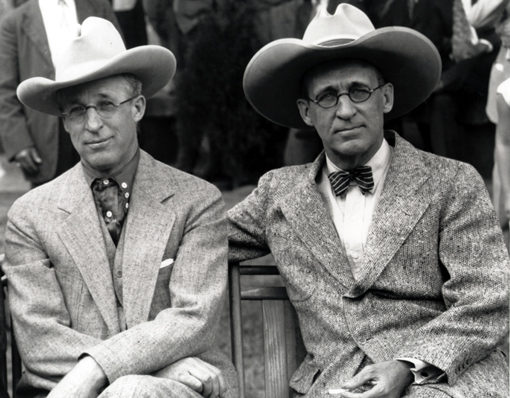
Brothers L.E. Phillips (left) and Frank Phillips established Phillips Petroleum Company in Bartlesville in 1917. Photo courtesy ConocoPhillips.
In 1927, Phillips Petroleum began selling its gasoline in Wichita, Kansas, the first of more than 10,000 Phillips 66 service stations. Phillips chemists received thousands of U.S. patents, including one in 1954 for Marlex, a high-density polyethylene. The Wham-O toy company was the first to buy the new plastic (see Petroleum Product Hoopla). The oil company’s high-octane Nu-Aviation fuel played an important role in winning World War II.
Phillips Petroleum merged with Conoco in 2002 to become ConocoPhillips, which in 2007 established petroleum museums in Ponca City and Bartlesville as part of the 100th anniversary of Oklahoma statehood.
June 13, 1928 – Hobbs Oilfield discovered in New Mexico
The modern New Mexico petroleum industry began with the discovery of the Hobbs oilfield near the southeastern corner of the state. After months of difficult cable-tool drilling, the Midwest State No. 1 well produced oil for the Midwest Refining Company, which had drilled the state’s first oil well in 1922.
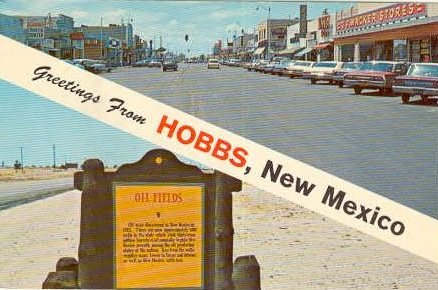
A June 1928 oilfield discovery brought many decades of petroleum prosperity to downtown Hobbs, New Mexico.
The Hobbs well revealed a giant oilfield, later described by the New Mexico Bureau of Mines & Mineral Resources as “the most important single discovery of oil in New Mexico’s history.” But after months of drilling, the well had reached a depth of 1,500 feet when an engine house fire consumed the wooden derrick. “Men with less vision would have given up, but not the drillers of Midwest,” noted the state geologist.
As the Great Depression approached, oil production from the Hobbs field attracted investors and drilling companies, quickly transforming Hobbs from “sand, mesquite, bear grass and jackrabbits” to the fastest-growing town in the nation.
Learn more in First New Mexico Oil Wells.
June 14, 1865 – First Daily Oil Region Newspaper
Pennsylvania’s oil region got its first daily newspaper when brothers William and Henry Bloss published a four-page broadsheet, the Titusville Herald, which soon exceeded a circulation of 300. The first edition’s articles included a reference to visits to the oil region by John Wilkes Booth to look into his oil interests.

The “First Daily Newspaper in the Pennsylvania Oil Region” noted John Wilkes Booth’s petroleum interests.
“John Wilkes Booth purchased a one-thirteenth interest in the territory in August 1864,” the newspaper reported. “We are credibly informed that this Homestead well (see Dramatic Oil Company) in which Booth was interested was destroyed by fire on the day he assassinated President Lincoln.”
June 14, 1938 – United States regulates Natural Gas
The federal government for the first time assumed regulatory control of U.S. natural gas sales to limit the growing market power of interstate pipeline companies.
Although the Natural Gas Act of 1938 did not apply to production, gathering or local distribution, it sought to establish “just and reasonable rates” for pipeline company transmission or sales of natural gas in interstate commerce. Regulatory functions were assigned to the Federal Power Commission (established in 1920), which became the Federal Energy Regulatory Commission (FERC) in 1977.
_______________________
Recommended Reading: The Extraction State, A History of Natural Gas in America (2021); Corsicana (2010); Texas Oil and Gas Postcard History (2013); Black Gold in California: The Story of California Petroleum Industry (2016); In Pursuit of Fame: Rembrandt Peale, 1778-1860 (1993); Drilling Technology in Nontechnical Language (2012); Oil And Gas In Oklahoma: Petroleum Geology In Oklahoma (2013); Oil Man: The Story of Frank Phillips and the Birth of Phillips Petroleum
 (2014); Oil in West Texas and New Mexico
 (1982); Around Titusville, Pa., Images of America
 (2004). Your Amazon purchase benefits the American Oil & Gas Historical Society. As an Amazon Associate, AOGHS earns a commission from qualifying purchases.
_______________________
The American Oil & Gas Historical Society (AOGHS) preserves U.S. petroleum history. Support this energy education website, our monthly email newsletter, This Week in Oil and Gas History News, and help expand historical research. Contact bawells@aoghs.org. Copyright © 2026 Bruce A. Wells. All rights reserved.