This Week in Petroleum History, November 23 – 29
November 23, 1947 – World’s First LPG Ship –
The first U.S. seagoing Liquefied Petroleum Gas (LPG) ship went into service as the Natalie O. Warren from the Houston Ship Channel to Newark, New Jersey. The vessel of Warren Petroleum Corporation of Tulsa, Oklahoma, had an LPG capacity of 38,053 barrels in 68 vertical pressure tanks.
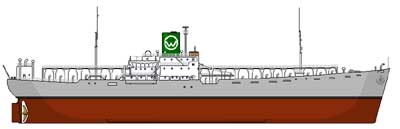
The experimental Natalie O. Warren, a converted freighter, had an LPG capacity of 38,053 barrels in 68 vertical pressure tanks.
The one-of-a-kind ship was the former Cape Diamond dry-cargo freighter before being converted by the Bethlehem Steelyard in Beaumont, Texas. The experimental design led to innovative maritime construction standards for such vessels.
By the early 1950s, Warren Petroleum became the largest producer and marketer of natural gasoline and propane in the world, according to the Tulsa Historical Society and Museum exhibit, “Warren: the man, the company.” LPG tankers today carry 20 times the capacity of the early vessels.
November 23, 1951 – Superman and the World’s Deepest Oil Well
Public fear of the risk of drilling wells too deep highlighted the theatrical release of Superman’s first feature-length movie, Superman and the Mole Men. The 1951 plot unfolded in the fictional town of Silsbey, “Home of the World’s Deepest Oil Well,” after an experimental well’s drill bit had “broken into clear air” at a depth of 32,742 feet.
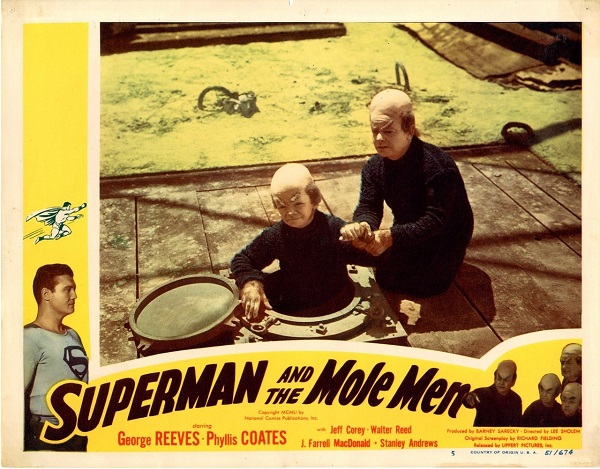
The 1951 first feature-length Superman movie starred mole men who emerged from an experimental oil well drilled more than six miles deep.
“Good heavens, that’s practically to the center of the earth!” exclaimed Lois Lane. In fact, the deepest U.S. well in 1951 reached 20,521 feet deep (also see Anadarko Basin in Depth). When mole-men emerged from the well, townspeople feared an invasion. In the end, Superman calmed an angry mob and the well ignited in flames, forever closing the connection between the two worlds.
November 25, 1875 – Continental Oil sends Kerosene Westward
Convinced he could profit by purchasing bulk kerosene in cheaper eastern markets, Isaac Blake formed the Continental Oil and Transportation Company and began transporting kerosene refined in Cleveland, Ohio, for distribution in Ogden, Utah.
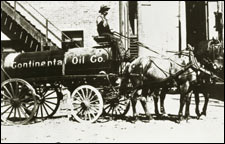
Conoco began in 1875 as Continental Oil, delivering kerosene to retail stores in Ogden, Utah. It became ConocoPhillips in 2002.
Continental purchased two railroad tank cars — the first to be used west of the Mississippi River — to ship the kerosene by rail. Blake’s company expanded into Colorado in 1876 and California in 1877 before being absorbed by the Standard Oil Company in 1885.
Following the 1911 breakup of Standard Oil, Continental Oil reemerged as Conoco, becoming ConocoPhillips in 2002. The company opened two Oklahoma petroleum museums to celebrate that state’s 2007 centennial.
November 27, 1940 – Museum displays Mobilgas Station Painting
With service stations part of America’s popular culture, the oil painting “Gas” by Edward Hopper (1882-1967) was first exhibited by the Whitney Museum of American Art in New York City. Art critics praised the work, suggesting the painting with the Pegasus sign anticipated the modern Pop Art movement by more than a decade.
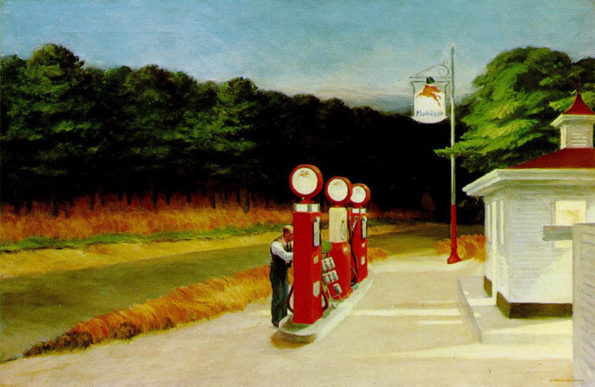
Another artist believed Edward Hopper’s 1940 oil on canvas “Gas” — an amalgamation of several gas stations near Truro, Massachusetts — would remain memorable because of the “honest presentation of the American scene.”
According to Hopper’s wife, the image of a Mobilgas station at the end of a highway was an amalgamation of several gas stations near their home in Truro, Massachusetts. Fellow artist Charles Burchfield admired Hopper’s simple title for the painting, saying that for “a less discerning artist, (it) would have come out as ‘Gas Station’ or ‘Gas Station Attendant.'” The painting is owned by the Museum of Modern Art in New York City. The value of the 26 1/4 inch by 40 1/4 inch work has been estimated at more than $100 million.
Learn more about petroleum’s artistic influences in Oil In Art.
November 27, 1941 – Death of the Oil Queen of California
Mrs. Emma Summers, once known as the Oil Queen of California, died at the age of 83 in Los Angeles. Forty years earlier, the San Francisco Call newspaper described Mrs. Summers as “A woman with a genius for affairs — it may sound paradoxical, but the fact exists. If Mrs. Emma A. Summers were less than a genius she could not, as she does today, control the Los Angeles oil markets.”

Newspapers featured Emma Summers as she succeeded in the fiercely competitive Los Angeles oilfields of the early 1900s.
Summers graduated from Boston’s New England Conservatory of Music and moved to Los Angeles in 1893 to teach piano — but soon caught oil fever. With her home near where Edward Doheny discovered the giant Los Angeles City field just a year before, Summers invested $700 for half interest in a well a few blocks from the site. Summers’ first 14 wells produced oil, launching her dominance in the oilfield.
Learn more in Oil Queen of California.
November 27, 1923 – Standard Oil registers Esso Trademark
The Standard Oil Company of New Jersey registered the Esso trademark, which had been in use since May 1923 for refined, semi-refined, and unrefined petroleum products. The name was a phonetic spelling of the abbreviation S.O. for Standard Oil.

A young Theodore Geisel created many Essolube ads beginning in the 1930s (see Seuss I am, an Oilman). When Standard Oil renamed itself Exxon in 1973, the company adopted the Exxon trademark nationwide. The Esso brand remains widely used outside the United States.

November 28, 1895 – Inventor Duryea wins First U.S. Auto Race
Six of America’s first “motor cars” left Chicago’s Jackson Park for a 54-mile race to Evanston, Illinois, and back through the snow. Inventor J. Frank Duryea received $2,000 for winning the first U.S. automobile race. His No. 5 racer took just over 10 hours at an average speed of about 7.3 mph. Frank and his brother Charles had patented America’s first gasoline-powered auto in June.

Charles and Frank Duryea tested a gasoline-powered automobile in 1892. Three years later, Frank (seated at right) won the first U.S. auto race. Photo courtesy Library of Congress.
The Chicago Times-Herald, the race’s sponsor, declared, “Persons who are inclined to decry the development of the horseless carriage will be forced to recognize it as an admitted mechanical achievement, highly adapted to some of the most urgent needs of our civilization.” New York City would host America’s first auto show within five years.
November 28, 1892 – First Kansas Oil Well
While drilling for natural gas, William Mills discovered small amounts of oil in eastern Kansas. He took a sample from his Norman No. 1 well and visited experienced oil drillers in Pennsylvania. Impressed, they convinced him to “shoot” the well at Neodesha with 30 quarts of nitroglycerine.

A rare photograph of the 1897 Standard Oil refinery in Neodesha, Kansas, the first to process oil from the Mid-Continent field. Photo courtesy Kansas Historical Society.
The Kansas oil well was the first to find commercial success drilling west of the Mississippi River. “It proved that Neodesha had the riches of oil and gas in their backyard,” according to Neodesha’s Norman No. 1 Historic Oil Well and Museum.
Only 832 feet deep, the discovery well uncovered the Mid-Continent producing region, eventually including five states. Abandoned in 1919, the discovery well was neglected until 1961, when a replica 67-foot wooden derrick was erected on the site as a memorial.
Learn more in First Kansas Oil Well.
November 28, 1939 – Mississippi Geologists organize
The Mississippi Geological Society (MGS) was founded “by 38 of the 57 petroleum geologists then employed in Jackson, Mississippi,” notes Stanley King in an MGS History, adding the discovery of the giant Tinsley field earlier in the year had made Mississippi a significant oil and natural gas producing state (see First Mississippi Oil Wells).
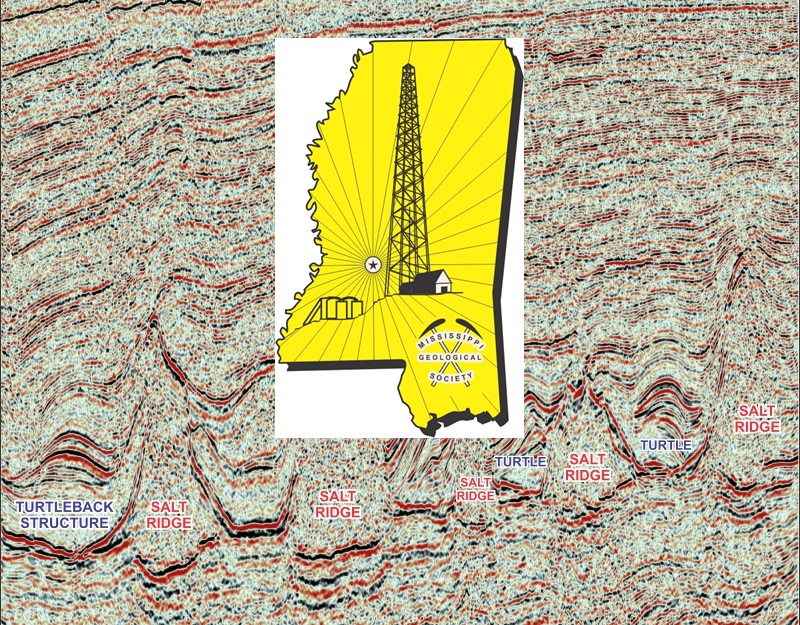
The MGS Library, established in 1945 to assist geologists and students in the pursuit of geological research, includes publications with legacy data and a collection of 3D seismic surveys courtesy of Seismic Exchange (SEI).
November 29, 1927 – Patent awarded for Coin-Operated Gas Pump
Lewis P. Starkey, of Fort Collins, Colorado, received a U.S. patent for his “Self Operating Filling Station,” an electrically powered coin-operated device for dispensing gasoline. The L.P. Starkey Pump Company competed with other manufacturers of automatic pumps that did not need an attendant.

Detail from the “Self-Operating Filling Station,” patented by Lewis Starkey of Fort Collins, Colorado, in 1927.
Earlier self-service “gasoline slot machines” had required motorists to insert a coin into a slot and turn a crank. The L.P. Starkey Pump Company was later acquired by Gas-O-Mat Inc. of Denver, which manufactured and sold two models of Starkey’s coin-operated pumps.
Learn more in Coin-Operated Gas Pumps.
_______________________
Recommended Reading: Natural Gas: Fuel for the 21st Century


_______________________
The American Oil & Gas Historical Society (AOGHS) preserves U.S. petroleum history. Please support this energy education website, subscribe to the free monthly newsletter, This Week in Oil and Gas History News, and help expand historical research. Contact bawells@aoghs.org. Copyright © 2026 Bruce A. Wells. All rights reserved.