by Bruce Wells | Nov 13, 2025 | Petroleum Transportation
The Smithsonian Institution’s National Museum of American History has educated millions of visitors about the history of U.S. transportation since “America on the Move” opened in November 2003 on the National Mall in Washington, D.C.
Today’s first-floor exhibits in the General Motors Hall of Transportation include the 1903 Winton (the first automobile to drive across the country), bicycles, carriages, antique automobiles, and a 1959 Chicago Transit Authority “L” mass transit car. Nearby, a A 260-ton locomotive built in 1926 is featured across from exhibits about Route 66 — the “People’s Highway.” (more…)
by Bruce Wells | Nov 5, 2025 | Petroleum Transportation
President Woodrow Wilson in 1914 opened a maritime project to support petrochemicals.
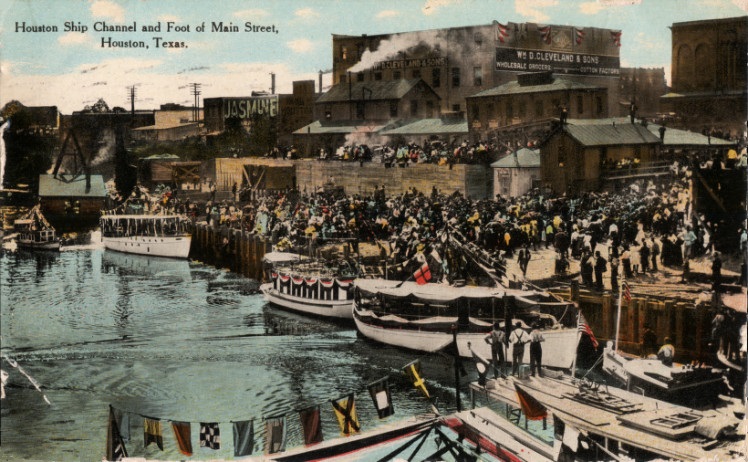
The Houston Ship Channel, the “port that built a city,” opened for ocean-going vessels on November 10, 1914, making Texas home to a world-class commercial port. President Woodrow Wilson saluted the occasion from his desk in the White House by pushing an ivory button wired to a cannon in Houston.
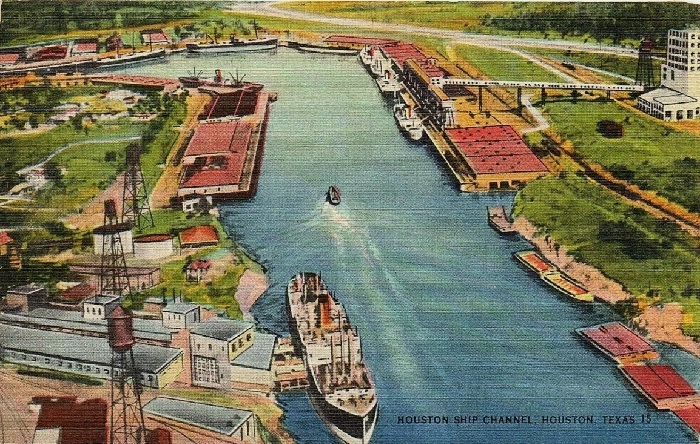
The Houston Ship Channel opened on November 10, 1914, as an ocean-vessel waterway linking Houston, the San Jacinto River, and Galveston Bay. 1950 postcard courtesy Boston Public Library.
The National Anthem played from a barge in the center of the Turning Basin as Sue Campbell, daughter of Houston Mayor Ben Campbell, sprinkled white roses into the water, according to a Port of Houston historian.
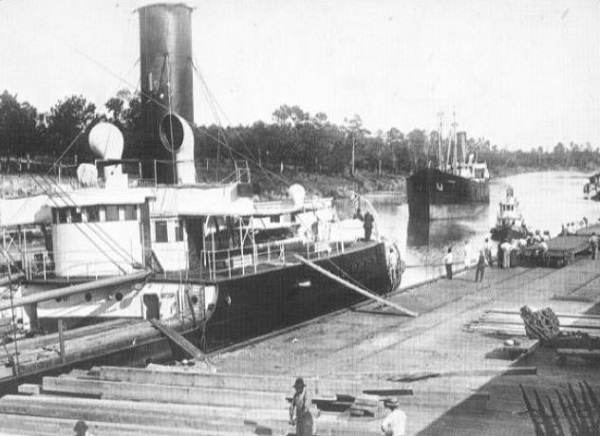
An 1915 image of the Houston Ship Channel that had been dredged to a depth of 25 feet. Photo courtesy Fort Bend Museum, Richmond, Texas.
“I christen thee Port of Houston; hither the boats of all nations may come and receive a hearty welcome,” Campbell proclaimed.

The bayou had been used to ship goods to the Gulf of Mexico as early as the 1830s. The American Society of Civil Engineers (ASCE) described the original waterway — known as Buffalo Bayou — as “swampy, marshy and overgrown with dense vegetation.”
“Steamboats and shallow-draft vessels were the only boats able to navigate the complicated channel,” noted ASCE, adding that in 1909, Harris County citizens formed a navigation district (an autonomous governmental body for supervising the port) and issued bonds to fund half the cost of dredging the channel.
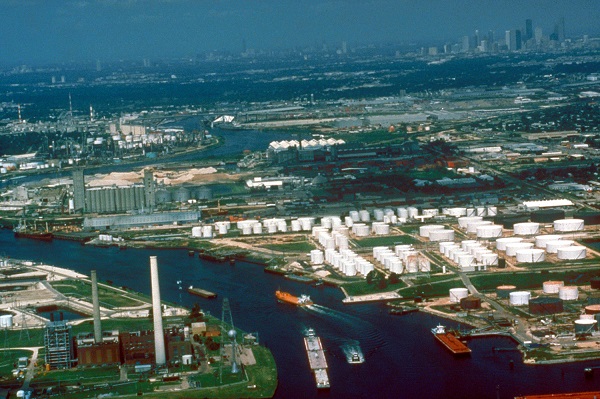
Army engineers dredge and maintain the Houston Ship channel for deepwater shipping. It terminates about four miles east of downtown Houston. Photo courtesy U.S. Army Corps of Engineers.
According to the Port of Houston Authority of Harris County, in 1937 the steamship Laura traveled from Galveston Bay up Buffalo Bayou to what is now Houston.

The steamship Laura’s trip — in water no deeper than six feet — proved the bayou was navigable by “sizable vessels” and established a commercial link between Houston and ports around the world
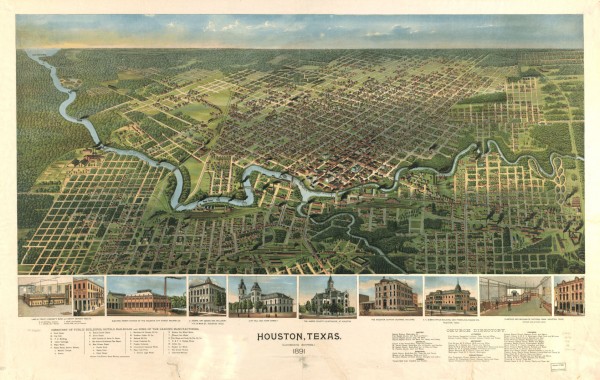
A bird’s eye view of Houston in 1891. Today’s Port of Houston is ranked first in foreign cargo and among the largest ports in the world. Map image courtesy Library of Congress Panoramic Maps.
“With the discovery of oil at Spindletop in 1901 and crops such as rice beginning to rival the dominant export crop of cotton, Houston’s ship channel needed the capacity to handle newer and larger vessels,” reported the Port Authority, administrator of the channel.
Harris County voters in January 1910 overwhelmingly approved dredging their ship channel to a depth of 25 feet for $1.25 million. The U.S. Congress provided matching funds. As work began in 1912, similar giant maritime projects included construction of the Panama Canal and the Gulf Intracoastal Waterway.
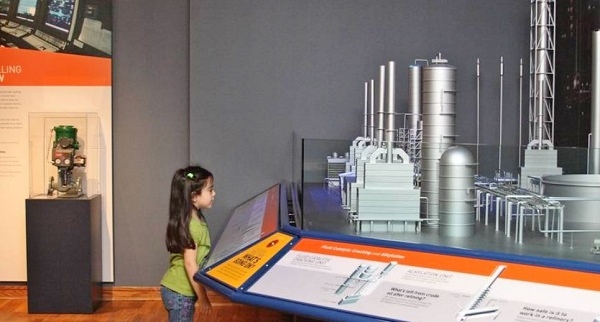
An oil museum in Beaumont, Texas, includes petroleum science and refinery exhibits for educating young people about the Port of Houston. Photo courtesy Texas Energy Museum.
By 1930, eight refineries were operating along the deep water channel, ASCE notes. The area eventually supported massive petrochemical complexes along the shoreline of processing facilities and oil refineries, including ExxonMobil’s Baytown Refinery.
Under continuous development since its original construction, the Houston Ship Channel has been extended to reach 52 miles with a depth of 45 feet and a width of up to 530 feet. It travels from the Gulf through Galveston Bay and up the San Jacinto River, ending four miles east of downtown Houston.
Although the dredging vessel Texas first signaled by whistle the channel’s completion on September 7, 1914, the official opening date has remained when Sue Campbell sprinkled her white roses and President Wilson remotely fired his cannon.
With refineries and expanded liquefied terminals for exporting natural gas (LNG), the Texas waterway has grown into one of the largest petrochemical facilities in the world.
_______________________
Recommended Reading: Sheer Will: The Story of the Port of Houston and the Houston Ship Channel  (2014). Your Amazon purchase benefits the American Oil & Gas Historical Society. As an Amazon Associate, AOGHS earns a commission from qualifying purchases.
_______________________
The American Oil & Gas Historical Society (AOGHS) preserves U.S. petroleum history. Please become an AOGHS annual supporter and help maintain this energy education website and expand historical research. For more information, contact bawells@aoghs.org. Copyright © 2025 – Bruce A. Wells. All rights reserved.
Citation Information: Article Title – “Houston Ship Channel of 1914.” Authors: B.A. Wells and K.L. Wells. Website Name: American Oil & Gas Historical Society. URL: https://aoghs.org/transportation/houston-ship-channel. Last Updated: November 7, 2025. Original Published Date: November 25, 2014.
by Bruce Wells | Nov 1, 2025 | Petroleum Transportation
Early autos shared unpaved roads with horses and wagons.
The first U.S. auto show opened in New York City’s Madison Square Garden in 1900, just five years after Charles Duryea claimed the first American patent for a gasoline-powered automobile. Gas proved to be the least popular source of engine power.
(more…)
by Bruce Wells | May 14, 2025 | Petroleum Transportation
From kerosene to gasoline, an 1892 Wayne Oil Tank & Pump Company dispenser preserves petroleum history.
Sharing petroleum history resources and personal “oil patch” stories are important The American Oil & Gas Historical Society ‘s History Research Forum and the forum for Oil & Gas Families complement the work of community museums preserving photographic, written and oral histories.
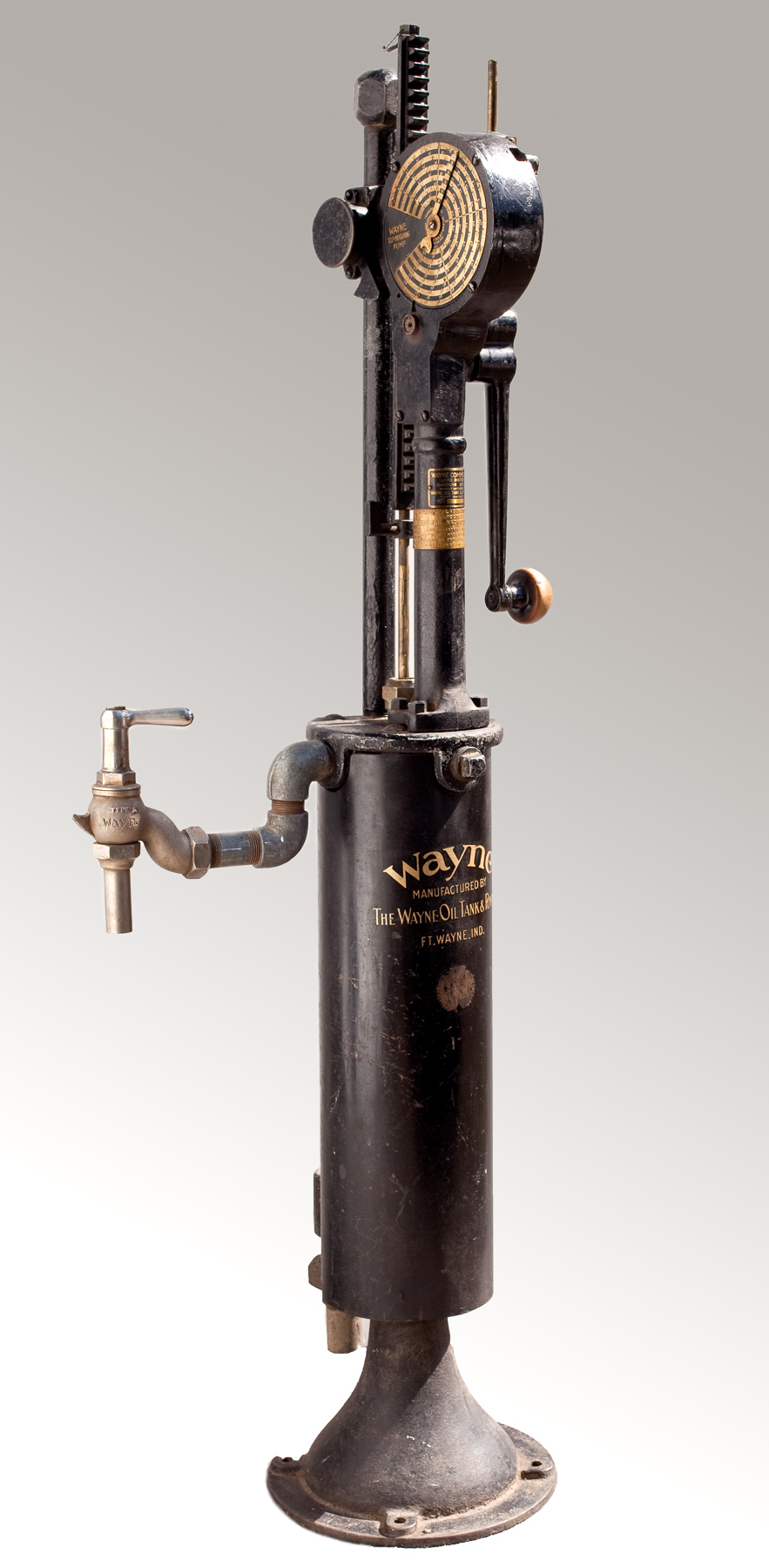
Wayne Lease owns a rare 1892 self-measuring pump originally designed to dispense kerosene. Wayne’s Wayne Oil Tank Company pump is one of only 50 manufactured by the company during its first year of business in Ft. Wayne, Indiana, he explained in a 2020 email to the American Oil & Gas Historical Society.
Wayne’s Wayne Oil Tank Co. Pump
Lease, from White Salmon, Washington, has researched his petroleum technology artifact, learning it was manufactured for selling kerosene, the popular 19th century lamp fuel sold at mercantile stores. His Wayne Company hand-cranked, measured dispensing pump apparently was later modified to supply gasoline.
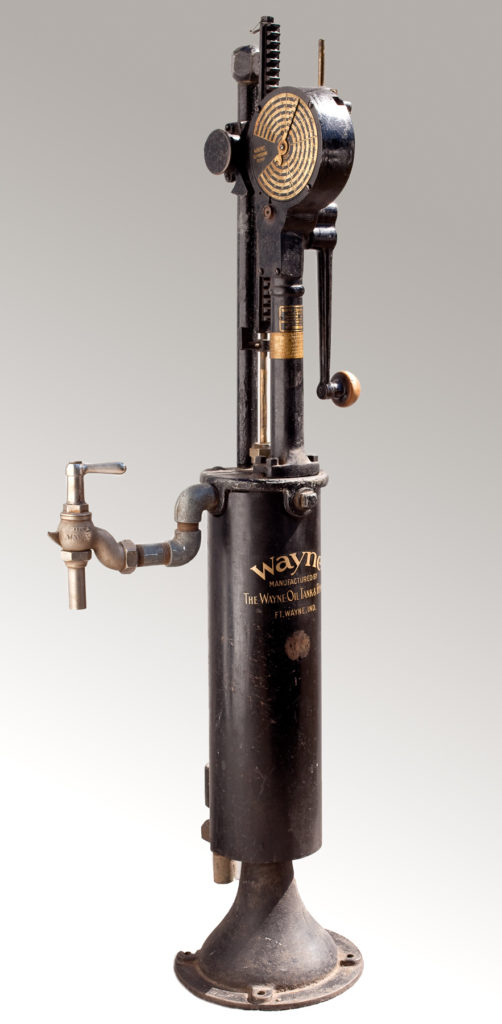
Original 1892 Wayne Oil Tank Company pump, one of just 50 manufactured to dispense kerosene during the company’s first year of business in Ft. Wayne, Indiana.
“My research indicates the Wayne pump was never manufactured to be used for gasoline, but rather kerosene only,” Lease noted.
He explained that many researchers of gasoline service station pumps have overlooked Wayne and other manufacturers’ altered pumps, “best defined as an ‘after strike,’ which allowed the use in the transfer of the more volatile gasoline.”
Self-measuring pump venders made good use of a dispenser that had become less needed because of electric lighting, Lease added.
The original Wayne Oil Tank & Pump Company design was limited to the specific use of kerosene as a lamp fuel, Lease explained. Kerosene was sold in general stores of rural America, where merchandise often could be found at stage coach stops spaced 15 miles to 25 miles apart.
Kerosene lamp fuel would be joined by a new transportation fuel in the early 1900s, gasoline for autos. “Small cities now become the hub of commerce on a larger scale with the introduction of the combustion engine,” he added. Kerosene would succumb to the Rural Electrification Act (1936) as gasoline became the U.S. consumer’s primary need.
“The Wayne pump, one of fifty made in1892, was then certified for the use of the transfer of Gasoline, and the vender made good use of what had become obsolete,” the amateur pump historian concluded in his 2020 email. He continues to research more information about the pump.
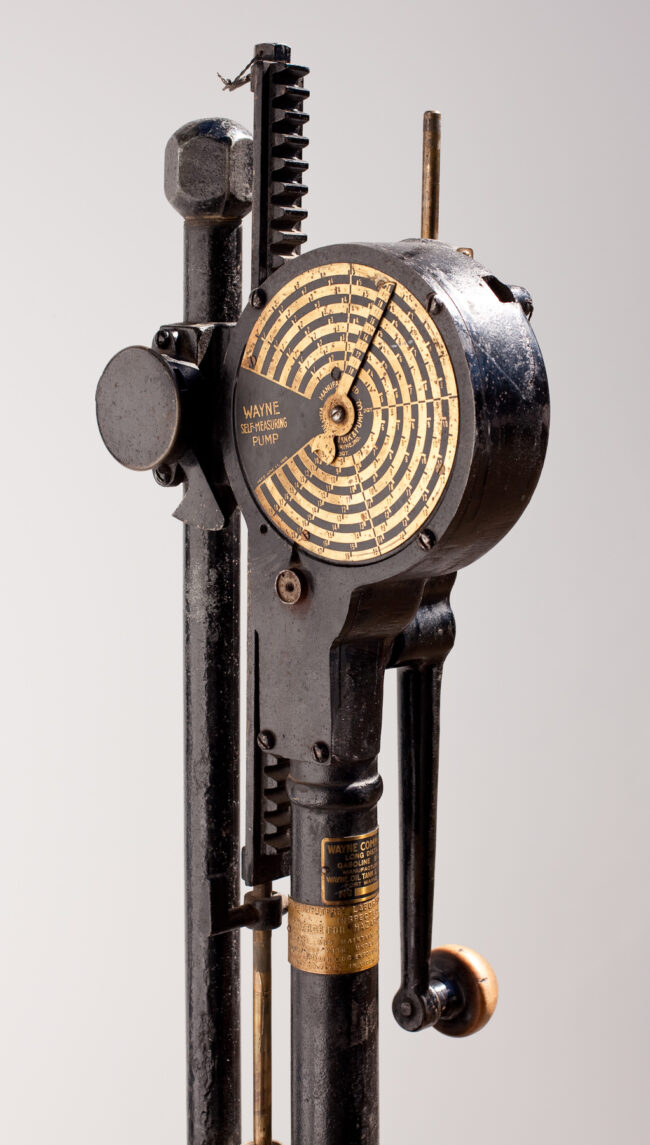
Detailed Wayne pump measurement scale 70 designed for dispensing kerosene and later, gasoline.
“It is in immaculate condition as you can see by the photographs, Lease noted. He is seeking more information about the pump…and a potential petroleum museum interested in adding the Wayne pump to its collection. Insights are welcomed in comment section below.
Wayne’s Wayne pump was also featured by Rural Heritage Magazine’s Facebook page. Learn more early transportation and gasoline pump history in First Gas Pump and Service Station and Coin-Operated Gas Pumps.
Wayne Fueling Systems
History from the former Wayne Oil Tank Company, today still operating as Wayne Fueling Systems:
Wayne has been shaping the retail and fleet fueling industry since we designed our first pump in 1891. We were known as the Wayne Oil Tank Company back then, and from the very beginning we were developing a reputation for quality.
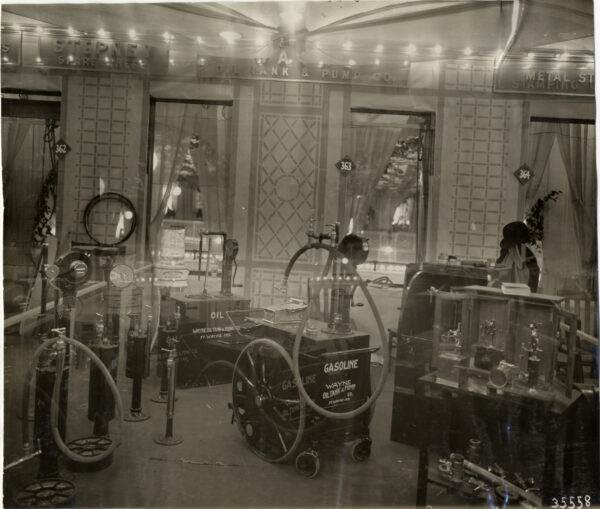
Trade show display for Wayne Oil Tank and Pump Company equipment, showing gasoline and oil pumps. Sign for Wayne Oil Tank & Pump Co. in background. Handwritten note on back: “Service stations, 1910. Gasoline pump.” Photo courtesy Detroit Public Library.
In fact, this inaugural product won the distinction “The Best Self Measuring Oil Pump” at the Columbian Exposition in Chicago just two years later. Once the motor vehicle entered the scene, our purpose and mission was solidified – to create a reliable, accurate way for motorists to refuel cars...Learn more at About Wayne Fueling Systems.
_______________________
Recommended Reading: Pump and Circumstance: Glory Days of the Gas Station (1993). Your Amazon purchase benefits the American Oil & Gas Historical Society. As an Amazon Associate, AOGHS earns a commission from qualifying purchases.
_______________________
The American Oil & Gas Historical Society (AOGHS) preserves U.S. petroleum history. Support this energy education website, subscribe to our monthly email newsletter, and help expand historical research. Contact bawells@aoghs.org. Copyright © 2026 Bruce A. Wells.
Citation Information – Article Title: “Wayne’s Self-Measuring Pump.” Authors: B.A. Wells and K.L. Wells. Website Name: American Oil & Gas Historical Society. URL: https://aoghs.org/transportation/waynes-self-measuring-pump. Last Updated: June 14, 2026. Original Published Date: July 14, 2021.
by Bruce Wells | Jan 28, 2025 | Petroleum Transportation
Library of Congress photo tells many early automobile tales.
Picturing oil history: Details of an image in the Library of Congress digital collection offer insights into the early U.S. petroleum industry.
A single 1921 black-and-white photograph of a Washington, D.C., suburban gas station features petroleum products and transportation infrastructure just 20 years after the first U.S. auto show. Printed from an eight-inch by six-inch glass negative, the image features Takoma Park, Maryland, and its railroad station on the northeastern border of the District of Columbia.
(more…)