by Bruce Wells | Mar 11, 2026 | Petroleum in War
Navy admirals reluctantly switched from coal to oil — adding engine power and simplifying resupply.
Commissioned on March 12, 1914, the USS Texas was the last American battleship built using engines with coal-fired boilers. Converted to burn fuel oil in 1925, the “Mighty T” became even more dominant at sea during the worldwide maritime change from coal to oil power.
When the Industrial Revolution ended the “Age of Sail,” supplies of coal that fired the boilers of steam-powered ships became a strategic resource. Worldwide “coaling stations” were essential at a time when oil was used as an axle grease or resource for making lamp kerosene. (more…)
by Bruce Wells | Feb 4, 2026 | Petroleum History Almanac
The Ranger who tamed oil and gas boom towns during the Great Depression. “Crime may expect no quarter.”
During much of the 1920s, a Texas Ranger became known for strictly enforcing the law in oilfield communities. By 1930, the discovery year of the largest oilfield in the lower 48 states, he was known as “El Lobo Solo” — the lone wolf — the Ranger who brought law and order to East Texas boom towns.
Manuel Trazazas Gonzaullas was born in 1891 in Cádiz, Spain, to a Spanish father and Canadian mother who were naturalized U.S. citizens. At age 15 he witnessed the murder of his only two brothers and the wounding of his parents when bandits raided their home. Fourteen years later, Gonzaullas joined the Texas Rangers.
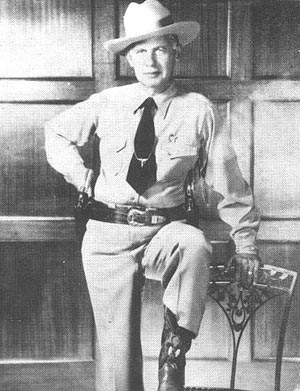
“Give Texas more Rangers of the caliber of ‘Lone Wolf’ Gonzaullas, and the crime wave we are going through will not be of long duration,” reported the Dallas Morning News in 1934.
“He was a soft-spoken man and his trigger finger was slightly bent,” independent producer Watson W. Wise characterized him during a 1985 interview in Tyler, Texas. “He always told me it was geared to that .45 of his.” (more…)
by Bruce Wells | Jan 10, 2026 | Petroleum History Almanac
The North Texas church proclaimed richest in America.
In the fall of 1917 near Ranger, Texas, the cotton-farming town of Merriman was inhabited by “ranchers, farmers, and businessmen struggling to survive an economic slump brought on by severe drought and boll weevil-ravaged cotton fields.”
Everything changed in Eastland County when a wildcat well drilled by Texas & Pacific Coal Company struck oil at Ranger, four miles from Merriman. The J.H. McCleskey No. 1 well produced 1,600 barrels of oil a day.
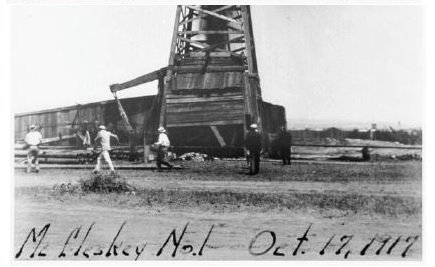
The 1917 headline-making McCleskey No. 1 cable-tool well — called “Roaring Ranger” — brought an oil boom to Eastland County, Texas, about 100 miles west of Dallas.
The rush to acquire leases that followed the oilfield discovery became legendary among drilling booms, even for Texas, home to the legendary 1901 gusher at Spindletop.
WWI Wave of Oil
As drilling continued, the yield of the Ranger oilfield led to peak production reaching more than 14 million barrels in 1919. Production from the “Roaring Ranger” well and its giant North Texas oilfield helped win World War I, with a British War Cabinet member declaring, “The Allied cause floated to victory upon a wave of oil.”
Texas & Pacific Coal Company had taken a great risk by leasing acreage around Ranger, but the risk paid off when lease values soared. The exploration company added “oil” to its name, becoming the Texas Pacific Coal and Oil Company.
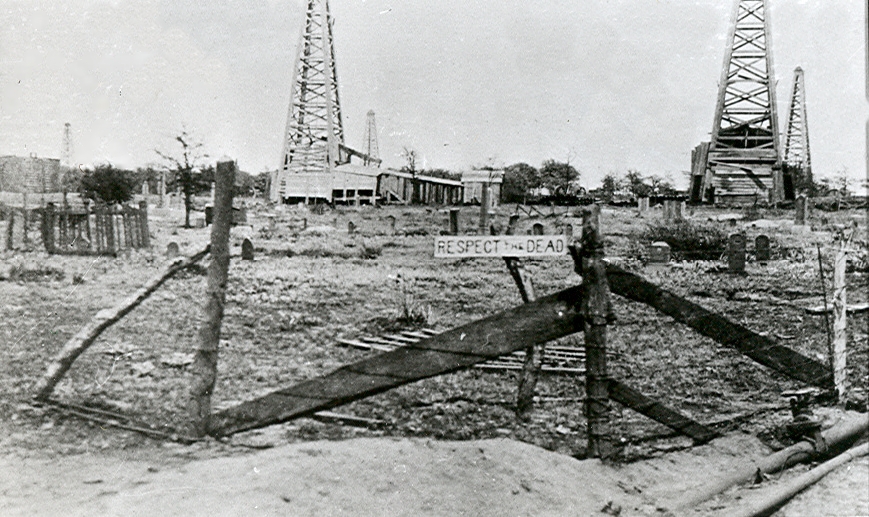
“So as we could not worship God on the former acre of ground, we decided to lease it and honor God with the product,” explained Merriman Baptist Church Deacon J.T. Falls. Photo courtesy Robert Vann, “Lone Star Bonanza, the Ranger Oil Boom of 1917-1923.”
The price of the oil company stock jumped from $30 a share to $1,250 a share as a host of landmen “scanned the landscape to discover any fractions in these holdings. A little school and church, before too small to be seen, now looked like a skyscraper.”
Warren Wagner, driller of the McCleskey discovery well, leased the local school lot and in August 1918 completed a well producing 2,500 barrels of oil a day. Leasing at Merriman Baptist Church proved to be a challenge.

In February, Deacon J.T. Falls complained that drilling new wells “ran us out, as all of the land around our acre was leased, producing wells being brought in so near the house we were compelled to abandon the church because of the gas fumes and noisy machinery.”
Falls added that, “As we could not worship God on the former acre of ground, we decided to lease it and honor God with the product.”
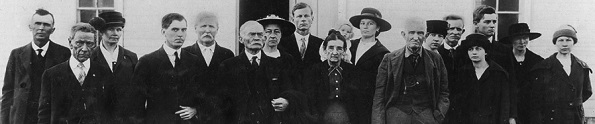
Deacon J.T. Falls (second from left) was not amused when the Associated Press reported in 1919 that his church had refused a million dollars for the lease of the cemetery.
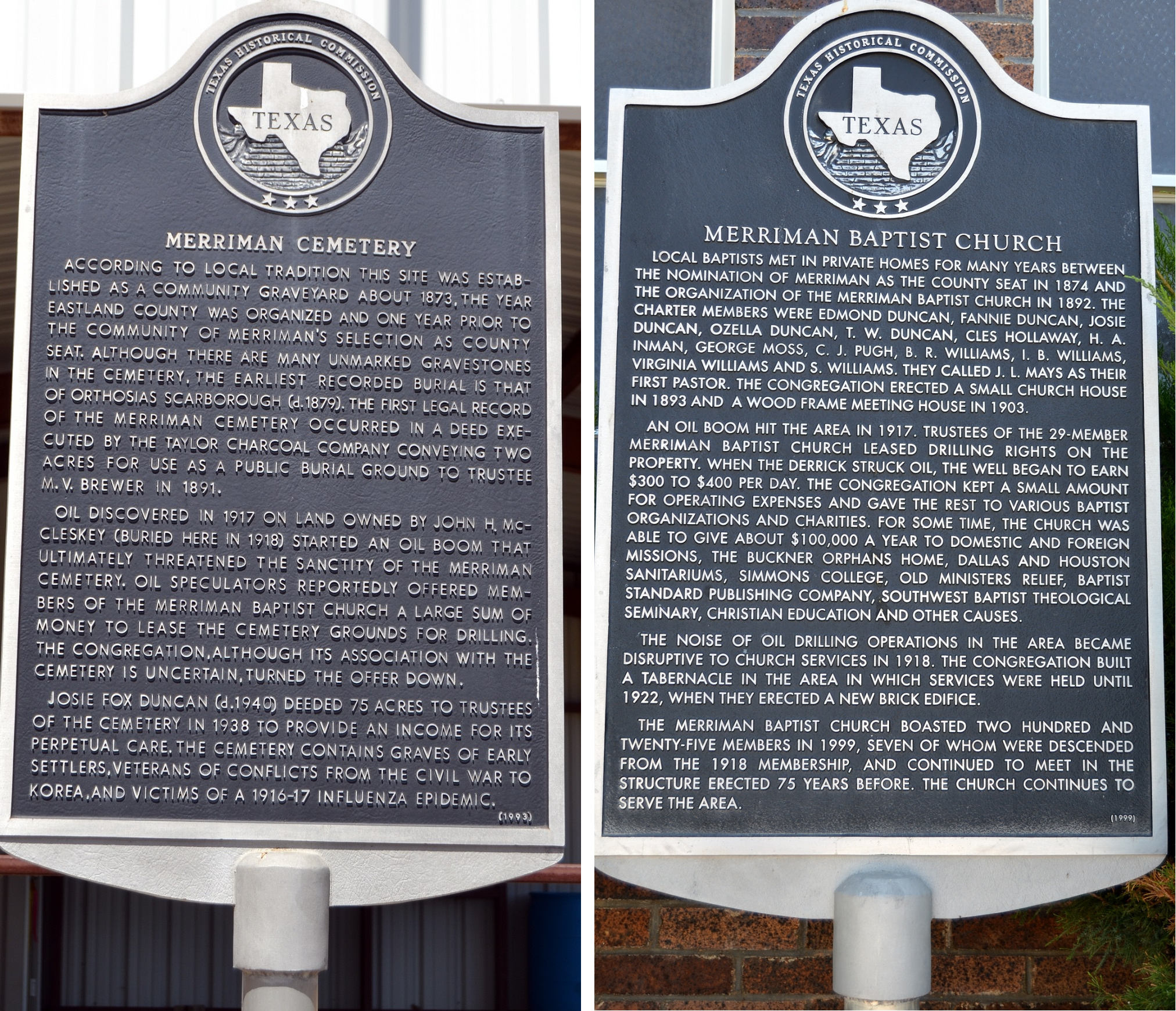
A Texas Historical Commission marker erected in 1999 described when the well on the church’s lease began producing oil, earning the congregation a royalty of between $300 and $400 a day. Merriman Baptist Church “kept a small amount for operating expenses and gave the rest to various Baptist organizations and charities.”
However, drilling in the church graveyard was a different matter. As oil production continued to soar in North Texas, the congregants of Merriman Baptist Church initially resisted one drilling site. As a January 18, 1919, article in the New York Times noted in its headline, “CHURCH MADE RICH BY OIL; Refuses $1,000,000 for Right to Develop Wells in Graveyard.”
Respecting the Dead
At Merriman’s church cemetery, a less seen historical marker erected in 1993 explains the drilling boom’s fierce competition to find property without a well already on it: “Oil speculators reportedly offered members of the Merriman Baptist Church a large sum of money to lease the cemetery grounds for drilling.”
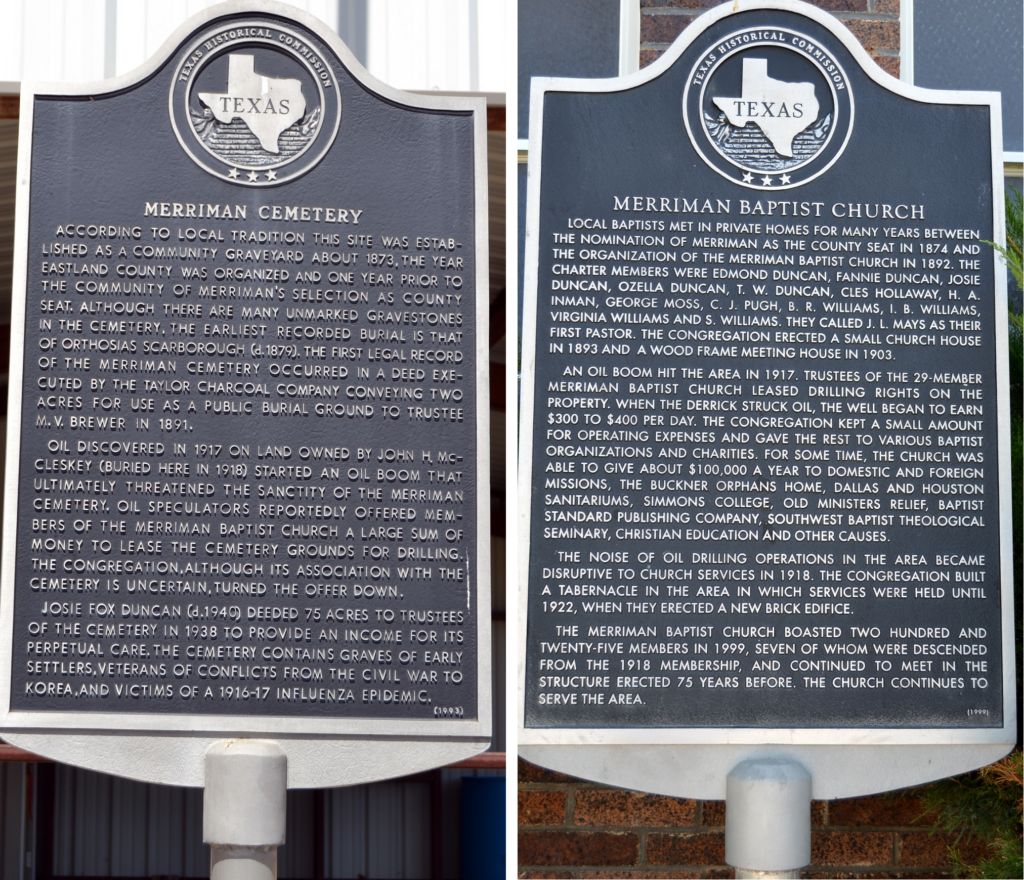
Near Ranger in Eastland County, Texas Historical Commission markers were erected in 1993 (left) and 1999 explaining how members of the Merriman Baptist Church shared their wealth from petroleum royalties. Photos courtesy the Historical Marker Database.
When local newspapers reported the church had refused an offer of $1 million, the Associated Press picked it up, and newspapers from New York to San Francisco ran the story. Literary Digest even featured “the Texas Mammon of Righteousness” with a photograph of “The Congregation That Refuses A Million.”
Deacon J.T. Falls was not amused. “A great many clippings have been sent to us from many secular papers to the effect that we as a church have refused a million dollars for the lease of the cemetery. We do not know how such a statement started,” the deacon opined.
“The cemetery does not belong to the church. It was here long before the church was. We could not lease it if we would, and we would not if we could,” the cleric added.
“If any person’s or company’s heart has become so congealed as to want to drill for oil in this cemetery, they could not — for the dead could not sign a lease, and no living person has any right to do so,” Falls proclaimed.
The church deacon concluded with an ominous admonition to potential drillers, “Those that have friends buried here have the right and the will to protect the graves, and any person attempting to trespass will assume a great risk.”
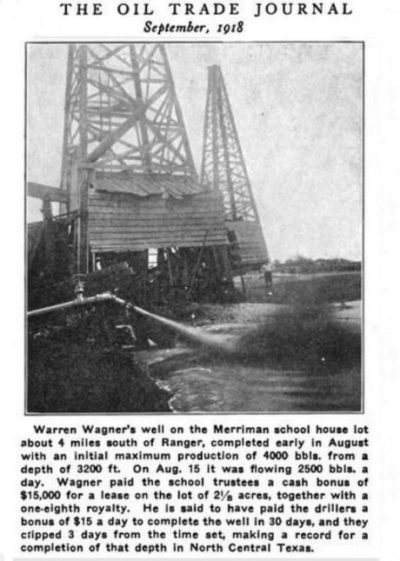
A 1918 article noted a “Merriman school house” oil well drilled to 3,200 feet in record time for North Central Texas.
Roaring Ranger’s oil production dropped precipitously because of dwindling reservoir pressures brought on by unconstrained drilling. Many exploration and production companies failed (including fraudulent ones like Hog Creek Carruth Oil Company).
In the decades since the McCleskey No. 1 well, advancements in horizontal drilling technology have presented more legal challenges to mineral rights of the interred, according to Zack Callarman of Texas Wesleyan School of Law.

In 2014, Callarman wrote an award-winning analysis of laws concerning drilling to extract oil and natural gas underneath cemeteries. “Seven Thousand Feet Under: Does Drilling Disturb the Dead? Or Does Drilling Underneath the Dead Disturb the Living?” was published in the Real Estate Law Journal.
Despite yet another North Texas oilfield discovery at Desdemona, by 1920 the Eastland County drilling boom was over. The faithful still gather at Merriman Baptist Church every Sunday.
_______________________
Recommended Reading: Early Texas Oil: A Photographic History, 1866-1936
 (2000);Texas Oil and Gas, Postcard History (2013);Wildcatters: Texas Independent Oilmen
 (1984). Your Amazon purchase benefits the American Oil & Gas Historical Society. As an Amazon Associate, AOGHS earns a commission from qualifying purchases.
_______________________
The American Oil & Gas Historical Society (AOGHS) preserves U.S. petroleum history. Please become an AOGHS annual supporter and help maintain this energy education website and expand historical research. For more information, contact bawells@aoghs.org. Copyright © 2026 Bruce A. Wells. All rights reserved.
Citation Information – Article Title: “Oil Riches of Merriman Baptist Church.” Authors: B.A. Wells and K.L. Wells. Website Name: American Oil & Gas Historical Society. URL: https://aoghs.org/oil-almanac/oil-riches-of-merriman-baptist-church. Last Updated: January 11, 2026. Original Published Date: January 18, 2019.
by Bruce Wells | Jan 5, 2026 | Petroleum Pioneers
Giant Texas oilfield discovery in 1901 coincided with gasoline demand for automobiles.
On January 10, 1901, the “Lucas Gusher” on a small hill in Texas revealed the Spindletop oilfield, which would produce more oil in a single day than the rest of the world’s oilfields combined.
Although the 1899 Galveston hurricane (still the deadliest hurricane in U.S. history) brought great misery to southeastern Texas as the 20th century dawned, a giant oilfield discovery three miles south of Beaumont launched the modern oil and natural gas industry. (more…)