by Bruce Wells | Dec 14, 2025 | Petroleum Art
Cartographer visited petroleum boom towns to draw popular bird’s-eye views.
Thaddeus M. Fowler created detailed, panoramic maps of America’s earliest petroleum boom towns during the late nineteenth and early twentieth centuries. His popular cartographic depictions of oil patch communities in Pennsylvania, Oklahoma, and Texas offered “aero views” seemingly drawn from great heights.
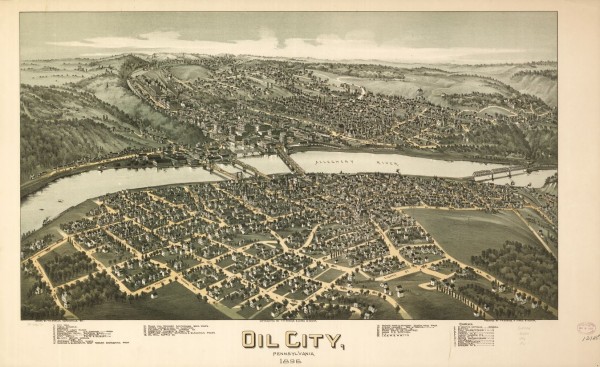
More than 400 Thaddeus Fowler panoramas have been identified. There are 324 in the Library of Congress, including this one of Oil City, Pennsylvania, in 1896. Source: Library of Congress Geography and Map Division, Washington, D.C.
Fowler has the largest number of panoramic maps in the collection of the Library of Congress (LOC) in Washington, D.C. His hand-drawn lithographs have fascinated viewers since the Victorian Age. Being depicted in one of Fowler’s maps, also known as “bird’s-eye views,” was a matter of civic pride for many community leaders. (more…)
by Bruce Wells | Dec 2, 2025 | Petroleum Pioneers
The lucky life of John Steele and America’s earliest oil wealth.
John Washington Steele’s good fortune began on December 10, 1844, when Culbertson and Sarah McClintock adopted him as an infant. The McClintocks also adopted his sister Permelia, bringing both home to the farm along Oil Creek in Venango County, Pennsylvania.
Fifteen years later, the U.S. petroleum industry began with a 69.5-foot-deep oil discovery at nearby Titusville, the first oil well drilled commercially for distilling into kerosene (also called coal oil).
Pennsylvania petroleum reserves revealed at Oil Creek made the widow McClintock a fortune in royalties. When she died in a kitchen fire in 1864, Mrs. McClintock left her oil wealth to her only surviving child, Johnny, who inherited $24,500 at age 20.
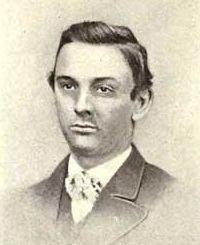
John Washington Steele of Venango County, Pennsylvania, inherited oil riches.
Johnny also inherited his mother’s 200-acre farm along Oil Creek between the now Rynd Farm and the small community of Rouseville, south of 15-miles Titusville. The farm already included 20 producing oil wells yielding $2,800 in royalties every day.
Rouseville was where future muckraking journalist Ida Minerva Tarbell (1857-1944) lived in 1861, when a gushing well erupted into flames — resulting in an early petroleum industry tragedy (see Rouseville 1861 Oil Well Fire).
Legendary Extravagance
“Coal Oil Johnny” Steele would earn his famous name in 1865 — after less than one year of extravagance, according to the New York Times.

“In his day, Steele was the greatest spender the world had ever known,” the newspaper proclaimed. “He threw away $3,000,000 in less than a year.”
Philadelphia journalists coined the name “Coal Oil Johnny” for him, reportedly because of his attachment to a custom carriage that had black oil derricks spouting dollar symbols painted on its red doors. He later confessed in his autobiography:
I spent my money foolishly, recklessly, wickedly, gave it away without excuse; threw dollars to street urchins to see them scramble; tipped waiters with five and ten dollar bills; was intoxicated most of the time, and kept the crowd surrounding me usually in the same condition.
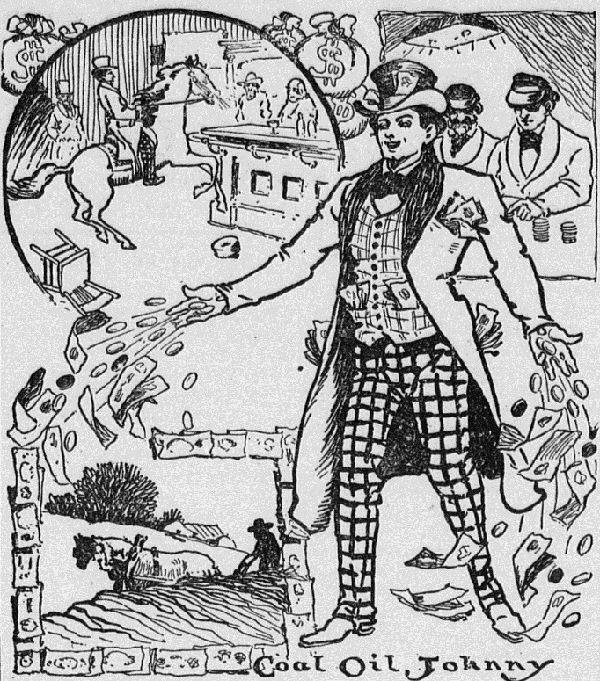
“Before J.R. Ewing, or the Beverly Hillbillies, or even John D. Rockefeller, there was Coal Oil Johnny,” noted a 2010 article in The Atlantic.
Such wealth could not last forever, but the rise and fall of Coal Oil Johnny, who died in modest circumstances in 1920 at age 76, has lingered in America’s petroleum history.
In 2010, The Atlantic magazine published “The Legend of Coal Oil Johnny, America’s Great Forgotten Parable,” an article sympathetic to his riches-to-rags story. It describes the country’s fascination with the earliest economic booms brought by “black gold” discoveries in Pennsylvania.

“Before J.R. Ewing, or the Beverly Hillbillies, or even John D. Rockefeller, there was Coal Oil Johnny,” noted the October 18 feature story. “He was the first great cautionary tale of the oil age — and his name would resound in popular culture for more than half a century after he made and lost his fortune in the 1860s.”
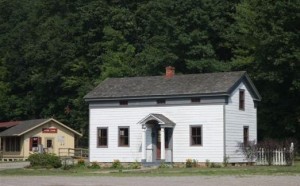
Refurbished boyhood home of “Coal Oil Johnny” at Oil Creek State Park (and train station) north of Rouseville, Pennsylvania. Photo by Bruce Wells.
For generations after the peak of his career, Johnny was still so famous that any major oil strike — especially the January 1901 gusher at Spindletop Hill in Beaumont, Texas — “brought his tales back to people’s lips,” noted the magazine article, citing Brian Black, a historian at Pennsylvania State University.
“It was wealth from nowhere,” Black explained. “Somebody like that was coming in without any opportunity or wealth and suddenly has a transforming moment. That’s the magic and it transfers right through to the Beverly Hillbillies and the rest of the mythology.”
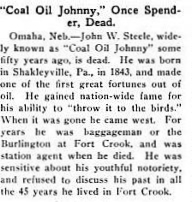
John W. Steele, who “made one of the first great fortunes out of oil,” died in 1920 in Nebraska.
“Coal Oil Johnny” was a legend, and like all legends, “he became a stand-in for a constellation of people, things, ideas, feelings and morals – in this case, about oil wealth and how it works,” he added.
“He made and lost this huge fortune – and yet he didn’t go crazy or do anything terrible. Instead, he ended up living a regular, content life, mostly as a railroad agent in Nebraska,” the 2010 Atlantic article concluded. “Surely there’s a lesson in that for the millions who’ve lost everything in the housing boom and bust.”
John Washington Steele’s Venango County home, relocated and restored by Pennsylvania’s Oil Region Alliance of Business, Industry & Tourism, stands today in Oil Creek State Park, just off Route 8, north of Rouseville.

On Route 8 south of Rouseville is the still-producing McClintock No. 1 oil well. “This is the oldest well in the world that is still producing oil at its original depth,” proclaims the Alliance. “Souvenir bottles of crude oil from McClintock Well Number One are available at the Drake Well Museum, outside Titusville.”
_______________________
Recommended Reading: The Legend of Coal Oil Johnny (2007); Cherry Run Valley: Plumer, Pithole, and Oil City, Pennsylvania, Images of America (2000); Western Pennsylvania’s Oil Heritage (2008). Your Amazon purchase benefits the American Oil & Gas Historical Society. As an Amazon Associate, AOGHS earns a commission from qualifying purchases.
_______________________
The American Oil & Gas Historical Society (AOGHS) preserves U.S. petroleum history. Please become an AOGHS annual supporter and help maintain this energy education website and expand historical research. For more information, contact bawells@aoghs.org. Copyright © 2025 Bruce A. Wells. All rights reserved.
Citation Information – Article Title: Legend of “Coal Oil Johnny.” Authors: B.A. Wells and K.L. Wells. Website Name: American Oil & Gas Historical Society. URL: https://aoghs.org/petroleum-pioneers/legend-of-coal-oil-johnny. Last Updated: December 4, 2025. Original Published Date: April 29, 2013.
by Bruce Wells | Nov 28, 2025 | Petroleum Pioneers
Rise and fall of an infamous Pennsylvania boomtown.
As the Civil War ended, oil discoveries at Pithole Creek in Pennsylvania created a headline-making boomtown for the young petroleum industry. As wells reached deeper into geological formations, the first gushers arrived — adding to “black gold” fever sweeping the country.
America’s oil production began in 1859 when Edwin L. Drake completed the first commercial well at Titusville, Pennsylvania. Drilled near natural oil seeps, his oilfield discovery at a depth of 69.5 feet led to a rush of exploration in the remote Allegheny River Valley.
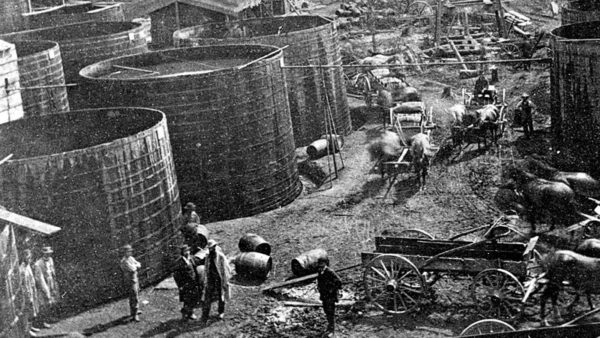
The new petroleum industry’s transportation infrastructure struggled as oil tanks crowded Pithole, Pennsylvania. In 1865, the first oil pipeline linked an oil well to a railroad station about five miles away. Photo by the “Oil Creek Artist,” John Mather, courtesy Drake Well Museum.
In 1864, businessman Ian Frazier found success along Cherry Creek, another small watercourse with signs of oil. After making a quick $250,000, Frazier looked for another opportunity for providing oil to new Pittsburgh refineries making kerosene for lamps.
Frazier hired a diviner to search along Pithole Creek, which smelled like “sulfur and brimstone,” according to historian Douglas Wayne Houck. “He went to the creek and followed the diviner around until the forked twig dipped, pointing to a specific spot on the ground,” Houck noted in 2014.
Although exploration techniques would improve, the science of petroleum geology was still in the future. Oil companies (and soon natural gas) had already begun drilling the “dry holes.”
Gusher at Pithole Creek
The first well of Ian Frazier’s United States Oil Company found no oil. A second well — drilled using the same steam-powered, cable-tool technology — erupted spectacularly on January 7, 1865, producing 650 barrels of oil a day. The Frazier well, the first U.S. oil gusher, brought a flood of drillers and speculators to Pithole Creek.

Two more wells erupted black geysers on January 17 and January 19, each flowing at about 800 barrels of oil a day (the invention of a practical blowout preventer was still half a century away). United States Oil Company subdivided its property and began selling lots for $3,000 per half-acre plot.
The Titusville Herald proclaimed Pithole as having “probably the most productive wells in the oil region of Pennsylvania, Houck explained in his Energy & Light in Nineteenth-Century Western New York. Fortunes were being made and lost in the oil regions (see the Legend of “Coal Oil Johnny”).
As the news spread through Venango County, “everyone came to the Pithole area to try their luck,” noted one reporter. Many were Confederate and Union war veterans. And as more successful wells came in, about 3,000 teamsters rushed to Pithole to haul out the rapidly multiplying barrels of oil.
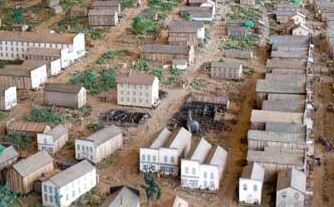
Managed by the Drake Well Museum, the Pithole Visitors Center includes a diorama of the vanished town. Photo by Bruce Wells.
There were many reasons behind the Pithole oil boom, including a flood of paper money at the end of the Civil War. Returning Union veterans had currency and were eager to invest — especially after reading newspaper articles about oil gushers and boomtowns. Thousands of veterans also wanted jobs after long months on army pay.
By May 1865, the town was home to 57 hotels, many shops, and its own daily newspaper. It had the third busiest post office in Pennsylvania — handling 5,500 pieces of mail a day.
Pithole’s Lady Macbeth
In December 1865, Shakespearean tragedienne Miss Eloise Bridges appeared as Lady Macbeth in America’s first famously notorious oil boomtown.
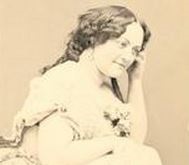
Shakespearean tragedienne Eloise Bridges appeared on the Pithole stage in 1865.
Bridges appeared at Murphy’s Theater, the biggest building in a town of more than 30,000 teamsters, coopers, lease-traders, roughnecks, and merchants. Three stories high, the building had 1,100 seats, a 40-foot stage, an orchestra, and chandelier lighting by Tiffany.
Bridges was the acclaimed darling of the Pithole stage. Eight months after she departed for new engagements in Ohio, the oilfield at Pithole ran dry; the most famous U.S. boomtown collapsed into empty streets and abandoned buildings.
Pennsylvania oil region visitors today walk the grassy streets of the first oil boom’s ghost town.
First Oil Pipeline
As Pithole oil tanks overflowed (and tank fires from accidents and lightning strikes increased), petroleum shipper Samuel Van Syckel conceived an infrastructure solution that became an engineering milestone.
In 1865, his newly formed Oil Transportation Association put into service a two-inch iron line linking the Frazier well to the Miller Farm Oil Creek Railroad Station, about five miles away.
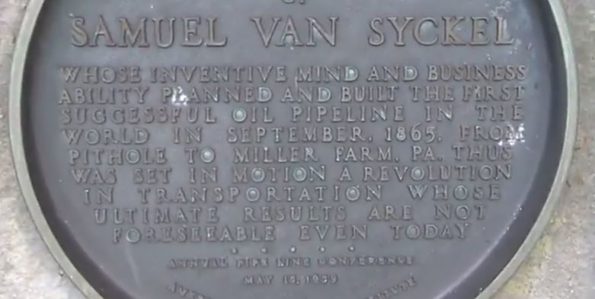
The American Petroleum Institute in 1959 dedicated a plaque on the grounds of the Drake Well Museum as part of the U.S. oil centennial.
“The day that the Van Syckel pipe-line began to run oil a revolution began in the business. After the Drake well it is the most important event in the history of the Oil Regions,” declared Ida Tarbell about the technology in her 1904 book, History of the Standard Oil Company.
Widely known as a known magazine journalist and a Lincoln biographer, Tarbell grew up in the area. Her family lived in Rouseville in 1861 when a gushing well erupted into flames — an early oilfield tragedy.

With 15-foot welded joints and three 10-horsepower Reed and Cogswell steam pumps, the pipeline transported 80 barrels of oil per hour — the equivalent of 300 teamster wagons working for 10 hours. Convinced their livelihood was threatened, teamsters attempted to sabotage the oil pipeline until armed guards intervened.
Unfortunately for Van Syckel, Pithole oil storage tanks frequently caught fire even as the Frazier well production began to decline. Other wells were beginning to run dry when, in 1866, fires spread out of control and burned 30 buildings, 30 oil wells, and 20,000 barrels of oil.
Pithole City
“Pithole’s days were numbered,” concluded historian Houck about the fire, which was documented by early oilfield photographer John Mather. “Buildings were taken down and carted off. A few people hung around until 1867.”
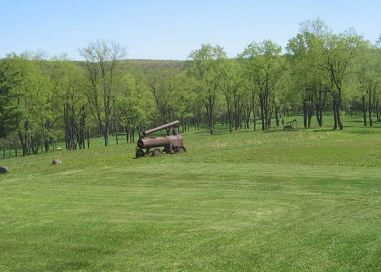
Visitors walk the grassy paths of Pithole’s former streets and see artifacts, including antique steam boilers. Volunteers “mow the streets.” Photo by Bruce Wells.
From beginning to end, America’s famous oil boomtown had lasted about 500 days. Pithole was added to the National Register of Historic Places on March 20, 1973.
A visitors center added in 1975 contains exhibits, including a scale model of the city at its peak and a small theater. Volunteers “mow the streets” on the hillside so that tourists can stroll where the petroleum boomtown once flourished.
“Pithole City is known in the Pennsylvania oil region as the oil boomtown that vanished as quickly as it appeared,” notes the Drake Well Museum, which manages Historic Pithole City. Among the region’s earliest and most infamous investors was John Wilkes Booth (see the Dramatic Oil Company).
Oil Town Aero Views
During the late 19th century, “bird’s-eye views” became a widely popular way to map U.S. cities and towns. Cartographer Thaddeus Mortimer Fowler created many of the best panoramic maps that he also called “aero views.”
The wealthy Pennsylvania oil regions attracted the attention of Fowler, who in 1885 moved his family to Morrisville, where he worked for the next 25 years.
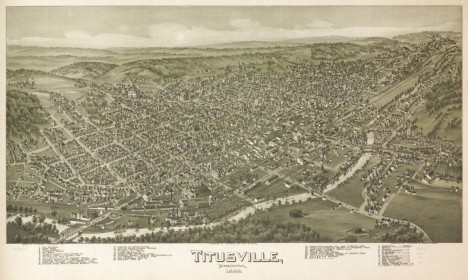
An 1896 Pennsylvania “aero view” map by Thaddeus M. Fowler, courtesy Library of Congress.
Fowler drew maps of Titusville, Oil City, and many petroleum-related boomtowns in West Virginia, Ohio — and Texas, where he created dozens of views of cities from 1890 to 1891.
But by far, most of the Fowler maps feature Pennsylvania cities between 1872 and 1922. There are 250 examples of his work in the collection of the Library of Congress. Learn more in Oil Town “Aero Views.”
_______________________
Recommended Reading: Energy & Light in Nineteenth-Century Western New York (2014); Cherry Run Valley: Plumer, Pithole, and Oil City, Pennsylvania, Images of America (2000); The Legend of Coal Oil Johnny
 (2007); Myth, Legend, Reality: Edwin Laurentine Drake and the Early Oil Industry
 (2009). Your Amazon purchase benefits the American Oil & Gas Historical Society. As an Amazon Associate, AOGHS earns a commission from qualifying purchases.
_______________________
The American Oil & Gas Historical Society (AOGHS) preserves U.S. petroleum history. Please become an AOGHS annual supporter and help maintain this energy education website and expand historical research. For more information, contact bawells@aoghs.org. © 2025 Bruce A. Wells. All rights reserved.
Citation Information – Article Title: “Oil Boom at Pithole Creek.” Authors: B.A. Wells and K.L. Wells. Website Name: American Oil & Gas Historical Society. URL: https://aoghs.org/petroleum-pioneers/pithole-creek/. Last Updated: November 29, 2025. Original Published Date: March 15, 2014.
by Bruce Wells | Sep 26, 2025 | Petroleum Pioneers
Post-Civil War oilfields launched Allegheny petroleum boom.
Soon after the Civil War ended and demand for kerosene lamp fuel soared, the rapidly growing U.S. petroleum industry discovered oilfields west of Tidioute, Pennsylvania. Wooden derricks replaced trees on Triumph Hill.
Formerly quiet Pennsylvania hillsides of hemlock woods vanished in early October 1866 when oil fever came to Triumph Hill. The U.S. oil industry was barely seven years old. About 15 miles east of the 1859 first American oil well at Titusville, an 1866 oil discovery at Triumph Hill sparked a rush of uncontrolled development.
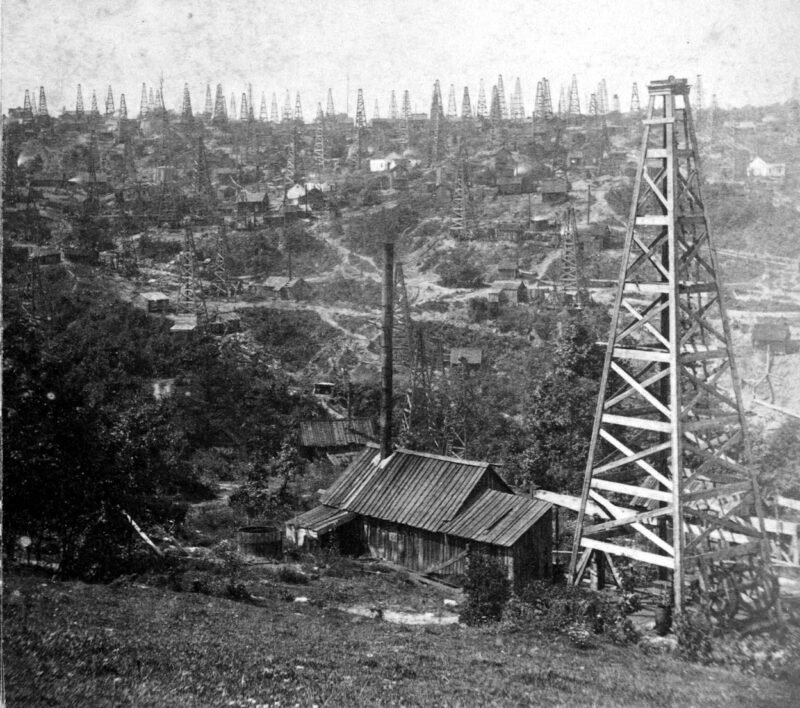
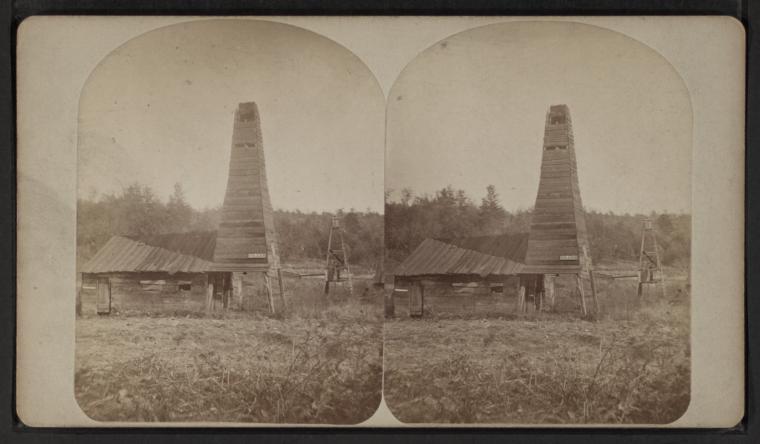
An 1870s photograph of the east side of Triumph Hill, near Tidioute, Pennsylvania, by Frank Robbins of Oil City. Image is right half of a stereo card rendered black and white for clarity from original sepia tone. Photo courtesy Biblioteca Nacional Digital Brazil.
The oil drilling craze would not last long, but boom towns sprang up at Gordon Run and Daniels Run west of Tidioute on Pennsylvania’s Allegheny River.
Like the earlier discoveries at Titusville, Rouseville, and Pithole, hillside trees were turned into derricks and oil storage tanks as drilling intensified. News about a deadly Rouseville oil well fire in April 1861 had been overshadowed by the Civil War.
The excitement at Tidioute (pronounced tiddy-oot) was joined by the roughneck-filled towns of Triumph and Babylon, where “sports, strumpets and plug-uglies, who stole, gambled, caroused and did their best to break all the commandments at once.”
Fresh from the oilfields at booming Pithole 25 miles to the southwest, the infamous Ben Hogan, self-proclaimed “Wickedest Man in the World,” operated a bawdy house on the Triumph hillside along the Allegheny River.
Latest Pennsylvania Oil Boom
Despite growing recognition that crowded drilling reduced reservoir pressures and production, the exploration and production bonanza, which began with the first well on October 4, 1866, prompted a frenzy of drilling as investors tried to cash in before the oil ran out.
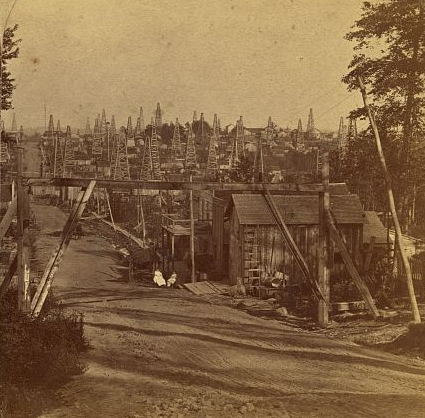
Detail from a Frank Robbins stereographic view of the west side of Triumph Hill, “showing buildings, storage tanks, and derricks, as well as two children sitting in chairs outside a building on Triumph Hill, near Tidioute, Pennsylvania,” — Library of Congress.
By the summer of 1867, Triumph Hill was producing 2,000 barrels of oil a day. The flood of oil bought lower prices — an early example of the petroleum industry’s boom and bust cycles.
Photographer Frank Robbins of Oil City published stereographic images of Triumph Hill, declaring it to be “the most magnificent oil belt (as oil men call a strip of producing land) ever yet discovered.”
He added, “On this belt which is but two miles long, and less than one mile wide — were over 180 producing wells, nearly every one of which was in operation at once.”
Robbins, who moved his studio to Bradford in 1879 when that region was on its way to becoming “America’s first billion-dollar oilfield,” also printed postcards for sale to tourists.
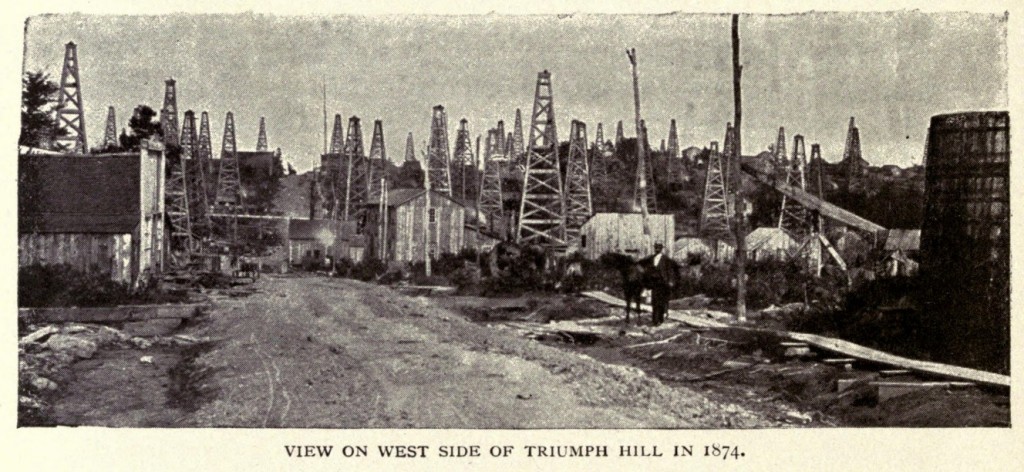
An image from the 1903 edition of “Sketches in Crude-Oil; some accidents and incidents of the petroleum development in all parts of the globe” by James McLaurin.
“Triumph Hill turned out as much money to the acre as any spot in Oildom,” noted James McLaurin in his 1896 book Sketches in Crude-Oil (some accidents and incidents of the petroleum development in all parts of the globe).
Many of the hill’s wells averaged 25 barrels of oil a day, McLaurin reported, adding that “the sand was the thickest – often ninety to one hundred and ten feet – and the purest the oil region afforded.” The tempo of oil exploration around Tidioute and boom town debauchery slowed as the region’s daily production fell.
Drilling discipline and well spacing, reservoir engineering and other oilfield management skills would evolve, but Triumph Hill’s glory dissipated within five years as overproduction drained the field.
Today, Triumph Hill remains one of the many quietly beautiful and forest-covered sites along the Allegheny River Valley that has earned a special place in America’s petroleum history.
Tidioute also is among the earliest panoramic maps of America’s petroleum communities. The view was created by Thaddeus Mortimer Fowler, a popular “bird’s-eye view” cartographer. Learn more about Fowler and his maps in Oil Town “Aero Views.”
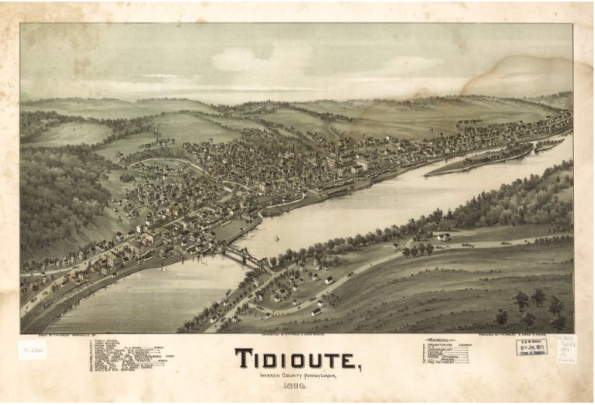
Traveling from Pennsylvania to Texas at the turn of the century, Thaddeus Mortimer Fowler created oil town “aero views” – panoramic maps of many of America’s earliest petroleum communities. Courtesy Library of Congress Prints and Photographs Division.
Early Oilfield Photography
Pioneer petroleum industry photographers like “Oil Creek Artist” John A. Mather documented Northwestern Pennsylvania boom towns. He and others like Frank Robbins captured views of North American oil booms, according to geologist and historian Jeff Spencer, noting, “Common scenes included oil gushers, oilfield fires, teamsters, and boom towns.”
Frank Robbins documented the emerging 1860s Pennsylvania petroleum industry, Spencer noted in a 2011 article for the journal Oil-Industry History. “He was one of the most prolific producers of stereoscopic views of oilfields in the Oil City and Bradford, Pennsylvania, and Olean, New York area,” Spencer noted.
Robbins photographed scenes from oilfields at Triumph Hill, Tidioute, Petrolia, and Pithole, according to Spencer, who in 2003, published Texas Oil and Gas (Postcard History Series) — learn more in Postcards from the Texas Oil Patch. For more resources on oilfield images, see petroleum photography websites.
_______________________
Recommended Reading: Cherry Run Valley: Plumer, Pithole, and Oil City, Pennsylvania, Images of America (2000); Around Titusville, Pa., Images of America (2004); Myth, Legend, Reality: Edwin Laurentine Drake and the Early Oil Industry (2009). Your Amazon purchase benefits the American Oil & Gas Historical Society. As an Amazon Associate, AOGHS earns a commission from qualifying purchases.
_______________________
The American Oil & Gas Historical Society (AOGHS) preserves U.S. petroleum history. Please become an AOGHS annual supporter and help maintain this energy education website and expand historical research. For more information, contact bawells@aoghs.org. Copyright © 2024 Bruce A. Wells. All rights reserved.
Citation Information – Article Title: “Derricks of Triumph Hill.” Authors: B.A. Wells and K.L. Wells. Website Name: American Oil & Gas Historical Society. URL: https://aoghs.org/petroleum-pioneers/triumph-hill-oil. Last Updated: September 26, 2024. Original Published Date: July 3, 2015.
by Bruce Wells | Sep 22, 2025 | Petroleum Companies
Learning hard lessons about wasteful overproduction and depleted reservoir pressures.
The discovery of oil along a small creek in Titusville, Pennsylvania, in August 1859 launched the American petroleum industry. Drilled just 69.5 feet deep at Oil Creek by former railroad conductor Edwin L. Drake, the well produced oil that could be refined into an inexpensive lamp fuel, kerosene.
Drake, who pioneered drilling technology, borrowed a local kitchen water pump to fill the first oil barrels. Early oil production from his and other northwestern Pennsylvania wells brought new refineries to Oil City and Pittsburgh on the Allegheny River.
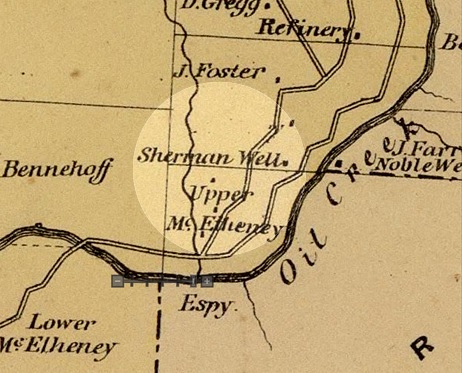
Four acres close to the Sherman well sold for $220,000 as venture oil capitalists, entrepreneurs, and speculators tried their luck in the newly created petroleum industry.
Demand for kerosene quickly outpaced the inexpensive but volatile lamp fuel camphene. Kerosene also replaced expensive whale oil. A typical four-year whaling voyage returned with 40,000 gallons; New oilfields produced 10 million gallons of kerosene in 1860 alone.
Edwin Drake’s well, drilled for the first U.S. oil company established by George Bissell, brought the country’s first drilling boom as entrepreneurs rushed in. Farmers who leased their land were among the first to benefit.
“Oil Creek was soon taken up and within a relatively short time, the entire valley as far back as into the hillsides, had been leased or purchased,” author Paul Gibbons noted.
With the science of petroleum geology yet to debut, early oil explorers searched near oil seeps and the “rich territory was limited to flats along the streams,” Gibbons added. Natural gas discoveries would later arrive to the benefit of Pittsburgh industries.
Sherman Well of 1861
J.T. Foster’s farm on Pioneer Run hillside off Oil Creek was in “the dry diggings” where few were willing to gamble. Nonetheless, newly minted oil operators gathered investors to try to find oil. Capital was hard to come by.
On the 200-acre Foster farm, one struggling and almost cashless outfit had to trade a one-sixteenth interest for $80 and an old shotgun to continue drilling on its Sherman well.
Drilling along Oil Creek continued undiminished, but in September 1861 on the Funk farm, the Empire well began flowing a river of oil under its own pressure. They called it a “fountain well.” Some said it initially produced 2,000 barrels of oil a day. Other successful wells followed.
Back on the Foster farm lease, the Sherman well (saved earlier for $80 and a shotgun) in March 1862 was completed as the “best single strike of the year,” despite being “above all the other flowing wells” according to the Hornellsville Tribune. Leases became highly prized and, as historian Terence Daintith observed, “subleasing was also a money machine.”
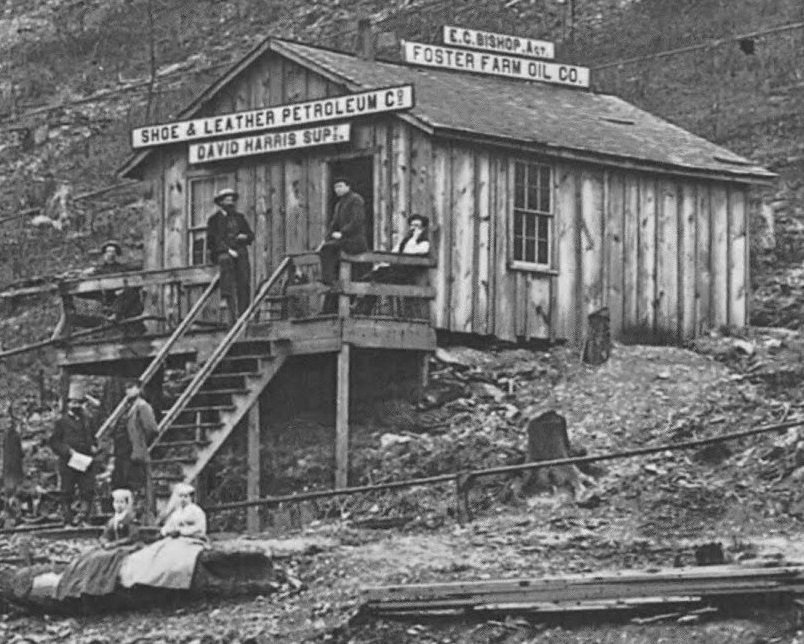
Oilfield offices of the Shoe & Leather Petroleum company, David Harris Supply Company, and the Foster Farm Oil Company, which drilled an 1866 well that produced 300 barrels of oil.
The Venango Citizen reported, “Territory along the river above and below Franklin has been changing hands at high figures, and preparations are being made for active work.”
Just four acres close to the Sherman well sold for $220,000 as venture capitalists, entrepreneurs, and speculators tried their luck in the newly created petroleum industry. The Foster Farm Oil Company and the Shoe & Leather Petroleum Company were among many corporations formed to exploit exploration opportunities.
Foster Farm Oil Company
Foster Farm Oil Company incorporated in February 1865. Based in Philadelphia and capitalized at $1.5 million, the company offered 150,000 shares to the public. “The Foster Farm is owned by a company of ten gentlemen, and is known as the Foster Farm Oil Company,” reported the The Titusville Morning Herald. E.C. Bishop (Elisa Chapman ) was principal owner as well as one time general agent, treasurer, and superintendent.
The new company secured acreage on the Foster farm that already had 12 wells pumping 100 barrels of oil a day. Foster leased acreage in small tracts to several new companies vying for closest proximity to known producers. Oil prices had always fluctuated wildly, but a standard 42-gallon barrel of crude oil sold in 1865 for about $6.50, including a Civil War excise tax of $1 per barrel.
Foster Farm Oil Company continued drilling and subleasing small tracts. In April 1866, it drilled a well producing 300 barrels of oil a day from 612 feet deep. Then a second well produced at 310 barrels, a third at 100, and another at 350 barrels of oil a day. In 1867, Foster Farm Oil Company sold 1,000 barrels of oil at $2.10 each.
All over the Pioneer Run hillside, wooden derricks with steam engines pumped away even as overproduction drained the oilfield. Margins disappeared and companies began to fail.
Foster Farm Oil Company’s fortunes faded, as did the value of its stock. In 1869, total U.S. oil production topped 4 million barrels and oversupply drove many out of business. After 10 years in the oil patch, Elisha C. Foster departed to enter the banking business in Connecticut.
By 1871, shares of Foster Farm Oil were being auctioned off along with other “Stocks, Loans, etc.” The following year, 5,000 shares of Foster Farm Oil Company were offered at 11 cents a share. Litigation began to overtake the failing company in 1873; it would continue long after the drilling boom had moved on, finally being settled by the Connecticut Superior Court in 1886.
Shoe & Leather Petroleum
Shoe & Leather Petroleum Company incorporated in New York City in March 1865 to join the Pennsylvania oil rush. The company initially capitalized at $400,000, later reduced to $160,000. “Until the spring of 1865, the Foster Farm, Pioneer Run and vicinity were considered dry territory. Through the exertions of Mr. David Harris of this city, the Shoe & Leather Petroleum was formed,” reported the Titusville Morning Herald.
The company leased six acres on the Foster farm, then subleased them into 11 smaller tracts – the kind sought by smaller, speculative operations. “Substantial leaseholders could milk their leases by subleasing small lots for large premiums and high royalties,” historian Daintith later noted. “Far more money could be made this way than by actual production.”
By 1867, Shoe & Leather Petroleum had five producing wells, on five different tracts, with five different operators, yielding about 350 barrels of oil a day. But frantic production at Pioneer Run and Oil Creek, compelled land owners above oil reserves to drill, “regardless of price or market demand, in order to prevent his neighbor from draining his reserves.”
This traditional “law of capture” rendered an oily landscape thick with derricks, according to local accounts.
Overproduction and waste depleted reservoir pressures. Wells were pumped dry. Triumph Hill, and Pithole and other examples reinforced the precedent of oil discovery leading to drilling boom, and then to inevitable bust. By 1902, United States Investor reported Shoe Leather & Petroleum Company had “disappeared” and concluded, “The supposition is that the company has gone out of existence.”
In 1904, Smythe’s Directory of Obsolete American Securities and Corporations described Shoe & Leather Petroleum, “Extinct. Stock worthless.”
The stories of exploration and production companies can be found updated in Is my Old Oil Stock worth Anything?
_______________________
Recommended Reading: Cherry Run Valley: Plumer, Pithole, and Oil City, Pennsylvania (2000); Myth, Legend, Reality: Edwin Laurentine Drake and the Early Oil Industry
 (2009). Your Amazon purchase benefits the American Oil & Gas Historical Society. As an Amazon Associate, AOGHS earns a commission from qualifying purchases.
_______________________
The American Oil & Gas Historical Society (AOGHS) preserves U.S. petroleum history. Please support this website, subscribe to the monthly email newsletter, and help expand our historical research. Contact bawells@aoghs.org. Copyright © 2026 Bruce A. Wells.
Citation Information – Article Title: “Early Wells of Oil Creek.” Authors: B.A. Wells and K.L. Wells. Website Name: American Oil & Gas Historical Society. URL: https://aoghs.org/stocks/early-wells-of-oil-creek. Last Updated: November 1, 2024. Original Published Date: December 22, 2018.