This Week in Petroleum History, October 19 – 25
October 19, 1990 – First Emergency Use of Strategic Petroleum Reserve –
As world oil prices spiked after the August 1990 invasion of Kuwait by Saddam Hussein’s Iraqi troops, the first presidentially mandated emergency use of the Strategic Petroleum Reserve was authorized by George H. W. Bush, who ordered the sale of five million barrels of SPR oil as a test to “demonstrate the readiness of the system under real-life conditions,” according to the Department of Energy.
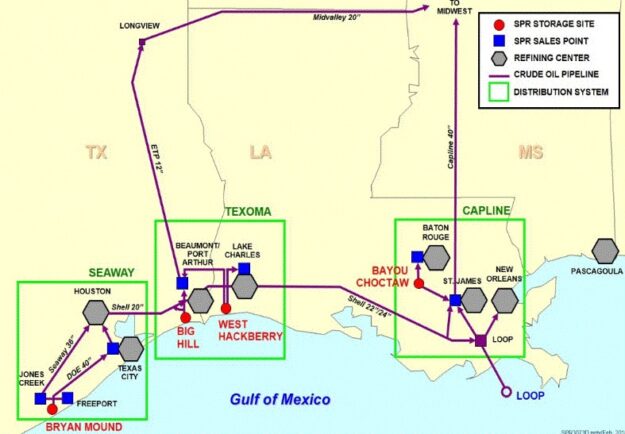
Strategic Petroleum Reserve oil storage facilities grouped into pipeline distribution systems in Texas and Louisiana. Map courtesy U.S. Department of Energy 2018 Report to Congress.
President Ford established the SPR in 1975 as a protection against severe supply interruptions. By 2020, four underground salt dome sites along the Gulf Coast stored 735 million barrels of oil — the largest stockpile of government-owned emergency oil in the world. In early October 2026, the SPR held 283 million barrels oil, down 132.5 million barrels from 415.4 million in March. and its lowest level since October 1982
October 20, 1924 – API issues Tubular Goods Standards
Shortages of equipment and drilling delays during World War I revealed the petroleum industry’s struggle with a lack of uniformity of pipe sizes, threads, and couplings. Founded in 1919, the American Petroleum Institute (API) gathered industry experts to come up with industry-wide standards to promote equipment compatibility. “After bringing these experts together to agree upon design and requirements, the first standard, Specifications for Steel and Iron Pipe for Oil Country Tubular Goods, was published on October 20, 1924,” notes API, which has since published more than 800 standards and guidelines. (more…)