Draft V.4
Thomas R. Bard, California petroleum industry pioneer.
Travers Newton of Carpinteria, California, is researching the history of the Ventura County oilfield discovered by his great-grandfather in 1867.
In 2020, Newton contacted the American Oil & Gas Historical Society (AOGHS). “Do you know anyone who is researching the history of the Ventura, California, oilfield? My great-grandfather, Thomas Bard, sank the first ‘gusher’ near Ojai, in Ventura County,” he noted
With subsequent emails — and the posting of his question on the AOGHS History Research Forum — Newton shared his already extensive research about Thomas Robert Bard (1841-1915).
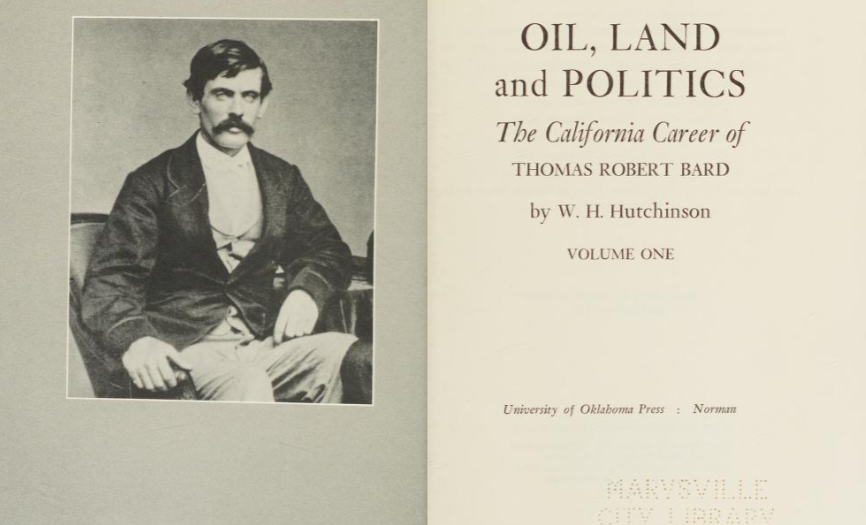
The University of Oklahoma Press in 1965 published Oil, Land and Politics: The California Career of Thomas Robert Bard (2 Volumes) by W. H. Hutchinson.
Newton’s research sources include a two-volume biography his family commissioned, Oil, Land, and Politics: The California Career of Thomas Robert Bard, by William Hutchinson, published by the University of Oklahoma Press in 1965.
In addition to his role in West Coast petroleum history, his great-grandfather served as a volunteer Union scout during the Civil War and in 1900 was elected to the U.S. Senate as a Republican, serving until 1905.
“Bard served in the U.S. Military Railroad, he rode horses well, knew how to operate a telegraph, and how to tap into a line,” New reports. “We have his diary when he was near Gettysburg before the battle: ‘I see rebels massing.” His brother Cephas joined the Union Army 126th Pennsylvania Volunteer Infantry. According to Hutchinson, both brothers fought at Antietam in 1862.
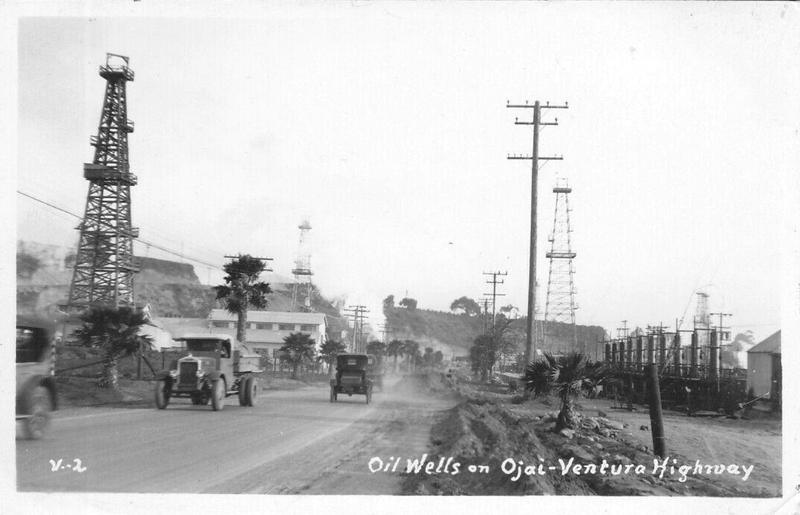
“Oil Wells on Ojai-Ventura Highway.” Ventura oilfield photo courtesy the Museum of Ventura County.
A Ventura County historic marker credits Thomas R. Bard for “the first well drilled for oil in California that yielded extended commercial production” in 1867. The marker was dedicated at the Ojai No. 6 wellsite almost a century later by the Union Oil Company of California and Petroleum Productions Pioneers Inc.
Union Oil Company was founded by Wallace L. Hardison (1850–1909), Lyman Stewart (1840–1923), and Bard, who became the company’s first president at its Santa Paula 1880s headquarters building, the closed California Oil Museum.
“Bard was the first president of the Union Oil Company, co-founded in 1890 by merging his Sespe Oil Company with Lyman & Stewart Company, founded by Wallace Hardison (1850-1909) and Lyman Stewart (1840-1923). Stewart had drilled unsuccessful wells in Titusville,” Newton says.
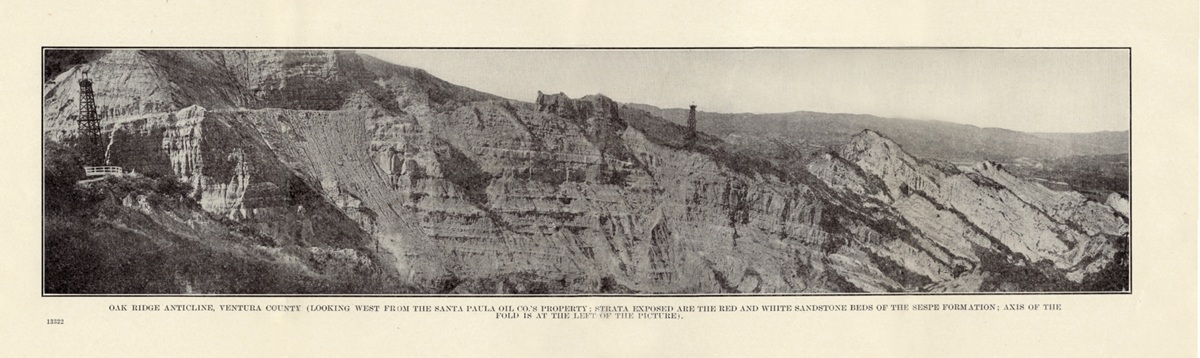
“Oak Ridge Anticline, Ventura (looking west from the Santa Paula Oil Co.’s property) strata exposed are red and white sandstone beds of the Sespe Formation; axis of fold is at left of the picture.” Photo courtesy John Nichols, Santa Paula.
“After Rockefeller gained control of the Pennsylvania oilfields, Lyman & Steward came to Santa Paula, California, in 1883 to develop newly discovered oilfields there, Newton adds. “Bard resigned in 1894 due to disagreements with Hardison & Stewart, and sold his shares in the company to represent California in the U.S. Senate In 1900.”
Ojai No. 6 Well
The bronze plaque for Oil Well Ojai No. 6 notes, “Mr. Bard conceived of drilling away from existing oil springs on a projected oil structure,” and describes the giant oilfield discovery as “prelude to California’s oil empire.”
Near here in May 1867, the California Petroleum Company brought in “Ojai No. 6” at a depth of 550 feet. W.W. Orcutt described it as “The first well drilled for oil in California that yielded extended commercial production.” It was the first producing well drilled by mechanical power and the first to flow by its own energy. It is regarded as the forerunner of the state’s oil bonanza.

A bronze plaque for Oil Well Ojai No. 6 Ventura oilfield discovery well was dedicated at the wellsite in 1965.
The well was located by Thomas R. Bard of the California Petroleum Company. Mr. Bard, age 26, came to California from Pennsylvania in 1865 representing T.A. Scott of the Pennsylvania Railroad and the California Petroleum Company. Mr. Bard conceived of drilling away from existing oil springs on a projected oil structure. With indomitable energy he was the principal figure in the first major effort to develop the petroleum resources of the state.
The historic marker concludes, “This monument is dedicated to Ojai No. 6, Senator Bard, to the pioneers of the Union Oil Company and the petroleum industry.”
Newton’s family research has further examined his great-grandfather’s visit to Titusville, Pennsylvania — five years after the first U.S. oil well was drilled there in August 1859. A young Bard returned to drill exploratory wells in Ventura County thanks to the trip arranged by a Pennsylvania railroad king.

Thomas Scott, president of the Pennsylvania Railroad, at the time “owned wells near today’s Drake Well Museum and sent Bard there in fall 1864 to learn oil extraction,” Newton explains.
“Scott also served as President Lincoln’s assistant secretary of war in his first administration in charge of railroad transportation,” Newton says. “Scott’s Texas & Pacific RR competed with and lost to the Big Four (Huntington, Stanford, Crocker, and Hopkins) transcontinental RR. Bard thought Scott’s RR would approach Ventura as a western terminus, and the oil could fuel the engines.”
In 1865, Bard returned from Pennsylvania to drill the Bard No. 1 well, “which did not produce, on Rancho Canada Larga, near the Ventura River. Canada Larga and Rancho Ojai were at the time owned by Scott. Bard acquired Canada Larga,” according to Newton.
Newton reports Bard sank the No. 6 well in 1867 in upper Ojai Valley, adding, “Scott was building the Texas & Pacific Railroad and hoped oil would power his locomotives as they transitioned from coal.”
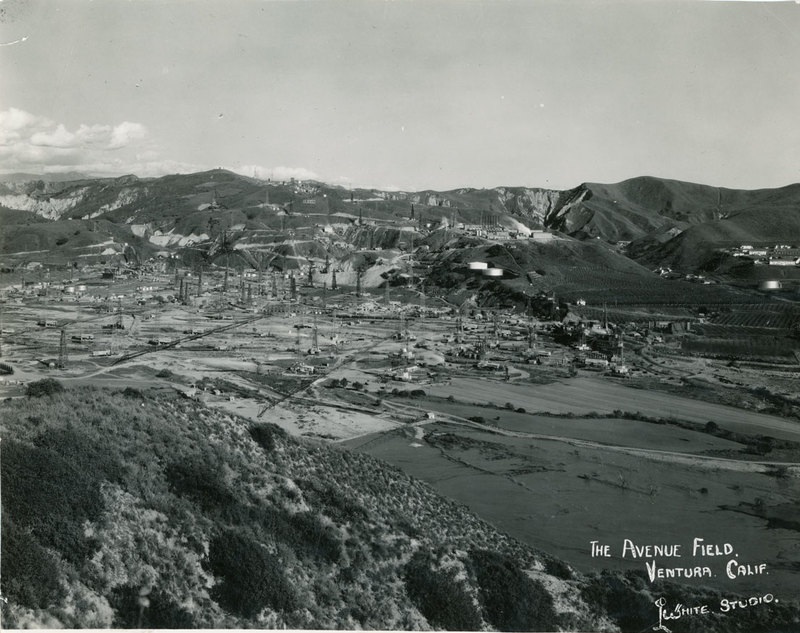
Also known as the Ventura Avenue Field, the Venture oilfield has been among the most productive in California since its discovery in 1867. Photo courtesy the Museum of Ventura County.
The Ojai No. 6 well’s success came after advice from Yale Professor Benjamin Silliman, who visited the California site between 1864 and 1865. Silliman had experimented with refining “rock oil” to make kerosene (see George Bissell’s Oil Seeps).
About this time, Bard’s No. 1 well was drilled on Sulphur Mountain above Ventura Avenue, where the Lloyd No. 1 well was drilled in 1914 but failed to produce oil. “So I understand that the major discovery of the Ventura field is usually dated to 1919,” Newton explains, adding, “I assume due to the technology needed to drill deeply.”
In 1915, Ralph Lloyd, known as “the father of the Ventura Oil Field,” formed the State Consolidated Oil Company with Joseph Dabney,” Newton further explains. The exploration company acquired mineral rights to land next to the Ventura River. “In 1916, they sank Lloyd No. 1 and in 1917 leased rights to Shell Oil.”

The title eventually passed to Aera Energy (a joint venture of Shell and ExxonMobil) and accounted for 25 percent of California’s oil and natural gas production, mainly in the San Joaquin Valley,” Newton notes. “In 2022, Aera sold the 4,300-acre Ventura field to the German asset management group Ikav Company.”
In 2025, title to the 6,500-acre Rancho Canada Larga was deeded to the Trust for Public Land, Newton reports. He is especially interested in the history of how petroleum was transported from the Ventura field to ships via undersea pipeline and 19th-century maps of wells in the area. Thomas Bard’s son Richard donated much of his father’s archive to the Huntington Library in San Marino.
Union Oil Company officially became Unocal in 1983 when it was reorganized. Chevron, established in San Francisco in 1879 as the Pacific Coast Oil Company, acquired Unocal in 2005.
Unocal Archives
Although the California Oil Museum in Santa Paula struggled to remain open since the pandemic, Newton and the city succeeded in preserving the museum’s archive, which includes Bard documents. In 2024, Chevron provided a $2 million grant benefiting the 1890 former Union Oil Company headquarters building — already recognized as a California Historical Landmark and listed on the National Register of Historic Places.
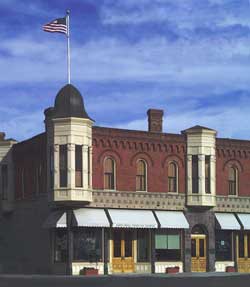
The 1890 Union Oil Company headquarters building in Santa Paula is home to the closed California Oil Museum.
Meanwhile, Newton continues to research the fate of the Unocal archive and the future of the California Oil Museum. He has learned the City of Santa Paula reached a long-term loan agreement with the Responsible Energy Council, which will create an updated inventory of the Union Oil Company archive, according Newton.
According to his research, portions of the Unocal archive (1884 – 2005) were donated to UCLA Library Special Collections by Michael W. Thacher, former Unocal general manager of public relations, 1995 until it merged with Chevron in 2005.” Newton explains, adding that Thacher joined Arco in 1981 as manager of educational services.
Sharing Research
In 1975, Edgar Wesley Owen’s Trek of the Oil Finders: A History of Exploration for Petroleum, published by the American Association of Petroleum Geologists (AAPG), described Bard as “a young man who was destined to become one of the key figures in the oil industry and politics of southern California.”
Newton’s research highlights the broader story of the Ventura oilfield’s growth. The City of Santa Paula today owns the Union Oil headquarters building and museum.
Meanwhile, he hopes visitors to the AOGHS website will share any related research — including about another family member, his great-grandfather’s son Richard, known as the “Father of Port Hueneme” for expanding that Ventura County city.
Please post comments and suggestions below or email Travers Newton at henrytraversnewton@yahoo.com.
______________________
Recommended Reading: Oil, Land and Politics: The California Career of Thomas Robert Bard (1965); Trek of the Oil Finders: A History of Exploration for Petroleum (1975); Sign of the 76: The fabulous life and times of the Union Oil Company of California (1977); Early California Oil: A Photographic History, 1865-1940 (1985); Black Gold in California: The Story of California Petroleum Industry (2016). Your Amazon purchase benefits the American Oil & Gas Historical Society. As an Amazon Associate, AOGHS earns a commission from qualifying purchases.
_______________________
The American Oil & Gas Historical Society (AOGHS) preserves U.S. petroleum history. Support this energy education website, subscribe to our monthly email newsletter, and help expand historical research. Contact bawells@aoghs.org. Copyright © 2026 Bruce A. Wells.
Citation Information – Article Title: “Discovering the Ventura Oilfield.” Authors: B.A. Wells and K.L. Wells. Website Name: American Oil & Gas Historical Society. URL: https:://aoghs.org/oil-almanac/discovering-the-venture-oilfield. Last Updated: July 14, 2026. Original Published Date: June 17, 2026.