This Week in Petroleum History: June 22 – 28

June 23, 1921 – Signal Hill brings California Oil Boom –

Another Southern California drilling boom began when a geyser of “black gold” erupted 114 feet high at Signal Hill. The Alamitos No. 1 well revealed a giant oilfield and produced about 600 barrels of oil a day.
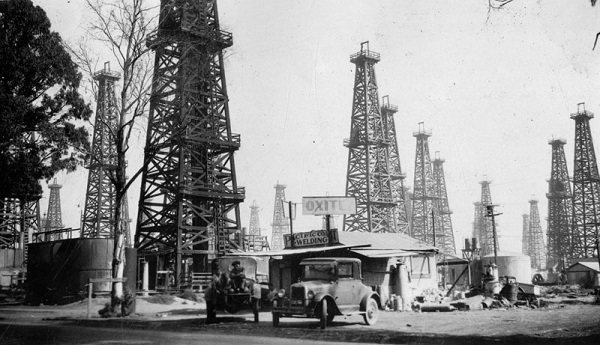
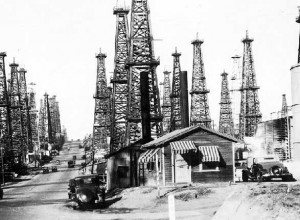
Rows of derricks at Signal Hill, California, with building and autos, circa 1930.

The Signal Hill oil discovery helped make California the source of one-quarter of the world’s oil output. Porcupine Hill and the Long Beach field produced 260,000 barrels of oil a day by 1923. Photo courtesy of Los Angeles Museum of Natural History.

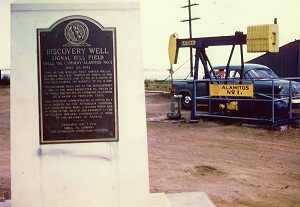
Known as “Porcupine Hill” by 1923, oil production from the Signal Hill field 20 miles south of Los Angeles reached almost 260,000 barrels a day. Combined with the 1892 Los Angeles Oilfield discovery and the 1920 Huntington Beach oilfield, California produced one-fourth of the world’s oil. A monument dedicated in 1952 at Discovery Well Park in Signal Hill’s has served “as a tribute to the petroleum pioneers for their success here.”

Learn more in Signal Hill Oil Boom.

June 23, 1947 – Supreme Court limits State Rights to Continental Shelf

The U.S. Supreme Court ruled the state of California could not claim rights to the Continental Shelf beyond three nautical miles. Litigation had resulted from President Harry Truman’s September 1945 Continental Shelf Proclamation, which placed control with the federal government. The Supreme Court ruling on the Truman Proclamation affirmed federal jurisdiction “with respect to the natural resources of the subsoil and seabed of the continental shelf.” Similar rulings effecting Louisiana and Texas would be made in 1950.

June 24, 1937 – Traces of Oil found in Minnesota

A remote wildcat well drilled in far western Minnesota began producing three barrels of oil a day from a depth of 864 feet. The unlikely discovery in Traverse County prompted more leasing, but no commercial quantities of oil were found.
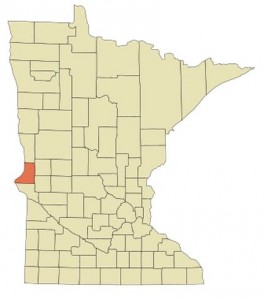
County map highlighting the Oil one county of Minnesota with potential petroleum production.

Traverse County, Minnesota, where oil production peaked in 1937.

The lack of an oilfield reaffirmed geologists’ conclusions since 1889 that conditions for significant petroleum deposits did not exist in Minnesota, despite some water wells in southern Minnesota containing small amounts of natural gas. “Not much oil and gas is obtained from Precambrian rocks, with which Minnesota is very amply blessed,” noted the 1984 book Minnesota’s Geology.

June 25, 1889 – First Oil Tanker catches Fire in California

The first oil tanker built for that purpose, a schooner named W.L. Hardison, burned at its wharf in Ventura, California. The Hardison & Stewart Oil Company (later Union Oil) commissioned the experimental vessel, which offered an alternative to paying for railroad oil tank cars charging one dollar per oil barrel to reach markets in San Francisco.

With oil-fired steam boilers and supplemental sails, the schooner could ship up to 6,500 barrels of oil below deck in specially constructed steel tanks. After the fire, the tanks were recovered and used at the company’s Santa Paula refinery. It took 11 years before the company launched a replacement tanker, the Santa Paula.
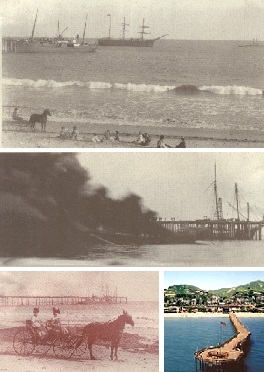
Rare photographs of the doomed oil tanker W.L. Hardison.

Rare photographs of the doomed oil tanker W.L. Hardison and Ventura pier courtesy the Museum of Ventura County.

The Ventura Wharf Company by April 1898 had exported 518,204 barrels of bulk oil during the previous year, according to the Los Angeles Times. The pier remained a working wharf until 1936, when it became the longest recreational wooden pier in California.

Designated a Ventura Historic Landmark in 1976 and now 1,600 feet long, California’s oldest pier was refurbished for $2.2 million in 2000, according to the Museum of Ventura County, which also operates archaeological and agricultural museums. In nearby Santa Paula, the 1890 headquarters building of Union Oil Company was donated to the city in 2023 by Chevron with a $2 million grant to maintain the building, home to the now closed California Oil Museum.

June 25, 1901 – Red Fork Discovery leads to Tulsa Boom

Six years before statehood, Oklahoma witnessed a second oil discovery (some say the third — see Another First Oklahoma Oil Well) when two drillers from the Pennsylvania oil regions discovered an oilfield at Red Fork in the Creek Indian Nation.

John Wick and Jesse Heydrick drilled the Sue A. Bland No. 1 well near the Creek village across the Arkansas River from Tulsa. Sue Bland, a Creek citizen, was the wife of homesteader Dr. John C. W. Bland. Their Red Fork well produced just 10 barrels of oil a day from a depth of 550 feet, but created a drilling boom attracting petroleum companies to nearby Tulsa.

Learn more in Red Fork Gusher.

Support the American Oil & Gas Historical Society link.

June 25, 1999 – Texas Post Office named Historic Place

The former U.S. Post Office building in Graham, Texas, with its Great Depression-era oilfield mural by Alexandre Hogue, joined the National Register of Historic Places. Hogue’s 1939 “Oil Fields of Graham” has been joined by other art exhibits in its historic Art Deco building on Third Street.
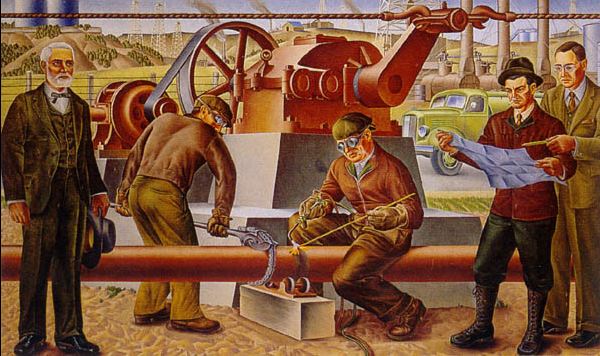
Oil Fields of Graham by Alexandre Hogue, a 1939 mural that is 12 feet wide and 7 feet high, was restored in 2002 at the Old Post Office Museum & Art Center, in Graham, Texas.

“Oil Fields of Graham” by Alexandre Hogue, a 1939 mural in the Old Post Office Museum & Art Center of Graham, Texas. The white-haired gentleman was the mayor of Graham.

Hogue’s artwork included many Southwestern scenes as part of the New Deal Federal Arts Program. His murals on the walls of public buildings often portrayed scenes of the Texas petroleum industry. In Graham’s historic building on Third Street, “Oil Fields of Graham,” 12 feet wide and 7 feet high, is among exhibits at the Old Post Office Museum & Art Center, which opened in 2002.

Learn more in Oil Art of Graham, Texas.

June 26, 1885 – Natural Gas Utility established in Pennsylvania

Peoples Natural Gas Company incorporated — the first Pennsylvania natural gas company chartered by the state to regulate production, transmission, and distribution of natural gas. A similar utility incorporation had taken place a year earlier in New York City when six competing companies combined to form Consolidated Edison.

By 1891, the Pittsburgh-based limited liability company had consolidated the pipelines and facilities of Pittsburgh Natural Gas, Lawrence Natural Gas, Conemaugh Gas, and Columbia Natural Gas companies. More than a dozen more companies would be acquired between 1903 and 1961. The utility acquired Equitable Gas in 2017, expanding natural gas services in West Virginia and Kentucky.

June 28, 1887 – Kansans celebrate First Natural Gas Jubilee

After erecting flambeau arches at the four corners of the town square, Paola, Kansas, hosted what local leaders described as “the first natural gas celebration ever held in the West.” Excursion trains from Kansas City brought about 2,000 people, “to witness the wonders of natural gas,” according to the Miami County Historical Museum, which preserves the region’s petroleum history.
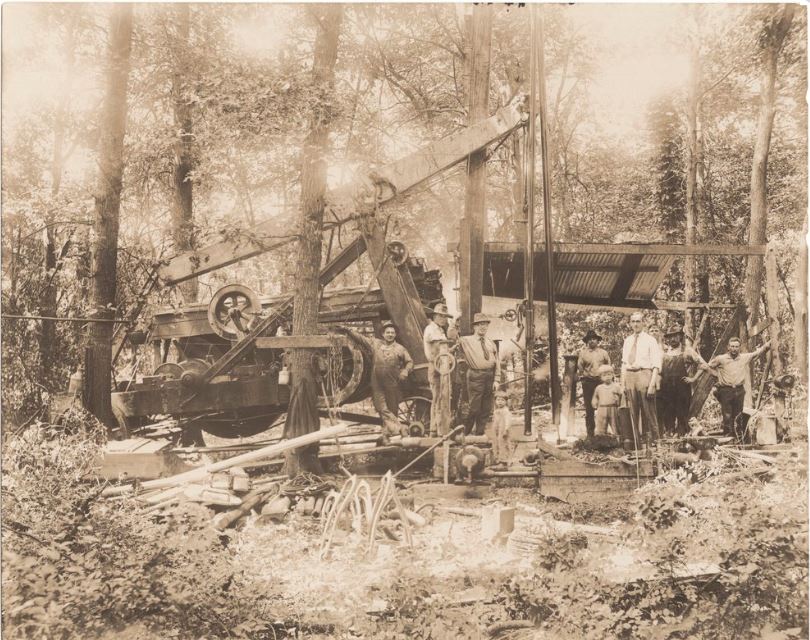
Oil well with visitors in Miami County, Kansas, circa 1920.

Paola’s giant natural gas field attracted more petroleum exploration to Miami County, including this circa 1920 oil well. Photo courtesy Kansas Historical Society.

Five years before the 1892 first Kansas oil well, Paola experienced a “grand illumination” of natural gas street lights, where “gas was attached to a yard sprinkler by a rubber hose, and when it was ignited there appeared nests of small blazes, which were beautiful and attractive.”
Registration link for AOGHS email newsletter.

June 28, 1967 – Hall of Petroleum opens in Smithsonian Museum

The Hall of Petroleum opened at the Smithsonian Institution’s Museum of History and Technology in Washington, D.C. Exhibits featured early offshore technologies, historic cable-tool rigs, and modern rotary drilling methods. Petroleum-production exhibits in the museum’s west wings offered examples of counterbalanced pumping units.

A giant mural by Delbert Jackson of Tulsa, Oklahoma, greeted visitors to what in 1980 became the National Museum of American History. Jackson spent two years creating a 13-foot by 56-foot painting featuring detailed scenes of oil and natural gas exploration, production, refining, and transportation.
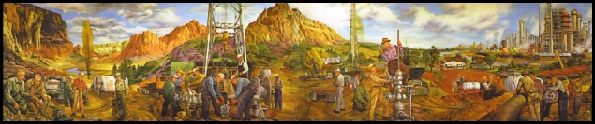
"Panorama of Petroleum” a 1967 mural by Delbert Jackson of Tulsa.

A “Panorama of Petroleum” once greeted visitors to the Smithsonian’s American History Museum in Washington, D.C. The 13-foot by 56-foot mural is on exhibit in the Tulsa International Airport.

Jackson’s “Panorama of Petroleum” featured industry pioneers and served as a visual map to the hall’s oilfield technology exhibits. “If the hall can increase the public’s knowledge of and respect for the technical skill and know-how of those who make this energy available, it will have served its purpose,” noted the exhibit’s 1967 catalog. The mural ended up in storage for three decades, until finding a home at Tulsa International Airport.

Learn more in Smithsonian’s “Hall of Petroleum.

_______________________

Recommended Reading: Signal Hill, California, Images of America (2006); Minnesota’s Geology (1982) Tulsa Oil Capital of the World, Images of America (2004); Oil in West Texas and New Mexico (1982); Minnesota’s Geology (1982); Black Gold in California: The Story of California Petroleum Industry (2016); Early California Oil: A Photographic History, 1865-1940 (1985); Tulsa Oil Capital of the World, Images of America (2004); Oil in West Texas and New Mexico (1982); Official Guide to the Smithsonian (2016). Your Amazon purchase benefits the American Oil & Gas Historical Society. As an Amazon Associate, AOGHS earns a commission from qualifying purchases.

_______________________

The American Oil & Gas Historical Society (AOGHS) preserves U.S. petroleum history. Support this energy education website, our monthly email newsletter, This Week in Oil and Gas History News, and help expand historical research. Contact bawells@aoghs.org. Copyright © 2026 Bruce A. Wells. All rights reserved.

Signal Hill Oil Boom

Cemetery in California oilfield produced royalty checks for next of kin.


In the summer of 1921, the Signal Hill oil discovery would help make California the source of one-quarter of the world’s entire oil output. Soon known as Porcupine Hill, the town’s Long Beach oilfield produced about 260,000 barrels of oil a day by 1923.

The Alamitos No. 1 well, drilled on a remote hilltop south of Los Angeles, erupted a column of “black gold” on June 23, 1921. Natural gas pressure was so great that the oil geyser climbed 114 feet into the air.

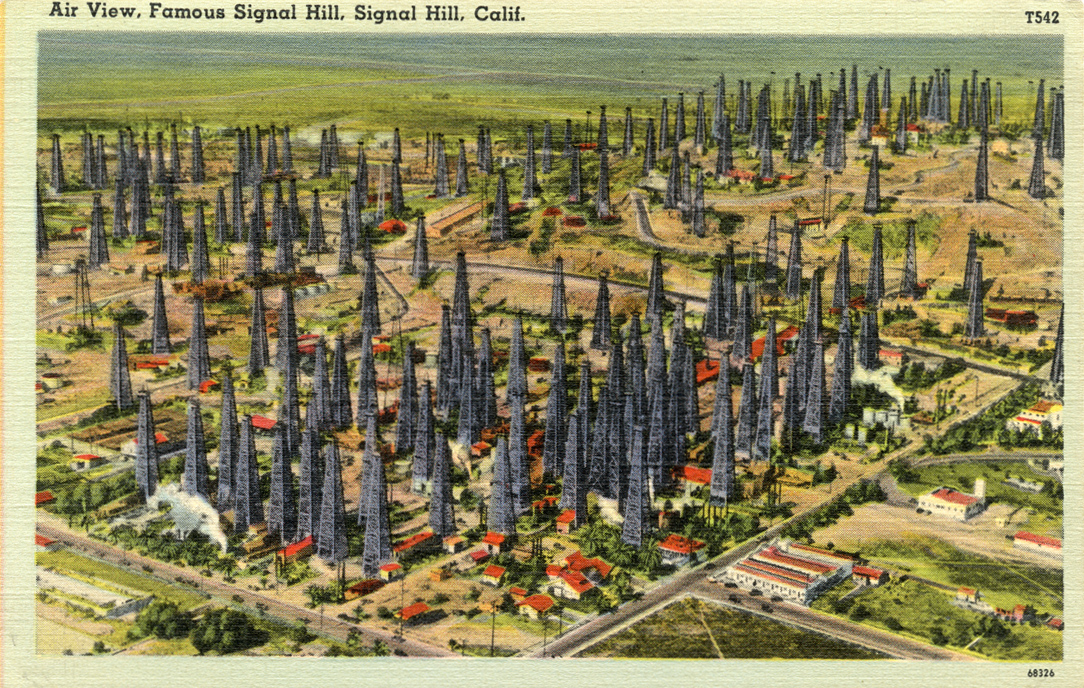
Postcard of oil derricks on Signal Hill, CA, circa 1930.

After the June 1921 oilfield discovery, Signal Hill had so many derricks that people called it Porcupine Hill. Circa 1935 postcard courtesy Boston Public Library, Digital Commonwealth.

The oilfield discovery well, which produced almost 600 barrels a day, would eventually produce 700,000 barrels of oil. Signal Hill incorporated three years after its Alamitos discovery well made headlines.

In 1923, Signal Hill’s petroleum field produced more than 68 million barrels of oil. The Signal Hill community later became one of the first U.S. cities to be completely surrounded by another city, Long Beach.

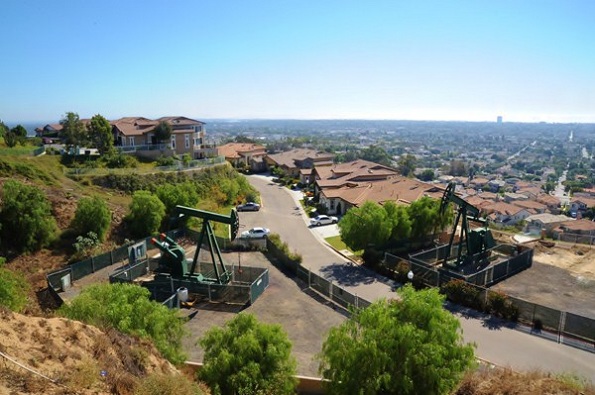
Modern view of Signal Hill oilfield in California.

Signal Hill, a residential area before the 1921 discovery of the Long Beach oilfield, became covered in derricks. “Today you can see wonderful commemorative art displays of this era throughout the lush parks and walkways of Signal Hill,” notes a local newspaper.

By the 2000s, more than one billion barrels of oil were pumped from the Long Beach oilfield since the original 1921 strike. “Signal Hill is the scene of feverish activity, of an endless caravan of automobiles coming and going, of hustle and bustle, of a glow of optimism,” reported California Oil World.

historic photo of signal hill oil derricks circa 1930.

Signal Hill circa 1930 — at the corner of 1st Street and Belmont Street. Photo courtesy of Los Angeles Museum of Natural History.

“Derricks are being erected as fast as timber reaches the ground,” the magazine adds. “New companies are coming in overnight. Every available piece of acreage on and about Signal Hill is being signed up.”

Derricks at Signal Hill, California with building in foreground, circa 1930.

Signal Hill helped make California the source of one-quarter of the world’s oil. “Porcupine Hill” and the Long Beach field produced 260,000 barrels of oil a day by 1923.

Within a year, Signal Hill — before and after a residential area — will have 108 wells, producing 14,000 barrels of oil a day. There were so many derricks, people started calling it Porcupine Hill. “Derricks are so close that on Willow Street, Sunnyside Cemetery graves generated royalty checks to next-of-kin when oil was drawn from beneath family plots,” noted one historian.

panorama of hundreds of oil derricks on signal

Derricks were so close, a cemetery in the Long Beach field “generated royalty checks to next-of-kin when oil was drawn from beneath family plots.” Photo is part of a panorama in the Library of Congress.

Dave Summers explained in his 2011 article, “The Oil Beneath California,” that when oilfields around Los Angeles began to develop, “Californian production became a significant player on the national stage.” The OilPrice.com article continued:

By 1923 it was producing some 259,000 barrels per day from some 300 wells, in comparison with Huntington Beach, which was then at 113,000 barrels per day and Santa Fe Springs at 32,000 barrels per day… And, in a foreboding of the future problems of overproduction, this was the first year in a decade that supply exceeded demand.

Shell Oil Geologists

Signal Hill oil potential had drawn wildcatters south of Los Angeles since 1917 but with no success. Two Royal Dutch Shell Oil Company geologists and a driller persevered.

“This was a great exploit and economic risk for the time. Shell Oil Company had just lost $3 million at a failed drilling site in Ventura, five years before,” reported a Long Beach newspaper.

Alamitos No. 1 well at Signal Hill in 1954

The Alamitos No. 1 well and its monument dedicated on May 3, 1952, “as a tribute to the petroleum pioneers for their success here…”

Although another “dry hole” would be expensive, Shell geologists Frank Hayes and Alvin Theodore Schwennesen spudded their well in March 1921. Driller O.P. “Happy” Yowells believed oil lay deeper than earlier “dusters” had attempted to reach.

By summer, the steam-powered cable tool rig had Yowells close to making oilfield history. On June 23, 1921, at a depth of 3,114 feet, his wildcat well for Shell Oil erupted, revealing a petroleum reserve that extended to nearby Long Beach.

According to the Paleontological Research Institution, Signal Hill became the biggest oil field the already productive Southern California region had ever seen. This made California, “the nation’s number-one producing state, and in 1923, California was the source of one-quarter of the world’s entire output of oil!”

Decades before Signal Hill, another giant Southern California oilfield had been discovered in 1892. A struggling prospector drilled into tar seeps he found near present-day Dodger Stadium (see Discovering Los Angeles Oilfields).

Signal Hill Oil Park

Today, Signal Hill’s Discovery Well Park includes a community center to educate the public. Historic photos and descriptions can be found at six viewpoints along the Panorama Promenade. There are producing oil wells throughout the hill — with the historic “Discovery Well, Alamitos Number 1” at the corner of Temple Avenue and East Hill Street.

A monument dedicated on May 3, 1952, serves “as a tribute to the petroleum pioneers for their success here, a success which has, by aiding in the growth and expansion of the petroleum industry, contributed so much to the welfare of mankind.”

Support the American Oil & Gas Historical Society link.

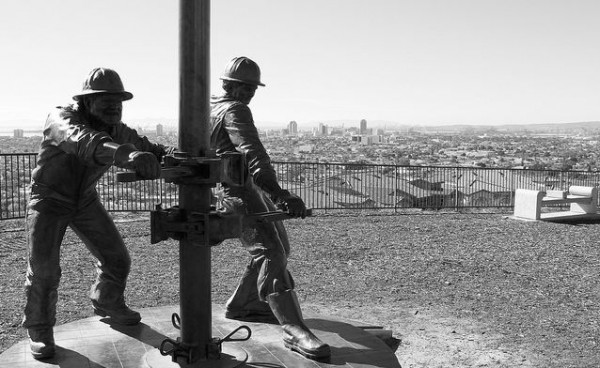
Visitors to the area can see “wonderful commemorative art displays of this era throughout the lush parks and walkways of Signal Hill,” reported the Long Beach Beachcomber. Dedicated on September 30, 2006, the statue “Tribute to the Roughnecks” can be found on Skyline Drive. 

Statue of oil workers on Signal Hill, California.

Cindy Jackson ‘s “Tribute to the Roughnecks” atop Signal Hill with Long Beach is in the distance. Signal Hill Petroleum Chairman Jerry Barto and Shell Oil employee Bruce Kerr were models.

The first California oil wells were drilled near oil seeps in the northern part of the state around the time of the Civil War. These Pico Canyon wells produced limited amounts of crude oil, but there was no market for the oil. Larger oilfields would be revealed in the early 1890s about 35 miles to the south. 

Earlier explorers noted evidence of California’s petroleum fields by the large number of oil seeps, both onshore and offshore. California’s first commercial oil well in 1876 was drilled in Pica Canyon, well known for its asphalt seeps. 

Between 1913 and 1923 Hollywood used the derricks on Signal Hill in movies starring Buster Keaton and Fatty Arbuckle. In 1957, what many consider the world’s first “all jazz” radio station, KNOB (now KLAX), first transmitted from a small studio on top of the historic oil hill.

_______________________

Recommended Reading:  Signal Hill, California, Images of America (2006); Huntington Beach, California, Postcard History Series (2009); Black Gold in California: The Story of California Petroleum Industry (2016). Your Amazon purchase benefits the American Oil & Gas Historical Society. As an Amazon Associate, AOGHS earns a commission from qualifying purchases.

_______________________

The American Oil & Gas Historical Society (AOGHS) preserves U.S. petroleum history. Support this energy education website, subscribe to our monthly email newsletter, and help expand historical research. Contact bawells@aoghs.org. Copyright © 2026 Bruce A. Wells. 

Citation Information – Article Title: “Signal Hill Oil Boom.” Authors: B.A. Wells and K.L. Wells. Website Name: American Oil & Gas Historical Society. URL: https://aoghs.org/petroleum-pioneers/signal-hill-oil/. Last Updated: June 20, 2026. Original Published Date: April 29, 2013.

Pin It on Pinterest

Share This