This Week in Petroleum History: June 8 – 14
June 8, 1969 – First LNG Export from Alaska –
Richfield Oil Company, predecessor of ARCO, exported liquefied natural gas to Japan from the Kenai Peninsula, where Richfield discovered the Swanson River oilfield in July 1957 (see First Alaska Oil Wells). Until it stopped exporting in 2015, the Kenai Peninsula plant was the longest, continuously operating LNG terminal in the world.
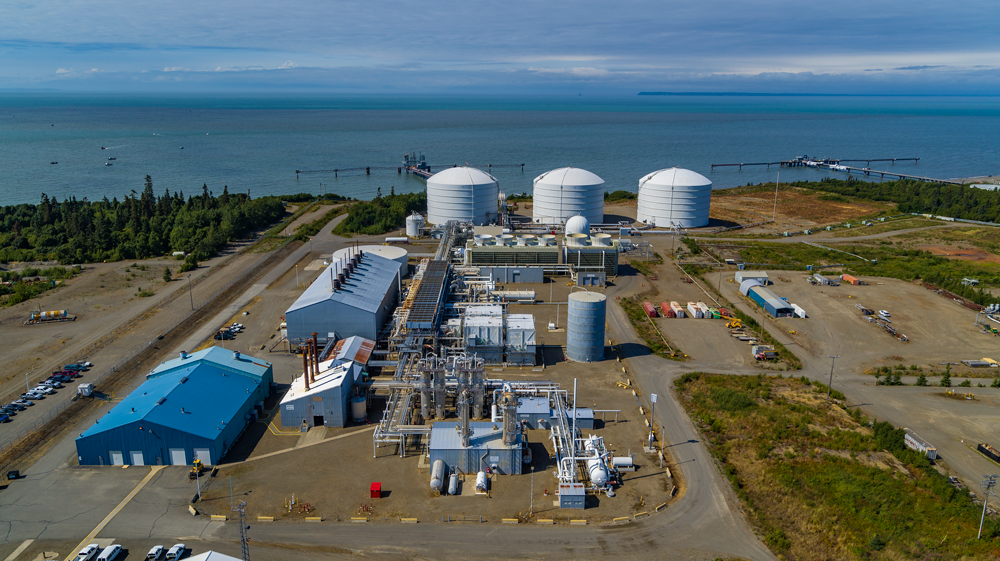
Marathon Petroleum mothballed the Kenai Peninsula plant in 2017 because of a lack of LNG buyers.
When ARCO was acquired by BP in 2000, federal antitrust concerns led to the sale of the Kenai Peninsula LNG plant to Phillips Petroleum (ConocoPhillips), which in 2017 mothballed the facility after failing to find LNG buyers, according to Global Energy Monitor (GEM). Marathon Petroleum acquired the Kenai LNG plant one year later.
Although the Federal Energy Regulatory Commission in 2020 approved modifying the facility to import LNG, Houston-based Harvest Midstream and Marathon in 2025 agreed to reconvert the facility to an LNG export terminal by December 2028. The ARCO brand remains the property of Marathon Petroleum.
June 9, 1894 – Water Well finds Oil in Corsicana, Texas
A contractor hired by the town of Corsicana to drill a water well on 12th Street found oil instead, launching the Texas petroleum industry seven years before the more famous Spindletop Hill gusher hundreds of miles to the southeast. Corsicana’s well produced just 2.5 barrels of oil a day from a depth of 1,035 feet but inspired a rush of exploration companies.
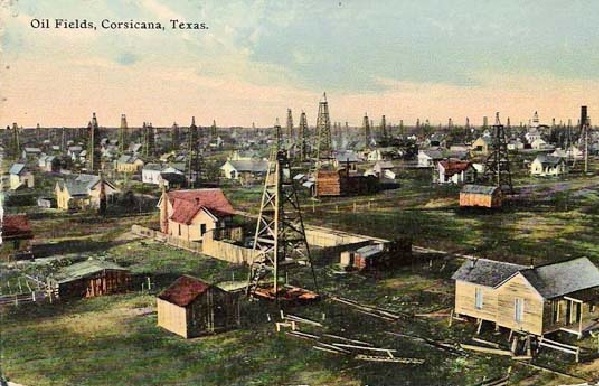
A colorized postcard depicts the Corsicana oilfield circa 1910. The boom town, which became an oilfield service and manufacturing center, today annually celebrates its oil patch heritage.
By 1898, about 300 produced oil in and around the boom town, which also became a center for technological innovation. A Corsicana company patented and manufactured the rotary rig that drilled the 1901 Spindletop discovery well near Beaumont.
Despite Corsicana’s oilfield discovery well bringing petroleum riches and a drilling boom, city officials paid the contractor only half of the $1,000 fee, citing the agreement for completing a water well. Corsicana has hosted an annual Derrick Days since 1976.
Learn more in First Texas Oil Boom.
June 9, 2023 — California Pump Jack added to Historic Register
An eccentric-wheel oilfield pumping unit that operated in California’s largest oilfield joined the National Register of Historic Places, thanks to research by Mark Smith, who submitted the application. Installed by the Engineers Oil Company in 1913, the Kern County jack plant’s eccentric wheels pumped oil until 1990.
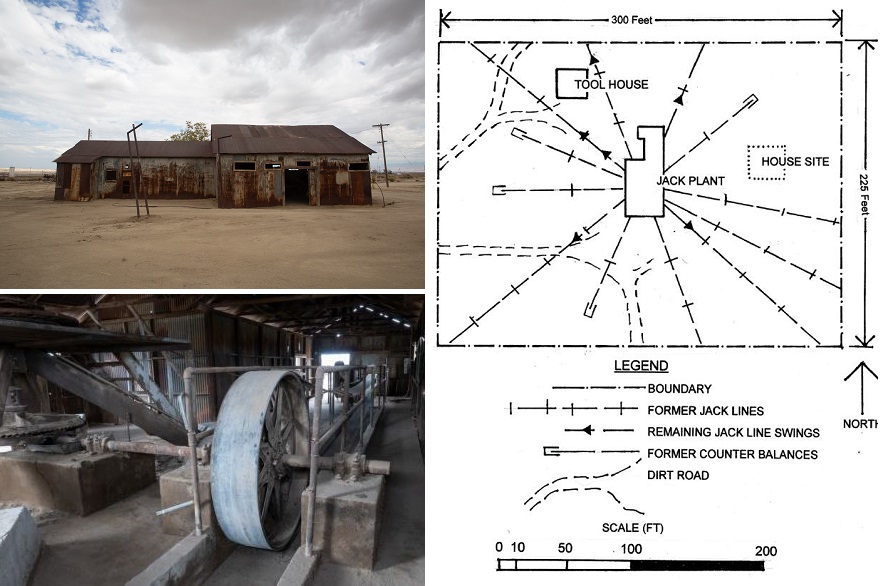
In operation until 1990, California’s Midway-Sunset Jack Plant used eccentric-wheel technologies from the late 19th century. The Kern County plant pumped more than 1.5 million barrels of oil. Photos courtesy John Harte. Illustration courtesy San Joaquin Geological Society.
“The Midway-Sunset Jack Plant is an extremely rare example of central power and ‘jack-line’ oil pumping technology on its original site and housed in its original building,” Smith noted in his 45-page draft application to the State Historical Resources Commission and later approved by the National Park Service. “Its design and operational history reflect significant advancements in oil extraction technology.”

June 11, 1816 – Manufactured Gas lights Art Museum in Baltimore
The first commercial gas lighting of residences, streets and businesses began when Rembrandt Peale impressed Baltimore civic leaders by illuminating a room in his Holliday Street Museum by burning “manufactured gas.” His display (using gas distilled from coal, tar or wood) dazzled them with a “ring beset with gems of light.”
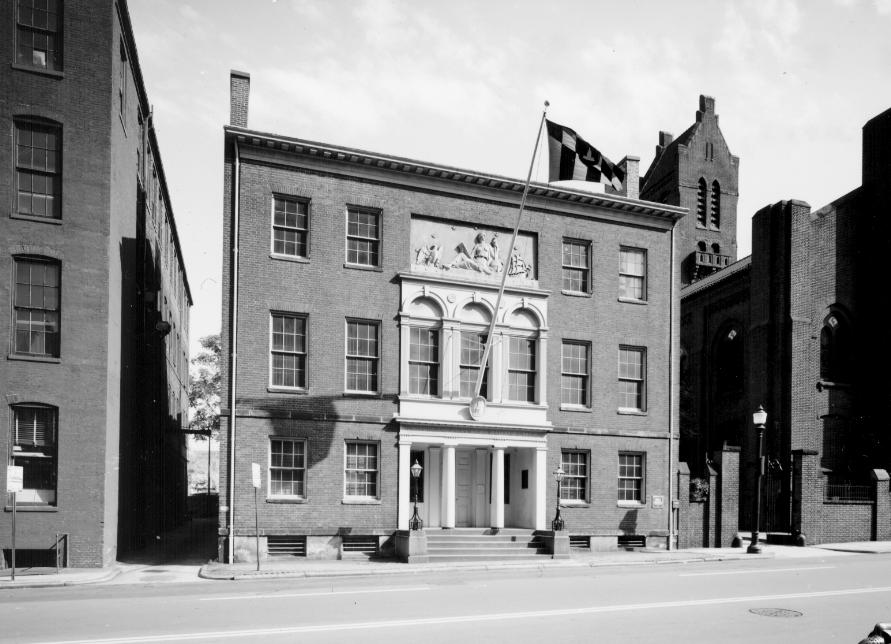
Lighted with manufactured gas, this Baltimore museum opened in 1814, America’s first building erected as a museum. Photo courtesy Maryland Historical Trust.
The Baltimore museum became the first U.S. public building to use gas lighting, according to the Maryland Historical Trust. Within a week, the city council approved plans to illuminate the city’s streets. Peale and a group of investors founded the Gas Light Company of Baltimore — the first gas company in America (today Baltimore Gas and Electric).
Learn more about “town gas” in Illuminating Gaslight.
June 11, 1911 – E.W. Marland discovers Ponca Nation Oilfield
Ernest W. Marland, founder of the 101 Ranch Oil Company in 1908, discovered an oilfield near Ponca City, Oklahoma, after reorganizing the company in his hometown of Pittsburgh, Pennsylvania. Almost broke after drilling eight uneconomical wells, Marland had turned to childhood friend John McCaskey of Pittsburgh, known as the “Sauerkraut King.”
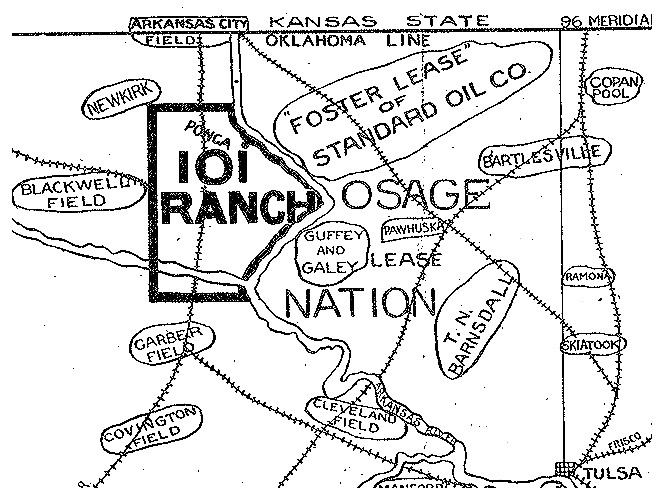
Circa 1910 newspaper promotion of the 101 Ranch Oil Company following discoveries near Ponca (City), west of Osage Nation leases and oilfields.
Partnered with McCaskey and the owners of the 101 Ranch, Marland received permission from White Eagle, chief of the Ponca Nation, to drill near a reservation burial ground. The oilfield discovery well and many that followed produced oil on a reservation allotment owned by Willie-Cries-For-War, age 19, who had leased his 160 acres to Marland for $1,000 a year and 12.5 cents per barrel of oil produced.
Marland would found Marland Oil Company in 1917, merge it with Continental Oil in 1928, and become governor of Oklahoma in 1935. ConocoPhillips opened a Conoco Museum in Ponca City in 2007.
June 11, 1929 – Independent Producers get Organized
Ninety-five years ago, Wirt Franklin of Ardmore, Oklahoma, spoke on behalf of small exploration and production companies during President Herbert Hoover’s Oil Conservation Conference at the Broadmoor Hotel in Colorado Springs, Colorado. Franklin and other independent producers opposed creating a federal commission that could restrict production and allow more imported foreign oil.
“If this condition should be brought about, it would mean the annihilation and destruction of the small producer of crude oil, ” proclaimed Franklin, who had found success in the shallow but prolific Healdton oilfield. Before returning to Ardmore, Franklin and other independents established today’s Washington, D.C.-based Independent Petroleum Association of America (IPAA).
June 12, 1879 – Allegheny Oilfield discovered by O.P. Taylor
Orville “O.P.” Taylor completed the Triangle No. 1 well at a depth of 1,177 feet in Allegheny County, New York, revealing an oilfield that extended into Pennsylvania. His discovery came after two failed wells were drilled near oil seeps first reported by a French missionary in 1627. The Allegheny oilfield drilling boom created the town of Petrolia.
The Confederate Army veteran had worked in the cigar manufacturing business in Virginia before catching “oil fever” after reading of oil discoveries along the Allegheny River (see Derricks of Triumph Hill). Early success led to his election as mayor of Wellsville, New York, and the title of “Father of the Allegheny Oilfield.” A Liberty Ship would be named for him during World War II.
June 13, 1917 – Phillips Petroleum Company founded
During the early months of America’s entry into World War I, as oil prices rose above $1 per barrel, Phillips Petroleum Company was founded in Bartlesville, Oklahoma. Brothers Frank and Lee Eldas “L.E.” Phillips consolidated their oil companies and began operating throughout Oklahoma and Kansas. Assets rose from $3 million to $100 million within a few years.
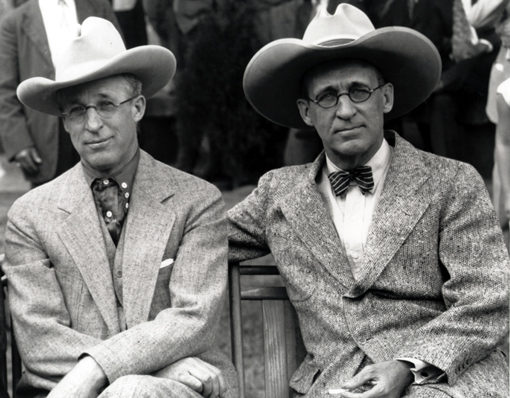
Brothers L.E. Phillips (left) and Frank Phillips established Phillips Petroleum Company in Bartlesville in 1917. Photo courtesy ConocoPhillips.
In 1927, Phillips Petroleum began selling its gasoline in Wichita, Kansas, the first of more than 10,000 Phillips 66 service stations. Phillips chemists received thousands of U.S. patents, including one in 1954 for Marlex, a high-density polyethylene. The Wham-O toy company was the first to buy the new plastic (see Petroleum Product Hoopla). The oil company’s high-octane Nu-Aviation fuel played an important role in winning World War II.
Phillips Petroleum merged with Conoco in 2002 to become ConocoPhillips, which in 2007 established petroleum museums in Ponca City and Bartlesville as part of the 100th anniversary of Oklahoma statehood.
June 13, 1928 – Hobbs Oilfield discovered in New Mexico
The modern New Mexico petroleum industry began with the discovery of the Hobbs oilfield near the southeastern corner of the state. After months of difficult cable-tool drilling, the Midwest State No. 1 well produced oil for the Midwest Refining Company, which had drilled the state’s first oil well in 1922.
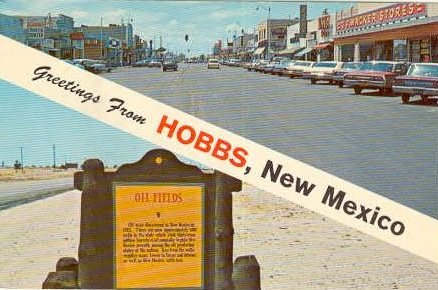
A June 1928 oilfield discovery brought many decades of petroleum prosperity to downtown Hobbs, New Mexico.
The Hobbs well revealed a giant oilfield, later described by the New Mexico Bureau of Mines & Mineral Resources as “the most important single discovery of oil in New Mexico’s history.” But after months of drilling, the well had reached a depth of 1,500 feet when an engine house fire consumed the wooden derrick. “Men with less vision would have given up, but not the drillers of Midwest,” noted the state geologist.
As the Great Depression approached, oil production from the Hobbs field attracted investors and drilling companies, quickly transforming Hobbs from “sand, mesquite, bear grass and jackrabbits” to the fastest-growing town in the nation.
Learn more in First New Mexico Oil Wells.
June 14, 1865 – First Daily Oil Region Newspaper
Pennsylvania’s oil region got its first daily newspaper when brothers William and Henry Bloss published a four-page broadsheet, the Titusville Herald, which soon exceeded a circulation of 300. The first edition’s articles included a reference to visits to the oil region by John Wilkes Booth to look into his oil interests.

The “First Daily Newspaper in the Pennsylvania Oil Region” noted John Wilkes Booth’s petroleum interests.
“John Wilkes Booth purchased a one-thirteenth interest in the territory in August 1864,” the newspaper reported. “We are credibly informed that this Homestead well (see Dramatic Oil Company) in which Booth was interested was destroyed by fire on the day he assassinated President Lincoln.”
June 14, 1938 – United States regulates Natural Gas
The federal government for the first time assumed regulatory control of U.S. natural gas sales to limit the growing market power of interstate pipeline companies.
Although the Natural Gas Act of 1938 did not apply to production, gathering or local distribution, it sought to establish “just and reasonable rates” for pipeline company transmission or sales of natural gas in interstate commerce. Regulatory functions were assigned to the Federal Power Commission (established in 1920), which became the Federal Energy Regulatory Commission (FERC) in 1977.
_______________________
Recommended Reading: The Extraction State, A History of Natural Gas in America (2021); Corsicana (2010); Texas Oil and Gas Postcard History (2013); Black Gold in California: The Story of California Petroleum Industry 


_______________________
The American Oil & Gas Historical Society (AOGHS) preserves U.S. petroleum history. Support this energy education website, our monthly email newsletter, This Week in Oil and Gas History News, and help expand historical research. Contact bawells@aoghs.org. Copyright © 2026 Bruce A. Wells. All rights reserved.