Nylon, a Petroleum Polymer

A Revolutionary DuPont lab product first used commercially in 1938 for toothbrush bristles.


The world’s first synthetic fiber was the petroleum product “Nylon 6,” discovered in 1935 by a DuPont chemist who produced the polymer from chemicals found in oil.

DuPont Corporation foresaw the future of “strong as steel” artificial fibers. The chemical conglomerate had been founded in 1802 as a Wilmington, Delaware, manufacturer of gunpowder. The company would become a global giant after its scientists created durable and versatile products like nylon, rayon, and lucite.
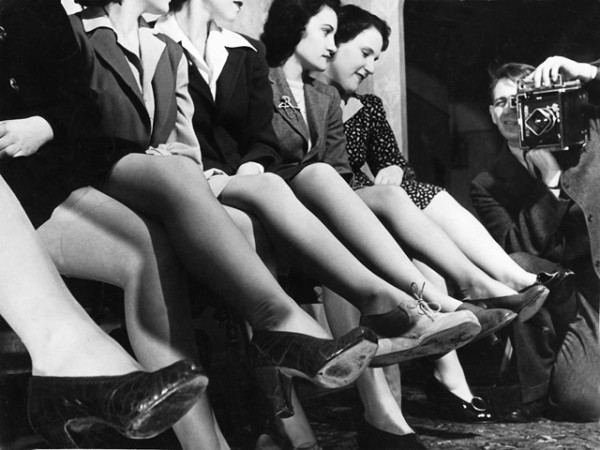
A row of women show off their stockings made of the petroleum product nylon.

“Women show off their nylon pantyhose to a newspaper photographer, circa 1942,” noted Jennifer S. Li in “The Story of Nylon – From a Depressed Scientist to Essential Swimwear.” Photo by R. Dale Rooks.

The world’s first synthetic fiber — nylon — was discovered on February 28, 1935, by a former Harvard professor working at a DuPont research laboratory. Called Nylon 6 by scientists, the revolutionary carbon-based product came from chemicals found in petroleum.

Man-made fiber Nylon 6 illustration of its six carbon atoms per molecule.

Chemists named the fiber Nylon 6 because chains of adipic acid and hexamethylene diamine each contained six carbon atoms per molecule.

Professor Wallace Carothers had experimented with artificial materials for more than six years. He previously discovered neoprene rubber (commonly used in wetsuits) and made major contributions to understanding polymers — large molecules composed of long chains of repeating chemical structures.

Polymer Chains

Carothers, 32, created fibers when he combined the chemicals amine, hexamethylene diamine, and adipic acid. His experiments formed polymer chains using a process in which individual molecules joined together with water as a byproduct. But the fibers were weak.

A PBS series, A Science Odyssey: People and Discoveries, in 1998 noted Carothers’ breakthrough came when he realized, “the water produced by the reaction was dropping back into the mixture and getting in the way of more polymers forming. He adjusted his equipment so that the water was distilled and removed from the system. It worked!”

Subscribe to Our Free Newsletter link.

DuPont named the petroleum product nylon — although chemists called it Nylon 6 because the adipic acid and hexamethylene diamine each contain six carbon atoms per molecule.
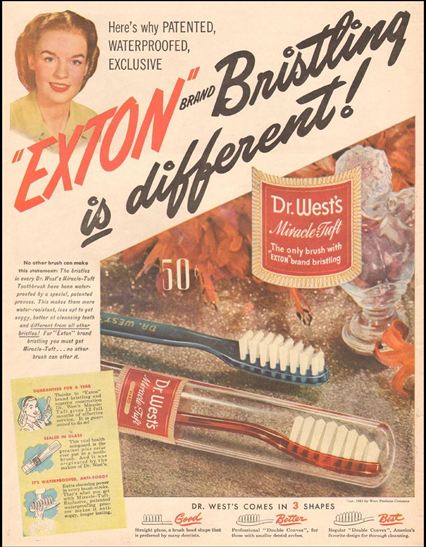
1938 ad for petroleum product nylon bristles on toothbrushes.

“Until now, all good toothbrushes were made with animal bristles,” noted a 1938 magazine ad.

Each man-made molecule consists of 100 or more repeating units of carbon, hydrogen, and oxygen atoms, strung in a chain. A single filament of nylon may have a million or more molecules, each taking some of the strain when the filament is stretched.

There’s disagreement about how the product name originated at DuPont.

“As to the word ‘nylon,’ it’s actually quite arbitrary. DuPont itself has stated that originally the name was intended to be No-Run (that’s run as in the sense of the compound chain of the substance unraveling), but at the time there was no real justification for the claim, so it needed to be changed,” noted Chris Nickson in a 2017 website post, Where Does the Name Nylon Originate?

Toothbrush Bristles

The first commercial use of this revolutionary petroleum product was for toothbrushes.

On February 24, 1938, the Weco Products Company of Chicago, Illinois, began selling its new “Dr. West’s Miracle-Tuft” — the earliest toothbrush to use synthetic DuPont nylon bristles.
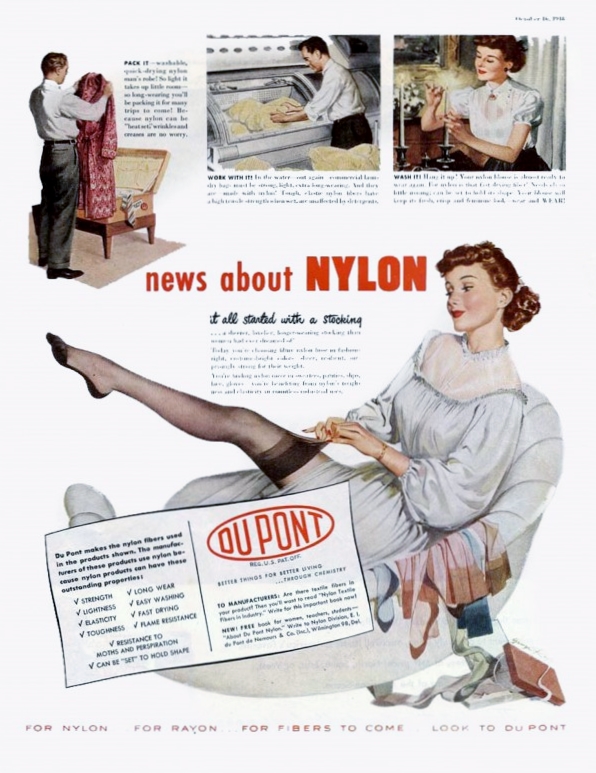
Petroleum product nylon used for women's stockings in a DuPont 1948 ad.

First used for toothbrush bristles, nylon women’s stockings were widely promoted by DuPont in 1948.

Americans will soon brush their teeth with nylon — instead of hog bristles, declared an article in the New York Times. “Until now, all good toothbrushes were made with animal bristles,” explained a 1938 Weco Products advertisement in Life magazine.

“Today, Dr. West’s new Miracle-Tuft is a single exception,” the ad proclaimed. “It is made with EXTON, a unique bristle-like filament developed by the great DuPont laboratories and produced exclusively for Dr. West’s.”

Support the American Oil & Gas Historical Society

Pricing its toothbrush at 50 cents, the Weco Products Company guaranteed “no bristle shedding.” Johnson & Johnson of New Brunswick, New Jersey, will introduce a competing nylon-bristle toothbrush in 1939.

Nylon Stockings

Although DuPont patented nylon in 1935, it was not officially announced to the public until October 27, 1938, in New York City.

A DuPont vice president unveiled the synthetic fiber — not to a scientific society or industry association — but to 3,000 Women’s Club members gathered at the site of the upcoming 1939 New York World’s Fair.
During WWII, Nylon was used as a substitute for silk in parachutes.

During WWII, nylon was used as a substitute for silk in parachutes.

“He spoke in a session entitled ‘We Enter the World of Tomorrow,’ which was keyed to the theme of the forthcoming fair, the World of Tomorrow,” explained DuPont historian David A. Hounshell in a 1988 book.

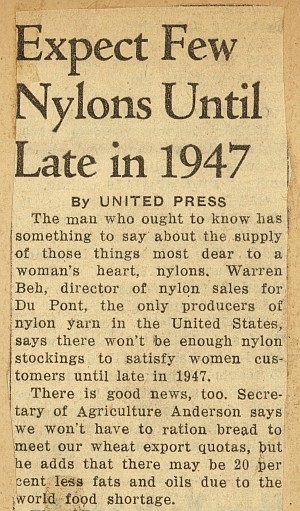
The petroleum product was an instant hit, especially as a replacement for silk in hosiery. DuPont built a full-scale nylon plant in Seaford, Delaware, and began commercial production in late 1939. The company purposefully did not register “nylon” as a trademark — choosing to allow the word to enter the American vocabulary as a synonym for “stockings.”

Women’s nylon stockings appeared for the first time at Gimbels Department Store on May 15, 1940. World War II would remove the polymer hosiery from stores since it was needed for parachutes and other vital supplies.

Petroleum history is important. Support link for AOGHS.

Nylon would become far and away the biggest money-maker in the history of DuPont. The powerful material from lab research led company executives to derive formulas for growth, according to Hounshell in The Nylon Drama.

“By putting more money into fundamental research, DuPont would discover and develop ‘new nylons,’ that is, new proprietary products sold to industrial customers and having the growth potential of nylon,” Hounshell explained in his 1988 book.

Carothers did not live to see the widespread application of his work — in consumer goods such as toothbrushes, fishing lines, luggage, and lingerie, or in special uses such as surgical thread, parachutes, or pipes — nor the powerful effect it had in launching a whole era of synthetics.

Devastated by the sudden death of his favorite sister in early 1937, Wallace Carothers committed suicide in April of that year. The DuPont Company would name its research facility after him.

The DuPont website notes that the invention of nylon changed the way people dressed worldwide and made the term ‘silk stocking’ obsolete (once an epithet directed at the wealthy elite). Nylon’s success encouraged DuPont and other companies to adopt long-term strategies for products developed from research.

_______________________

Recommended Reading: The Golden Thread: How Fabric Changed History (2019); Enough for One Lifetime: Wallace Carothers, Inventor of Nylon (2005); The Nylon Drama (1988). Your Amazon purchases benefit the American Oil & Gas Historical Society; as an Amazon Associate, AOGHS earns a commission from qualifying purchases.

_______________________

The American Oil & Gas Historical Society (AOGHS) preserves U.S. petroleum history. Please support AOGHS to help maintain this energy education website, a monthly email newsletter, This Week in Oil and Gas History News, and expand historical research. Contact bawells@aoghs.org. Copyright © 2026 Bruce A. Wells.

Citation Information – Article Title: “Nylon, a Petroleum Polymer.” Authors: B.A. Wells and K.L. Wells. Website Name: American Oil & Gas Historical Society. URL: https://aoghs.org/products/petroleum-product-nylon-fiber. Last Updated: February 19, 2026. Original Published Date: February 23, 2014.
View Post


Pawnee Bill Oil Company

Like his friend “Buffalo Bill,” Oklahoma showman Maj. Gordon W. “Pawnee Bill” Lillie caught oil fever.


With America joining “the war to end all wars” in Europe and oil demand rising, a popular Oklahoma showman launched his own petroleum exploration and refining company.

Although not as well known as his friend Col. William F. “Buffalo Bill” Cody of Wyoming, Maj. Gordon William “Pawnee Bill” Lillie was “a showman, a teacher, and friend of the Indian,” according to his biographer.

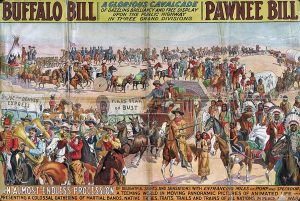
Pawnee Bill and Buffalo Bill combined western show poster circa 1910

Col. William F. “Buffalo Bill” Cody and Maj. Gordon William “Pawnee Bill” Lillie combined their shows from 1908 to 1913 as “Buffalo Bill’s Wild West and Pawnee Bill’s Great Far East.”

Maj. Lillie was admired for being a “colonizer in Oklahoma and builder of his state,” noted Stillwater journalist Glenn Shirley in his 1958 book Pawnee Bill: A Biography of Major Gordon W. Lillie.

The two entertainers joined their shows in 1908 to form “Buffalo Bill’s Wild West and Pawnee Bill’s Great Far East,” promoted as “a glorious cavalcade of dazzling brilliancy,” noted Shirley, adding that the combined shows offered “an almost endless procession of delightful sight and sensations.”

But times were changing as public taste turned to a new form of entertainment, motion picture shows. By 1913, the two showmen’s partnership was over, and their western cavalcade was foreclosed. Lillie turned to other ventures — real estate, banking, ranching, and like his former partner, the petroleum industry (see Buffalo Bill Shoshone Oil Company).

Petroleum history is important. Support link for AOGHS.

Oklahoma oilfield discoveries near Yale (population of only 685 in 1913) had created a drilling boom that made it home to 20 oil companies and 14 refineries. In 1916, Petrol Refining Company added a 1,000-barrel-a-day-capacity plant in Yale, about 25 miles south of Lillie’s ranch.

The trade magazine Petroleum Age, which had covered the 1917  “Roaring Ranger” oilfield discovery in Texas, reported that for Pawnee Bill, “the lure of the oil game was too strong to overcome.” 

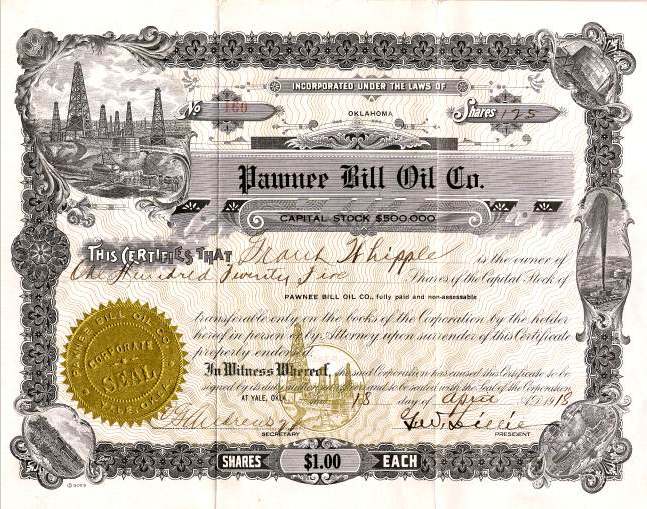
Pawnee Bill Oil Company 1918 stock certificate.

Obsolete financial stock certificates with interesting histories, like Pawnee Bill Oil Company are valued by collectors.

The Oklahoma showman founded the Pawnee Bill Oil Company on February 25, 1918, and bought Petrol Refining’s new “skimming” refinery in March.

An early type of refining, skimming (or topping) removed light oils, gasoline, and kerosene and left a residual oil that could also be sold as a basic fuel. To meet the growing demand for kerosene lamp fuel, early refineries built west of the Mississippi River often used the inefficient but simple process.

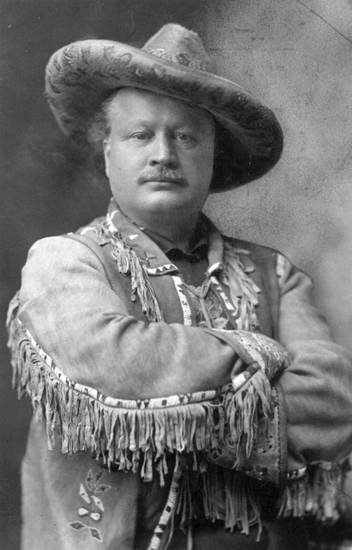
Portrait of Maj. Gordon W. "Pawnee Bill" Lillie in buckskins.

Maj. Gordon William “Pawnee Bill” Lillie (1860-1942).

Lillie’s company became known as Pawnee Bill Oil & Refining and contracted with the Twin State Oil Company for oil from nearby leases in Payne County.

Support the American Oil & Gas Historical Society

Under headlines like “Pawnee Bill In Oil” and “Hero of Frontier Days Tries the Biggest Game in All the World,” the Petroleum Age proclaimed:

“Pawnee Bill, sole survivor of that heroic band of men who spread the romance of the frontier days over the world…who used to scout on the ragged edge of semi-savage civilization, is doing his bit to supply Uncle Sam and his allies with the stuff that enables armies to save civilization.”

Post-War Refinery Bust

By July 30, 1919, Pawnee Bill Oil (and Refining) Company had leased 25 railroad tank cars, each with a capacity of about 8,300 gallons. But the end of “the war to end all wars” drastically reduced demand for oil and refined petroleum products. Just two years later, Oklahoma refineries were operating at about 50 percent capacity, with 39 plants shut down.

Although Lillie’s refinery was among those closed, he did not give up. In February 1921, he incorporated the Buffalo Refining Company and took over the Yale refinery’s operations. He was president and treasurer of the new company. But by June 1922, the Yale refinery was making daily runs of 700 barrels of oil, about half its skimming capacity.

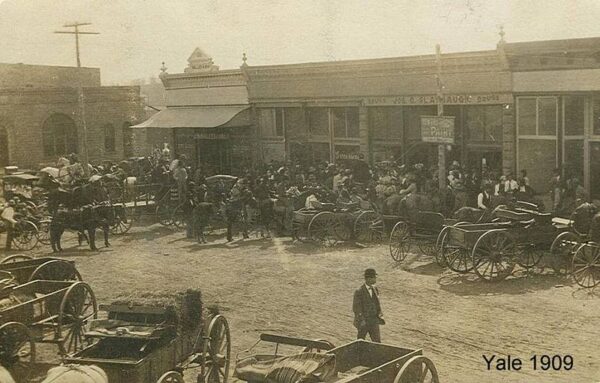
Yale Oklahoma downtown scene during Pawnee Bill Oil company days

The Pawnee Bill Oil Company held its annual stockholders meetings in Yale, Oklahoma, an oil boom town about 20 miles from Pawnee Bill’s ranch.

“At the annual stockholders’ meeting held at the offices of the Pawnee Bill Oil Company in Yale, Oklahoma, in April, it was voted to declare an eight percent dividend,” reported the Wichita Daily Eagle. “The officers and directors have been highly complimented for their judicious and able handling of the affairs of the company through the strenuous times the oil industry has passed through since the Armistice was signed.” 

Subscribe to Our Free Newsletter link.

The Kansas newspaper added that although many independent refineries had been sold at receivers’ sale, “the financial condition of the Pawnee Bill company is in fine shape.” 

Wild West Oil Ventures

What happened next has been hard to determine since financial records of the Pawnee Bill Oil Company are rare. A 1918 stock certificate signed by Lillie, valued by collectors one hundred years later, could be found selling online for about $2,500.

Maj. Gordon William “Pawnee Bill” Lillie’s friend and partner Col. William F. “Buffalo Bill” Cody also had caught oil fever, forming several Wyoming oil exploration ventures, but none of them lasted. In 1920, yet another legend of the Old West — lawman and gambler Wyatt Earp — began his a search for oil riches on a piece of California scrubland. One century later, his Kern County lease still paid royalties; learn more in Wyatt Earp’s California Oil Wells.

_______________________

Recommended Reading: Pawnee Bill: A Biography of Major Gordon W. Lillie (1958). Your Amazon purchases benefit the American Oil & Gas Historical Society. As an Amazon Associate, AOGHS earns a commission from qualifying purchases.

_______________________

The American Oil & Gas Historical Society (AOGHS) preserves U.S. petroleum history. Please support AOGHS to help maintain this energy education website, a monthly email newsletter, This Week in Oil and Gas History News, and expand historical research. Contact bawells@aoghs.org. Copyright © 2026 Bruce A. Wells.

Citation Information – Article Title: “Pawnee Bill Oil Company.” Authors: B.A. Wells and K.L. Wells. Website Name: American Oil & Gas Historical Society. URL: https://aoghs.org/stocks/pawnee-bill-oil-company. Last Updated: February 21, 2026. Original Published Date: February 24, 2017.

Halliburton cements Wells

Inventing technologies for protecting oil and natural gas wells and the environment.


Erle P. Halliburton in March 1921 received a U.S. patent for his improved method for cementing oil wells, helping to bring greater production and environmental safety to America’s burgeoning oilfields.

When Halliburton patented his “Method and Means for Cementing Oil Wells,” the 29-year-old inventor changed how oil and natural gas wells were completed. His contribution to oilfield production technology was just beginning. (more…)

First Alabama Oil Well

Reports of a “mineral tar” from the 1840s helped H.L. Hunt discover an oilfield a century later.


Swallowing “tar pills” supposedly had been curing ills since the mid-1800s, but Alabama’s petroleum industry officially began in 1944 with a Choctaw County well drilled by a Texas wildcatter. On February 17, independent producer Haroldson Lafayette “H.L.” Hunt completed his Jackson No. 1 well after discovering Alabama’s first oilfield. (more…)

“Smokesax” Art has Pipeline Heart

Artist Bob “Daddy-O” Wade used petroleum pipelines to create a Texas landmark.


More than 2.5 million miles of oil and natural gas pipelines crisscross the United States. In 1993, an offbeat Texas sculptor repurposed about 70 feet to create a work of art.

Many Texas travelers at some point have witnessed the monumental sculptures of Bob “Daddy-O” Wade, known for “keeping it weird” since he made the scene in Austin in 1961. Decades of giant artworks by “Daddy-O” have reflected his unusual Texas sense of scale. (more…)

Pin It on Pinterest