by Bruce Wells | Jun 27, 2024 | Energy Education Resources
Discoveries in the 1920s led to a giant oilfield in 1957.
A 1961 Clare County historical marker explains Michigan petroleum history began in 1886, but that Michigan State Geologist Alexander Winchell had reported that oil and natural gas deposits lay under Michigan’s surface as early as 1860.
“First commercial oil production was at Port Huron, where 22 wells were drilled, beginning in 1886,” the marker notes. “Total output was small. Michigan’s first oil boom was at Saginaw, where production began about 1925. About three hundred wells were drilled here by 1927, when Muskegon’s ‘Discovery Well’ drew oil men from all over the country to that field.”
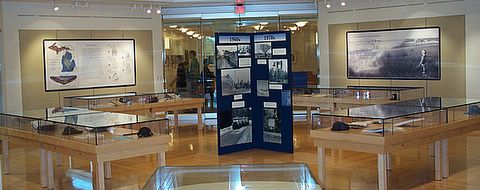
“Michigan Oil & Gas History,” a 2005 Clarke Historical Library exhibit at Central Michigan University, Mount Pleasant. Photo by Kristin L. Wells.
The Clare County historical marker notes that the Mt. Pleasant field, discovered in 1928, “helped make Michigan one of the leading oil producers of the eastern United States. Mount Pleasant became known as the “Oil Capital of Michigan.”
Central Michigan University Oil Exhibit
In the summer of 2005, a special petroleum exhibit opened at Central Michigan University’s (CMU) Clarke Historical Library, Mount Pleasant.

“They work hard, take risks, prosper, and by and large benefit everybody,” noted Frank Boles, director of the Clarke Historical Library, about oil and natural gas producers. “What I didn’t understand about the industry is that these people all know each other.”
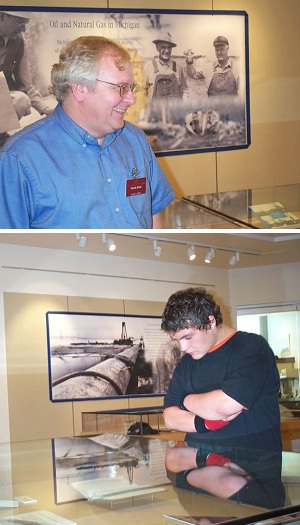
Frank Boles (top), director of the Clarke Historical Library, designed an exhibit creatively combining documents and photographs to capture the attention of students. Photos by Kristin L. Wells.
The library told their story with an “Oil and Natural Gas in Michigan” exhibit.
The state’s abundant oil production comes as a surprise to many, said Boles, who put the exhibit together with the cooperation of the Michigan Oil & Gas Association and the Michigan Oil & Gas Producers Educational Foundation.
Jack Westbrook, retired managing editor of Michigan Oil & Gas News magazine, marshaled the resources and worked tirelessly to ensure success, Boles said. “In a very real sense, there would be no exhibit if it were not for Jack.”
The exhibit was designed to designed to pique a visitor’s curiosity – and be transportable. The region’s students learned that Mount Pleasant, home to CMU, had its own oil boom in 1928 and today is known as the historical center of Michigan’s oil industry.
Exhibit visitors learned that more than 57,000 oil and gas wells had been drilled in their state since 1925 — and that Michigan ranks 17th in nationwide oil production and 11th in natural gas. More surprises awaited those students who looked more closely, Boles said.
“We’re about usage,” he explained. “Our profit is people coming in, using our resources, and hopefully learning something. We want our exhibits to prompt them to dig deeper.”
Golden Gulch of Oil
Clarke Historical Library visitors learned about late 1920s oil discoveries and that after decades of dry holes or small oil finds, a January 7, 1957, Houseknecht No. 1 well revealed Michigan’s largest oilfield, 29-miles-long. Ferne Houseknecht had convinced her uncle, Clifford Perry, to take time between his other farm projects to drill the historic well.
Learn more in Michigan’s Golden Gulch of Oil.
For the Clarke Historical Library exhibit, Boles used six walls and eleven cabinets to tell this and other stories, so careful planning was essential. He said that from the project’s outset, pursuit of community support, resources, and partners was essential.
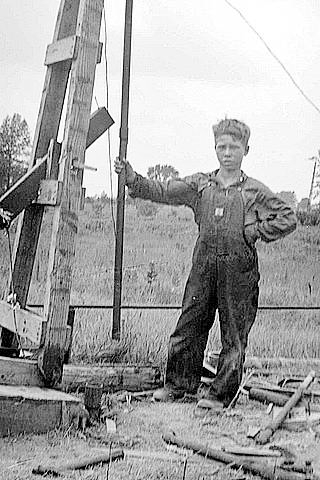
Showing off his homemade cable tool rig in 1932, Earl “Red” Perry Jr., 12, was the nephew of Cliff Perry — who would discover Michigan’s largest oilfield in 1957. Photo courtesy Clarke Historical Library, Central Michigan University.
The exhibit began with storyboarding and the interactive process of writing and rewriting proposed text. Large photo formats with understandable text dominated the walls, while display cases featured unique artifacts and documents.
Visitors discovered a rich oil history and learned of the complex environmental issues Michigan has successfully addressed.
The 1970s “Pigeon River State Forest” ecological controversy was presented — along with its innovative solution. In 1976, Michigan became the first state in the nation to earmark state revenue generated through mineral, including oil and gas, activity for acquisition and improvement of environmentally sensitive or public recreation lands.
According to Jack Westbrook, all 83 Michigan counties have benefited from the fund’s $635 million collected from oil and gas revenues — and other states followed Michigan’s example. His book, Michigan Natural Resources Trust Fund 1976-2011: A 35 year Michigan investment heritage in Michigan’s public recreation future, can be found on Amazon Books (link below).
Visit the Clarke Historical Library.
_______________________
Recommended Reading: American Oil And Gas History Book: Michigan’s Golden Gulch Of Oil: The Great Depression (2021); At Home in Earlier Mt. Pleasant Michigan: A visit with our neighbors of the past (2021); Michigan Natural Resources Trust Fund 1976-2011: A 35-year Michigan Oil and Gas Industry Investment Heritage in Michigan’s Public Recreation Future (2011); Handbook of Petroleum Refining Processes
 (2016).
_______________________
The American Oil & Gas Historical Society preserves U.S. petroleum history. Become an annual AOGHS annual supporter and help maintain this energy education website and expand historical research. For more information, contact bawells@aoghs.org. Copyright © 2024 Bruce A. Wells. All rights reserved.
Citation Information – Article Title: “Michigan Petroleum History.” Authors: B.A. Wells and K.L. Wells. Website Name: American Oil & Gas Historical Society. URL: https://aoghs.org/energy-education-resources/exhibiting-michigan-petroleum-history. Last Updated: November 12, 2024. Original Published Date: June 19, 2014.
by Bruce Wells | Apr 29, 2024 | Energy Education Resources
Petroleum geologists helped create the Boy Scouts of America geology merit badge in 1953.
The Boy Scouts of America’s geology merit badge began in 1911 as a mining badge — one of less than 30 scouting badges. The mining merit badge in 1937 changed to rocks and minerals before becoming the geology badge in 1953.
The story behind the geology merit badge is best told by a member of the Houston Geological Society (HGS), a resource for potential badge earners.

Petroleum geologists helped inspire the Geology merit badge adopted in 1953.
Petroleum geologist Jeff Spencer, himself an Eagle Scout, has published dozens of petroleum history papers and frequently contributed to Oil-Industry History, the peer-reviewed journal of the Petroleum History Institute (PHI), Oil City, Pennsylvania.
According to Spencer, the original Boy Scouts mining merit badge had several basic requirements, including naming at least 50 minerals; describing the 14 great divisions of the earth’s crust; and defining terms like watershed, delta, drift, fault, glacier, terrace and stratum.
Scouts seeking the mining badge also were asked to identify 10 different kinds of rock and describe methods for mine ventilation and safety devices,
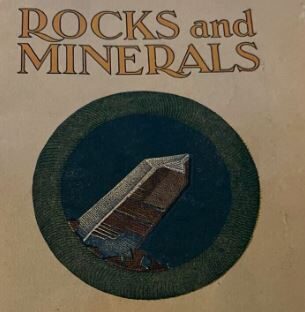
Scouts earned the Rocks & Minerals badge from 1937 until 1953.
The first mention of oil and natural gas appeared in 1927 — the mining badge requirement asked Scouts to “explain how we locate petroleum and natural gas pools, and how we obtain oil and gas,” Spencer notes.
In September 1937, the mining merit badge (a shovel) was replaced with the rocks and minerals badge (a crystal). The first merit badge booklet was published the same year by Daniel O ’Connell, chairman of the department of geology at the City College of New York.
O’Connell’s “Rocks and Minerals” booklet would go through through many revised printings in the next ten years, according to the Geological Society of America (GSA).
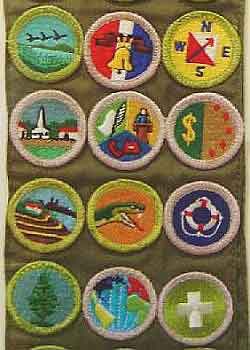
The first 12 merit badges of the Boy Scouts of America, which encourages visits to science museums and geology departments of local universities.
In 2014, thanks in part to the Society for Mining and Metallurgy (SME), the mining merit badge returned as “Mining and Society.”
Petroleum Geologists
In 1945, the American Association of Petroleum Geologists (AAPG) formed a “Committee on Boy Scout Literature” at the urging of industry leaders, including A.C. Bace, a geologist with Stanolind, and George W. Pirtlem, an independent geologist from Tyler, Texas.
Oklahoma geologist Frank Gouin chaired the AAPG committee’s effort to revise the merit badge and its requirements, and the geology badge officially replaced the Rocks and Minerals badge in 1953.
Spencer notes that the 1953 merit badge’s description of what a geologist does said that four out of five geologists become “oil geologists” with an expected starting salary of $300 per month.
“You may have to be a nomad instead of settling down for life in one spot,” the description continued. “You may have to ‘sit on’ a well all night and then drive a hundred miles to report on it. You may have to burn in India, freeze in Alaska, or do both in the Texas Panhandle.”
Although minor revisions of the geology merit badge occurred in 1957, the next major change came in 1982, adding anticlines, synclines, and faults with a requirement to draw simple diagrams showing unconformity, strikes and dips.
The last major revision of the geology badge occurred in 1985, Spencer says, again with the cooperation of AAPG leadership. The badge now has 13 requirements, organized under five categories: earth materials, earth processes, earth history, geology and people, and careers in geology.
- The earth materials section includes the collection and identification of rocks and minerals.
- The earth processes section covers geomorphology, the hydrologic cycle, volcanoes, mountain building, and the ocean floor.
- The earth history section includes the geologic time chart, fossils, and continental drift. The geology and people section covers environmental geology and energy sources with a field trip option in this category.
In addition to its involvement in merit badges, AAPG and its chapters serve the scouting program in many ways, Spencer concludes. The Houston Geological Society has sponsored “Explorer Posts” and worked with the Houston Museum of Natural Science to teach the elements of earning the badge.

OPEC-inspired energy badge.
There now are more than 120 merit badges. The OPEC oil embargo of 1973 — and the need for energy conservation — led to creation of an energy merit badge in 1977.
In 2013, Jeff Spencer published a selection of oil patch post cards via Arcadia Publishing’s postcard history series. Texas Oil and Gas includes more than 200 vintage black-and-white images through decades of oil booms throughout the state.
Chapters reflect the Lone Star State’s petroleum heritage by region, including “Spindletop and the Golden Triangle,” a prolific area in southeast Texas between Beaumont, Port Arthur and Orange (read more about Spencer’s Texas oil postcards).
_______________________
Recommended Reading: Texas Oil and Gas, Postcard History (2013); Trek of the Oil Finders: A History of Exploration for Petroleum (1975); Anomalies: Pioneering Women in Petroleum Geology 1917-2017 (2017). Your Amazon purchase benefits the American Oil & Gas Historical Society. As an Amazon Associate, AOGHS earns a commission from qualifying purchases.
_______________________
The American Oil & Gas Historical Society (AOGHS) preserves U.S. petroleum history. Please become an AOGHS annual supporter and help maintain this energy education website and expand historical research. For more information, contact bawells@aoghs.org. Copyright © 2024 Bruce A. Wells. All rights reserved.
Citation Information: Article Title – “Merit Badge for Geology.” Authors: Aoghs.org Editors. Website Name: American Oil & Gas Historical Society. URL: https://aoghs.org/energy-education-resources/geology-merit-badge. Last Updated: May 1, 2024. Original Published Date: June 1, 2008.
by Bruce Wells | Jun 21, 2023 | AOGHS Newsletter, Energy Education Resources
by Bruce Wells | Jun 6, 2023 | Energy Education Resources
Retired Service station owner preserved U.S. transportation history with Wisconsin Petroleum Museum.
Editor’s Note: After two decades of educating more than 80,000 visitors, in 2024 the Northwoods Petroleum Museum on Highway 45 closed for good, a decision made by its founder, Ed Jacobsen, 80, of Three Lakes, Wisconsin.
Deciding to leave his job as oil company sales rep in the Chicago area, Ed Jacobsen in the late 1960s bought his first service station. More than three decades and six stations later, he retired to his wife’s hometown of Three Lakes, in the Northwoods region of upper Wisconsin. Missing the world of service stations, Jacobson began gathering artifacts to establish a petroleum museum.
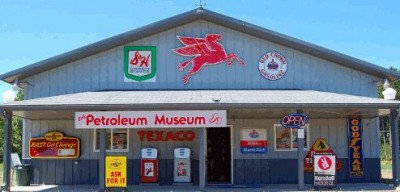
Ed Jacobsen’s expertise — and love for “the world of service stations” — led to the 2006 opening of Wisconsin’s Northwoods Petroleum Museum.
When by 2006 his petroleum-related memorabilia climbed above 2,700 items, Jacobson (and his wife) realized there was a looming storage problem — although he still maintained that technically, he was not a collector.
“Many collectors buy, sell or trade memorabilia to make money,” he says. “I believe in the educational value of these items – and preserving a history many people may have forgotten.” (more…)
by Bruce Wells | Oct 31, 2022 | Energy Education Resources
Fall 2017 gathering of the American Association of Petroleum Geologists in Oklahoma City.
The annual meeting of mid-continent petroleum geologists in Oklahoma City was attended by American Oil & Gas Historical Society Executive Director Bruce Wells, who participated in a day-long field trip to Bartlesville and Frank Phillip’s Woolaroc Ranch. The 2017 chapter meeting included top leadership of the American Association of Petroleum Geologists, founded 100 years earlier.
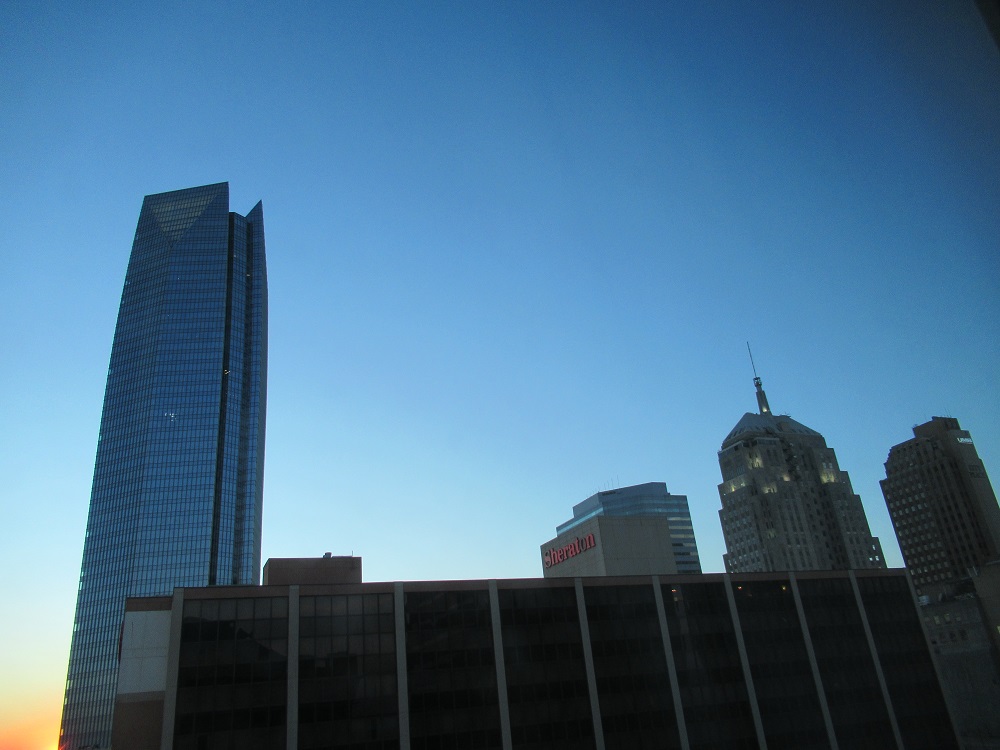
The 2017 AAPG Mid-Continent Section Meeting in downtown Oklahoma City took place near the Devon Energy Center, the company’s 50-story headquarters. Photo by Bruce Wells.
The tour bus trip into the heart of Oklahoma petroleum history (with commentary and videos by the American Oil & Gas Historical Society), combined with earth science exhibits, presentations, and speeches from industry executives to highlight the September 2017 meeting.
Thanks to a sponsorship by the Oklahoma Geological Foundation, AOGHS Executive Director Bruce Wells attended the 2017 Mid-Continent Section meeting of the American Association of Petroleum Geologists (AAPG).
Wells spoke about the lengthy history of hydraulic fracturing during an October 3 technical session.
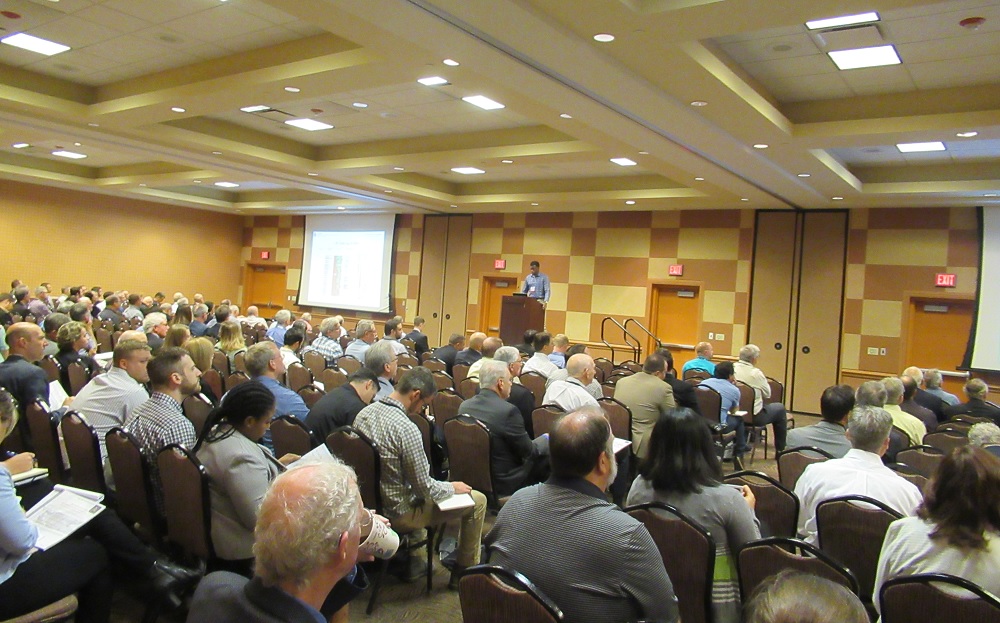
The four-day section meeting began September 30 at the Cox Business Services Center. Exhibit booths opened the next day. The technical program included workshops and 100 oral and poster presentations. Photo by Bruce Wells.
On September 30, Wells joined geologists on a field trip to the Phillips Petroleum Company Museum in Bartlesville. The group also visited the Nellie Johnstone No. 1 replica derrick in Discovery One Park, where Oklahoma’s first oil well was completed in 1897.
The field trip included a tour of Frank Phillips’ Woolaroc Museum & Wildlife Preserve. According to CEO Bob Fraiser, a special effort is underway to raise funds for the the long-term preservation of the Frank Phillips Mansion in downtown Bartlesville.
In Bartlesville, field trip members were joined by educator and historian Kay Little, owner of Little History Adventures. She provided insights about the life of Frank Phillips, his company, and the history of Woolaroc.
Staff members at the museum also answered questions – and introduced Jim Low, the grandson of Phillips, who happened to be visiting. Special access was granted to the building’s board room.
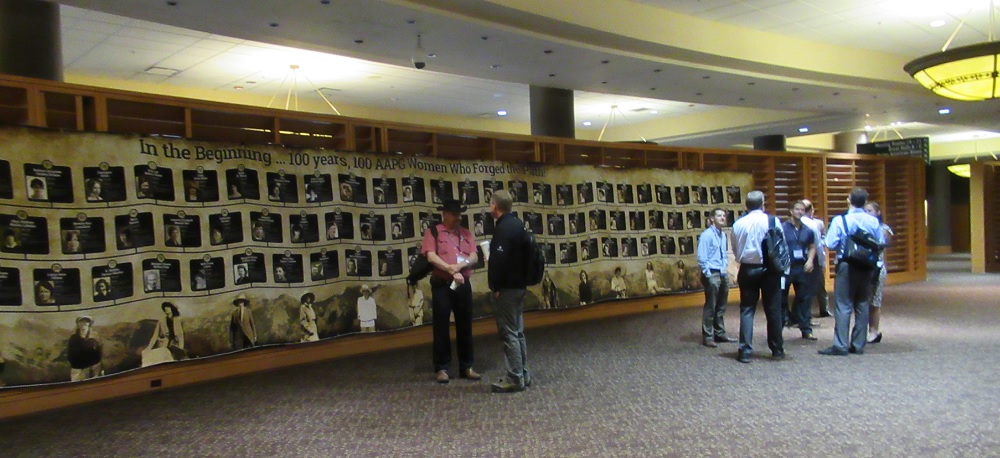
AAPG’s 2017 conferences have featured a special traveling mural: “In the Beginning…100 years, 100 AAPG Women Who Forged the Path.” The portraits are from the recently published book, Anomalies – Pioneering Women in Petroleum Geology: 1917 – 2017 by Robbie Rice Gries. Photo by Bruce Wells.
The day-long field trip offered an opportunity to discuss the AOGHS energy education mission and the petroleum history articles posted on AOGHS.org.
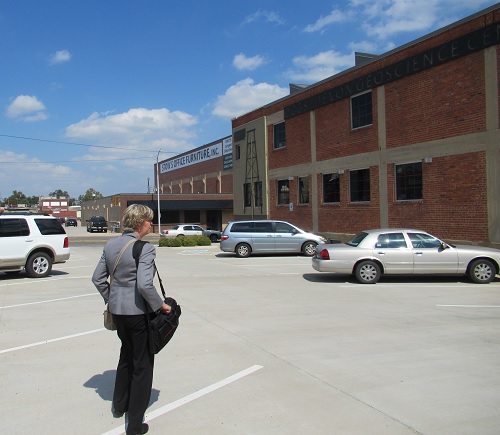
Joan Bruns, a geologist with Baker Hughes, a GE Company, arranged a tour of the Mid-Continent Geological Library in the original 1923 home of the Oklahoma Cotton Growers Association. Photo by Bruce Wells.
During the bus ride Wells discussed the importance of oil history in energy education and played a selection of DVDs he collected over the years from community oil museums.
The AAPG meeting at the Cox Business Services Center focused on recent advancements in technology, “with some of the brightest professionals in out industry,” according the meeting chairman, Thomas Cronin. It began with five September 30 workshops.
A sixth special workshop was held for teachers. “More! Rocks in Your Head,” was led by Rochard Opalka at the Petroleum Club, which also hosted several receptions. Ninety-six exhibit booths opened at the Cox Business Services Center the next day.
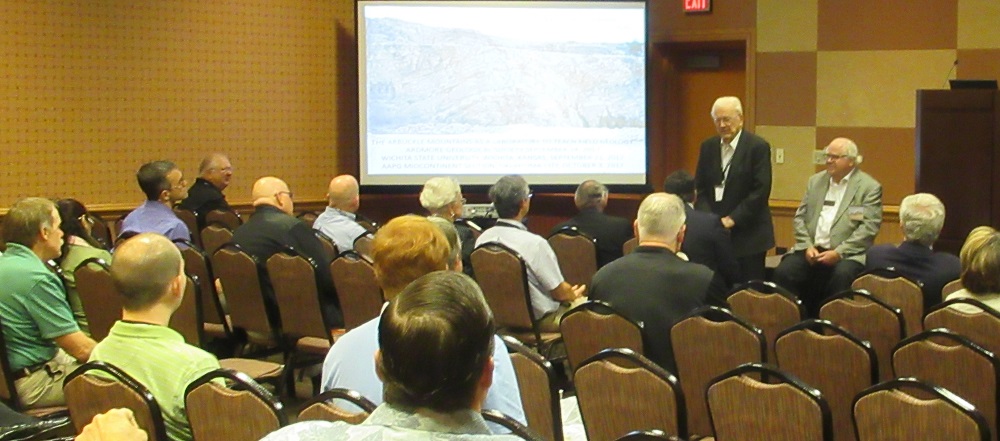
After leading a field trip earlier, veteran geologists Robert Allen of Ardmore and Robert Newman of Ada, Oklahoma, spoke at the October 3 technical session, “The Arbuckle Mountains as a Laboratory for Geological Education.” Photo by Bruce Wells.
In addition to conference activities at the center, AOGHS’ Wells toured the nearby Mid-Continent Geological Library and visited the downtown headquarters buildings of Devon Energy and Continental Oil. AAPG generously sponsored his attendance at receptions, dinners, and other events.
Wells made an October 3 presentation that featured details from a highly read AOGHS website article first posted in 2007, Shooters – A “Fracking” History.
Energy Education Contacts
Wells shared education outreach ideas with AAPG members, other speakers, and exhibitors. He attended alumni receptions of Oklahoma, Kansas State and Kansas universities. Wells also viewed mud-logging technologies in an Exlog company trailer, guided by Jami Poor, a geologist with MAP Royalty.
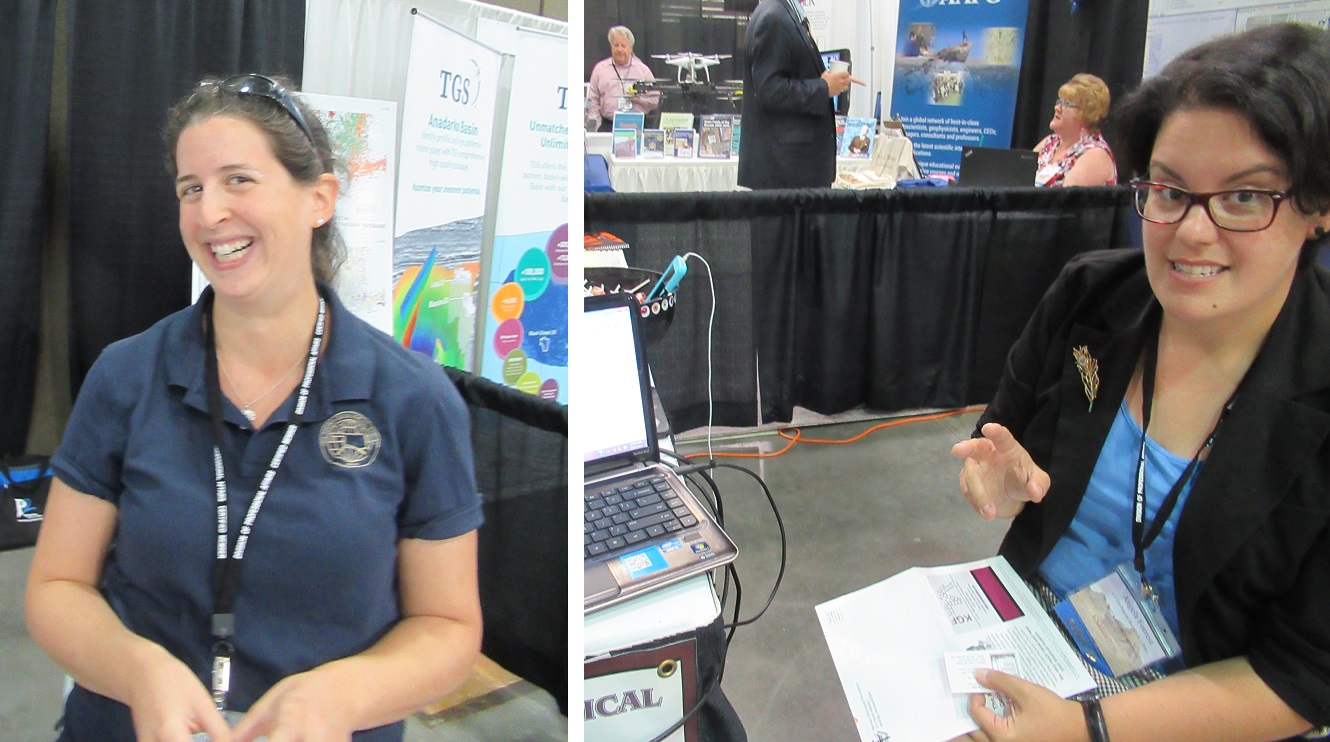
Among the exhibitors were Molly Yonker, education and outreach coordinator for the Oklahoma Geological Survey in Norman; and Angela Forrest of the Kansas Geological Society and Library in Wichita. Photos by Bruce Wells.
Wells discussed earth science education strategies with Molly Yunker, education coordinator for the Oklahoma Geological Survey, and Prof. Jennifer Roberts, chairperson of the Department of Geology at the University of Kansas.
According to AAPG’s Joel Alberts, who organized the field trip and is a Jayhawk alumni, new geoscience facilities have been completed on the Lawrence campus; an Earth, Energy and Environment Center will open for classes in spring 2018. KU offered its first geology class almost 150 years ago.
Among the presenters at the meeting was geologist Ray Sorenson, who has spent years researching where in North America oil had been reported prior to America’s first commercial well of 1859. His extensive documentation of reports of natural seeps and other signs of oil or gas was the basis of an October 3 presentation.
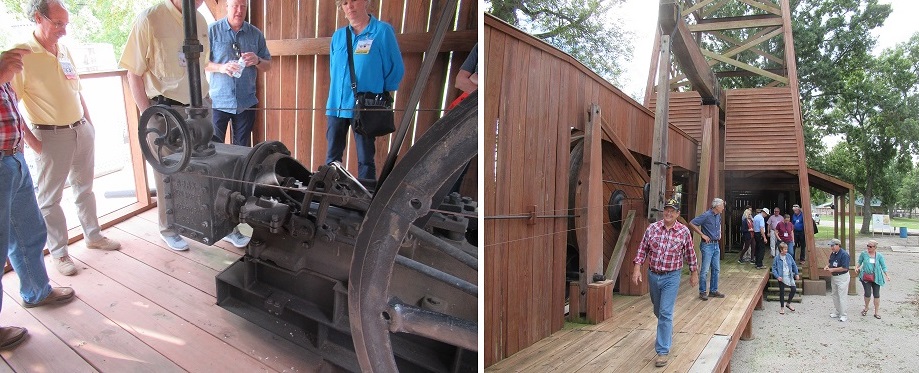
AAPG Mid-Continent Section President Doug Davis Jr., at left, was among the visitors to the replica of Nellie Johnstone No. 1 well of 1897. Volunteer Randi Olsen, who recently moved to Bartlesville from Florida, assisted in an engine-running demonstration — and water gusher. Photos by Bruce Wells.
“Pre-Drake published accounts of oil and natural gas were known from thirty-one states and five Canadian provinces,” he explained, adding that production (not necessarily used) came from wells at 28 locations in 10 states and two provinces.
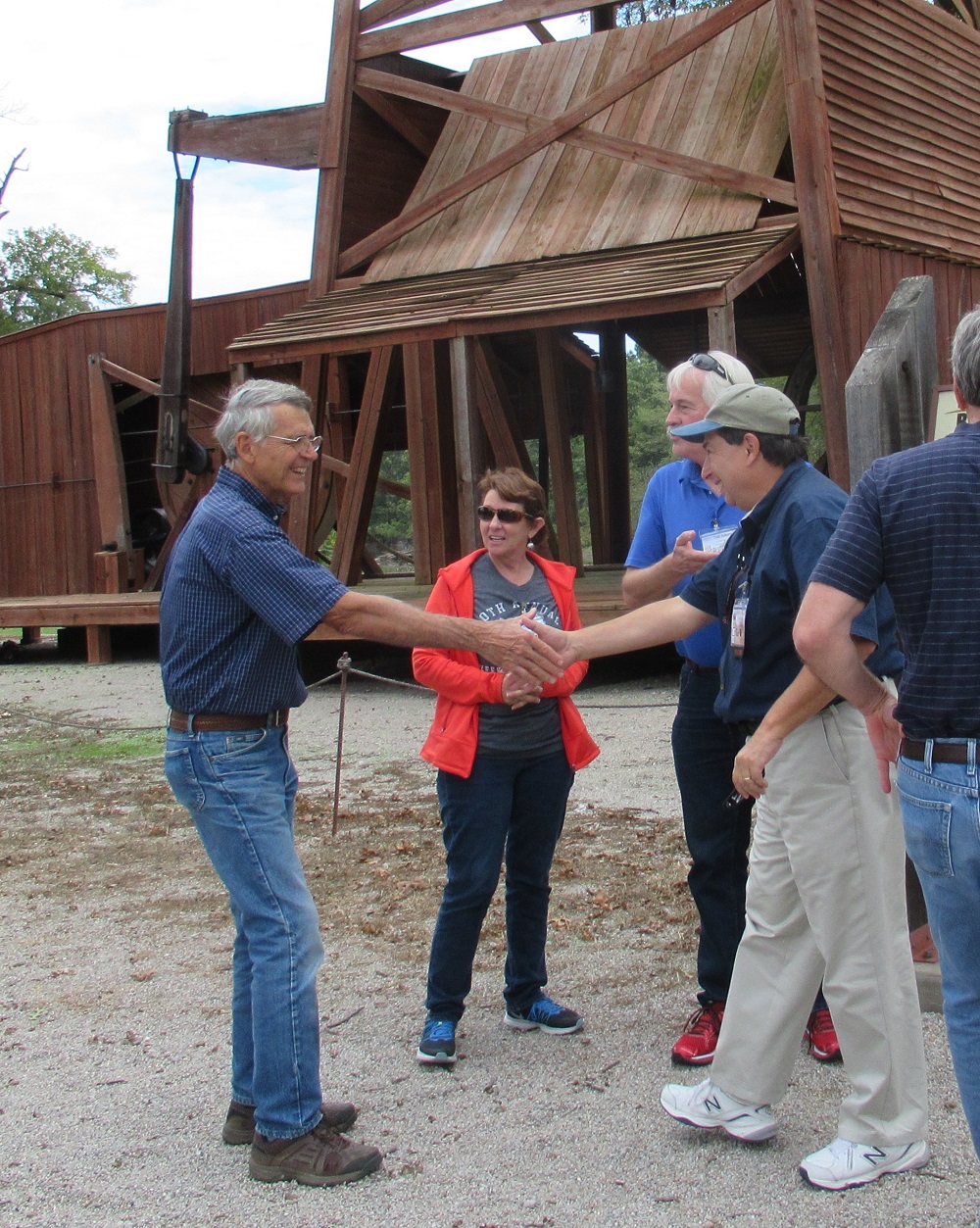
Dan Droege welcomed AAPG President Charles Sternbach to Discovery One Park. Also pictured are AAPG members Jami Poor and Joel Alberts, who organized the field trip. Droege was instrumental in the derrick’s reconstruction in 2008. Photo by Bruce Wells.
Sorenson’s on-going research is collected in 31 notebooks organized by topic. Some of his discoveries have been added to AOGHS articles, including the history of the First Alabama Oil Well.
Sorenson was among a group of earth science historians and educators, including 2015-2017 AAPG Mid-Continent Section President H.W. “Dub” Peace II, and Robert Allen, a consulting geologist from Ardmore and a close friend of Robert Newman, professor emeritus, East Central University, Ada, Oklahoma.
Allen and Newman hosted another AAPG September 30 field trip, “The Arbuckle Mountains As A Laboratory For Geological Education.” They took a group south along I-35 to quarries with rocks of every age, from pre-Cambrian to Permian. The geologists reportedly discussed the “three Fs: folding, faulting and fried pies.”
During his five days in Oklahoma City, Wells also met several top industry leaders and spoke to employees of the new oil and gas technology center of Baker Hughes, a GE Company (BHGE). He toured the center courtesy BHGE geologist Joan Bruns and Mike Ming, the general manager and former Oklahoma Secretary of Energy.
BHGE was created on July 3, 2017, when General Electric completed a buyout of Baker Hughes Inc. The combined company is the world’s second-largest oilfield service provider by revenue (behind Schlumberger), according to Fortune. BHGE built its Oklahoma City tech center above two specially drilled wells for on-going experiments. Scientists there are examing emerging oilfield digital technologies, including advancements in computed tomography core scans and 3-D printing. “Tomorrow’s Energy Company: A New Way of Doing Business” was the topic for October 2 luncheon speech by BHGE president and CEO Lorenzo Simonelli.
Another luncheon speaker leads a major petroleum company’s R&D program in shale gas and oil. Claudia Hackbarth, vice president of unconventional technology at Shell International Exploration and Production Inc. of Houston, also runs Shell TechWorks, in Cambridge, Massachusetts.
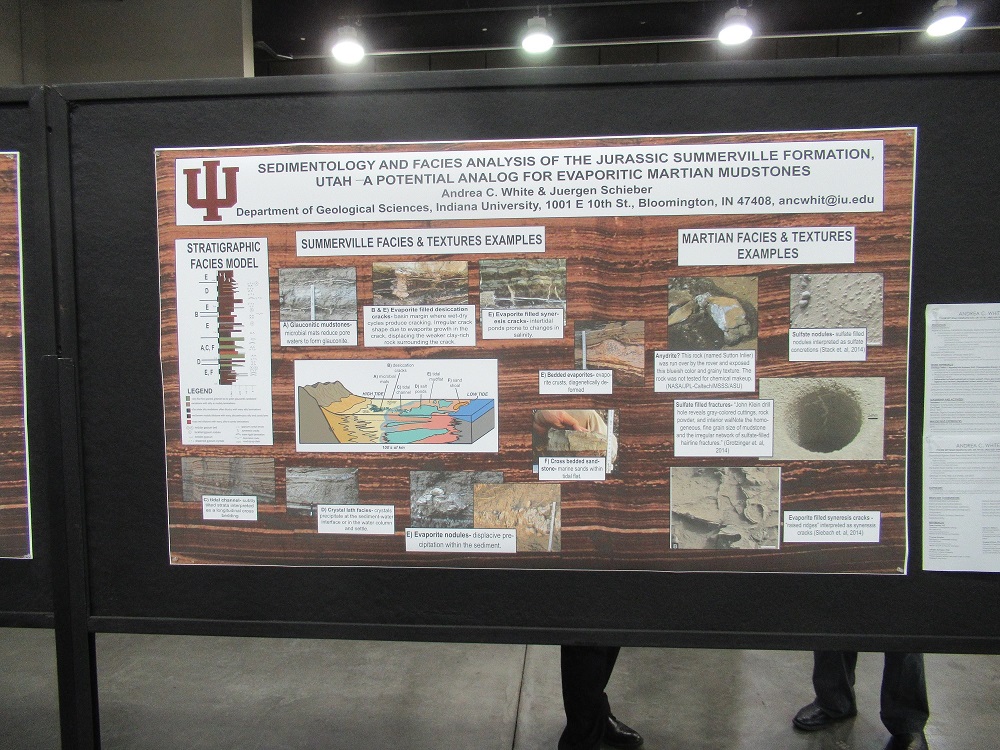
A dozen poster presentations were among the 96 company, university, and professional organization exhibitors in the Cox Business Services Center. Photo by Bruce Wells.
On Oct. 3, Hackbarth spoke on “Innovation in Unconventional Resource Development: Data, Nano, Sensing, Trial and Error; And Good Old Fashioned Hard Work.”
Steve Wyett, a senior vice president at the Bank of Oklahoma, was the meeting’s opening day keynote speaker. He discussed “Oil Price Dynamics in a Changing
World.”
AAPG President Erie Presentation
Among AAPG leadership attending the Mid-Continent Section Meeting was current national AAPG President Charles A. Sternbach, who updated members about current AAPG activities. He is an expert on the life of Amos Eaton, a pioneering New York State geologist who created geological maps based on the excavation of the Erie Canal in the 1820s.
A week earlier Sternbach attended the AAPG Easter Section Meeting in Morgantown, West Virginia, and presented “The Erie Canal’s 200th Anniversary and the Map that changed the New World – Pioneering Geology Mapmakers across the Atlantic.”
The presentation has been posted on YouTube: Charles Sternbach – Amos Eaton Maps the Erie Canal. On October 15, he would be giving the presidential address at the opening session of the 2017 AAPG International Conference & Exhibition in London.
The Oklahoma City meeting featured member awards, including the 2017 Robey H. Clark Award. The 2017 recipient was Ernie Morrison, “for his long time, dedicated service as a Councilor Member and as the President of the AAPG Mid-Continent Section.”
_______________________
Recommended Reading: Trek of the Oil Finders: A History of Exploration for Petroleum (1975) by Edgar Wesley Owen; Anomalies: Pioneering Women in Petroleum Geology 1917-2017 (2017) by Robbie Rice Gries (American Association of Petroleum Geologists); The Birth of the Oil Industry (1936) by Paul H. Giddens. Your Amazon purchase benefits the American Oil & Gas Historical Society. As an Amazon Associate, AOGHS earns a commission from qualifying purchases.
_______________________
The American Oil & Gas Historical Society preserves U.S. petroleum history. Become an AOGHS annual supporting member to help maintain this energy education website and expand historical research. For more information, contact bawells@aoghs.org. © 2022 Bruce A. Wells.
Citation Information – Article Title: “Meeting Mid-Continent Geologists in 2017.” Authors: B.A. Wells and K.L. Wells. Website Name: American Oil & Gas Historical Society. https://aoghs.org/petroleum-pioneers/kansas-mid-continent-oil-fields. Last Updated: October 31, 2022. Original Published Date: November 16, 2017.
by Bruce Wells | Apr 21, 2021 | AOGHS Newsletter