First Oil Book
Promoting a new resource for making kerosene — Rock Oil, “The Wonder of the Nineteenth Century.”
Less than 10 months after Edwin L. Drake and his driller William “Uncle Billy” Smith completed the first commercial U.S. oil well on August 27, 1859, along Oil Creek in Titusville, Pennsylvania, Thomas A. Gale wrote a detailed study about rock oil — and helped launch the petroleum age.
Published in 1860, The Wonder of the Nineteenth Century: Rock Oil in Pennsylvania and Elsewhere described a radical fuel source for the popular lamp fuel kerosene, which had been made from coal for more than a decade.
“Those who have not seen it burn may rest assured its light is no moonshine; but something nearer the clear, strong, brilliant light of day,” Gale declared in his 25-cent pamphlet printed in Erie by Sloan & Griffith Company.
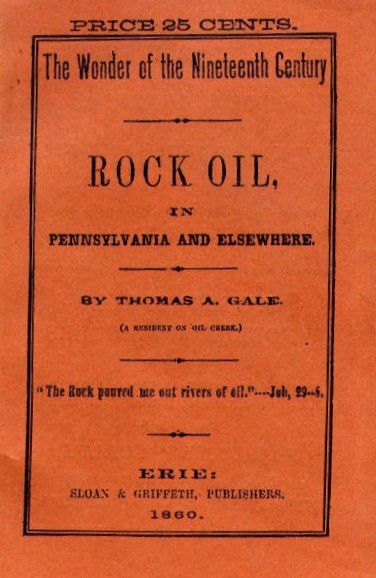
Thomas Gale’s 80-page pamphlet in 1860 marked the beginning of the petroleum age, illuminated with kerosene lamps.
“In other words, rock oil emits a dainty light; the brightest and yet the cheapest in the world; a light fit for Kings and Royalists, and not unsuitable for Republicans and Democrats,” Gale added.
Oil in Rocks
Gale’s descriptions of the value of petroleum helped launch investments in new exploration companies, especially as he noted the commercial qualities of Pennsylvania oil for refining into kerosene, the distilled “coal oil” invented in 1848 by Canadian chemist Abraham Gesner.
Historians regard the 80-page publication as the first book about America’s petroleum industry. The Wonder of the Nineteenth Century: Rock Oil in Pennsylvania and Elsewhere was almost forgotten until 1952, when the Ethyl Corporation of New York republished the work. Only three original copies were known to exist.
“Not by the widest stretch of the imagination could Thomas Gale have realized, when he put down his pen on June 1, 1860, that he had written a book destined to become one of the rarest of all oil books,” proclaimed the Ethyl historian when the company republished Gale’s book.

Ethyl Corporation noted the scarcity of copies of the book had prevented “all but a few historians” from giving the book the attention it deserved.
“Gale wrote his book to satisfy a public desire for more information about petroleum. Newspapers had carried belated accounts of Drake’s discovery well, and the mad scramble for oil that followed, but actually the world knew little about petroleum.”
“The Rock poured…”
The book’s 11 chapters explain practical aspects of the new petroleum industry. Chapters one and two, “What is Rock Oil?” and “Where is the Rock Oil found?” were followed by “Geological Structure of the Oil Region.”
Chapters four through six explained the early technologies (and costs) for pumping the oil, while the next two chapters examine “Uses of Rock Oil.” The final three chapters offered “Sketches of several oil wells,” “History of the Rock Oil Enterprise,” and “Present condition and prospects of Rock Oil interests in different localities.”
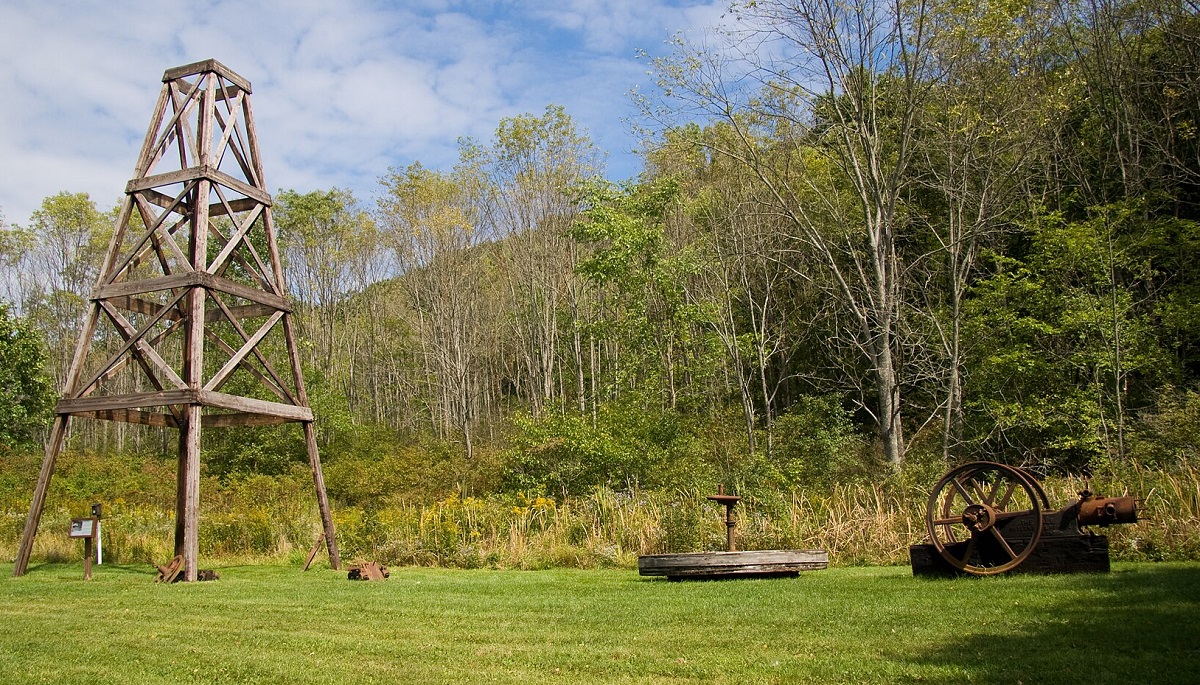
Chapter three in The Wonder of the Nineteenth Century: Rock Oil in Pennsylvania and Elsewhere features the “geological structure of the oil region,” today part of Oil Creek State Park in northwestern Pennsylvania.
Originally published by Sloan & Griffith of Erie, Pennsylvania, the 1860 cover noted the author as “a resident of Oil Creek” and included a biblical quote, “The Rock poured me out rivers of oil,” from Job, 29:6.
In addition to mysteriously burning gasses and “tar pits,” explorers for millennia have referenced signs of coal, bitumen, and substances very much like petroleum — a word derived from the Latin roots of petra, meaning “rock” and oleum meaning “oil.”
But did Thomas Gayle’s 1860 work produce the first book about oil as Ethyl Corporation historians believed when the company reprinted it in 1952? In fact, there have been many references to natural oil seeps recorded millennia ago (including in the Bible), according to a geologist who has researched the earliest sightings of petroleum.
Illuminating Petroleum
Several years before the 1859 oil discovery in Pennsylvania, businessman George Bissell hired a prominent Yale chemist to study the potential of oil and its products to convince potential investors (see George Bissell’s Oil Seeps).
“Gentlemen, it appears to me that there is much ground for encouragement in the belief that your company have in their possession a raw material from which, by simple and not expensive processes, they may manufacture very valuable products,” reported Benjamin Silliman Jr. in 1855.
Silliman’s groundbreaking “Report on the Rock Oil, or Petroleum, from Venango Co., Pennsylvania, with Special Reference to its Use for Illumination and Other Purposes,” convinced the petroleum industry’s earliest investors to drill at Titusville. Cable-tool technology developed for brine wells would drill the well.

According to historian Paul H. Giddens in the 1939 classic, The Birth of the Oil Industry, Silliman’s 1855 report, “proved to be a turning-point in the establishment of the petroleum business, for it dispelled many doubts about its value.”
The Pennsylvania Rock Oil Company would evolve into the Seneca Oil Company of New Haven, Connecticut, which became America’s first oil company after Drake completed the first U.S. commercial well drilled seeking oil in 1859.
Rock Oil Products
In addition to providing oil for refining into kerosene lamps (and someday rockets), oilfield discoveries led to many products. Early petroleum products included axle greases, an oilfield paraffin balm, and in Easton, Pennsylvania, Crayola crayons.
Further, oil offered an improved asphalt prior to the first U.S. auto show in November 1900 in New York City’s Madison Square Garden.
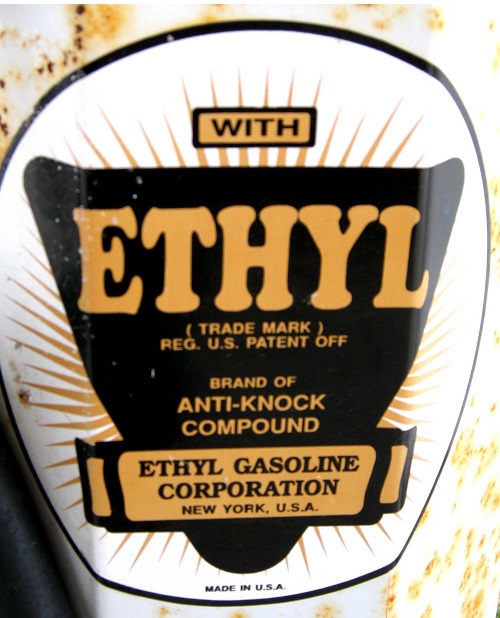
Ethyl Corporation was established in 1923 by General Motors and Standard Oil of New Jersey,
Responding to consumer demand for better automobile gasoline, General Motors and Standard Oil of New Jersey established the Ethyl Corporation in 1923. The company initially downplayed the danger of tetraethyl lead. Leaded gas would be banned for use in cars in the 1970s
Importantly, high-octane leaded aviation fuel proved vital for victory in World War II — and the additive still fuels many piston-engine aircraft and racecars.
_______________________
Recommended Reading: The Wonder of the Nineteenth Century: Rock Oil in Pennsylvania and Elsewhere (1952); The Birth of the Oil Industry (1939); Myth, Legend, Reality: Edwin Laurentine Drake and the Early Oil Industry
_______________________
The American Oil & Gas Historical Society (AOGHS) preserves U.S. petroleum history. Please become an AOGHS annual supporter and help maintain this energy education website and expand historical research. For more information, contact bawells@aoghs.org. Copyright © 2025 Bruce A. Wells.
Citation Information – Article Title: “First Oil Book of 1860.” Authors: B.A. Wells and K.L. Wells. Website Name: American Oil & Gas Historical Society. URL: https://aoghs.org/oil-almanac/first-oil-book-of-1860. Last Updated: May 17, 2025. Original Published Date: May 31, 2020.