Cemetery generated royalty checks to next-of-kin when oil was drawn from beneath family plots.
In the summer of 1921, the Signal Hill oil discovery would help make California the source of one-quarter of the world’s entire oil output. Soon known as “Porcupine Hill,” the town’s Long Beach oilfield produced about 260,000 barrels of oil a day by 1923.
The Alamitos No. 1 well, drilled on a remote hilltop south of Los Angeles, erupted a column of “black gold” on June 23, 1921. Natural gas pressure was so great that the oil geyser climbed 114 feet into the air.
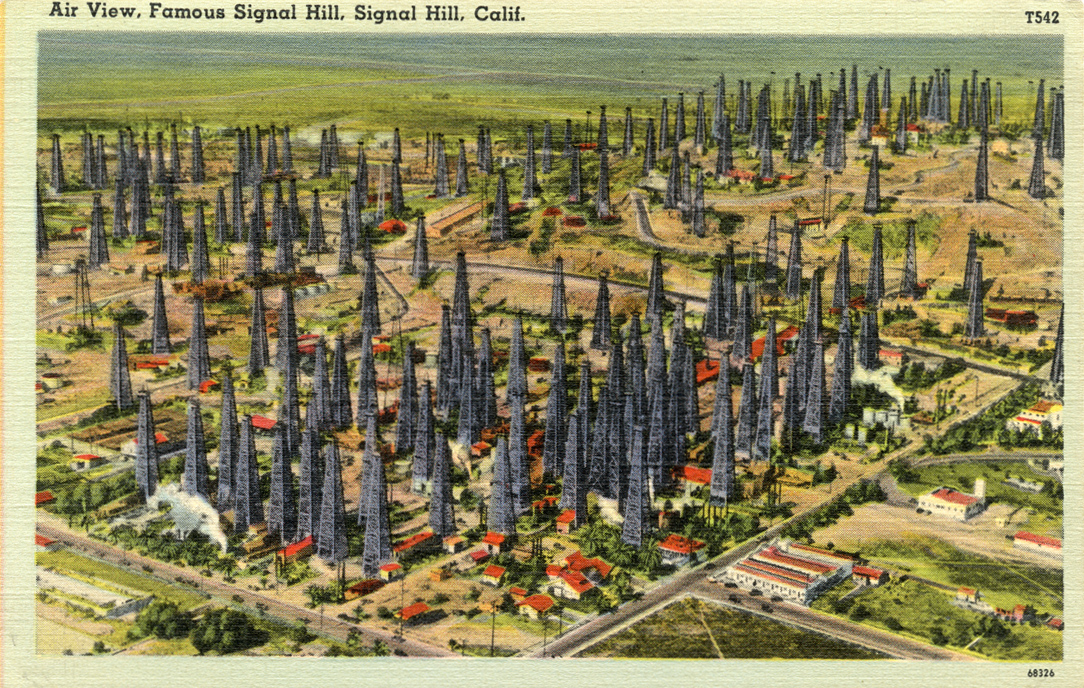
After the June 1921 oilfield discovery, Signal Hill had so many derricks that people called it Porcupine Hill. Circa 1935 postcard courtesy Boston Public Library, Digital Commonwealth.
The oilfield discovery well, which produced almost 600 barrels a day, would eventually produce 700,000 barrels of oil. Signal Hill incorporated three years after its Alamitos discovery well made headlines.

In 1923, Signal Hill’s petroleum field produced more than 68 million barrels of oil. The community of Signal Hill later became one of the first U.S. cities to be surrounded by another city, Long Beach.
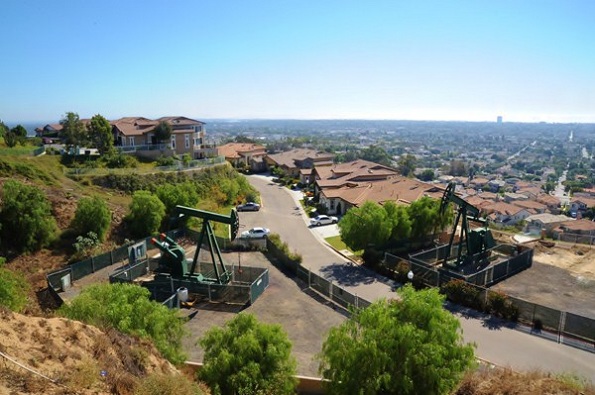
Signal Hill, a residential area before the 1921 discovery of the Long Beach oilfield, became covered in derricks. “Today you can see wonderful commemorative art displays of this era throughout the lush parks and walkways of Signal Hill,” notes a local newspaper.
By the 2000s, more than one billion barrels of oil were pumped from the Long Beach oilfield since the original 1921 strike. “Signal Hill is the scene of feverish activity, of an endless caravan of automobiles coming and going, of hustle and bustle, of a glow of optimism,” reported California Oil World.
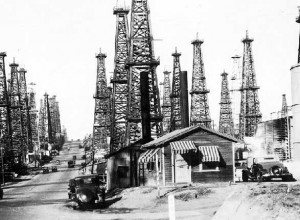
Signal Hill circa 1930 — at the corner of 1st Street and Belmont Street. Photo courtesy of Los Angeles Museum of Natural History.
“Derricks are being erected as fast as timber reaches the ground,” the magazine adds. “New companies are coming in overnight. Every available piece of acreage on and about Signal Hill is being signed up.”
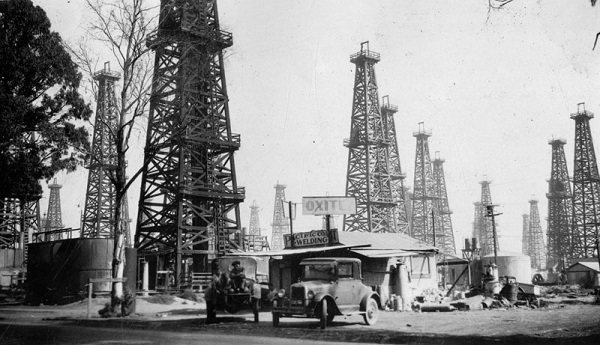
Signal Hill helped make California the source of one-quarter of the world’s oil. “Porcupine Hill” and the Long Beach field produced 260,000 barrels of oil a day by 1923.
Within a year, Signal Hill — before and after a residential area — will have 108 wells, producing 14,000 barrels of oil a day. There were so many derricks, people started calling it Porcupine Hill. “Derricks are so close that on Willow Street, Sunnyside Cemetery graves generated royalty checks to next-of-kin when oil was drawn from beneath family plots,” noted one historian.

Derricks were so close to one cemetery that graves “generated royalty checks to next-of-kin when oil was drawn from beneath family plots.” By 1923, production would reach 259,000 barrels per day from nearly 300 wells. Photo is part of a panorama in the Library of Congress.
Dave Summers explained in his 2011 article, “The Oil Beneath California,” that when oilfields around Los Angeles began to develop, “Californian production became a significant player on the national stage.” The OilPrice.com article continued:
By 1923 it was producing some 259,000 barrels per day from some 300 wells, in comparison with Huntington Beach, which was then at 113,000 barrels per day and Santa Fe Springs at 32,000 barrels per day… And, in a foreboding of the future problems of overproduction, this was the first year in a decade that supply exceeded demand.
Shell Oil Geologists
Signal Hill oil potential had drawn wildcatters south of Los Angeles since 1917 but with no success. Two Royal Dutch Shell Oil Company geologists and a driller persevered.
“This was a great exploit and economic risk for the time. Shell Oil Company had just lost $3 million at a failed drilling site in Ventura, five years before,” reported a Long Beach newspaper.
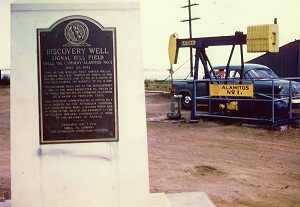
A 1954 photograph of the Alamitos No. 1 well — and the monument dedicated on May 3, 1952, “as a tribute to the petroleum pioneers for their success here…”
Although another “dry hole” would be expensive, Shell geologists Frank Hayes and Alvin Theodore Schwennesen spudded their well in March 1921. Driller O.P. “Happy” Yowells believed oil lay deeper than earlier “dusters” had attempted to reach.
By summer the steam-powered cable tool rig had Yowells close to making oilfield history. On June 23, 1921, at a depth of 3,114 feet, his wildcat well for Shell Oil erupted, revealing a petroleum reserve that extended to nearby Long Beach.
According to the Paleontological Research Institution, Signal Hill became the biggest oil field the already productive Southern California region had ever seen. This made California, “the nation’s number-one producing state, and in 1923, California was the source of one-quarter of the world’s entire output of oil!”
Decades before Signal Hill, another giant southern California oilfield had been discovered in 1892. A struggling prospector drilled into tar seeps he found near present-day Dodger Stadium (see Discovering Los Angeles Oilfields).
Signal Hill Oil Park
Today, Signal Hill’s Discovery Well Park includes a community center to educate the public. Historic photos and descriptions can be found at six viewpoints along the Panorama Promenade. There are producing oil wells throughout the hill — with the historic “Discovery Well, Alamitos Number 1” at the corner of Temple Avenue and East Hill Street.
A monument dedicated on May 3, 1952, serves “as a tribute to the petroleum pioneers for their success here, a success which has, by aiding in the growth and expansion of the petroleum industry, contributed so much to the welfare of mankind.”
Visitors to the area can see “wonderful commemorative art displays of this era throughout the lush parks and walkways of Signal Hill,” reported the Long Beach Beachcomber. Dedicated on September 30, 2006, the statue “Tribute to the Roughnecks” can be found on Skyline Drive.
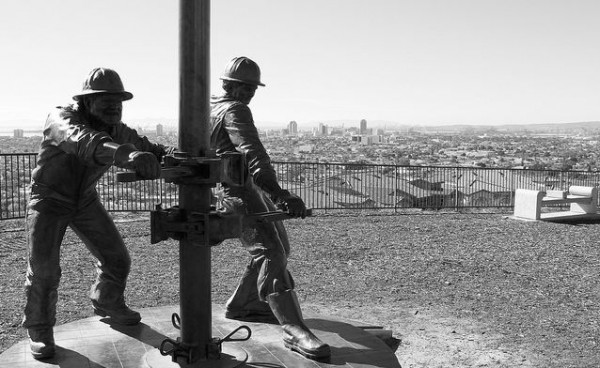
“Tribute to the Roughnecks” by Cindy Jackson stands atop Signal Hill. Long Beach is in the distance. Signal Hill Petroleum Chairman Jerry Barto and Shell Oil employee Bruce Kerr are depicted in bronze.
The first California oil wells were drilled near oil seeps in the northern part of the state around the time of the Civil War. These Pico Canyon wells produced limited amounts of crude oil, but there was no market for the oil. Larger oilfields would be revealed in the early 1890s about 35 miles to the south.

Earlier explorers noted evidence of California’s petroleum fields by the large number of oil seeps, both onshore and offshore. California’s first commercial oil well in 1876 was drilled in Pica Canyon, well known for its asphalt seeps.
Between 1913 and 1923 Hollywood used the derricks on Signal Hill in movies starring Buster Keaton and Fatty Arbuckle. In 1957, what many consider the world’s first “all jazz” radio station, KNOB (now KLAX), first transmitted from a small studio on top of the historic oil hill.
_______________________
Recommended Reading: Signal Hill, California, Images of America


_______________________
The American Oil & Gas Historical Society (AOGHS) preserves U.S. petroleum history. Please become an AOGHS annual supporter and help maintain this energy education website and expand historical research. For more information, contact bawells@aoghs.org. © 2025 Bruce A. Wells.
Citation Information – Article Title: “Signal Hill Oil Boom.” Authors: B.A. Wells and K.L. Wells. Website Name: American Oil & Gas Historical Society. URL: https://aoghs.org/petroleum-pioneers/signal-hill-oil/. Last Updated: June 18, 2025. Original Published Date: April 29, 2013.