19th-century “Smoky City” skies cleared when factories replaced coal with natural gas.
In 1878, the Haymaker brothers discovered a Pennsylvania natural gas field near Pittsburgh – and laid the foundation for many modern petroleum companies.
Like many young men of their time, Michael Haymaker and his brother Obediah sought to make their fortunes in Pennsylvania’s booming petroleum industry. They left their Westmoreland County farm to seek work in the oilfields.
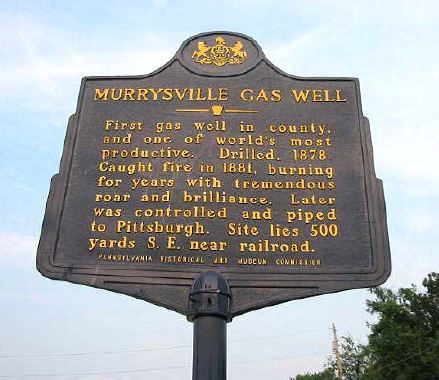
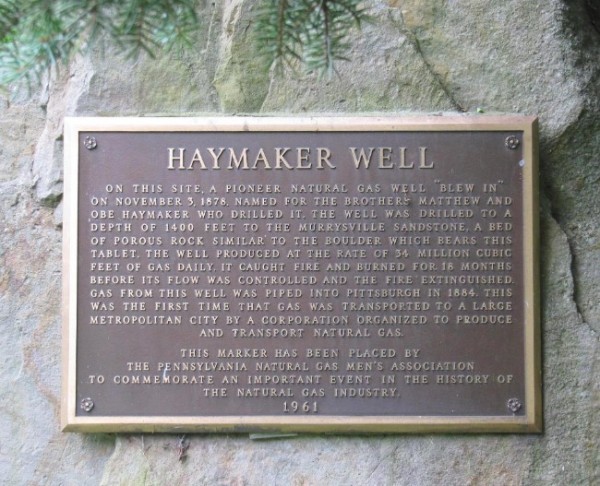
A marker on Route 22 at Murrysville, Pennsylvania, commemorates the Haymaker brothers’ historic natural gas well of 1878.
The brothers first worked as drillers for an independent operator, Israel Painter, who had completed successful oil wells a few miles north of Oil City in Venango County – not far from the 1859 first U.S. oil discovery less than 20 years earlier.
In 1876, while drilling for Painter’s Ozark Oil Company in Clarion County, Michael approached his boss with a new prospect near Murrysville, 18 miles east of Pittsburgh.
Michael and his younger brother “Obe” had become acquainted with Josh Cooper, who they learned used seeping natural gas to boil down maple sugar sap along Turtle Creek. Painter liked the brothers — and saw an unexploited opportunity.
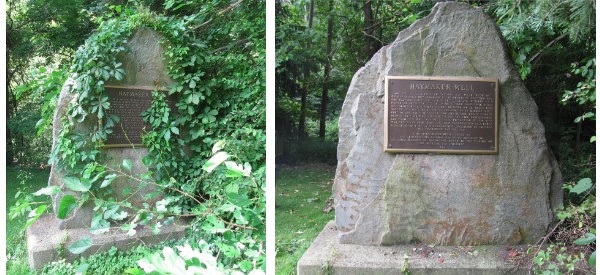
At the Haymaker well site, members of the Murrysville Historical Preservation Society, led by President Carl Patty, spent a day removing overgrowth from the 12-foot sandstone historical marker on Norbotrol Street in Murrysville. Gas seeps were known, but the Murrysville area had never been drilled.
After consulting with his partners, Painter agreed to finance the young men’s venture. Michael and Obe set off for Murrysville. In 1877 they leased land on a farm owned by Henry Remaley and erected a wooden derrick.

However, the brothers needed a lot of money for a steam boiler, engine, drill string, casing, and cable-tool bits (see Making Hole — Drilling Technology). But a financial panic that began three years earlier had finally reached their backer, Painter, and drilling capital dried up.
“Murrysville became the site of the nation’s first commercial gas well industry,” noted a local historian. “Many new businesses took shape in the region, including Equitable Gas Company, which was soon acquired by George Westinghouse to become part of his Philadelphia Company.”
The Haymaker brothers scrambled to find financing. They even approached the wealthy Dr. Jacob Hostetter, purveyor of “Hostetter’s Stomach Bitters,” a 94-proof elixir popular with Civil War soldiers. Hostetter declined.
The brothers scrounged what used equipment they could find and began drilling. In a 1936 interview, 88-year-old Michael remembered, “It was the worst drilling outfit I had ever seen. The tools were light, and the steel in the bits was of the poorest grade. The whole outfit was hopelessly worn out.”

It took about one year of cable-tool pounding to get through the 400-foot-thick, flint-like “Big Injun Sand” (the Pocono sandstone formation). By then, there was no money for casing.
Once again the Haymaker brothers set out to find financial backing and once again, none could be found. No one was interested in a well drilled far from proven territory — especially one that had already been drilled more than 500 feet with no show of oil.
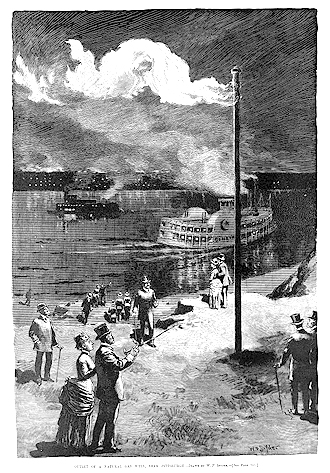
“Outlet of a Natural Gas Well, Near Pittsburgh,” reported Harper’s Weekly in 1885. Murrysville is 18 miles east of Pittsburgh.
Out of luck and hope, Michael and Obe waited for the train in the Greensburg, Pennsylvania, station to take them back to their half-drilled oil well in Murrysville. The effort to secure backers for their wildcat oil well had failed.
While awaiting the train, the brothers learned of one final possibility, Hilary Jacob Brunot, a new resident who was engaged in coal land speculation. After so many disappointments, the decision to try once more was left to a coin toss. Years later, Michael recalled, “The coin said we should, but I wasn’t very enthusiastic about it.”
Brunot — the coal investor — proved receptive and purchased an interest in the highly speculative well. With a bit more financing and renewed hope, the brothers returned to Murrysville to drill deeper.
Roaring Torch seen for Miles
On November 3, 1878, at a depth of almost 1,400 feet, the well blew in. “Every piece of rigging went sky high, whirling around like so much paper caught in a gust of wind,” Michael said. “But instead of oil, we had struck gas.”
The well produced an estimated 30 million cubic feet of natural gas a day. But with no way to cap the well and no pipeline to exploit commercial possibilities, it later burst into flames. The roaring torch of the Haymaker gas well, visible from miles away, would draw thousands of onlookers — for a year and a half. Finding a buyer for the flaming well presented another problem.
In a chance meeting, Hilary Brunot met Joseph Newton Pew. Pew and his partner, Edward Emerson, had incorporated Keystone Gas Company in 1880 after tapping the Bradford, Pennsylvania, natural gas fields to supply drillers – and later to heat and light the boom town (see Mrs. Alford’s Nitro Factory).
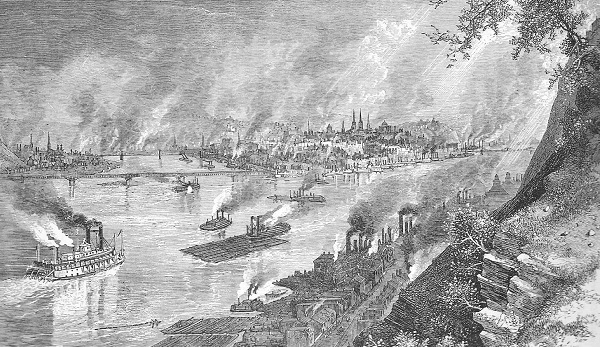
“Natural gas is king in Pittsburgh,” proclaimed the New York Times in 1885, adding, “Its Use Clarifies the Atmosphere at Pittsburgh.”
Pew and Emerson had profited from natural gas supplying a community; they saw great potential in the Haymaker well’s proximity to Pittsburgh. In June of 1883, the brothers completed the Haymaker well and surrounding properties and organized the Penn Fuel Company to pipe natural gas to Pittsburgh.
But there was a competing claim from Chicago capitalist Milton Weston, whose agents occupied the Haymaker site. The dispute with Weston’s men erupted into violence. Tragically, Obe Haymaker was shot — and bayoneted — on November 26, 1883. He died with his brother at his side.
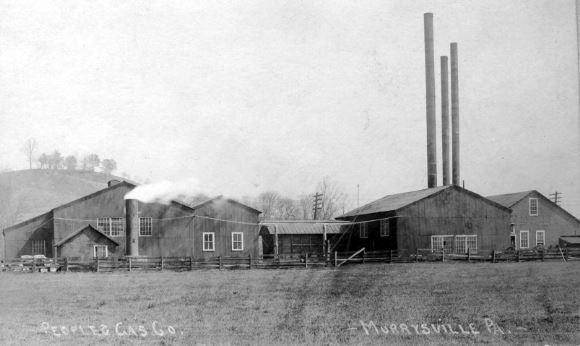
Pumping station of Peoples Natural Gas in use in the late 1890s. Natural gas replaced coal to fire boilers and compress gas for transport by pipeline to Pittsburgh.
About one year later, natural gas was piped into Pittsburgh — “the first time that gas was transported to a large metropolitan city by a corporation organized to produce and transport natural gas,” proclaims a plaque affixed to the sandstone boulder at the Haymaker brothers’ well.
The courts sent Weston to prison as an accessory to murder. Pew and Emerson continued to develop the Murrysville field and piped the natural gas to Pittsburgh.
Clearing Smoky City’s Skies
Historical documents record the Penn Fuel Company as the “first to supply natural gas to a major city (Pittsburgh) for home and industrial use.”
Inventor and manufacturer George Westinghouse’s interest in the potential of natural gas led him to drill an experimental (and successful) gas well on the grounds of his estate on Thomas Blvd. in Pittsburgh. He promptly purchased the Penn Fuel Company.
“Natural gas is king in Pittsburgh,” proclaimed an October 18, 1885, New York Times article about the former “smoky city” headlined “Value of Natural Gas, Its Use Clarifies the Atmosphere at Pittsburgh.”

Citing the Haymaker well, the article noted the “advantages of natural gas over coal are numerous” and added that “Every steel and iron mill, glass factory, and manufactories generally of any consequence, besides many private dwellings, now depend on gas for fuel.”
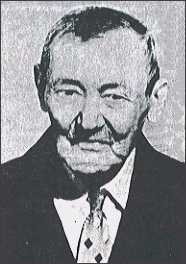
Michael Haymaker lived to be 96. This photo reportedly was taken after his 90th birthday.
Harper’s New Monthly Magazine in 1886 reported that natural gas in Pittsburgh “already displaces over ten thousand tons of coal daily. Thus the character of that city will be completely transformed, and it will no longer be properly described as ‘the dirtiest city in America.’”
According to Western Pennsylvania History (Spring 2009), “By 1887, for the first time in decades, the smoky skies over Pittsburgh cleared as mills, furnaces, and factories burned natural gas instead of coal.”
Sunoco
After selling their Penn Fuel Company to George Westinghouse, Joseph Pew and Edward Emerson organized a new venture, Peoples Natural Gas, which competed with Penn Fuel in supplying natural gas to Pittsburgh. They would take advantage of oil discoveries near Findlay, Ohio, to form the Sun Oil Company in 1890.
Sun Oil’s lease holdings expanded in Texas after the 1901 Spindletop gusher blew in, revealing a massive oilfield at Beaumont.
Meanwhile, with electrification reducing demand for kerosene lamp fuel, refineries increasingly were producing a former byproduct — gasoline — to meet demand for automobiles. The first U.S. auto show was held in 1900 in New York City (learn more in Cantankerous Combustion — First Auto Show).
In 1919 “Snake Hollow Gusher” at Pittsburgh in Pennsylvania, another headline-making natural gas well, prompted a speculation frenzy that saw $35 million invested during a drilling boom that last just seven months (see McKeesport Gas Company).
In 1998, 115 years after acquiring the Haymaker’s spectacular gas well, in November 1998 Sun Oil Company changed its name to Sunoco. The major manufacturer of petrochemical products headquartered in Philadelphia traces its roots to Pew and Emerson’s Keystone Gas Company…and the Haymaker brothers from Murrysville.
Historic Place Status
Although local historians consider Murrysville the cradle of the modern natural gas industry, in July 2012 their well was deemed ineligible for the National Register of Historic Places by the Pennsylvania Historical and Museum Commission.
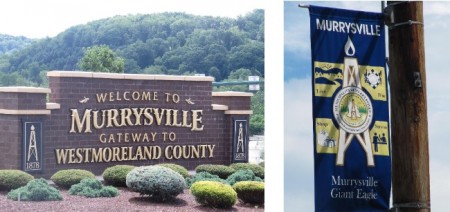
The derrick representing the original Haymaker Well is featured on the ‘Welcome to Murrysville’ sign on Route 22 East as well as on the many banner flags lining Old William Penn Highway in Murrysville.
The Murrysville Historical Preservation Society had hoped to preserve the grassy area along Turtle Creek as the “first commercial gas derrick in the world,” known as Haymaker No. 1. “It’s very disappointing,” said Carl Patty, president of the society.
 According to Trib Total Media, the commission stated that gas was piped from wells to homes in Venango County in 1867 and Crawford County in 1872. “Based on that information, it is difficult to see how (the Murrysville) site represents the first commercial gas well.”
Murrysville Historical and Preservation Society Secretary Jackie Stempfer said the group will appeal the decision. She questioned the dates of wells in the other counties. Special thanks to Murrysville resident Charles A. Hall, whose three books about the town’s history have been preserved and made available.
_______________________
Recommended Reading: The Extraction State, A History of Natural Gas in America (2021); Western Pennsylvania’s Oil Heritage

_______________________
The American Oil & Gas Historical Society (AOGHS) preserves U.S. petroleum history. Please become an AOGHS annual supporter and help maintain this energy education website and expand historical research. For more information, contact bawells@aoghs.org. Copyright © 2025 Bruce A. Wells. All rights reserved.
Citation Information – Article Title: “Natural Gas is King in Pittsburgh.” Authors: B.A. Wells and K.L Wells. Website Name: American Oil & Gas Historical Society. URL: https://aoghs.org/petroleum-pioneers/pennsylvania-natural-gas. Last Updated: October 30, 2025. Original Published Date: November 1, 2015.