Conrad Hilton saw a long line of roughnecks waiting outside a Texas hotel — and recognized an opportunity.
Hilton Hotels began in 1919, when Conrad Hilton witnessed a crowd of roughnecks waiting in front of a small hotel in Cisco, Texas. He had intended to buy a bank in the booming Ranger oilfield. “He can keep his bank!” declared the businessman before buying the Mobley Hotel.
On October 17, 1917, the McCleskey No. 1 well hit an oil-bearing sand at 3,432 feet deep and launched the world-famous Ranger oilfield boom. Thanks to this “Roaring Ranger,” in just 20 months the Texas Pacific Coal and Oil Company — whose stock had skyrocketed from $30 to $1,250 a share — was drilling 22 wells in the area.
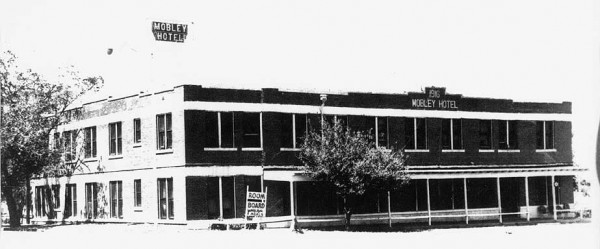
Conrad Hilton visited Cisco, Texas, intending to buy a bank. When the deal fell through, he went from the train station across the street to a two-story red brick building called the Mobley Hotel. He noticed roughnecks from the Ranger oilfield waiting in line for a room.
Eight Eastland County refineries were soon open or under construction, and Ranger’s four banks added $5 million in deposits. The Ranger oilfield and other nearby North Texas discoveries gained international fame by eliminating critical oil shortages during World War I — allowing the Allies to “float to victory on a wave of oil.”
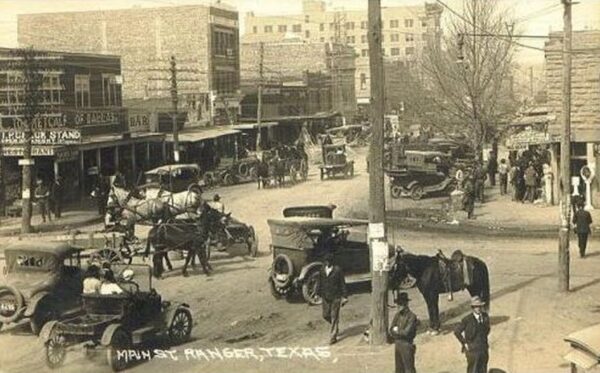
Ranger’s Main Street in the 1920s. The North Texas town’s petroleum boom came at a time when the industrialized world depended more and more on oil.
Investment capital and aspiring millionaires soon overwhelmed the little town of Ranger as well as nearby Cisco, where the Texas Central Railroad crossed the Texas & Pacific.

The new Texas oilfield gave birth to countless stories of fortunes made with gushers and good luck. But one tale endures of a fortune made because oil was easier to find than a good place to sleep.
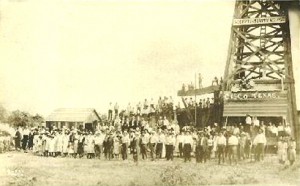
The McCleskey No. 1 well struck oil in October 1917, reached a daily production of 1,700 barrels — and launched an economic boom in Eastland County, Texas.
Conrad Hilton learned the banking business in his hometown of San Antonio, New Mexico (still a territory when he was born there in 1887). As a young man with only $2,900 capital, he founded the New Mexico State Bank of San Antonio. His tenacity in pursuit of investors and deposits paid off.
In two years, Hilton built his bank’s assets to $135,000. He believed he had found his life’s work. World War I interrupted his plans, prompting Hilton to sell his bank and serve his country.
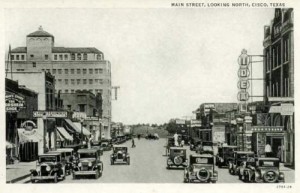
A postcard provides a view of downtown Cisco, Texas, in the 1920s.
Upon returning from France after the Armistice, Hilton began anew. He set out for Albuquerque, determined to start again in the banking business. But times had changed and banking opportunities had dried up. Despite Hilton’s best efforts, he couldn’t break back into the business.
Then a longtime Albuquerque friend, Emmett Vaughey, suggested Texas, where the Ranger oilfield was making millionaires. Persuaded and confident, Hilton boarded the train bound for Wichita Falls.
However, just as Hilton had discovered in Albuquerque, there was no room for a “new guy” in the solidly locked up banking community of Wichita Falls. The same was true even further south, in Breckenridge.
Disappointed but determined, Hilton continued down the Texas Central Railroad to the Cisco railway station, just east of Ranger’s booming oilfield in Eastland County. He was 31 years old and determined to build a banking empire.
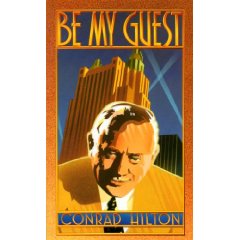
Conrad Hilton described his first hotel as “a cross between a flophouse and a gold mine.”
With $5,011 in his pockets, Hilton walked to the first bank he saw in Cisco and found to his delight that it was for sale — asking price — $75,000. Accustomed to finding financial backers and undeterred by the $70,000 shortfall, he wired the absentee Kansas City owner to close the deal.
First Hilton Hotel
Conrad Hilton was poised to build the banking empire he had long dreamed of when the Cisco bank seller sent him a telegram tersely raising the sale price to $80,000.
In his autobiography, Be My Guest, Conrad Hilton recalled telling the startled telegraph operator, “He can keep his bank! Then I strode out of the station and across the street to a two-story red brick building boosting itself as the ‘Mobley Hotel.’”
Henry Mobley, the hotel’s owner, was making the most he could off of the Ranger oilfield boom. His lobby was constantly packed with tired workers, maneuvering for space and impatiently awaiting their turn to rent a room. Mobley rented the hotel’s 40 beds in eight-hour blocks corresponding to shifts.
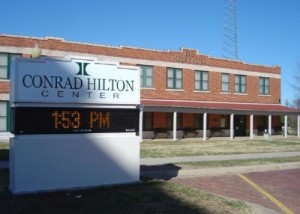
The first Hilton Hotel is a Cisco tourist attraction and community center.
Hilton joined the crowd in line, suddenly alert to an unanticipated opportunity. He approached Henry Mobley, who was convinced that the real money was in oil, not in the “glorified boarding house” business. Before long, they closed a $40,000 deal and Conrad Hilton had his first hotel. He would never return to banking.
Later in the year, with profits earned from the Mobley Hotel, Hilton bought the Melba Hotel in Fort Worth, and the following year the Waldorf in Dallas.
Although petroleum production from the Ranger field collapsed in 1921, taking with it scores of businesses and a number of failed banks, Hilton’s business continued to expand.
By 1923. Hilton owned five Texas hotels; the Dallas Hilton in 1925 became the first to use the Hilton name. By 1930, he was the largest hotel operator in the region.
The Depression and the years that followed brought Hilton many challenges. While memories of the Ranger boom slipped away, his business grew to dominate the hotel marketplace.
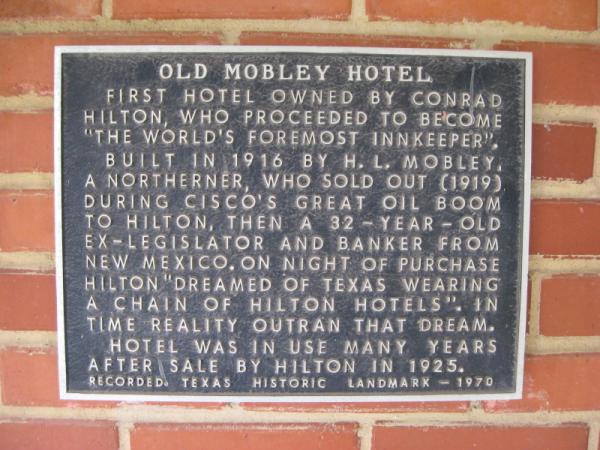
The restored Mobley building is no longer a hotel, but serves as a landmark community center, museum and city park. Two of the original rooms were restored to show visitors.
According to a National Register of listed sites narrative about the Mobley Hotel, Hilton considered his purchase the “ideal hotel to practice on.” Two principles now basic to all Hilton hotels were first tried in the Mobley: maximum reduction of wasted space and “esprit de corps” among the employees.
Hilton is remembered not as a banker but as a preeminent hotelier…and an oilfield entrepreneur. The restored and renovated Mobley Hotel, which Hilton once referred to as “a cross between a flophouse and a gold mine,” has become home to the Cisco Chamber of Commerce and serves as a community center, museum, and park.
Hilton later said he regarded his oil boom town purchase as his “first love” and “a great lady.”
In the years after World War I, as more “motor hotels” opened for automobile travelers, Hilton’s hotel competitors coined the term motel by 1925.
Learn more North Texas oil and gas history in Pump Jack Capital of Texas.
Bad Santa of Cisco
Adding to the lore of Cisco, Texas — in addition to being near the 1917 “Roaring Ranger” oilfield and home of Hilton’s first hotel — on December 23, 1927, a man disguised as Santa Claus made an ill-fated attempt to rob a bank two days before Christmas.
Marshall Ratliff donned a Santa Claus disguise and tried to rob the First National Bank with three armed accomplices. A running gun battle with police and citizens ensued before Ratliff was captured.
“After the gun smoke cleared, six people were dead, eight others wounded, two little girls and a young man had been kidnapped, and two bloody gun battles had been fought, launching the largest manhunt in Texas history,” explained Damon C. Sasser in “The Bloody Cisco Santa Claus Christmas Caper.”
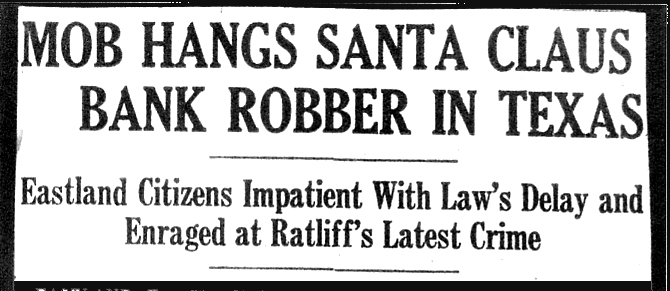
The mortal wounding of a guard during an escape attempt sealed bank-robbing Santa’s fate.
In November 1928, Ratliff attempted to escape from the Eastland County jail and mortally wounded a guard before being subdued. The next morning, enraged citizens dragged Ratliff from the jail and strung him up from a nearby utility pole. When the first rope broke, they got a new one that did not.
Organized in 1992, the Eastland County Museum & Historical Society maintains an archive of period photographs and other memorabilia related to the county.
_______________________
Recommended Reading: Be My Guest

_______________________
The American Oil & Gas Historical Society (AOGHS) preserves U.S. petroleum history. Become an AOGHS annual supporting member and help maintain this energy education website and expand historical research. For more information, contact bawells@aoghs.org. Copyright © 2023 Bruce A. Wells. All rights reserved.
Citation Information – Article Title: “Oil Boom Brings First Hilton Hotel.” Authors: B.A. Wells and K.L. Wells. Website Name: American Oil & Gas Historical Society. URL: https://aoghs.org/petroleum-pioneers/first-hilton-hotel. Last Updated: October 15, 2023. Original Published Date: July 1, 2005.