John Wilkes Booth and his actor friends drilled for Pennsylvania oil in 1864 — and found it.
After forming an oil company and drilling for “black gold” in booming northwestern Pennsylvania, the actor’s dreams of a petroleum fortune collapsed in June 1864. He then sought fame as a martyr to the Confederacy. A failed oilman turned assassin.
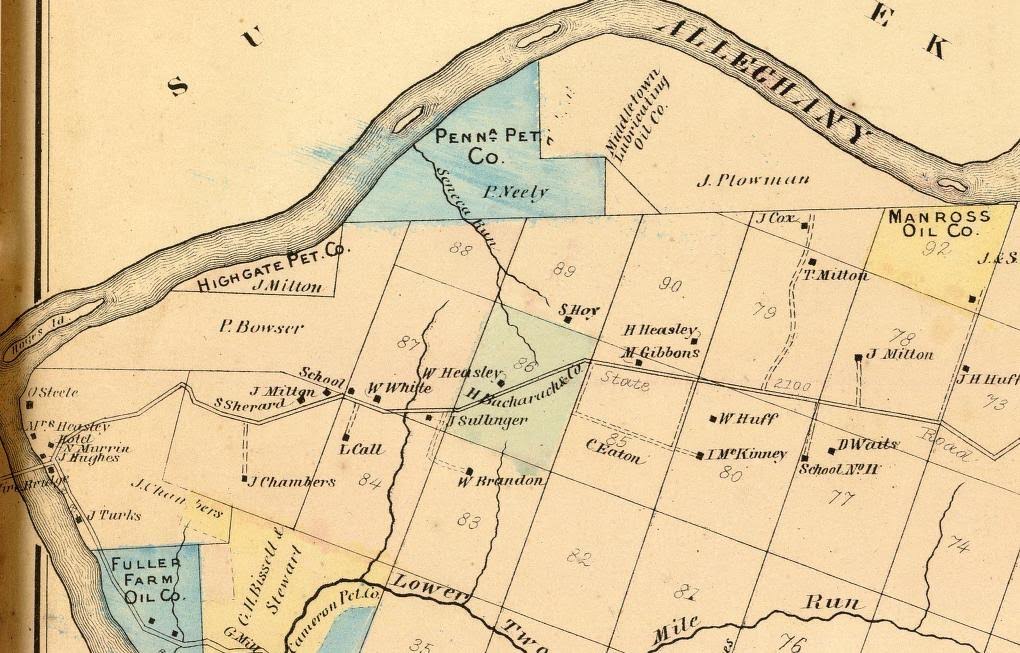
As the Civil War approached its bloody conclusion, John Wilkes Booth in January 1864 made the first of several trips to Franklin, Pennsylvania, where he purchased an oil lease on the Fuller farm. Maps reveal the three-acre strip of land on the farm, about one mile south of Franklin and on the east side of the Allegheny River.
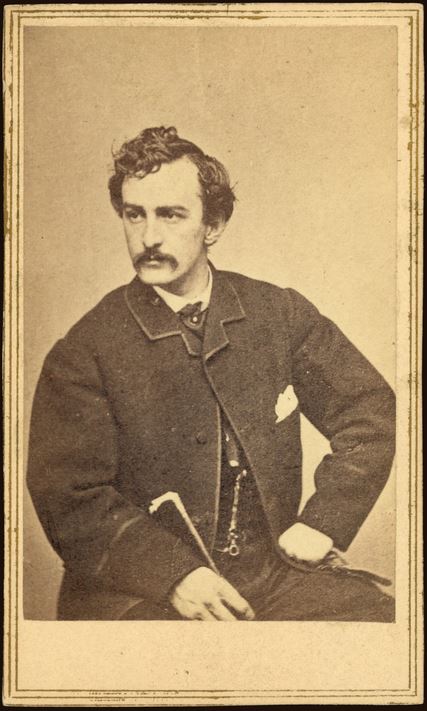
John Wilkes Booth’s dreams of Pennsylvania oil riches collapsed in July 1864. Photo courtesy Library of Congress.
Hidden deep in the woods of the “Valley that Changed the World,” a small concrete marker can be found (with some effort) at the actual site where the future assassin drilled for oil. The weathered post and Booth’s capped well stand about 20 miles south of an oil museum and park at Titusville — where the first commercial U.S. oil well was drilled in 1859 by former railroad conductor Edwin L. Drake.
Drilled for the Seneca Oil Company of New Haven, Connecticut, Drake’s August 27, 1859, discovery launched a drilling boom that made newspaper headlines (the industry’s first “dry hole” a few days later did not). Investors had organized Seneca Oil for tax advantages after founding the first American oil company established to drill for oil, the Pennsylvania Rock Oil Company of New York.
Actor and Oilman
The 1863 theater season had brought a handsome, 24-year-old aspiring actor the fame he had long pursued. For years, he had struggled in the shadows of his renowned thespian father, Junius, and brothers, Edwin and Junius, Jr.
John Wilkes Booth opened his stage career in 1855 at the Charles Street Theater in Baltimore and became a member of the Richmond Theater in 1858.
Unlike the rest of his family, he would become a Confederate sympathizer as audiences in Richmond adopted him as one of their own. They loved his energetic Shakespearean performances – the sword fights and dangerous leaps from balconies.
John Wilkes Booth made his first trip to the oil boom town of Franklin, Pennsylvania, in January 1864 after earning $20,000 during the theater season. He purchased a 3.5-acre lease on the Fuller farm.
Popular success followed on stages in Baltimore, New York, and Boston. “Star of the first magnitude,” “the youngest star in the world,” and “the most handsome man on the American stage” became commonplace praise in theater columns. Booth’s fortunes dramatically improved after years of just getting by. By 1862, he was earning $20,000 during the theater season (about $770,600 in 2025 dollars).
The now popular stage actor began spending his newfound wealth. Acquaintance John Simonds, a teller at Boston’s Mechanics Bank, assisted Booth in the purchase of a choice $8,000 lot in Boston’s exclusive Back Bay area. A devoted son, Booth had the property titled in his mother’s name, Mary Ann Booth.

Booth began investing to add to his wealth, buying $1,500 worth of Boston Water Company shares, as well as $3,000 in U.S. bonds and $1,000 in Philadelphia bonds. Riding the crest of his financial success, in December 1862 Booth wrote to his friend Edwin Keach, “My goose does indeed hang high.”
Dramatic Oil Company
In late 1863, John Wilkes Booth performed at the Cleveland Academy of Music, managed by his friend John Ellsler.
With newspapers full of tantalizing stories of the petroleum boom in Venango County and recent discoveries at Pithole Creek, Booth convinced Ellsler and Thomas Mears to join him in a new investment. They established the Dramatic Oil Company.
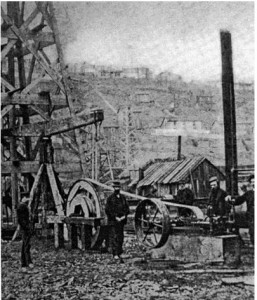
A typical Venango County drilling rig used a single-cylinder steam engine to lift and drop heavy cable tools. Photo detail courtesy Drake Well Museum.
In January 1864, Booth made his first trip to Franklin, Pennsylvania, where much of the oil excitement was centered. There he purchased a 3.5-acre lease on the Fuller farm.
The Venango County Recorder’s Office, Deed Book Z, page 309, subsequently detailed their agreement:
Between Thomas G. Mears of the city of Cleveland, State of Ohio, and Teresa Wilhelmina, his wife, parties of the first part, and Joseph H. Simonds of the Borough of Franklin, County of Venango and State of Pennsylvania, in trust for himself and John A. Ellsler of the city of Cleveland, State of Ohio and John Wilkes Booth of the city of New York, to be held as part for the sum of $4000 lawful money of the USA all that certain piece or parcel of land situate in the township of Cranberry, County of Venango, and the State of Pennsylvania.
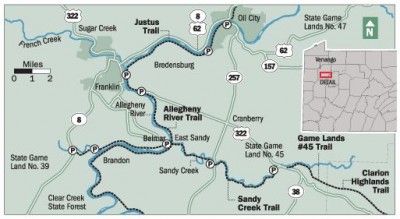
John Wilkes Booth drew his last paycheck as an actor in May 1864. He drilled in what would become Venango County’s scenic “Valley that Changed the World.”
The Dramatic Oil Company hired an experienced driller, Henry Sires. When first introduced to John Wilkes Booth at a typically grimy field location, Sires apologized for his oily handshake. “Never mind, that’s what we are after,” replied Booth.
They named their first well Wilhelmina in honor of partner Thomas Mears’ wife, and drilling began in the summer of 1864. The well proved costly and difficult, but to the partners’ delight the Wilhelmina No. 1 began producing oil from a depth of 1,900 feet. Oil prices that summer fluctuated, selling for about $16 to $20 a barrel.
Believing his fortune would be made in Pennsylvania oilfields, Booth drew his last paycheck as an actor and left the Boston stage on May 28, 1864. He wanted to focus exclusively on his petroleum business.
Shooting the Well
By June 1864, Booth had invested another $1,000 of his now substantially diminished cash for a 1/30 share in a Boston Oil Well Company lease (later Botolph Oil & Mining Company) on the Hyner farm at booming Pithole Creek.
Meanwhile, the Dramatic Oil Company’s Wilhelmina well was producing about 25 barrels of oil daily — but was beset with problems and mounting costs. Booth and his partners finally determined that “shooting” their well could increase its production.
At the time, this fracturing technique required that a large quantity of black powder be detonated deep in the well.
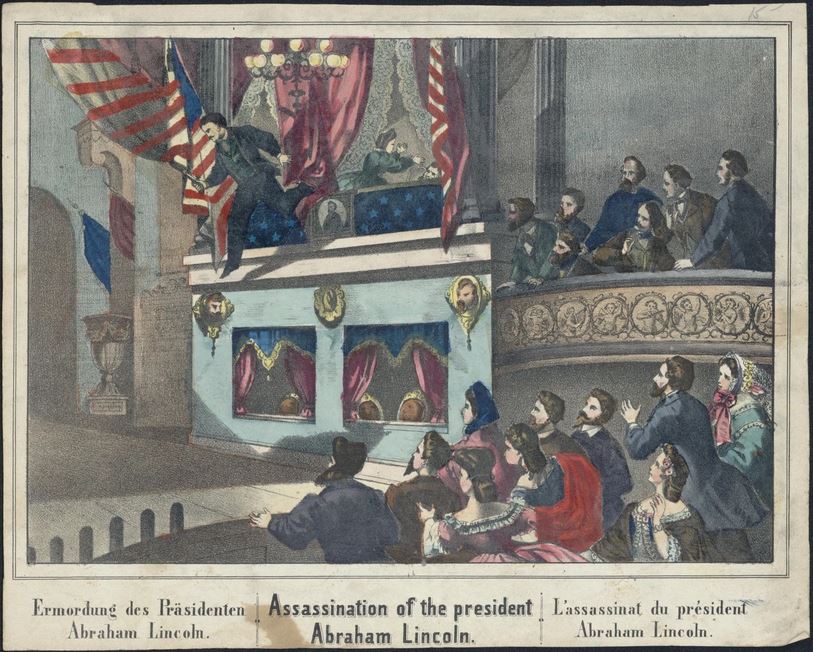
John Wilkes Booth left Pennsylvania in July 1864 — and began the conspiracy that would end with President Lincoln’s assassination. Image courtesy Library of Congress.
Successful shooting would fragment an oil-bearing formation and enable far more oil to be extracted from the well. Booth and his partners gambled. They lost. “The well was ‘shot’ with explosives to increase production,” reported Thomas Mears’ son Frank. “Instead of accomplishing that, the blast utterly ruined the hole and the well never yielded another drop.”
Learn more about the history of well fracturing technology in Shooters — A “Fracking” History.
Failed Oilman turns Assassin
John Wilkes Booth’s hopes for Pennsylvania oil wealth abruptly and permanently collapsed. He had lost over $6,000 in the Wilhelmina well. Booth left the oil region in July 1864 — no longer the wealthy entrepreneur he had been just 18 months earlier.
A few weeks later, Booth checked into Baltimore’s Barnum Hotel. In this hotel, the Lincoln conspiracy first began to take shape with Booth’s boyhood friends and former Confederate soldiers, Michael O’Laughlen and Samuel B. Arnold.

Over the next eight months, the plan would evolve from kidnapping to assassination, culminating in Ford’s Theater on April 14, 1865, when Booth assassinated President Abraham Lincoln. His own life ended with a bullet when the Union cavalry caught up with him 12 days later, about 60 miles south of Washington, D.C.
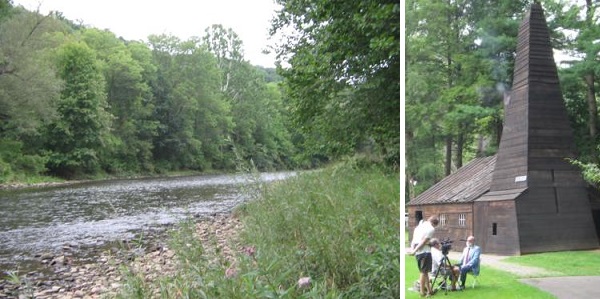
Once lined with hundreds of wooden cable-tool derricks, Oil Creek today attracts hikers, canoeists, anglers — and tourists to the Drake Well Museum in Titusville, Pennsylvania. Photos by Bruce Wells.
Two months after John Wilkes Booth’s death, a major oilfield discovery was made on the Hyner farm of Pithole Creek. The “Homestead Well” would yield 500 barrels of oil a day — and make many fortunes. Nobody can know what path Booth and the nation might have taken had his venture into Pennsylvania’s oilfields succeeded.
Explore a replica cable-tool derrick at Edwin L. Drake’s historic well site by visiting the Drake Well Museum and Park in Titusville.
Finding Booth’s Oil Well
The Samuel Justus Recreational Trail Visitor Center on Highway 322 offers access to the Allegheny River and the site of Booth’s well, unmarked in 2014 when visited by American Oil & Gas Historical Society volunteers. A chiseled but unlettered stone stood near the capped well.
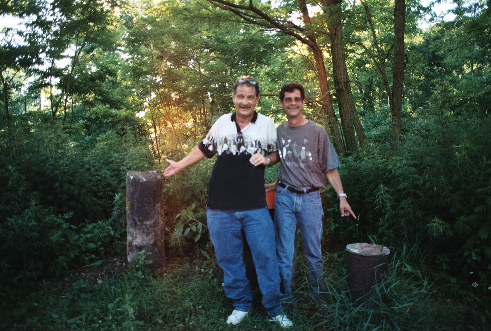
American Oil & Gas Historical Society volunteers Kris and Tim Wells stand in summer of 2014 near Allegheny River, Pennsylvania, site of the fateful well drilled by the Dramatic Oil Company in 1864. Photo by Bruce Wells.
A Venango County deed book described Booth’s lease as bordered “on the north by lands of Murrin; on the east by the public road leading from Franklin to Clarion; on the south by the lands of Vance Stewart; and on the west by the Allegheny River containing three acres more or less.”
The 1870 book Petrolia: A Brief History of the Pennsylvania Petroleum Region by Andrew Cone and Walter R. Jones described the Damtatic Oil Company’s well location as “half a mile south of Franklin bridge, Allegheny River fronting it on the west.”
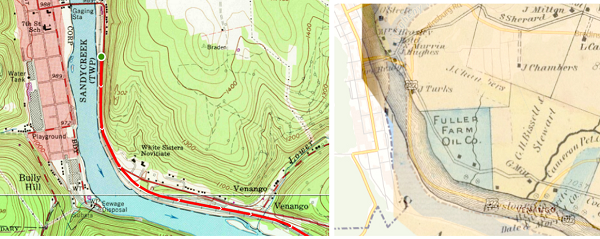
Maps show John Wilkes Booth’s well location based on an 1870 description as “a half a mile south of Franklin bridge, Allegheny River fronting it on the west.” Mapping courtesy David Rumsey.
The authors listed the well’s owners as “Simonds, Jacobs, J. Wilkes Booth’s (of infamous notoriety) heirs” and noted the Fuller Farm was purchased in 1865, “bounded on the north by Booth, east by Bissell, south and west by river.”
According to John J. McLaurin’s 1898 book Sketches in Crude Oil, the lease “was sliced off the north end of the (Fuller) farm, a short distance below the upper bridge and valley station,” while noting that “the farm is producing no oil and the Simonds-Booth wells have disappeared.”
_______________________
Recommended Reading: Petrolia: A Brief History of the Pennsylvania Petroleum Region (1870); Sketches in Crude-Oil (1902); Myth, Legend, Reality: Edwin Laurentine Drake and the Early Oil Industry
_______________________
The American Oil & Gas Historical Society (AOGHS) preserves U.S. petroleum history. Please support this energy education website, subscribe to our monthly email newsletter, and help expand historical research. Contact bawells@aoghs.org. Copyright © 2026 Bruce A. Wells.
Citation Information – Article Title: “Dramatic Oil Company.” Authors: B.A. Wells and K.L. Wells. Website Name: American Oil & Gas Historical Society. URL: https://aoghs.org/stocks/the-dramatic-oil-company. Last Updated: April 8, 2026. Original Published Date: June 1, 2005.