Santa Rita taps Permian Basin
West Texas discoveries in the 1920s revealed a petroleum expanse 250 miles wide and 300 miles long.
A West Texas oil well blessed by nuns revealed the true size of the petroleum-rich Permian Basin in 1923. A small university in Austin owned the arid land, which had been deemed mostly worthless by experts.
Successful exploration of the Permian Basin, once known as a “petroleum graveyard,” began in February 1920 with a discovery by William H. Abrams in Mitchell County in West Texas. When completed after “shooting” the well with nitroglycerin in July, production averaged 20 barrels of oil a day.
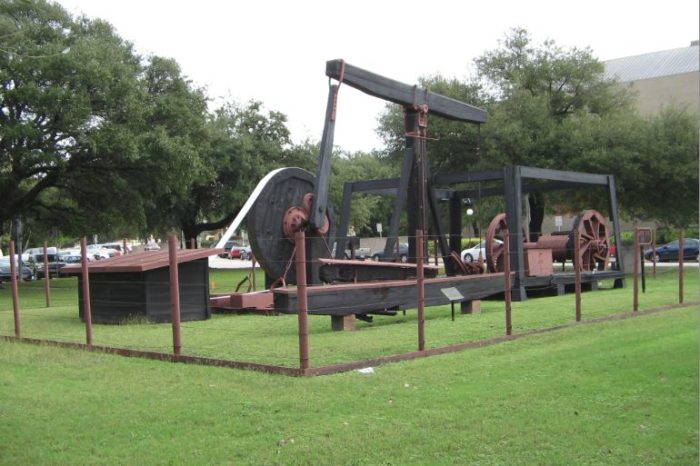
In 1958, the University of Texas moved the Santa Rita No. 1 well’s walking beam and other equipment to the Austin campus. The student newspaper described the well, “as one that made the difference between pine-shack classrooms and modern buildings.” Photo from 2007 by Bruce Wells.
The W.H. Abrams No. 1 oilfield discovery well of the Permian Basin would lead to the area’s first commercial oil pipeline in the Permian Basin, according to a Texas Historical Commission historic marker placed near the well in 1996 (reported missing in 2020).
Meanwhile, even with its limited production, the Abrams well began attracting oil exploration to the barren region.
West Texas Oilfields
It would be another Permian Basin discovery well that launched a stampede of wildcatters to explore the full 300-mile extent of the basin from West Texas into southeastern New Mexico.
Geologists remained unconvinced the Permian Basin contained commercial amounts of petroleum until the Santa Rita No. 1 well tapped a vast oilfield. The well, drilled by Texon Oil and Land Company near Big Lake, Texas, struck oil on land leased from the University of Texas. Drilling stopped for the day, but the next morning, May 28, 1923, the well came in, “spewing a mist of black oil.”
It had not been easy for Texon Oil and Land Company. The well required 21 months of cable-tool drilling that averaged less than five feet per day to reach a total depth of 3,055 feet. Once completed at a reported “pay zone” of 2,480 feet, the well produced oil for the next 70 years.
Because state legislators had given the land and mineral rights to the University of Texas when it opened in 1883, the oilfield’s royalties would endow the University of Texas with $4 million.
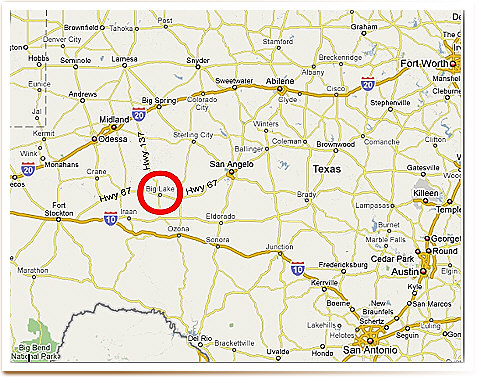
Discovery of the Big Lake oil field in 1923 led to many boom towns, including Midland, which some called “Little Dallas.”
The Texas Board of Regents moved Santa Rita’s drilling equipment to the campus in 1958, “In order that it may stand as a symbol of a great era in the history of the university.” After the dedication, the student newspaper of the day described the well “as one that made the difference between pine-shack classrooms and modern buildings.”
Santa Rita No. 1
The historic well’s oil discovery began in 1919 when attorney and oil speculator Rupert Ricker applied to lease rights on more than 430,000 acres of arid land designated by the state for the financing of the University of Texas. As time ran out to pay a filing fee of about $43,000, Ricker failed to raise money from Fort Worth investors.

“Nobody seemed to have any interest in the deal so with the deadline looming he sold the entire scheme to El Pasoans Frank T. Pickrell and Haymon Krupp for the sum of $2,500,” noted a 2017 article in the Permian Basin Petroleum Association Magazine. The men had served in the same Army company during World War I. They looked at an area west of the Reagan County seat Big Lake.
San Antonio geologist Hugh Tucker, hired to survey the are at $100 a day, mapped a “sure to exist” subsurface area nine miles wide and 30 miles long a few miles from the town of Best, two miles south of the tracks of the Kansas City, Mexico & Orient Railroad, according to research by The Texas Compound. “Pickrell cogitated on this and came to the conclusion that if the structure was that large, he would rather drill right by the tracks, so a location was picked 175 feet north of the railroad.”
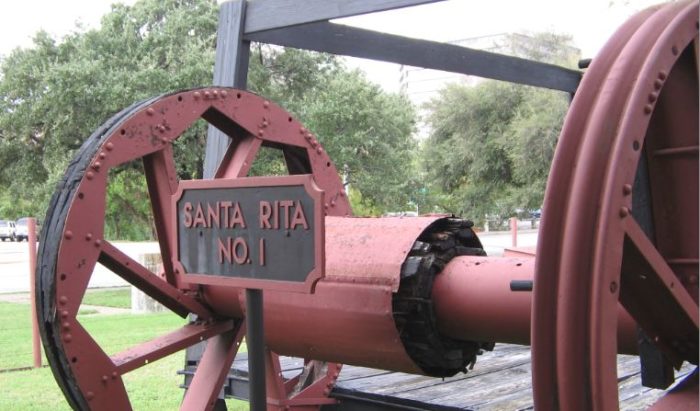
A 2007 University of Texas exhibit featured original Santa Rita cable-tool drilling equipment at San Jacinto Boulevard and 19th Street on the Austin campus. Photo by Bruce Wells.
Pickrell hired an experienced Pennsylvania drilling contractor, Carl Cromwell, to drill the Texon Oil and Land Company well. Cromwell had been born in 1889 not far from the first commercial U.S. oil well in Titusville, Pennsylvania. The Santa Rita No. 1 wildcat well began “making hole” shortly before midnight on August 17, 1921 — on the last day before the 18-month drilling permit expired.
Nuns and Roses
At the time, West Texas drilling crews, when available, “consisted mostly of cowboy roustabouts who were distinguished for high absenteeism and steady turnover,” notes one historian. The well often needed to be shut down because of a lack of cash to pay salaries or buy supplies.

Several months after the start of drilling, an increasingly concerned Pickrell climbed the derrick. At the top, he threw handfuls of rose petals that a group of Catholic women investors from New York had given him and christened his wildcat well for the Patroness of Impossible Causes, Santa Rita.
On May 25, 1923, early signs of oil and natural gas appeared. Three days later, Santa Rita No. 1 roared in — erupting as a West Texas gusher. People as far away as Fort Worth traveled to see the column of “black gold.” Much-needed well casing and other well equipment arrived a month later to bring the well under control, and the first commercial well in the Permian Basin went into production.
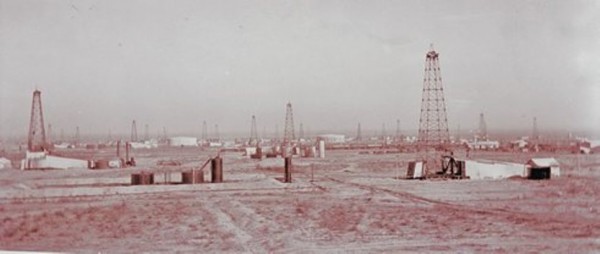
The Big Lake field — at 4.5 square miles — revealed that shallow and deep formations contained vast oil reserves. Drilling spread throughout the Permian Basin, still among the largest U.S. oil-producing regions.
In the fall of 1923, Pickrell found an important investor, Michael L. Benedum, the highly successful independent oilman from Pittsburgh, Pennsylvania. Benedum and another Pittsburgh wildcatter, Joseph Trees, purchased Texon properties and formed the Big Lake Oil Company in 1924.
Big Lake Oilfield
The new company’s president, Levi Smith, would be instrumental in creating Big Lake — the first oil company town in the Permian Basin. Santa Rita No. 1 well, “Discovery Well of the Big Lake Pool,” would be preserved, its cable-tool equipment moved to the University of Texas campus at Austin.
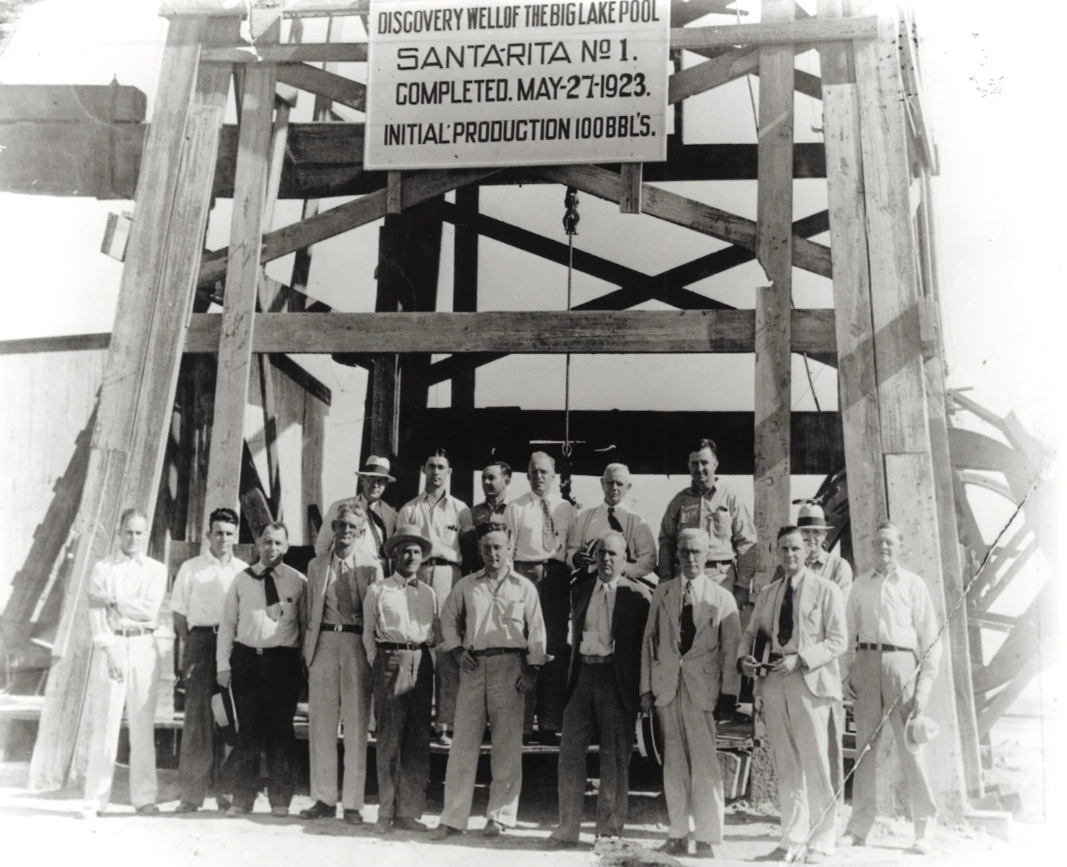
A circa 1934 photo of Sant Rita No 1 well with W.M. Griffith, assistant superintendent of Big Lake Oil Company, at front left among University of Texas regents, surveyors, Big Lake Oil geologists, and petroleum engineers. Photo courtesy Texas Compound.
The Big Lake oilfield proved to be 4.5 square miles and demonstrated that vast oil reserves in West Texas came from both shallow and deep horizons. Exploration spread into other areas of the Permian Basin, which would become one of the largest oil-producing regions in the United States.
Big Lake’s Reagan County Park includes a replica of Santa Rita No. 1 derrick, an the original Santa Fe Depot, a historic jail house — and “The Rookie” baseball field.
The Permian Basin’s Petroleum Museum in Midland also preserves West Texas history. In neighboring Odessa, an Ector County historic marker erected in 1965 notes “the first Permian Basin dry hole.” Pennsylvania independent operators drilled the well to 900 feet and found only “Red Bed” rock in 1924. That well would be abandoned but Ector County would have 9,600 producing wells by 1964.
Hollywood at Big Lake
The 2002 movie “The Rookie” was filmed almost entirely in West Texas. It featured a Big Lake high-school teacher played by Dennis Quaid, who despite being in his mid-30s briefly makes it to the major leagues.
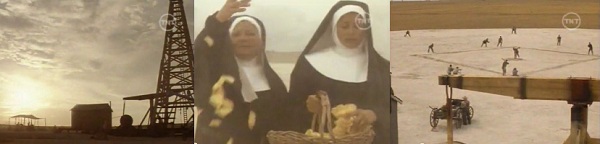
The opening scenes of the 2002 movie “The Rookie” included Catholic nuns christening the wildcat well with rose petals.
As the well is being drilled, Catholic nuns are shown carrying a basket of rose petals to christen it for the patron Saint of the Impossible – Santa Rita.
Learn more about baseball teams fielded by petroleum “company towns” in Oilfields of Dreams.
_______________________
Recommended Reading: Santa Rita: The University of Texas Oil Discovery

_______________________
The American Oil & Gas Historical Society (AOGHS) preserves U.S. petroleum history. Please support AOGHS to help maintain this energy education website, a monthly email newsletter, This Week in Oil and Gas History News, and expand historical research. Contact bawells@aoghs.org. Copyright © 2026 Bruce A. Wells.
Citation Information – Article Title: “Santa Rita taps Permian Basin.” Authors: B.A. Wells and K.L. Wells. Website Name: American Oil & Gas Historical Society. URL: https://aoghs.org/petroleum-pioneers/west-texas-petroleum. Last Updated: March 3, 2026. Original Published Date: November 1, 2004.