Powered by an railroad diesel-electric engine in 1934, a “Streamliner” cut steam locomotion time by half.
By the early 1930s, America’s passenger railroad business was in deep trouble. In addition to the Great Depression, the once dominant transportation industry faced growing competition from automobiles. New U.S. refineries produced vast amounts of gasoline, thanks to giant oilfield discoveries like Spindletop Hill in Texas.
Primitive diesel engines of the day remained heavy and slow. The railroad diesel-electric engine was in the future.
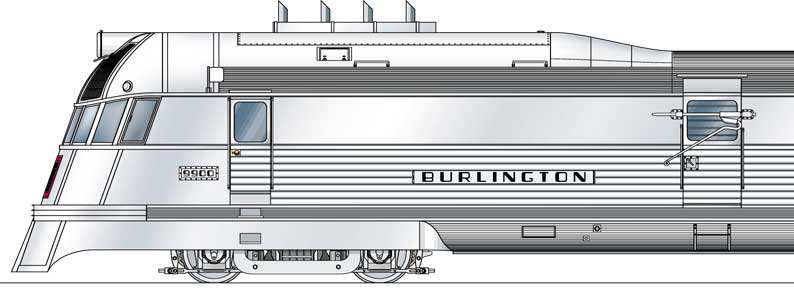
Diesel-electric engines pioneered by General Motors and Winton Engine Company saved America’s railroad passenger industry. Two-stroke diesel engines provided a four-fold power to weight gain. Photo courtesy Model Railroader magazine, January 1999.
It had been just 60 years since coal-burning steam locomotives and the transcontinental railroad had linked America’s east and west coasts on May 10, 1869. Despite the hard economic times, gasoline powered more than 30 million cars, trucks, and buses on U.S. roads (many without asphalt paving). But what would power heavy transportation?
“Once I built a railroad, I made it run, made it race against time. Once I built a railroad; now it’s done. Brother, can you spare a dime?” — Bing Crosby, 1932.
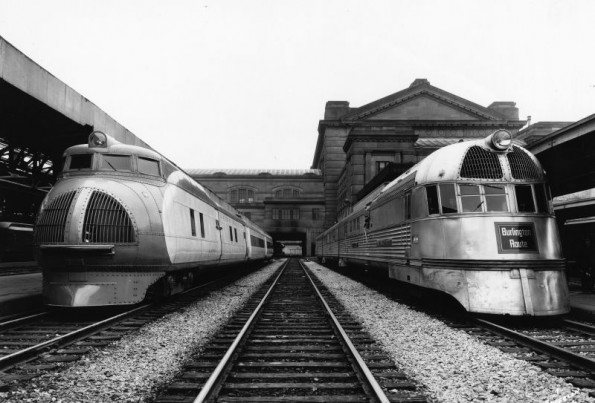
The two “streamliner” trains that changed America’s railroad industry in the late 1930s: the Union Pacific M-10000 (left) and Burlington Zephyr. Today the Zephyr is on display at the Chicago Museum of Science and Industry. Photo courtesy Union Pacific Museum.
Although railroad steam engine technology had advanced since the “golden spike” of 1869 in Promontory Point, Utah, locomotives still “belched steam, smoke, and cinders,” noted one railroad historian, adding “Passengers often felt like they had been on a tour of a coal mine.”

While most locomotives were still steam-powered, General Electric built America’s first commercially successful gasoline-powered engine locomotive in 1913. Two 175-horsepower V-8s powered two 600-volt, direct current generators to propel the 57-ton locomotive to a top speed of 51 miles per hour.
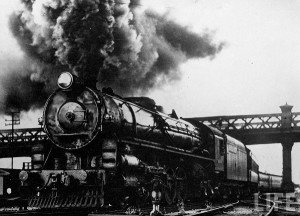
Diesel engines had been used since about 1925. The engines were heavy, producing only a single horsepower from 80 pounds of engine weight.
The Electric Line of Minnesota Company purchased this new gas-powered electric hybrid for $34,500 and named it “Dan Patch” in honor of the world’s champion harness horse of the time. It would not be long before diesel engines with electric generators would transform train travel.
Primitive diesels had been used in switch engines from about 1925, but they were slow, according to Richard Cleghorn Overton in Burlington Route: A History of the Burlington Lines. But the railroads’ distillate-burning internal combustion engines proved heavy and difficult to maintain.
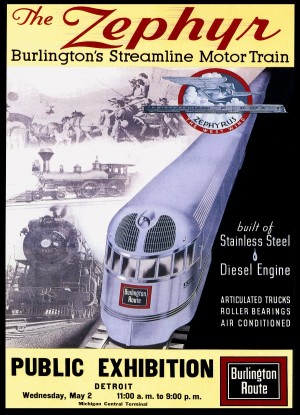
The powerful diesel-electric Zephyr arrived in 1934; its technology was a result of the Navy’s search for an improved submarine engine.
Burning fuels ranged from a low-grade gasoline to painter’s naphtha and diesel. Distillate railroad engines emitted an oily smoke and often produced only a single horsepower from 80 pounds of engine weight. These common four-stroke engines fouled easily and required multiple spark plugs per cylinder.
Help for America’s failing passenger railroads would come from U.S. Navy diesel-electric engine technology, wrapped in a stainless steel Art Deco locomotive.
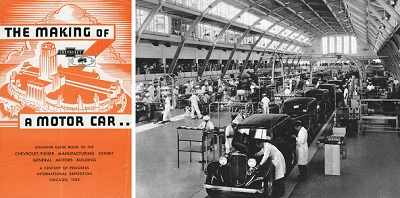
New diesel-electric engines generated power for the “Making of a Motor Car” exhibit at the 1933 Century of Progress fair in Chicago. The assembly line fascinated visitors who watched from overhead galleries.
“Wings to the Iron Horse…Burlington pioneers again — the first diesel streamline train,” proclaimed passenger rail advertisements in the 1930s. The long awaited technology for railroad diesel-electric engines had arrived.
Railroad Diesel-Electric Engines
With the Nazi threat and war on the horizon, the U.S. Navy needed a lighter weight, more powerful diesel engine for its submarine fleet. The Navy also recognized it had been too slow converting its surface vessels from coal to fuel oil (see Petroleum and Sea Power).
General Motors joined the nationwide competition to develop a new diesel engine for the Navy.
Seeking engineering and production expertise, in 1930 GM acquired the Winton Engine Company of Cleveland, Ohio. Winton, established in 1896 as Winton Bicycle Company, was an early automobile manufacturer. Winton Engine Company evolved into a developer of engines for marine applications, power companies, pipeline operators — and railroads.
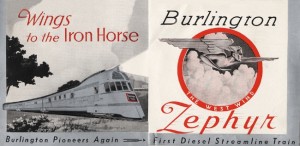
America’s first diesel-electric train, the Burlington Zephyr, was a transportation milestone.
With GM’s financial backing, Winton engineers designed a radical new two-stroke diesel that delivered one horsepower per 20 pounds of engine weight. It provided a four-fold power to weight gain.
The Model 201A prototype — a 503-cubic-inch, 600 horsepower, 8-cylinder diesel-electric engine — used no spark plugs, relying instead on newly patented high pressure fuel injectors and a 16:1 compression ratio for ignition.
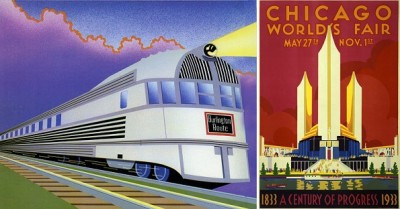
Powered by an eight-cylinder Winton 201A diesel engine, the revolutionary “streamliner” traveled the 1,015 miles from Denver to Chicago in just over 13 hours — a passenger train record.
At Chicago’s Century of Progress World’s Fair in 1933, GM evaluated two railroad diesel-electric engines, using them to generate power for its “Making of a Motor Car” exhibit. The working demonstration of a Chevrolet assembly line fascinated thousands of visitors who watched from overhead galleries.
One visitor happened to be Ralph Budd, president of the Chicago, Burlington & Quincy Railroad (known as the Burlington Line). Budd recognized the locomotive potential of these extraordinary new diesel-electric power plants. He saw them as a perfect match for the lightweight “shot-welded” stainless steel rail cars pioneered by the Edward G. Budd (no relation) Manufacturing Company in Philadelphia.
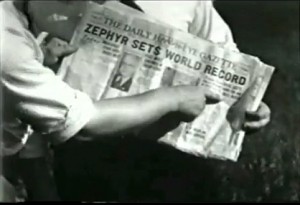
During its “dawn to dusk” record-breaking run, the Zephyr burned only $16.72 worth of diesel fuel.
Edward Budd was the first to supply the automobile industry with all steel bodies in 1912. His success in steel stamping technology made the production of car bodies cheaper and faster. By 1925, his system was used to produce half of all U.S. auto bodies.
The Depression, however, put the Budd Manufacturing Company almost $2,000,000 in the red — prompting its fortuitous diversification into the railroad car market to generate revenue. When approached by Burlington President Ralph Budd in 1933, this Budd was ready.
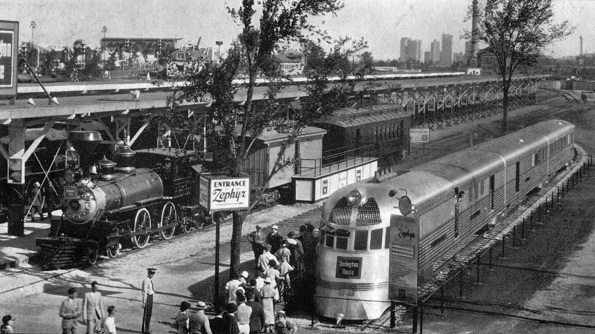
Chicago World’s Fair visitors line up to admire the stainless steel beauty of the Burlington Zephyr, which will soon be featured in a Hollywood movie. Eight major U.S. railroads soon convert to efficient diesel-electric locomotives. Photo from a Burlington Route Railroad 1934 postcard.
Within a year, the two technologies were successfully merged with the creation of the Winton 201A powered Burlington Zephyr, America’s first diesel-electric train. It would change railroad transportation history.
Art Deco Silver Streak
The Zephyr rolled into Chicago’s Century of Progress exhibition on May 26, 1934, ending a nonstop 13 hour, 4 minute, and 58 second “dawn to dusk” promotional run from Denver.
Powered by a single eight-cylinder Winton 201A diesel, the “streamliner” cut average steam locomotive time by half. The Zephyr traveled 1,015 miles at an average speed of 76.61 miles per hour and reached speeds along the route in excess of 112 mph — to the amazement and delight of track-side spectators from Colorado to Illinois.
During its record-breaking run, the Zephyr burned just $16.72 worth of diesel fuel (about four cents per gallon). The same distance in a coal steamer would have cost $255. Construction innovations included the specialized shot-welding that joined sheets of stainless steel.
The lightweight steel also resisted corrosion so it didn’t have to be painted.
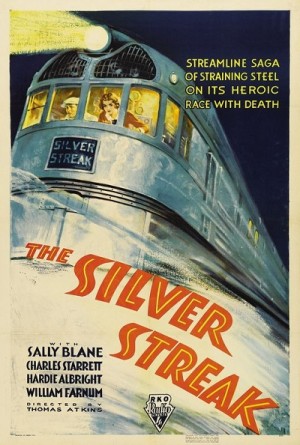
Although ”The Silver Streak” was a 1934 “B” movie — intended for the bottom half of double features — it remains a favorite of some railroad history fans.
Americans fell in love with the Zephyr. Four months after its high-speed appearance at Chicago’s Century of Progress, the streamliner made its 1934 Hollywood film debut, starring as “The Silver Streak” for an RKO picture.
The Zephyr was loaned for filming — and the Burlington logo on its front was repainted to read Silver Streak. “The stream-lined train, platinum blonde descendant of the rugged old Iron Horse, has been glorified by Hollywood in the modern melodrama,” proclaimed the New York Times.
Although the black-and-white “B” movie came and went without making much of a splash, it has won its place in movie history as a rail-fan favorite, according to a 2001 article in the Zephyr Online. “It did have a lot of action, and the location shots of the Zephyr are an interesting record of this pioneer.”
The RKO film should not to be confused with 20th Century Fox’s 1976 comedy “Silver Streak,” which was filmed in Canada using Canadian Pacific Railway equipment from the Canadian, a transcontinental passenger train.
WWII Submarine Power
By the end of 1934, eight major U.S. railroads had ordered diesel-electric locomotives. The engine technology’s cost advantages in manpower, maintenance, and support were quickly apparent.
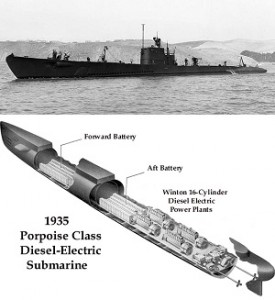
Winton diesel-electric engines powered a new generation of U.S. submarines. The Porpoise (SS-172) was the first of its class to join the fleet in 1935 — and served throughout World War II..
Despite the greater initial cost of diesel-electric, a century of steam locomotive dominance soon came to an end. By the mid-1950s, steam locomotives were no longer being manufactured in the United States.
GM won the Navy’s competition for a lightweight powerful diesel — choosing the 16-cylinder Winton Engine Company diesel-electric to power a new class of submarine. In 1935, the USS Porpoise was first to join the fleet, where it served throughout World War II. Diesel-electrics power plants descended from the Burlington Zephyr would remain part of the fleet until replaced by nuclear propulsion.
A Zephyr competitor — the Union Pacific M-10000 built by the Pullman Car & Manufacturing Company — also showcased railroad diesel-electric engine technology at the Century of Progress World’s Fair in Chicago.
In fact, the aluminum M-10000 streamliner was revealed six weeks earlier than the Zephyr. Recognized as America’s first streamliner, the M-10000 was cut up for scrap in 1942. The Zephyr (later renamed the Pioneer Zephyr) ended up on display at the Chicago Museum of Science and Industry.
_______________________
Recommended Reading: Burlington’s Zephyrs, Great Passenger Trains

_______________________
The American Oil & Gas Historical Society (AOGHS) preserves U.S. petroleum history. Become an AOGHS annual supporting member and help maintain this energy education website and expand historical research. For more information, contact bawells@aoghs.org. © 2023 Bruce A. Wells.
Citation Information – Article Title: “Adding Wings to the Iron Horse.” Authors: B.A. Wells and K.L. Wells. Website Name: American Oil & Gas Historical Society. URL: https://aoghs.org/transportation/adding-wings-to-the-iron-horse. Last Updated: May 21, 2023. Original Published Date: April 29, 2014.