Your source for energy education. Petroleum history offers a context

for teaching the modern business of meeting America's energy needs.

Oil and Natural Gas History, Education Resources, Museum News, Exhibits and Events


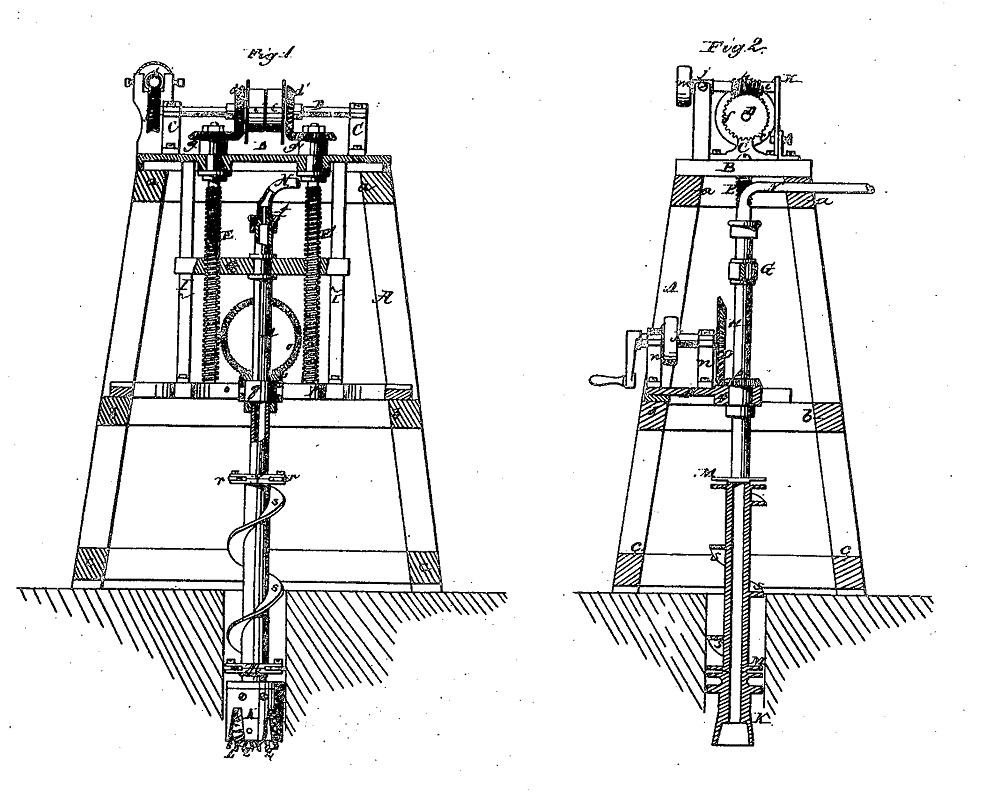
For some, the beginning of the modern offshore oil and natural gas industry can be traced to an 1869 U.S. patent.

Although it will never be constructed as originally designed, Thomas Rowland's offshore platform with its four telescoping legs is an 1869 technological marvel.

Although it will never be constructed as originally designed, Thomas Rowland’s offshore platform with its four telescoping legs is an 1869 technological marvel.

On May 4, 1869, Thomas Fitch Rowland (1831-1907), owner of Continental Iron Works in Greenpoint, New York, received a patent for his “submarine drilling apparatus.”

Rowland’s patent (No. 89,794) for a fixed, working platform for drilling offshore to a depth of almost 50 feet – just ten years after Edwin Drake made the nation’s first commercial oil discovery in Titusville, Pennsylvania – pioneers modern offshore drilling technology.

Although his rig is designed to operate in shallow water, the anchored, four-legged tower resembles modern offshore rigs. It has telescoping legs.

My invention consists – First, in novel construction of drill frame, or stand, or, as it may be termed, working-platform, by providing or forming it with telescopic legs made up of tubes and plungers.

The platform’s legs are connected with suitable hydraulic attachments or devices for forcing water into the legs for the proper support of the platform at different elevations, according to the depth of the water, and to adjust the legs or their plungers to a firm bearing on the rock to be drilled. Read the rest of this entry »


On April 22, 1920 – Natural Gas discovered in South Arkansas

The Arkansas Natural Resources Museum opened in 1986.

The first natural gas well in south Arkansas is completed two and a half miles southeast of El Dorado.

Drilled to a depth of 2,247 feet, the well produces between 40 million to 60 million cubic feet of gas a day – and “a spray of oil produced from the Nacatoch sands,” according to The Discovery of Oil in South Arkansas, 1920-1924.

Although just six days earlier a small independent company completes the first oil well in Arkansas, the well does not produce commercial quantities. Officially, it will be the January 10, 1921, Busey-Armstrong No. 1 well’s discovery of oil that launches the state’s petroleum industry.

By 1925, a young oilman named Haroldson Lafayette “H.L.” Hunt has acquired substantial holdings in the El Dorado and Smackover fields. In 1930 he will discover the largest oilfield in the United States less than 175 miles away. Read “H.L. Hunt and the East Texas Oilfield.” Read the rest of this entry »


For more than 100 years, nitroglycerin detonations increased a well’s production from petroleum bearing formations. Modern hydraulic fracturing technology can trace its roots to April 25, 1865, when Civil War veteran Col. Edward A. L. Roberts received the first of his many patents for an “exploding torpedo.”

More effective — and far safer — than nitroglycerin, hydraulic fracturing has been used since 1949. Today, about 30 percent of U.S. oil and natural gas reserves are accessible through “fracking.”

Read the rest of this entry »


Geology in Bartlesville, Oklahoma, marks the spot where on April 15, 1897, a large crowd gathered at Nellie Johnstone No. 1 to watch as as a “go devil” was used to “shoot” the well – a downhole nitroglycerin explosion to maximize production – before it was completed.

Prior to the Civil War, America’s search for oil prompted entrepreneurs, speculators, and wildcatters to seek their fortunes on the great plains of the Indian Territory.

This was land reserved for Native Americans by Congress and home to its indigenous people as well as the “Five Civilized Tribes” – Choctaw, Cherokee, Seminole, Creek, and Chickasaw, which had been relocated from the Southeast.

Today, Oklahoma ranks 7th in U.S. oil production and 4th in natural gas. George B. Keeler and William Johnstone are remembered as the Indian Territory entrepreneurs who opened an Oklahoma oil boom that continues to this day.

Each of the Five Civilized Tribes established national territorial boundaries, constitutional governments, and advanced judicial and public school systems. The Indian Territory included present-day Oklahoma north and east of the Red River, as well as Kansas and Nebraska.

Discovering Indian Territory Oil

By 1856, fifty-one years before Oklahoma statehood, the Indian Territory had become home to the Five Civilized Tribes – as well as the Osage, Pawnee, Seneca, Shawnee, Delaware, and others.

A non-tribal member coming into the Indian Territory to work was required to take out a license or permit; one who married into a tribe was adopted and able to share in tribal property.

In 1859, Lewis Ross, a brother of Chief John Ross of the Cherokees, found a pocket of oil that produced about ten barrels a day for nearly a year. He was drilling for saltwater – brine being  much-desired for making salt, a food preservative.

Ross drilled his well on the Grand River near Salina in what is now Mayes County, Oklahoma. After deciding to sink a deeper well for greater production, he found oil instead. News spread of this potential source of tribal revenue.

Spectators watched as Miss Jenni Cass, dropped a weighted percussion device (often called a go devil) down the well bore to set off a waiting canister of nitroglycerin – producing a gusher that heralded the beginning of Oklahoma’s oil era.

According to the constitutions of the Choctaw and Chickasaw nations at that time, the land was held in common by the Indian citizens of the nations – but the individual citizens could lease out a limited amount of land.

The Ross well was quickly depleted, but it proved that there was oil to be found in the Indian Territory.

By 1875, Jacob H. Bartles, another pioneer and adopted Delaware Indian, was operating a trading post on the Caney River in the Cherokee Nation.

Bartles employed two ambitious young men, George B. Keeler and William Johnstone. They too were adopted members of the Osage and Delaware tribes, respectively.

Within a few years, Keeler and Johnstone started their own competing general store on the other side of the Caney River, in what became Bartlesville. It was a successful enterprise and while the partners knew of oil seeps in the area at this time, they lacked the financial support and tribal permissions necessary to pursue the opportunity.

More than 20 years later, Keeler and Johnstone would make oil history just around the river bend from their general store.

The Search for Rock Oil

In 1884, the Cherokee Nation passed a law authorizing the “Organization of a company for the purpose of finding petroleum, or rock oil, and thus increasing the revenue of the Cherokee Nation.”

Five years later, a wildcatter named Edward Byrd secured mineral leases from the Cherokee Nation. He drilled his first well near present-day Chelsea (Rogers County) in 1890, and found oil at a depth of only 36 feet. His well produced about a half a barrel a day but his efforts were hampered severely by government regulation, inadequate transportation facilities and the lack of a readily accessible market.

Edward Byrd organized the U.S. Oil and Gas Company, and sold one half of his acreage to the Cherokee Oil and Gas Company. His Chelsea well is still celebrated as Oklahoma’s first.

A re-enactment of the dramatic moment that changed Oklahoma history highlighted the 2008 dedication of a 84-foot replica derrick at Discovery 1 Park in Bartlesville. The derrick replaced one dedicated in 1948.

Following Edward Byrd’s success, Kansas oilmen James Guffey and John H. Galey approached several prominent Indian citizens, including general store partners Keeler and Johnstone, and offered to purchase mineral sub-leases and pay a royalty of three and one-half percent to the Cherokee Nation on any petroleum production.

Years later George B. Keeler recalled, “Guffey and Galey of Pittsburgh, Pennsylvania, were drilling at Neodesha, Kansas, in 1893. Mr. Galey got in his buggy and followed the mounds from Kansas to the mound at Bartlesville.

“He came to my store on the present site of Bartlesville and told me that there was oil here and that if I would get a lease from the Cherokees, he would drill a well. Mr. Galey said that he knew there was oil here because of the mounds which, in his opinion, had been thrown up by gas pressure; and he called attention to the broken edges of all the rocks which, he said, would be round if caused by water and erosion.”

However, before the deal could be completed, Guffey and Galey withdrew their backing and moved on to a new project near Beaumont, Texas. There, in 1901, they would bring in the famous well, “Spindletop.”

Nellie Johnstone No.1

Meanwhile, George Keeler, William Johnstone, Frank Overlees, their Indian wives, and other locals had acquired mineral leases on over 200,000 acres of Cherokee land. They ultimately secured new financial backing from the millionaire Chicago meat-packer Michael Cudahy’s “Cudahy Oil Company.”

The new venture’s search for oil began in earnest when they hired the well-known firm of “McBride and Bloom” from Independence, Kansas. Albert P. McBride and Camden L. Bloom had drilled Kansas’ first commercially successful well, Norman No.1, in what would come to be known as the Mid-Continent Field, before they ranged into the Indian Territory.

In December 1896, McBride and Bloom abandoned a 1,750 foot dry hole near Red Fork (today part of Tulsa) to drill a new well for Cudahy Oil Co. It took three-weeks of hauling equipment, tools, pipe and other materials 70-miles northward across the freezing Arkansas River to the new Keeler and Johnstone site on Spencer Creek of the Caney River.

Drilling began in January 1897, the same month that Bartlesville was incorporated with a population of about 200 people. Four months later, at 1,320 feet, the Nellie Johnstone No.1 well (named for partner William Johnstone’s six year-old daughter), showed for oil.

A downtown Oklahoma City parade celebrating the 2007 centennial of Oklahoma statehood included a float acknowledging Oklahoma’s petroleum heritage, seen here in an artist’s early conception.

“Shooting” had been used since the 1859 Drake well in Pennsylvania to stimulate production, so G. M. Perry, an expert shooter, was brought in. Perry had been McBride and Bloom’s shooter for the successful Norman No.1 well in Kansas.

Liquid nitroglycerin was poured into a metal canister – or “torpedo” – and lowered into the well on April 15, 1897, as a crowd of about 50 curious onlookers gathered. At 3 p.m., George Keeler’s stepdaughter, Miss Jenni Cass, dropped the “go devil” detonating device down the well bore to set off the waiting nitroglycerin.

The explosion caused Nellie Johnstone No.1 to blow in as a gusher, producing from 50 to 75 barrels of oil a day. Despite the production, the Cudahy Oil Co. was confronted with the same problem Edward Byrd had faced seven years earlier: more crude oil than the local market could consume.

With no storage tanks, pipelines, or railroads available, the Nellie Johnstone No. 1 was capped for two years.

Another chapter in Bartlesville’s rich petroleum history is exhibited at the Phillips Petroleum Company Museum, which opened May 12, 2007.

The railroad finally came to Bartlesville with the opening of the Atchison, Topeka and Santa Fe in 1899. Oil could then be shipped from Bartlesville to Caney, Kansas, and from there by pipeline to a small Standard Oil refinery in Neodesha for processing into kerosene and other products.

With the railroad and pipeline, the Nellie Johnstone No.1, became commercially profitable in May 1900 with the initial shipment of oil at a price of $1.25 per barrel, less 25 cents for handling.

As the discovery well for the giant Bartlesville-Dewey Field, the Nellie Johnstone No.1 ushered in the oil era for Oklahoma Territory. It produced more than 100,000 barrels of oil in its lifetime. In the ten years following the Nellie Johnstone discovery, Bartlesville’s population grew from 200 to over 4,000 while Oklahoma’s oil production grew from 1,000 barrels to over 43 million barrels annually.

At the age of 12, future oil giant J. Paul Getty started selling the “Saturday Evening Post” in Bartlesville. By the age of 23, he had earned his first million in oil. Frank Phillips, perhaps most beloved of all the Bartlesville oil legends, established the international Phillips Petroleum Company, which remained in Bartlesville until merging with Conoco in 2003.

After the Nellie Johnstone success, production in the Indian Territory rose rapidly, adding much impetus towards the granting of Statehood in 1907. In the 10 years between the Nellie Johnstone and Statehood, Oklahoma became the largest oil-producing entity in the world.

Today, Oklahoma still ranks 7th in United States’ oil production and 4th in natural gas. George B. Keeler and William Johnstone are remembered as the Indian Territory entrepreneurs who opened an Oklahoma oil boom that continues to this day. Oklahoma’s first commercial oil well is commemorated north of downtown Bartlesville on Cherokee Avenue, where a rebuilt replica of the Nellie Johnstone No.1, stands at the original site.

The 1948 presentation of the well to the city of Bartlesville appropriately noted, “Like the rush for Oklahoma land, the discovery of oil attracted both men and capital from far and near, these pioneers in petroleum development were as rugged and self-sufficient as those who settled the land … Oklahoma’s two greatest industries, agriculture and petroleum, have developed largely hand in hand, and back of both developments are the pioneers, men of restless energy and unbounded faith.”

———————————————————————–

Editor’s Note – According to the U.S. Energy Information Administration, Oklahoma continues to be a leading natural gas producing state with more than a dozen of the 100 largest natural gas fields in the country; Oklahoma has five petroleum refineries with a combined capacity of roughly three percent of the total U.S. distillation capacity.

Please support the American Oil & Gas Historical Society with a donation.


April 9, 1914 – Ohio Cities Gas Company

In Columbus, Ohio, Beman Dawes and Fletcher Heath form the Ohio Cities Gas Company. The company acquires Pennsylvania-based Pure Oil Company in 1917 and adopts that name three years later.

Pure Oil becomes one of the 100 largest industrial corporations in the United States by 1965, when it is purchased by Union Oil Company of California, now a division of Chevron Corporation. Chevron - established on September 10, 1879, as the Pacific Coast Oil Company – has used more than a dozen logos in 130 years. Read the rest of this entry »


Oil patch lore says “yellow dog” lanterns were so named because their two burning wicks resembled a dog’s glowing eyes at night. Others say the lamps cast a dog’s head shadow on the derrick floor.

Jonathan Dillen’s lantern was “especially adapted for use in the oil regions…where the explosion of a lamp is attended with great danger by causing destructive conflagration and consequent loss of life and property.”

Rare is the community oil and natural gas museum that doesn’t have a “yellow dog” in its collection. The two-wicked lamp is an oilfield icon.

Some say that the unusual design originated with whaling ships – but neither the Nantucket nor New Bedford whaling museums can find any such evidence.

Railroad museums have collections of cast iron smudge pots, but nothing quite like these heavy, odd shaped, crude-oil burning lanterns once prevalent on petroleum fields from Pennsylvania to California.

Although many companies manufactured the iron or steel lamps, the yellow dog’s origins remain in the dark.

Oil patch lore says these lanterns were so named because their two burning wicks resembled a dog’s glowing eyes at night.

Others say the lamps cast a dog’s head shadow on the derrick floor.

Inventor Jonathan Dillen of Petroleum Centre, Pennsylvania, was first to patent what became the yellow dog in 1870. Read the rest of this entry »


January 14, 1928 – Future Dr. Seuss begins Career at Standard Oil  

During the Great Depression, Theodore Geisel created advertising campaigns for Standard Oil – where he developed the skills – and critters – that would redefine children’s literature.

New York City’s Judge magazine includes its first cartoon drawn by Theodore Seuss Geisel – who will develop his skills as “Dr. Seuss” while working for Standard Oil Company.

In the 1928 cartoon that launches his career, Geisel draws a peculiar dragon trying to dodge Flit, a popular bug spray of the day. Read the rest of this entry »


January 7, 1905 – Discovery of Humble Oil Field leads to Major Oil Company

Standard Oil of New Jersey will acquire a 50 percent interest in Humble in 1919.

The Humble oil field in Harris County, Texas, is discovered by C. E. Barrett. His Beatty No. 2 well will yield 8,500 barrels a day and launch an oil boom.

The small community of Humble will grow from 700 to 20,000 in a few  months. Overall production from the field – the largest in Texas for the year 1905 –  reaches almost 16 million barrels of oil.

Natural gas had been discovered on “Moonshine Hill” in October 1904 by Higgins Oil and Fuel Company. Early reports of natural gas seepage in the area were not uncommon in the late 19th century.

According to a 1972 historical marker in downtown Humble, the oil field leads to the creation of the Humble Oil and Refining Company in 1911 by a group of its operators, including Ross Sterling, a future governor of Texas.

“Production from several strata here exceeded the total for fabulous Spindletop by 1946,” the marker notes. “Known as the greatest salt dome field, Humble still produces and the town for which it was named continues to thrive.”

Humble Oil Company will consolidate operations with Standard Oil of New Jersey, eventually leading to Exxon and today’s ExxonMobil. Read the rest of this entry »


Spindletop-Gladys City Boomtown Museum, operated by Lamar University in Beaumont, is a 15-building complex, which re-creates Gladys City, an early 1900s era boomtown on the historic Spindletop oil field. The museum provides services to the public, including school tours, adult group tours, teachers’ workshops – and gusher re-enactments.

The Beaumont, Texas, museum includes 15 buildings of exhibits to educate visitors.

On January 1, 1901, if you asked residents of Beaumont, Texas, what news interested them, they would have said the Galveston Hurricane of September 8 (the deadliest hurricane in U.S. history), or the dawning of a new century.

However, as a southeastern Texas petroleum museum explains, if you asked them after January 10, 1901 – they would have said the great oil gusher on Spindletop Hill.

The Spindletop-Gladys City Boomtown Museum in Beaumont tells the story of the Spindletop well, a discovery that created the greatest oil boom in America – exceeding the nation’s first oil discovery well in 1859 in Pennsylvania.

Just as consumer demand for kerosene for lamps was declining in favor of electricity, Americans would soon want far more of another refined petroleum product: gasoline. Within a few decades, new oil companies will pump gasoline into automobiles from “filling stations” across the country.

Once a popular view in Beaumont’s Dixie Hotel: “Spindletop Viewing Her Gusher,” 1903, pastel on linen, by Aaron Arion.

According to museum Curator Christy Marino, Texaco and Gulf got their start in the Beaumont area oilfields. Humble (now ExxonMobil) began at the at the nearby town of Humble.

Also known as the “Lucas Gusher” after Captain Anthony F. Lucas, a mining engineer who drilled on a hill, the oilfield produced 3.59 million barrels in its first year and an incredible 17.4 million barrels the next.

The discovery near the southeastern Texas Gulf Coast defied predictions of other earth scientists.

As a result of Spindletop, “Christmas trees” to control oil wells became commonplace in the industry. The Texas discovery “changed the way people would live all over the world,” proclaimed Houston oilman Michel T. Halbouty in 1952. “It revived the industrial revolution…caused the United States to become a world power…(and) revolutionized transportation through the automobile industry.”

Texas oil production also would help bring an end to John D. Rockefeller’s oil monopolies. In 1936 – fifteen years after Lucas died – the American Institute of Mining and Metallurgical, and Petroleum Engineers (founded in 1871) began awarding its Anthony F. Lucas Medal to recognize “distinguished achievements in improving the technique and practice of finding and producing petroleum.”

——————————————————————————————————————————-

Spindletop creates the modern oil and natural gas industry, changes the future of American industry and transportation – and brings many new oilfield technologies.

The discovery well’s story – which popularizes rotary drilling technology – begins more than a decade earlier when the Gladys City Oil, Gas & Manufacturing Company is formed by Patillo Higgins. Higgins, a one-armed mechanic and self-taught geologist, is one of the few at the time who believes U.S. industries will soon switch fuels from coal to oil.

The Spindletop-Gladys City Boomtown Museum in Beaumont, Texas, tells the story of one of America’s greatest petroleum discoveries, the “Lucas Gusher” of January 10, 1901. The Spindletop field will produce more oil in one day than the rest of the world’s oilfields combined.

Higgins is convinced that the “Big Hill” four miles south of Beaumont has oil — despite conventional wisdom to the contrary. Through the latter half of the 19th century, Pennsylvania had been the most oil-productive state in the country, notes an article by the Paleontological Research Institution (PRI). Texas had produced only minor amounts of oil, starting with a well in 1866 drilled by Lyne T. Barret near the East Texas town of Nacogdoches.

Patillo Higgins forms the Gladys City Oil, Gas & Manufacturing Company on August 24, 1892.

Formed over millions of years, the hill near Beaumont is the result of a giant underground dome of salt that moved towards the surface, explains the article. Higgins had a feeling that drilling a well on top of this salt dome would produce oil.

“The Texas press, as well as the local geologists, had been very skeptical of Higgins for years, and no one in the area believed that a salt dome structure could produce oil,” the article says.

The Gladys City Oil, Gas & Manufacturing Company drills wells on Spindletop in 1893, 1895 and 1896. All are dry holes.

Higgins, who will leave the venture, hires a Croatian mining engineer. Anthony Lucas (Antun Lucic, born in 1855). Lucas has studied at the Polytechnic Institute in Graz, Austria, and served as a captain in the Austrian navy. He recently has been a salt miner in Louisiana.

Capt. Anthony Lucas, a Croatian mining engineer and former officer in the Austrian navy.

I  went to Beaumont, Texas, about seventy miles west of Lafayette. There I was attracted by an elevation, then known locally as Big Hill, although this hill amounted merely to a mound rising only twelve feet above the level of the prairie.

This mound attracted my attention on account of its contour, which indicated possibilities for an incipient dome below, and because at the apex of it there were exudations of sulphuretted hydrogen gas. — Capt. Lucas quote from an article by Adam S. Eterovich.

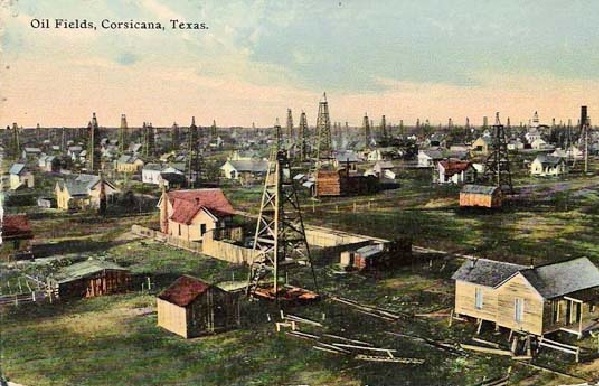
Lucas contacts famed Pennsylvania oilman John Galey and his partner James Guffey, who had drilled marginally successful wells in nearby Corsicana in 1896. Galey and Guffey had returned to Pennsylvania, convinced that there was little future in Texas oil.

“Lucas turned to Guffey and Galey, who had left the area three years earlier,” the PRI article continues. “Something made them change their minds, and in 1900, John Galey returned to Beaumont, Texas, to survey the area. He picked the spot, and the drilling began on October 27, 1900.”

Technological advances from drilling at Spindletop “paved the way for other oil producing states like California to increase their production.” Early major oil companies like Texaco, Gulf, Mobile, Humble and Sun Oil trace their roots to the “Big Hill.”

Drilling is difficult at first. “There is little in the way of rock at the surface in that part of the world. Instead, oil wildcatters had to drill through several hundred feet of sand,” the article notes. “This made the hole prone to cave in on them. To help solve this problem, one of Lucas’s drillers, Curt Hamill, came up with a solution that was revolutionary at the time.”

Instead of pumping water down the hole to flush out the cuttings produced by the action of the drill, Hamill used mud. “This proved to help not only in retrieving the cuttings, but just as importantly, it was found that the mud stuck to the sides of the hole and kept it from caving in, explains the PRI article. “It was found there were even more benefits, and mud has been used in almost every drill hole around the world ever since.”

“On this spot on the tenth day of the twentieth century a new era in civilization began,” notes an inscription on the 25-foot-tall monument erected in 1941 — and today part of the Spindletop-Gladys City Boomtown Museum’s outdoor exhibits.

The “Lucas Gusher” will erupt more than 150 feet into the air. It begins flowing at an astounding 100,000 barrels per day from a depth of 1,010 feet. I

This is the first discovery of the prolific salt dome structures along the coast of the Gulf of Mexico. The well is not brought under control for nine days, losing an estimated 850,000 barrels of oil. According to PRI, a new device – now called a “Christmas Tree” – is invented on the spot to control the flow of oil.

The Spindletop field will soon produce more oil in one day than all the rest of the world’s oilfields combined. In its first year alone Spindletop produced 3.59 million barrels of oil — climbing to 17.4 million by its second year. The huge amount of oil causes the price of oil to drop from $2 to less than 25 cents a barrel. Texaco, Gulf, Mobile, Humble and Sun oil companies can trace their roots to the Big Hill.

“Technological advances engineered in Texas during this early period paved the way for other oil producing states like California to increase their production,” concludes Vintage Oil, a website that sells photographs.

“Fishtail drilling bits gave way to the Hughes Tool rotary rock bit.” the site adds. “The movers and shakers of the oil industry converged on Houston in the early 1900s and the city still reigns today as the energy capital of the world.”

The Spindletop discovery “affected the entire world,” proclaims Michel T. Halbouty, a legendary Houston oilman who co-authored the 1952 book Spindletop: the True Story of the Oil Discovery That Changed the World.

“It changed the way people would live all over the world,” Halbouty explains. “It revived the industrial revolution, which had been dead for a while. It caused the United States to become a world power. It revolutionized transportation through the automobile industry. It started the Liquid Fuel Age, the greatest age in the history of the world.”

Two Beaumont museums tell the story of the Spindletop discovery — and today’s role of the petroleum industry in America’s economic development. Visit the Texas Energy Museum and the Spindletop-Gladys City Boomtown Museum — where educational water-gusher demonstrations occur.

Read about salt domes in “Offshore Oil History.” Learn more about Texas exploration history in “First Lone Star Discovery.”

Please support the American Oil & Gas Historical Society with a donation.


With a collection of more than three million artifacts, the National Museum of American History in Washington, D.C., today exhibits surprisingly few relating to America’s petroleum exploration and production industry. It wasn’t always so.

Tulsa will recover the forgotten “Panorama of Petroleum” mural – thanks to the city’s Gilcrease Museum. In 1998, the mural is restored and installed at the Tulsa International Airport, where it remains today.

In June 1967, a massive “Hall of Petroleum” opened at the Smithsonian Institution’s museum on the national mall. The exhibit featured many exploration and production technological advancements – and the resulting onshore and offshore discoveries considered essential to development of U.S. energy resources. Read the rest of this entry »


December 31, 1954 - Ohio Company sets Depth Record in California

The West Kern Oil Museum in Taft – where a statue was dedicated in 2011 – educates visitors about California’s energy industry.

As drilling technology continues to advance, a new record depth of 21,482 feet is reached by an Ohio Oil Company exploratory well about 17 miles southwest of Bakersfield, Kern County, California, in the San Joaquin Valley.

The Ohio Oil Company (today’s Marathon Oil Corporation) sets a world-record with its No. 1 KCL-A-72-4. The well is a dry hole.

Deep-drilling technologies will advance in coming decades. In 1974 – after 504 days of drilling – the No. 1 Bertha Rogers reaches total depth of 31,441 feet in Oklahoma’s Anadarko basin. The well hits molten sulfur and is abandoned.

Visit the West Kern Oil Museum and the “Black Gold: The Oil Experience” exhibit at the Kern County Museum.

January 2, 1866 – Early Rotary Drilling Patent

An “Improvement in Rock Drills” patent is filed that for the first time includes the basic elements of modern rotary rigs and notes that its “peculiar construction is particularly adapted for boring deep wells.” Read the rest of this entry »
 

A good cable-tool man is just about the most highly skilled worker you’ll find.

In 1909, wildcatter Howard Robard Hughes Sr. was granted two U.S. patents on a drilling bit “that created the cornerstone of Hughes Tool Company, revolutionizing the oil industry.”

Besides having a feel for the job, knowing what’s going on thousands of feet under the ground just from the movement of the cable, he’s got to be something of a carpenter, a steam-fitter, an electrician, and a damned good mechanic.

A cable tool driller knows more knots and splices than any six sailors you can find. – From a 1939 interview in “Voices from the Oilfield” by Paul Lambert and Kenny Franks.

Making Hole

Drilling or “making hole” began long before oil or natural gas were anything more than flammable curiosities found seeping from the ground.

For centuries, digging by hand or shovel was the best technologies that existed to pry into the earth’s secrets. Oil seeps provided a balm for injuries. Natural gas seeps – when ignited – created folklore and places called “burning springs.”

The Chinese drilled with bamboo spring poles as early as 450 A.D.

Drilling technology advanced when the spring pole harnessed the resiliency of a bent tree to assist in pummeling a hole into the ground to find water.

Ancient histories record the technique, which is still used in some corners of the world. While repeatedly kicking down a stirrup was primitive and slow, the spring pole’s rope and chisel were practical drilling technologies.

Salt was an essential commodity for preserving food and extracting it from brine was a simple process. In 1802 in what is now West Virginia, salt brine drillers David and Joseph Ruffner took 18-months to drill through 40 feet of bedrock to a total depth of 58 feet using a spring pole.

The Ruffner brothers’ tools for their spring pole probably consisted of a manila line — and a variety of chisels.

The Ruffner brothers drilling ingenuity and innovation made the Kanawha River Valley a major salt manufacturing and distribution center in the early 1800s. Many early drilling technologies were developed there.

“The Ruffner brothers’ well was the first well known to have been ‘drilled,’ as distinct from ‘dug,’ in the Western Hemisphere,” notes J.E. Brantly in the History of Oil Well Drilling. The well’s historic significance rests on the “development of well drilling tools and practices, which became almost immediately standard equipment used by many other well drillers in the new salt industry.”

There was money to be made from brine wellss. The rapidly growing number of settlers in the frontier needed a lot of salt to preserve food. However, sometimes a good well would be fouled with the intrusion of unsought and unwanted oil. The rainbow sheen and pungent smell of oil was bad news to brine drillers.

Chiseling a Hole with Cable Tools

A detailed model of a late 19th century standard cable-tool drilling rig.

The advent of cable-tool drilling introduced the wooden derrick into the changing American landscape. Using the same basic notion of chiseling a hole deeper and deeper into the earth, but adding the miracle of steam power and clever mechanical engineering, wells could be drilled far more efficiently.

Frequent stops were needed to remove the chipped-away rock and other material, bail out water – and sharpen the bit. Bull wheels and hemp rope repeatedly hoisted and dropped heavy iron drill strings and a curious variety of bits deep into the borehole. Oil was still an adversary to those in search of either fresh water or brine.

However, savvy businessmen like the Ruffner brothers and Samuel Kier of Tarentum, Pennsylvania, learned to profit from this oil.

It had long been recognized that oil could be collected and used as a medicine, lubricant, and even a foul-smelling, smoky illuminant. American Indians gathered oil by using blankets to soak it up from natural seeps. The Ruffner brothers sold their oil to marketers of patent medicines and lubrication products.

Oil from natural seeps had been used as a balm by Native Americans. In 1848, Samuel Kier bottled and sold “Rock Oil” proclaiming its “Wonderful Medical Virtues.”

A decade before the birth of the petroleum industry, Samuel Kier of Pittsburgh, Pennsylvania., sold 50-cent, half-pint bottles of Pennsylvania “Rock Oil” proclaiming its “Wonderful Medical Virtues.”

Kier’s advertisements featured wooden cable-tool derricks drilling brine wells.

When a Yale chemist, Benjamin Silliman, found that oil could be distilled into a kerosene illuminant, the world changed forever. Inspired entrepreneurs formed the Pennsylvania Rock Oil Company with the idea of using cable tool drilling to extract oil they hoped to find near Pennsylvania’s known oil seeps at Oil Creek near Titusville. It worked, and the petroleum age was born.

Kier soon abandoned his patent medicine and went into the kerosene refining business, buying all the oil he could get.

Edwin L. Drake’s August 27, 1859, discovery of commercial quantities of oil at 69. 5 feet brought America’s first drilling boom — and virtually created an industry. Soon, cable-tool rigs were everywhere, pounding into the earth, searching for oil. In June 1860, J.C. Rathbone used a steam engine to power a rig and produced a 100-barrel-per-day producer at 140 feet in what is now West Virginia.

In Pennsylvania, West Virginia and Ohio, the soft soil yielded to cable-tool drilling. But further west, oilmen found resistant rock strata that made drilling far more difficult.

Rotary Rigs cut Faster, Deeper

Rotary drilling introduced the hollow drill stem that enabled broken rock debris to be washed out of the borehole.

A new technology answered the call of necessity and the lure of opportunity. Rotary drilling is most often associated with the spectacular 1901 Spindletop Hill discovery near Beaumont, Texas.

Instead of the repetitive lift and drop of heavy cable-tool bits, rotary drilling introduced the hollow drill stem that enabled broken rock debris to be washed out of the borehole with re-circulated mud while the rotating drill bit cut deeper.

Rotary drilling uses fluids (drilling mud) to circulate out the rock as it is chipped away. The fluid washes out the drill hole as it goes, making the process more efficient. By applying downward pressure, drilling mud also stops an oil well from bursting forth unexpectedly – the dangerous and wasteful gushers.

Meanwhile, grinding their way through layers of rock rather than pounding, the heavy fishtail bits made history. Rotary rigs soon became the preferred means of drilling for oil, although to this day they still share the oil patch with a few cable-tool rigs.

The record depth recorded for a cable-tool rig is 11,145 feet. On Russia’s Kola Peninsula, a rotary rig reached more than 40,000 feet after ten years of drilling.

The Duel Cones of Howard Hughes Sr.

Howard Hughes Jr. will greatly expand the petroleum service company fortune created by his father, who paid $150 for the rights to the roller bit.

Fishtail bits became obsolete in 1909 when Howard Hughes Sr. introduced the twin-cone roller bit. History remembers several men who were trying to develop better drill bit technologies, but it was Hughes who made it happen.

The Society of Petroleum Engineers (SPE) notes that about the same time Hughes developed his bit, Granville A. Humason of Shreveport, La., patented the first cross-roller rock bit, the forerunner of the Reed cross-roller bit.

By 1934, Hughes had patented a three-cone bit, an enduring design that remains much the same today. Rotary drilling revolutionized the search for oil by allowing deeper wells through harder rock formations.

More innovations followed. Frank Christensen and George Christensen developed the earliest diamond bit in the 1941. The tungsten carbide tooth came into use in the early 1950s. The company Hughes founded would merge in 1987 with one founded in 1927 by Carl Baker (Baker Oil Tool).

In 1990, Baker Hughes purchased the Christensen company, which in 1992 resulted in the first rolling cone bit company and first diamond bit company becoming today’s Hughes Christensen, a Baker Hughes company.

Editor’s Note – Biographers note that Howard Hughes Sr. met Granville Humason in a Shreveport bar, where Humason sold his roller bit rights to Hughes for $150. The University of Texas’ Center for American History has a rare 1951 recording of Humason’s recollections of that chance meeting. Humason recalls he spent $50 of his sale proceeds at the bar during the balance of the evening.

Please donate to this society.

To learn more about early petroleum technologies, see “All Pumped Up — Production Technology.”


December 26, 1905 – Nellie Bly patents the 55-Gallon Drum

Nellie Bly – well known in her day as a journalist for the New York World newspaper – is issued a U.S. patent for the “metal barrel” that will become today’s 55-gallon steel drum.

Nellie Bly, known worldwide for her exploits as a reporter for the New York World, was issued a U.S. patent on December 26, 1905 — for the “Metal Barrel” that would become today’s standard 55-gallon steel drum.

Patent No. 808,327 is assigned to Elizabeth Cochrane Seaman, better known as Nellie Bly, the most famous woman journalist of her day – who is also president of the Iron Clad Manufacturing Company.

An 1890 photograph of Nellie Bly.

Bly’s company, which produces milk cans, boilers, enamel ware, and dozens of other steel products, will manufacture early versions of the “metal barrel” that becomes the now ubiquitous 55-gallon steel drum.

After marrying wealthy industrialist Robert Seaman in 1894, Bly’s invention begins with a 1904 visit to Europe, where she first sees glycerin containers made of steel. Read more in “The Remarkable Nellie Bly.”

“I determined to make steel containers for the American trade,” she recalls. “My first experiment leaked and the second was defective because the solder gave way, and then I brazed them with the result that the liquid inside was ruined by the brazing metal.”

Bly perfected her technique. “I finally worked out the steel package to perfection, patented the design, put it on the market and taught the American public to use the steel barrel,” she explains.

Soon she would proudly claim, “I am the only manufacturer in the country who can produce a certain type of steel barrel for which there is an immense demand at present, for the transportation of oil, gasoline, and other liquids.” Read the rest of this entry »


December 4, 1928 – First Oil Discovery using Reflection Seismography 

A monument in Seminole, Oklahoma, commemorates the December 4, 1928, birth of reflection seismography, a vital petroleum exploration technology.

A new and revolutionary oil field technology is applied for the first time near Seminole, Oklahoma.

Amerada Petroleum Corporation drills into the Viola limestone formation to bring in the first oil well from a geological structure identified by reflection seismography.

This seismic survey, executed by Amerada Petroleum’s subsidiary Geophysical Research, uses technology that evolved from the early seismic experiments of Reginald Fessenden, Ludger Mintrop – and renowned Oklahoma physicist John C. Karcher. Read the rest of this entry »


Travelers on U.S. 62 four miles south of the Allegheny River Bridge at Tidioute, Pennsylvania, discover this Warren County roadside marker erected in July 1959.

Few remember the names of those who come in second — they often are relegated to the “also rans,” no matter how close to the finish. Petroleum history is the same.

Second-place finishers most often dwell in the fine print of history. Consider America’s first oil well.

Edwin L. Drake drilled his famous well in Titusville, Pennsylvania, in 1859. As a result, the Drake Well Museum today draws thousands of visitors each year. The discovery’s 2009 sesquicentennial was commemorated in the “valley that changed the world.”

August 27, 1859, marks the date of America’s first oil well. But August 31 – just four days later – is ignored. It was on that day that a second oil well was drilled by a young man named John Livingston Grandin.

A few days after “Drake’s Folly” at Titusville surprised everybody by producing barrels of oil from a depth of 69.5 feet, the news arrived in Tidioute’s General Store, 20 miles away. Each barrel was said to be selling for 75 cents and 23-year-old John Grandin, the owner’s son and an aspiring entrepreneur, saw an opportunity. Read the rest of this entry »

The Cherokee Strip Regional Heritage Center opened April 1, 2011, in Enid, Oklahoma.

Honoring America’s Petroleum Pioneers

Many universities and colleges with petroleum-related curricula honor accomplishments of their oil patch alumni. Ohio’s Marietta College, with a renowned geology and petroleum engineering program, maintains a Petroleum and Geology Hall of Fame on campus.

Their reputations among peers speak of many noble achievements — and award deserving careers in the oil patch. Every year a select group oil and natural gas business leaders are honored by their colleagues, their industry, and their communities.

Among the most prestigious awards (to name only a few that take place every year) are: the Independent Petroleum Association of America, Washington, D.C., presentation of the Chief Roughneck Award at its annual meeting. The bronze “Joe Roughneck” statue has been presented since 1955. See “Meet Joe Roughneck.”

Other awards are presented by the Petroleum Museum in Midland, Texas, the Offshore Energy Center in Houston, Kansas museums in El Dorado and Great Bend, and the Pioneer Oil Museum in Bolivar, New York. All host special award events or maintain their own halls of fame honoring men and women of the petroleum industry.

Still other organizations, including professional trade groups like the Texas Alliance of Energy Producers, Wichita Falls, frequently host legends or legacy award dinners and luncheons. Universities in oil producing states also honor their alumni.

Ohio’s Marietta College, with its world-renowned geology and petroleum engineering program, adds members to its Petroleum and Geology Hall of Fame. The Ohio Oil & Gas Association maintains its hall of fame “as a way to honor those who have made their own distinct contributions to the Ohio oil and gas industry.”

Petroleum Museum Hall of Fame

The Petroleum Hall of Fame at the Petroleum Museum in Midland, Texas, is “dedicated to those who cherished the freedom to dare, and whose work and service helped build the Permian Basin.”

The Petroleum Hall of Fame at the Petroleum Museum in Midland, Texas — which added five distinguished members on April 14, 2011, is “dedicated to those who cherished the freedom to dare, and whose work and service helped build the Permian Basin — Let their achievements be remembered and their beliefs inspire!”

The Hall of Fame received its first member in 1968, several years before the museum itself actually opened in 1975. Induction of the 100th member came in 1999. In each odd-numbered year a maximum of four people are inducted into the Hall of Fame.

Those inducted have been elected by the museum’s governing board, after an exhaustive study of their qualifications by a special committee. Candidates not chosen in the year submitted will be automatically reconsidered in future elections.

The 2011 inductees were I. Jon Brumley, Sam G. Gibbs, William D. Kleine, and “the team of Mack C. Chase and John R. Gray,” according to museum Director Kathy Shannon. Biographical files and portraits of each honoree are available in the museum archives.

Located in the heart of the Permian Basin in West Texas, The Petroleum Museum includes a 40,000-square-foot facility housing photographic wall murals depicting early life in the oilfields, a West Texas boomtown, and a marine diorama of 230 million years ago.

Colonel Edwin L. Drake Legendary Oilman Award

The Petroleum History Institute’s Larry Woodfork, left, presented the 2011 Colonel Edwin L. Drake Legendary Oilman Award to I.L. “Ike” Morris, founder and CEO of Waco Oil and Gas Company, Inc., Glenville, West Virginia.

In late June, the Petroleum History Institute(PHI) of Oil City, Pennsylvania, presented a life-time achievement award during its History Symposium in Marietta, Ohio. Oilman I.L. “Ike” Morris received the Petroleum History Institute’s “highest honor and most prestigious award,” the Colonel Edwin L. Drake Legendary Oilman Award.

The June 23, 2011, presentation took place during the Institute’s annual symposium and field trip — as members cruised aboard a sternwheeler riverboat on the Ohio River following a reception and banquet. Larry D. Woodfork, PHI chairman of the honors and awards committee, presented this year’s award to Morris, founder and CEO of Waco Oil and Gas Company, Glenville, West Virginia.

Originally from Oklahoma, Morris established an oil service company in Gilmer County, West Virginia, in the early 1960s and eventually expanded into all exploration and production, notes an article in the Gilmer Free Press.

Every September since 1969, the West Virginia Oil and Gas Festival is hosted by Sistersville, an historic oil community on the Ohio River. In addition to antique engine shows, a parade and the crowning of an Oil and Gas Queen, festival organizers host a banquet for its West Virginia Oil and Gas Man of the Year.

The PHI 2011 award was presented by Woodfork, an independent consulting geologist and emeritus state geologist of West Virginia. He praised Morris and his “stellar business career, great successes and accomplishments in the oil and gas industry, as well as his contributions to the local community, including the very generous philanthropy of he and his wife, Sue — a Gilmer County girl and long-time school teacher — to Glenville State College, their support of W.V.U., and numerous other charitable organizations and enterprises — the list of which goes on and on.”

Both Woodfork and Morris have been previously honored as the “West Virginia Oil and Gas Man of the Year”  — Woodfork in 1991 and Morris in 1994. The award is made during the September annual West Virginia Oil and Gas Festivalheld in Sistersville, an historic oil community on the Ohio River.

Chronicle of Gulf of Mexico Petroleum History

The Offshore Oil and Gas History Project “draws from economic research, oral histories, photographs, artifacts — and personal accounts gathered to examine the historical evolution of the offshore oil and gas industry and its effects on Louisiana’s coastal culture, economy, landscape, and society.”

Is knowledge of U.S. offshore exploration and production history important?

Although America’s offshore petroleum industry began in the Pacific Ocean more than 100 years ago, it wasn’t until 1947 that a company drilled beyond the sight of land — southwest of Morgan City, Louisiana.

Now available online: the first six volumes of a project to study Louisiana offshore petroleum history — a decade in the making and still in progress.

“Understanding Louisiana’s relationship with offshore energy development must begin in the bayous, lakes and marshes of south Louisiana in the late 1920s,” notes the Bureau of Ocean Energy Management, Regulation and Enforcement (BOEMRE), which is working with three universities to compile a history of southern Louisiana’s oil and natural gas industry.

Funded by the agency’s environmental studies program, the Offshore Oil and Gas History Project draws from economic research, oral histories, photographs, artifacts — and personal accounts gathered from former industry engineers, managers, workers, and community and political leaders, according to Ocean Science, a quarterly publication of BOEMRE, formerly the Minerals Management Service.

This offshore history project, begun in 2002 as a cooperative agreement with the Louisiana State University — which partnered with the University of Arizona and the University of Houston — has two phases. The six volumes of the completed first phase (a southern Louisiana offshore history up to 1970) are available online at the University of Arizona. The second phase focuses on the development farther offshore.

The first-quarter 2011 issue of BOEMRE’s Ocean Science notes that the two phases of the Offshore Oil and Gas History Project “forms the basis for understanding the evolution of the industry and how that is intertwined with local communities.”

Editor’s Note — The first U.S. well out of sight of land was drilled in 1947 in the Gulf of Mexico by Kerr-McGee Oil Industries partnered with Phillips Petroleum and Stanolind Oil & Gas companies. A freestanding platform was erected 10 miles offshore…in 18 feet of water. Read more at Offshore Oil History.”