A red Pegasus soared into Dallas petroleum history in 1934.
The Mobil Oil Pegasus perched atop the Magnolia Petroleum building in Dallas from 1934 until 1999, when rust and growing structural issues forced its removal. On the first day of 2000, a carefully crafted duplicate returned to the Dallas skyline.
Thanks to its widespread popularity, Mobil Oil’s high-flying trademark returned to its Texas home with one red Pegasus on each side of a sign painstakingly recreated by the American Porcelain Enamel Company. As the year 1999 drew to a close, the duplicated Pegasus soared again.

The “Flying Red Horse” trademark of Magnolia Petroleum landed on the company’s Dallas headquarters in 1934, in time for the annual meeting of the American Petroleum Institute (API).
A Dallas hotel would later restore the original Mobil Oil Pegasus after finding its rusted remains in a city-owned shed. The Omni Dallas Hotel funded the restoration, and in 2015 the surviving red neon-edged symbol — a one-sided version — was re-lit in front of the Omni on Lamar Street.
The Mobil Oil (now ExxonMobil) trademark has been a feature of Dallas since first welcoming attendees to a 1934 convention of petroleum company executives. The Magnolia building’s Pegasus has remained one of the most recognizable corporate symbols in American history — and a marketing icon rivaling the Sinclair dinosaur.
Magnolia Petroleum
When the 400-foot-tall Magnolia Petroleum building opened in 1922, it was the city’s first skyscraper — and tallest building west of the Mississippi River. With 29 floors and seven elevators, the Magnolia building towered over its Beaux-Arts neighbor, the Adolphus Hotel, built in 1913.
The Magnolia building’s multi-million dollar construction featured a “modified classical design” by a famed architect from the United Kingdom. The Texas Historical Commission in 1978 placed a marker at Commerce and Akard streets in Dallas that reads:
Erected in 1921-22, this building housed the offices of Magnolia Petroleum Co., later Mobil Oil Co. It was designed by Sir Alfred C. Bossom (1881-1965), noted British architect, and built at a cost of $4 million. The tallest structure in Dallas for almost 20 years, it reflected the city’s increasing economic importance. In 1934 a revolving neon sign was placed atop the building. The “Flying Red Horse,” trademark for Magnolia products, quickly became a local landmark.
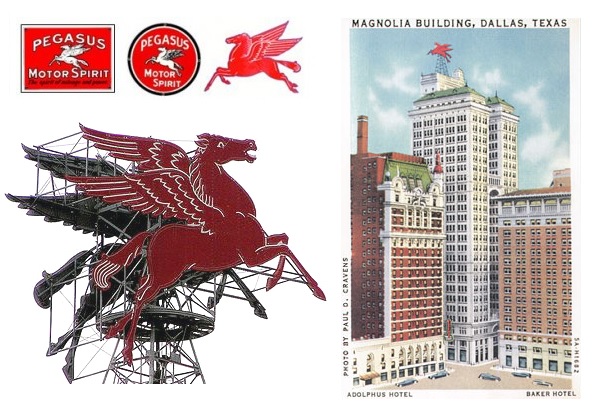
Vacuum Oil Company trademarked the Pegasus logo in 1911 and by the 1930s was marketing Pegasus Motor Spirits and Mobiloil. The Magnolia Petroleum building, completed in 1922, was “a great peg driven into the ground holding Dallas in its place.”
The Magnolia building also was among the first high-rises to have air conditioning when it opened in 1922, according to the management company that acquired it in 1997. A fully restored lobby features a gold leaf decorative plaster and original elevator doors engraved with the Pegasus logo.

Much of the original architecture’s classical design has been restored, according to the Magnolia Dallas Downtown — a boutique hotel blending the historic building’s past with modern amenities.
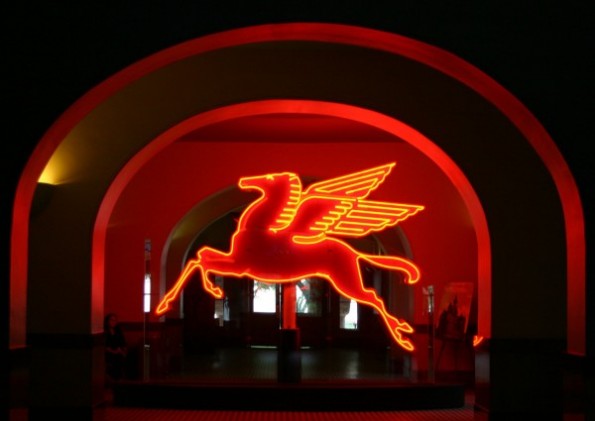
An 11-foot Mobil Oil Pegasus displayed at the 1939 New York World’s Fair found its way to a Mobil service station in Casa Linda, Texas, and later to a Dallas County museum.
After the Magnolia building’s 1922 opening, a local reporter described the oil company headquarters building as “a great peg driven into the ground holding Dallas in its place.”
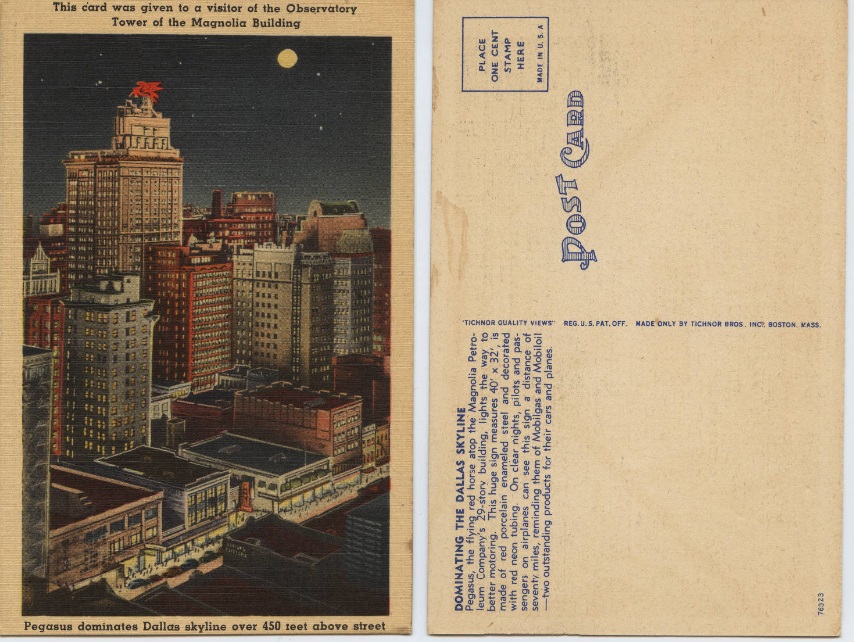
A circa 1935 Dallas skyline postcard given to visitors to the observatory tower in the Magnolia Building. Image courtesy DeGolyer Library, Southern Methodist University, digital collection.
When Standard Oil Company of New York (Socony) acquired the Magnolia Petroleum Company in 1925, the building was part of the deal. Nine years later, the two-sided Pegasus sign would land on its roof.
Pegasus takes Flight
The Mobil Oil Pegasus began its journey in 1911, when a Vacuum Oil Company subsidiary in Cape Town, South Africa, first trademarked the Pegasus logo. Based in Rochester, New York, Vacuum Oil had built a successful petroleum lubricants business around an 1869 patent by its founder, Hiram Everest, long before gasoline was even a branded product.
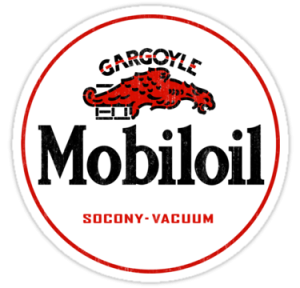
Vacuum Oil Company’s products used a gargoyle prior to adopting the winged horse of mythology.
At first, a stylized red gargoyle advertised the company, which produced early petroleum-based lubricants for horse-drawn carriages and steam engines. The Pegasus trademark proved to be a more enduring image. In Greek mythology, Pegasus — a winged horse — carried thunderbolts for Zeus.

By 1931, growth of the automobile industry expanded the Vacuum Oil product lineup to include Pegasus Spirits and Mobilgas — later simplified to Mobil. When Standard Oil of New York and Vacuum Oil combined to form Socony-Vacuum Oil Company, the new company adopted the familiar winged trademark, as did an affiliate, Magnolia Petroleum.
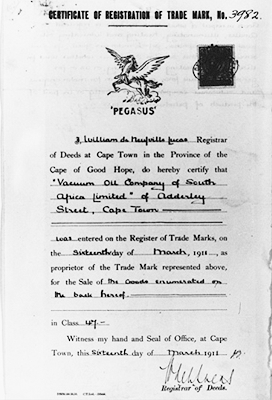
The certificate from Cape Town, South Africa, notes that the “Vacuum Oil Company of South Africa Limited” is named “as proprietor of the Trade Mark represented above.” Image courtesy ExxonMobil Historical Collection/Center for American History, University of Texas, Austin.
It took a year to build the rotating 35-foot by 40-foot Pegasus sign, which beamed a red neon glow in 1934 to welcome the annual meeting to be held in Dallas by the American Petroleum Institute (API). For decades the emblem slowly rotated above the growing city as corporate consolidations and mergers changed Socony-Vacuum ownership.
In 1955, the name of the company changed to Socony Mobil Oil; in 1966, it became just Mobil Oil. A neon Mobil Oil Pegasus displayed at the 1939 New York World’s Fair found its way to a Mobil gas station in Casa Linda, Texas, and later to the Old Red Museum of Dallas County History & Culture.
The Old Red Museum was closed by 2024, when its historic building — the original Dallas County Courthouse — became home to the Texas Fifth Circuit Court of Appeals.
A New Pegasus
In 1974 the rotating red sign’s motor ground to a halt, and Mobil Oil moved out of the Magnolia building three years later. The company sold its aging skyscraper and the glowing but unmoving sign to the city of Dallas. Twenty years later, Pegasus’ neon lights finally went out.
In the late 1990s, when a Denver-based developer transformed the deteriorating Magnolia building into a luxurious 330-room hotel, a dedicated group of patrons and corporate partners joined in to bring the rusting Pegasus sign back to life.
With a fundraising effort that raised more than $600,000, the Project Pegasus team targeted New Year’s Eve of 1999 to reintroduce Dallas citizens to their petroleum heritage landmark. Restoration of the 8,000-pound sign proved challenging.
The derrick-like tower structure was reparable, and the old mechanical rotation system could be updated with new technology.
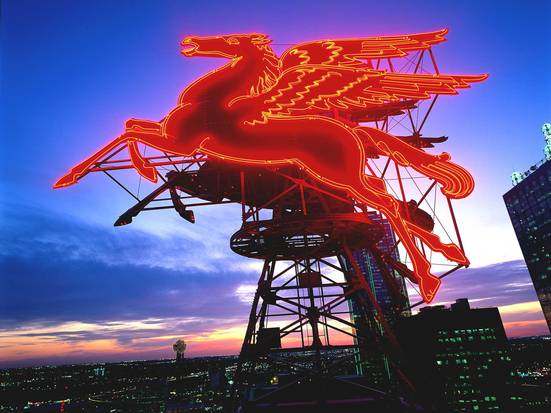
A view of Pegasus in photographer Carolyn Brown’s 2003 book, Dallas: Where Dreams Come True.
But time and weather had damaged the porcelain-coated steel signage and neon tubing. New 16-gauge steel panels had to be cut, using the originals as templates.
Only two facilities in the United States were large enough to accommodate baking the emblematic red porcelain onto the new panels; fortunately, both were in Dallas. More than 1,000 feet of new neon tubing was required to trace the familiar outlines as craftsmen and technicians remained faithful to the original.
Red Icon Returns
Oil history preservation efforts were rewarded at midnight on December 31, 1999, when new millennium celebrations welcomed the Mobil Oil Pegasus back to the Dallas skyline.
“You can’t tell the new one from the old one except for the fact that the faces are now red and not rusty,” explained one of the restorers. “We replaced every old piece with a new piece that was exactly the same as it was before.”
The Pegasus sign “is a beloved icon of the city of Dallas,” proclaimed Kay Kallos, public art manager in the Office of Cultural Affairs, which manages its maintenance. Mobil Oil merged with Exxon in 1999, creating ExxonMobil, headquartered in Irving, Texas.
_______________________
Recommended Reading: Dallas: Where Dreams Come True (2003); Smithsonian ExxonMobil Historical Collection, 1790-2004 (2014); The Seven Sisters: The great oil companies & the world
_______________________
The American Oil & Gas Historical Society (AOGHS) preserves U.S. petroleum history. Please support this energy education website, subscribe to our monthly email newsletter, and help expand historical research. Contact bawells@aoghs.org. Copyright © 2026 Bruce A. Wells.
Citation Information – Article Title: “Mobil’s High-Flying Trademark.” Authors: B.A. Wells and K.L. Wells. Website Name: American Oil & Gas Historical Society. URL: https://aoghs.org/petroleum-art/high-flying-trademark. Last Updated: March 9, 2026. Original Published Date: March 14, 2010.