by Bruce Wells | Nov 4, 2025 | Petroleum Pioneers
New resource for making kerosene for lamps created the U.S. petroleum industry.
America’s petroleum exploration and production industry began in the mid-19th century when a lumber company sold 105 acres along a creek known for natural oil seeps.
On November 10, 1854, the lumber firm of Brewer, Watson & Company sold a parcel of the company’s land at the junction of the east and west branches of Oil Creek southeast of Titusville, Pennsylvania. (more…)
by Bruce Wells | Aug 23, 2025 | Petroleum Pioneers
The U.S. petroleum industry began in 1859 to meet demand for “Coal Oil” — the popular lamp fuel kerosene.
American oil history began in a valley along a creek in remote northwestern Pennsylvania. Today’s exploration and production industry was born on August 27, 1859, near Titusville when a well specifically drilled for oil found it.
Although crude oil had been found and bottled for medicine as early as 1814 in Ohio and in Kentucky in 1818, these had been drilled seeking brine. Drillers often used an ancient technology, the “spring pole.” Sometimes the salt wells produced small amounts of oil, an unwanted byproduct.
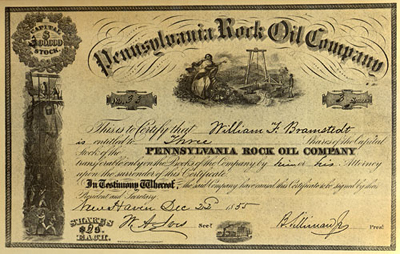
America’s first petroleum exploration company – the Pennsylvania Rock Oil Company of New York – incorporated in 1854. It reorganized as the Seneca Oil Company of New Haven, Connecticut, in 1858.
The advent of cable-tool drilling introduced the wooden derrick into the changing American landscape. The technology applied the same basic idea of chiseling a hole deeper into the earth.
Using steam power, a variety of heavy bits, and improved mechanical engineering skills, cable-tool drillers became more efficient (learn more Making Hole – Drilling Technology). (more…)