Your source for energy education. Petroleum history offers a context

for teaching the modern business of meeting America's energy needs.

Oil and Natural Gas History, Education Resources, Museum News, Exhibits and Events

Archive for the 'This Week' Category


May 14, 1953 – Tulsa’s Golden Driller debuts at Petroleum Expo

 An American Oil & Gas Historical Society energy education conference in 2007 included a field trip to petroleum museums in Seminole, Drumright and Tulsa - with a stop at the Golden Driller.

A 2007 American Oil & Gas Historical Society energy education conference includes a field trip to museums in Seminole, Drumright and Tulsa – with a stop at the Golden Driller.

The Mid-Continent Supply Company of Fort Worth introduces the original Golden Driller at the International Petroleum Exposition in Tulsa, Oklahoma, May 14 to May 23, 1953.

It is temporarily erected again for the 1959 Expo – and attracts so much attention that the company refurbishes and donates it to the Tulsa County Fairgrounds Trust Authority.

The giant is rebuilt in 1966.

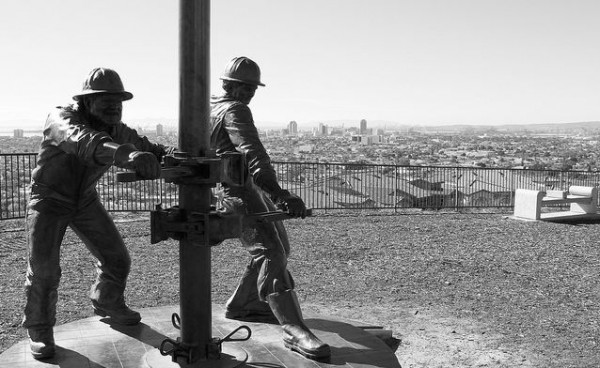
Today, the Golden Driller – a 76-foot tall, 43,500 pound statue of an oil worker – is the largest freestanding statue in the world, according to city officials.

The rebuilt statue  is permanently installed at the 21st Street and Pittsburg Avenue site for the 1966 International Petroleum Exposition. Refurbished again in 1979, the angle-iron structure made of plaster and concrete reportedly can withstand 200 mph winds.

The Golden Driller first appears at the 1953 International Petroleum Exposition. In 1966, Mid-Continent Supply Company builds a permanent version that can withstand 200 mph winds. Photos courtesy the Tulsa Historical Society.

The Golden Driller’s right hand rests on an old production oil derrick moved from an oil field in Seminole, Oklahoma.

Declared Oklahoma’s official state monument in 1979, a plaque at his base dedicates him “to the men of the petroleum industry who by their vision and daring have created from God’s abundance a better life for mankind.”

Tulsa’s first International Petroleum Exposition and Congress, held in 1923, helps make the city known as the “oil capital of the world.”

May 14, 2004 – Petroleum Museum Opens in Oil City, Louisiana

In 1911, Gulf Refining Company built drilling platforms to reach the oil beneath Caddo Lake in Louisiana. This early “offshore” technology worked well and production continues today — out of sight for most vacationers, water enthusiasts and young fishermen.

The first public museum in Louisiana dedicated to the oil and gas industry opens in Oil City, 30 miles northwest of Shreveport.

Chevron donated an oil derrick that stands beside the Louisiana State Oil Museum in Oil City, about a 20-minute drive from Shreveport.

The Louisiana State Oil and Gas Museum, originally the Caddo-Pine Island Oil and Historical Museum, includes the historic depot of the Kansas City Southern Railroad. The museum preserves the many Caddo Parish discoveries – and the economic prosperity brought by a North Louisiana petroleum boom.

With the first oil wells drilled in the early 1900s, by 1910 almost 25,000 people are working in and around Oil City, which becomes the first “wildcat town” in the Arkansas-Louisiana-Texas region.

The museum documents the historical importance of the first oil discovery in 1905 – and the technology behind the May 1911 Ferry No. 1 well at Caddo Lake, one of the nation’s earliest over-water oil wells. Gulf Refining Company completed this early “offshore” oil well on Caddo Lake, where production continues today. Read the rest of this entry »


May 7, 1920 – Erle Halliburton launches Halliburton

Innovative oilfield technologies of the 1920s include Halliburton Company trucks with “jet cement” mixers. Photograph courtesy Hart’s E&P magazine.

The Halliburton Company is organized as an oil well “cementing” company in Wilson, Oklahoma, by Erle P. Halliburton (1892–1957), succeeding his New Method Oil Cementing Company formed a year earlier during the Burkburnett boom in Texas.

The use of cement in drilling oil wells remains integral to the industry, because its injection into the well seals off water formations from the oil, protects the casing, and minimizes the danger of blowouts.

Halliburton’s company, which will reach global dimensions within his lifetime, in 1922 patents a new “jet-cement” mixer that increases the speed and quality of the mixing process.  Read the rest of this entry »


The American Association of Petroleum Landmen locates mineral owners and negotiates leases.

April 30, 1955 – “Landmen” form Trade Association

The American Association of Petroleum Landmen (AAPL) is organized in Fort Worth, Texas.

A key part of the petroleum industry, landmen research records to determine ownership, locate mineral and land owners and negotiate oil and natural gas leases, deals, trades and contracts as well as ensuring compliance with governmental regulations.

AAPL has grown into an organization with about 12,000 members and 43 affiliated associations in the United States and Canada.
Read the rest of this entry »


On April 22, 1920 – Natural Gas discovered in South Arkansas

The Arkansas Natural Resources Museum opened in 1986.

The first natural gas well in south Arkansas is completed two and a half miles southeast of El Dorado.

Drilled to a depth of 2,247 feet, the well produces between 40 million to 60 million cubic feet of gas a day – and “a spray of oil produced from the Nacatoch sands,” according to The Discovery of Oil in South Arkansas, 1920-1924.

Although just six days earlier a small independent company completes the first oil well in Arkansas, the well does not produce commercial quantities. Officially, it will be the January 10, 1921, Busey-Armstrong No. 1 well’s discovery of oil that launches the state’s petroleum industry.

By 1925, a young oilman named Haroldson Lafayette “H.L.” Hunt has acquired substantial holdings in the El Dorado and Smackover fields. In 1930 he will discover the largest oilfield in the United States less than 175 miles away. Read “H.L. Hunt and the East Texas Oilfield.” Read the rest of this entry »


April 15, 1897 – Birth of the Oklahoma Petroleum Industry

A re-enactment of the moment that changed Oklahoma history highlighted the 2008 dedication of the Nellie Johnstone No. 1 replica derrick in Bartlesville’s Discovery 1 Park.

A large crowd gathers at the Cudahy Oil Company’s Nellie Johnstone No. 1 well near Bartlesville, in the Indian Territory that will become Oklahoma.

George Keeler’s stepdaughter, Miss Jenni Cass, drops a “go devil” down the well bore to set off a waiting canister of nitroglycerin – producing a gusher that heralds the beginning of Oklahoma’s oil and natural gas industry.

As the discovery well for the giant Bartlesville-Dewey Field, the Nellie Johnstone No.1 ushers in the oil era for Oklahoma Territory. By the time of statehood in 1907, Oklahoma will lead the world in oil production.

In the ten years following the Nellie Johnstone discovery, Bartlesville’s population grew from 200 to over 4,000 while Oklahoma’s oil production grew from 1,000 barrels to over 43 million barrels annually.

Today, a 184-foot derrick and education center, renovated in 2008, tells the story in Bartlesville’s Discovery 1 Park.

Read more about the Sooner State’s first commercial oil well in “Discovering Oklahoma Oil.”

April 16, 1855 – Pennsylvania Rock Oil promises “Very Valuable Products”

A report about oil’s potential as an illuminant will lead to the Pennsylvania Rock Oil Company discovering America’s first commercial well.

A report from Yale chemist Benjamin Silliman Jr. says Pennsylvania “rock oil” can be distilled into a high-quality illuminating oil.

The New Haven, Connecticut, professor’s “Report on Rock Oil or Petroleum” is an analysis of samples from Cherrytree Township, Venango County.

“Gentlemen,” Silliman writes to his clients – soon to be oilmen – “it appears to me that there is much ground for encouragement in the belief that your company have in their possession a raw material from which, by simple and not expensive processes, they may manufacture very valuable products.” Read the rest of this entry »


April 9, 1914 – Ohio Cities Gas Company

In Columbus, Ohio, Beman Dawes and Fletcher Heath form the Ohio Cities Gas Company. The company acquires Pennsylvania-based Pure Oil Company in 1917 and adopts that name three years later.

Pure Oil becomes one of the 100 largest industrial corporations in the United States by 1965, when it is purchased by Union Oil Company of California, now a division of Chevron Corporation. Chevron - established on September 10, 1879, as the Pacific Coast Oil Company – has used more than a dozen logos in 130 years. Read the rest of this entry »


April 1, 1911 – First “Pump Jack Capital of Texas” Discovery

The April 1, 1911, well brought prosperity to Electra, Texas, where citizens celebrated the discovery’s centennial.

Just south of the Red River border with Oklahoma, near Electra, Texas, the Clayco Oil & Pipe Line Company’s Clayco No. 1 well launches an oil boom that lasts for decades.

“As news of the gusher spread through town, people thought it was an April Fools joke and didn’t take it seriously until they saw for themselves the plume of black oil spewing high into the sky,” notes one Electra historian. “That day secured Electra’s place in the history books as being one of the most significant oil discoveries in the nation.”

The gusher on cattleman William T. Waggoner’s lease settled into production of about 650 barrels per day from 1,628 feet. Hundreds of producing wells will follow, reaching the oilfield’s peak production of more than eight million barrels in 1913.

Founded in 1907, the Wichita County town is named after Waggoner’s daughter. Its population grew from 1,000 to 5,000 within months of the discovery. But as the Texas Handbook Online notes, the chaos often associated with oil booms was kept to a minimum – because much of the surrounding land had been leased. “Many who rushed to Electra seeking quick profits, however, just as quickly departed.”

Restoring Electra’s historic Grand Theatre today is a citywide project.

Thanks to several dedicated community activists, Texas legislators designated Electra as the “Pump Jack Capital” of Texas in 2001. Restoration of the historic Grand Theatre – built in 1919 – is underway as a citywide project.

In 2011, the Electra Clayco No. 1 centennial celebration included a parade and  re-dedication ceremony of the well’s historic marker.

Among the centennial highlights were a pictorial display of petroleum history inside the Grand Theatre, a walking tour of antique oil equipment – and the popular Chuck Wagon Gang Lunch and chili cook-off.

April 1, 1986 – Oil Prices hit Modern Low

World oil prices fall below $10 a barrel – a new low for the modern petroleum industry.

Causes include excessive OPEC production, worldwide recession (increasing supplies with declining demand) and a U.S. petroleum industry heavily regulated by production or price controls.

The record peak of oil prices will be $145 per barrel in July 2008 – before a price collapse to below $32 by the end of the year.

April 2, 1980 – Carter signs Windfall Profit Tax

One year after lifting price controls on oil, President Jimmy Carter signs the  Crude Oil Windfall Profit Tax (WPT) into law. The controversial WPT imposes an excise tax on oil production.

President Jimmy Carter signs into law the Crude Oil Windfall Profit Tax.

“From 1980 to 1988, the nation levied a special tax on domestic oil production,” explains historian Joseph Thorndike. Policymakers, “imposed an excise levy on domestic oil production, taxing the difference between the market price of oil and a predetermined base price.”

The base price is derived from 1979 oil prices and requires annual adjustments for inflation. A remnant of President Richard Nixon’s general wage and price freeze of 1971 –  WPT is meant to limit increases in oil prices.

However, “the windfall profits tax has nothing to do, in fact, with profits,” observed the Washington Post in 1979. “It is an excise tax – that is, a tax on each barrel of oil produced.”

After eight years of the tax, domestic oil production falls to its lowest level in 20 years – increasing U.S. reliance on foreign oil. In August 1988, Congress decides to repeal the tax. “Few mourned its passing,” says Thorndike. Read the rest of this entry »


March 26, 1930 – “Wild Mary Sudik” makes Worldwide Headlines

What will become one of Oklahoma’s most famous wells strikes a high-pressure formation about 6,500 feet beneath Oklahoma City – and oil erupts skyward. The Indian Territory Illuminating Oil Company’s Mary Sudik No. 1 well will flow for 11 days before being brought under control.

The well, which produces 20,000 barrels of oil and 200 million cubic feet of natural gas a day, becomes a worldwide sensation known as “Wild Mary Sudik.”

Newsreel photographers will send film of the “Wild Mary Sudik” well to Hollywood, according to the Oklahoma History Center. Within a week, newsreels appear in theaters around the country. When the Mary Sudik is brought under control, crews will recover 200,000 barrels of oil from pits and ponds.

The giant discovery is featured in newsreels and on radio, according to an audio program of the Oklahoma History Center in Oklahoma City. The program’s narrator notes that after drilling to 6,471 feet, the roughnecks overlook a dangerous pressure increase in the well.

“The exhausted crew failed to fill the hole with mud,” he explains. “They didn’t know the Wilcox sand formation was permeated with natural gas under high pressure, and within minutes that sand under so much pressure found a release.”

The drilling crew is caught off guard when oil and natural gas suddenly “came roaring out of the hole,” the narrator adds. “Pipe stems were thrown hundreds of feet into the air like so many tooth picks.”

The Oklahoma History Center in Oklahoma City includes the Devon Energy Oil and Gas Park.

On April 6, Floyd Gibbons of NBC Radio – who broadcast regular reports about the well – announces that after two unsuccessful attempts, the well is closed with a two-ton “overshot” cap.

With the well was brought under control, drilling continued in Oklahoma City. But the prolific, high-pressure of the Wilcox sands formation continues to challenge drillers and the technologies of the day. Read more in “World Famous ‘Wild Mary Sudik’.”

Recognizing the risks of drilling into the Wilcox sand, Oklahoma City passes additional ordinances for safety and well spacing in the city. In December 1933, James Abercrombie will patent an improved blowout preventer that sets a new standard for safe drilling during the Oklahoma City oilfield boom. See “Ending Oil Gushers – BOP.”

Abraham Gesner

March 27, 1855 – Canadian Chemist invents Kerosene

Canadian chemist Abraham Gesner patents a process to distill bituminous shale and cannel coal into kerosene.

“I have invented and discovered a new and useful manufacture or composition of matter, being a new liquid hydrocarbon, which I denominate Kerosene,” he proclaims in his patent. When it is found that kerosene can also be distilled from crude oil, it becomes America’s principle source of illumination until commercial electricity arrives. Read the rest of this entry »


March 18, 1937 – Odorless Natural Gas Explosion devastates East Texas School

Roughnecks from the East Texas oilfield rushed to the school after the explosion.

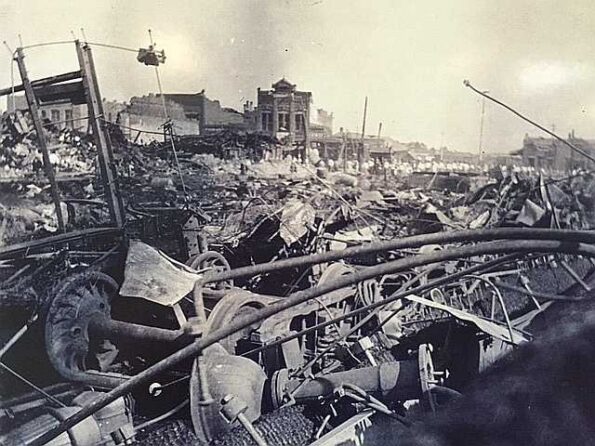
With just minutes left in the school day – and more than 700 students and teachers inside the building – a natural gas explosion destroys the New London High School in Rusk County, Texas.

Odorless natural gas has leaked into the basement and ignited – with a force felt even four miles away. Roughnecks rush in from the nearby East Texas oilfield to save their children.

Despite rescue efforts, 298 people are killed (dozens more later die of injuries). The cause of the school explosion is found to be an electric wood-shop saw that sparked unscented gas that had pooled beneath and in the walls of the school.

A young man working for United Press in Dallas, Walter Cronkite, was among the first reporters to reach the scene, where it was dark and raining. “He got his first inkling of how bad the incident was when he saw a large number of cars lined up outside the funeral home in Tyler,” notes one local historian. At the scene, floodlights cast long shadows.

“We hurried on to New London,” Cronkite writes in his book, A Reporter’s Life. “We reached it just at dusk. Huge floodlights from the oilfields illuminated a great pile of rubble at which men and women tore with their bare hands. Many were workers from the oilfields…”

Decades later, Cronkite will add, “I did nothing in my studies nor in my life to prepare me for a story of the magnitude of that New London tragedy, nor has any story since that awful day equaled it.”

David M. Brown, author of Gone at 3:17, describes the sad irony of how the East Texas oil boom, “financed building the wealthiest rural school system in the nation in 1934, the faulty heating system that permitted raw gas to accumulate beneath it and, at 3:17 on March 18, 1937, the resulting explosion that laid waste to a town’s future.”

As a result of this disaster, Texas and other states soon pass laws requiring that natural gas be mixed with a malodorant to give early warning of a gas leak. Read the rest of this entry »


March 11, 1829 – “Great American Well” discovered in Kentucky

Decades before the launch of America’s petroleum industry in Pennsylvania, an 1829 Kentucky well – drilled seeking salt water – produces a gusher. Oil from the “American Oil Well” is bottled and sold for “medicinal” purposes. A state geology survey 1865 map preserves the historic Cumberland County discovery.

Boring for salt brine with a simple spring-pole device on a farm near Burkesville, Kentucky, Martin Beatty strikes an oilfield at 171 feet deep. Drilled for a local doctor, the gusher shoots “to the top of the surrounding trees.” Read the rest of this entry »


March 4, 1918 – West Virginia Well sets World Depth Record

On the Martha Goff farm in Harrison County, West Virginia, the Hope Natural Gas Company drills to 7,386 feet and brings the world’s deepest well record to America.

Until then, the deepest well had been drilled to 7,345 feet near Czuehon, Germany.

A March 1974 well set a world record while drilling in Oklahoma’s Anadarko Basin, about 12 miles west of Cordell. The Bertha Rogers No. 1 drilled almost six miles into Oklahoma’s Anadarko Basin before the drill bit stuck.

Today, rotary rigs in the Gulf of Mexico reach up to 35,000 feet deep. A 1970s experimental well on Russia’s Kola Peninsula during the Soviet era exceeded 40,000 feet – after ten years of drilling. Visit the Oil and Gas Museum in Parkersburg, West Virginia. Read the rest of this entry »


February 25, 1897 – “Golden Rule” Jones elected in Ohio

The founder of the Acme Sucker Rod Company will become a popular Toledo, Ohio, mayor

Samuel “Golden Rule” Jones, the founder of an early oilfield service company, is elected Mayor of Toledo, Ohio, on a progressive Republican ticket.

Jones, a 40-year veteran of the Pennsylvania oilfields, first earns his nickname in 1894 when he posts the biblical admonition at his newly formed Acme Sucker Rod Company.

Jones will introduce better wages, paid vacations, five-percent bonuses – and become an advocate for eight-hour workdays as a means to increase employment opportunities. The oilman is elected Toledo’s mayor four times and serves until dying on the job in 1904.

February 25, 1919 – Oregon enacts First Gas Tax Read the rest of this entry »


February 19, 1863 – Pennsylvania Pipeline

First pipeline from an oilfield to a refinery is completed at Oil Creek, Pennsylvania. New Jersey inventor J. L. Hutchings constructs the 2.5-mile pipeline from James Tarr’s farm near Oil Creek to the Humboldt refinery using newly patented rotary pumps to move the oil through two-inch diameter piping. Unfortunately, leaking makes this innovative pipeline impractical.

Visit the “valley that changed the world” and the Drake Well Museum in Titusville.

February 19, 1889 – Ohio acts to Conserve Natural Gas

The Ohio House of Representatives enacts the state’s first petroleum conservation measure – “an Act to prevent the wasting of Natural Gas and to Provide for the plugging of all abandoned wells.”

The Ohio Oil and Gas Association documents wells drilled/completed by County in 2010.

The state’s first commercial petroleum production had begun almost 30 years earlier in Macksburg, Washington County, according to the Ohio Department of Natural Resources.

Ohio remains a leading producer, ranking in the top half of all producing states, the agency notes. As of 2010, more than 275,700 wells have been drilled in the state – yielding more than 1.1 billion barrels of oil and more than 8.52 trillion cubic feet of natural gas. Modern technologies now are finding success in eastern Ohio – the Marcellus shale.

Ohio also claims an 1814 oil discovery as America’s first with a drilled well, according to the Ohio Oil and Gas Energy Education Program. “Two men drilled 475 feet in search of salt in Olive Township of Noble County,” says Director Rhonda Reda. “They cursed when a black liquid oozed into the pit.”

February 20, 1959 – World’s First LNG Tanker arrives

After a three-week voyage, the Methane Pioneer – the world’s first liquefied natural gas tanker – arrives at the world’s first LNG terminal at Canvey Island, England, from Lake Charles, Louisiana. Read the rest of this entry »


February 12, 1954 – First Major Oil Discovery in Nevada

Nevada’s petroleum industry begins with the discovery of oil by Shell Oil’s Eagle Springs No. 1 well drilled in Railroad Valley in Nye County.

Shell Oil Company’s second test of its Eagle Springs No. 1 well finds oil.

This routine test becomes the discovery well for the Railroad Valley field – and Nevada’s first major producer.

“This milestone represents a great achievement for Nevada’s oil industry,” notes Alan Coyner, administrator of the Nevada Division of Minerals. “Nevada continues to have tremendous exploration potential for additional oil discoveries in the future.”

According to the Nevada Bureau of Mines and Geology, the discovery well is 10,358 feet deep and produces 306,029 barrels of oil from a productive interval between 6,450 and 6,730 feet during its 16-year productive life.

Since 1954, there have been about 50 million barrels of oil produced from 101 wells drilled within 15 different Nevada fields.

February 13, 1924 – Forest Oil incorporates

Forest Oil’s logo features the “Yellow Dog” — a two-wicked lantern once used on derricks.

A corporate logo with a lantern burning two wicks? An oil company originally founded in 1916 consolidates with four other independent petroleum companies to form the Forest Oil Corporation – an early leader in secondary recovery technology.

Originally based in Bradford, Pennsylvania – home of the “first billion dollar oilfield” in the United States – the Forest Oil logo features the lantern often seen on early wooden derricks. Some believe the lantern’s name, “yellow dog,” comes from the two burning wicks resembling a dog’s glowing eyes at night.

Read “Yellow Dog – Oilfield Lantern.”

Today headquartered in Denver, Forest Oil (publicly held since 1969) and its subsidiaries engage in petroleum exploration, production and marketing, with principal reserves and producing properties in Arkansas, Louisiana, New Mexico, Oklahoma, Texas, Utah, and Wyoming. Read the rest of this entry »


February 5, 1873 – “Moonlighter” shoots his Last Illegal Well

Nitroglycerine could prove fatal to illegal oil well shooters – “moonlighters.”

Andrew J. Dalrymple is killed with his wife in a nitroglycerin explosion at his home on Dennis Run, Pennsylvania.

Dalrymple is alleged to have been “moonlighting” – illegal oil well shooting – in the Tidioute oil field. Nitroglycerine was a powerful but dangerous means of fracturing (fracking) oil bearing strata to increase production. The technology had been patented, its use rigorously protected.

“The Dalrymple torpedo accident at Tidioute brings to light the fact that nitroglycerine, or other dangerous explosives, are used, stored and manipulated secretly in places little suspected by the general public,” reports the Titusville Morning Herald.

“A large amount of this dangerous material has lately been stolen from the various magazines throughout the country, ” the newspaper adds. “This species of theft is winked at by some parties, who are opposed to the Roberts torpedo patent.”

The modern term moonlighting comes from this practice of surreptitious avoidance of licensing fees imposed on the use of Civil War veteran Col. E.A.L. Roberts’ patented fracking technique. Read “Shooters — A Fracking History.”

Read the rest of this entry »


January 28, 1969 – Santa Barbara Spill brings Environmental Movement

After drilling 3,500 below the Pacific Ocean floor, a Union Oil Company drilling platform six miles off Santa Barbara suffers a blowout. The accident spills up to 100,000 barrels of oil into the ocean and reaches southern California’s beaches, including Summerland – where the U.S. offshore industry began in 1896 with wells drilled from piers.

Earth Day is born in the spring following the January 1969 offshore spill at Santa Barbara, California, according to the University of California, Santa Barbara.

At the Union Oil platform, “Riggers began to retrieve the pipe in order to replace a drill bit when the ‘mud’ used to maintain pressure became dangerously low,” explains a report by the University of California, Santa Barbara.

“A natural gas blowout occurred. An initial attempt to cap the hole was successful but led to a tremendous buildup of pressure. The expanding mass created five breaks in an east-west fault on the ocean floor, releasing oil and gas from deep beneath the earth.”

It will take oil field workers 12 days to control the well by pumping chemical mud down the bore hole at a rate of 1,500 barrels an hour.

“In the spring following the oil spill, Earth Day was born nationwide,” the report concludes. “Many consider the publicity surrounding the oil spill a major impetus to the environmental movement.” Read the rest of this entry »


January 21, 1865 - Civil War Veteran tests an Oil Well “Torpedo”

A Pennsylvania historical marker commemorates Colonel E.A.L. Roberts, a Civil War veteran who patented “torpedoes” – iron canisters filled with gunpowder (later nitroglycerin) that were lowered into wells and ignited by a weight dropped along a suspension wire onto a percussion cap.

Civil War veteran Col. Edward A. L. Roberts (1829-1881) conducts his first experiment to increase oil production by using an explosive charge deep in the well.

Roberts twice detonates eight pounds of black powder 465 feet deep in the bore of the Ladies Well on Watson’s Flats south of Titusville, Pennsylvania.

The “shooting” of the well increases daily production from a few barrels to more than 40 barrels. In 1866, the Titusville Morning Herald will report:

Our attention has been called to a series of experiments that have been made in the wells of various localities by Col. Roberts, with his newly patented torpedo.

The results have in many cases been astonishing. The torpedo, which is an iron case, containing an amount of powder varying from 15 pounds to 20 pounds, is lowered into the well, down to the spot, as near as can be ascertained, where it is necessary to explode it. It is then exploded by means of a cap on the torpedo, connected with the top of the shell by a wire. Read the rest of this entry »


January 14, 1928 – Future Dr. Seuss begins Career at Standard Oil  

During the Great Depression, Theodore Geisel created advertising campaigns for Standard Oil – where he developed the skills – and critters – that would redefine children’s literature.

New York City’s Judge magazine includes its first cartoon drawn by Theodore Seuss Geisel – who will develop his skills as “Dr. Seuss” while working for Standard Oil Company.

In the 1928 cartoon that launches his career, Geisel draws a peculiar dragon trying to dodge Flit, a popular bug spray of the day. Read the rest of this entry »


January 7, 1905 – Discovery of Humble Oil Field leads to Major Oil Company

Standard Oil of New Jersey will acquire a 50 percent interest in Humble in 1919.

The Humble oil field in Harris County, Texas, is discovered by C. E. Barrett. His Beatty No. 2 well will yield 8,500 barrels a day and launch an oil boom.

The small community of Humble will grow from 700 to 20,000 in a few  months. Overall production from the field – the largest in Texas for the year 1905 –  reaches almost 16 million barrels of oil.

Natural gas had been discovered on “Moonshine Hill” in October 1904 by Higgins Oil and Fuel Company. Early reports of natural gas seepage in the area were not uncommon in the late 19th century.

According to a 1972 historical marker in downtown Humble, the oil field leads to the creation of the Humble Oil and Refining Company in 1911 by a group of its operators, including Ross Sterling, a future governor of Texas.

“Production from several strata here exceeded the total for fabulous Spindletop by 1946,” the marker notes. “Known as the greatest salt dome field, Humble still produces and the town for which it was named continues to thrive.”

Humble Oil Company will consolidate operations with Standard Oil of New Jersey, eventually leading to Exxon and today’s ExxonMobil. Read the rest of this entry »


December 31, 1954 - Ohio Company sets Depth Record in California

The West Kern Oil Museum in Taft – where a statue was dedicated in 2011 – educates visitors about California’s energy industry.

As drilling technology continues to advance, a new record depth of 21,482 feet is reached by an Ohio Oil Company exploratory well about 17 miles southwest of Bakersfield, Kern County, California, in the San Joaquin Valley.

The Ohio Oil Company (today’s Marathon Oil Corporation) sets a world-record with its No. 1 KCL-A-72-4. The well is a dry hole.

Deep-drilling technologies will advance in coming decades. In 1974 – after 504 days of drilling – the No. 1 Bertha Rogers reaches total depth of 31,441 feet in Oklahoma’s Anadarko basin. The well hits molten sulfur and is abandoned.

Visit the West Kern Oil Museum and the “Black Gold: The Oil Experience” exhibit at the Kern County Museum.

January 2, 1866 – Early Rotary Drilling Patent

An “Improvement in Rock Drills” patent is filed that for the first time includes the basic elements of modern rotary rigs and notes that its “peculiar construction is particularly adapted for boring deep wells.” Read the rest of this entry »


December 26, 1905 – Nellie Bly patents the 55-Gallon Drum

Nellie Bly – well known in her day as a journalist for the New York World newspaper – is issued a U.S. patent for the “metal barrel” that will become today’s 55-gallon steel drum.

Nellie Bly, known worldwide for her exploits as a reporter for the New York World, was issued a U.S. patent on December 26, 1905 — for the “Metal Barrel” that would become today’s standard 55-gallon steel drum.

Patent No. 808,327 is assigned to Elizabeth Cochrane Seaman, better known as Nellie Bly, the most famous woman journalist of her day – who is also president of the Iron Clad Manufacturing Company.

An 1890 photograph of Nellie Bly.

Bly’s company, which produces milk cans, boilers, enamel ware, and dozens of other steel products, will manufacture early versions of the “metal barrel” that becomes the now ubiquitous 55-gallon steel drum.

After marrying wealthy industrialist Robert Seaman in 1894, Bly’s invention begins with a 1904 visit to Europe, where she first sees glycerin containers made of steel. Read more in “The Remarkable Nellie Bly.”

“I determined to make steel containers for the American trade,” she recalls. “My first experiment leaked and the second was defective because the solder gave way, and then I brazed them with the result that the liquid inside was ruined by the brazing metal.”

Bly perfected her technique. “I finally worked out the steel package to perfection, patented the design, put it on the market and taught the American public to use the steel barrel,” she explains.

Soon she would proudly claim, “I am the only manufacturer in the country who can produce a certain type of steel barrel for which there is an immense demand at present, for the transportation of oil, gasoline, and other liquids.” Read the rest of this entry »


December 17, 1884 –  Fighting Oil Field Fires with Cannons

Especially in the Great Plains, frequent lightening strikes caused oil tank fires. This rare photograph is from the collection of the Kansas Oil Museum in El Dorado.

“Oil Fires, like Battles, are fought by Artillery” is the catchy phrase in a New England magazine.

The Massachusetts Institute of Technology publishes its firsthand account of the problem of lightning strikes in America’s growing number of oil fields – and the technology used to extinguish burning oil tanks. MIT not only reports on the fiery results of an oil field lightning strike, but also the practice of using artillery to fight such conflagrations.

A park in Bartlesville, Oklahoma, includes an “oil patch cannon.”

“A Thunder-Storm in the Oil Country” explains that “it is usually desirable to let (oil) out of the tank to burn on the ground in thin layers; so small cannon throwing a three inch solid shot are kept at various stations throughout the region for this purpose.”

Today, several oil patch community museums have a cannon on exhibit to educate visitors about this early firefighting technology, especially in the Great Plains, where frequent lightening strikes caused oil tank fires. Oil patch museums in Seminole and Bartlesville, Oklahoma, include cannons to educate visitors about this early fire-fighting technology. Read more in “Oil Field Artillery.” Read the rest of this entry »


December 10, 1844 – “Coal Oil Johnny” adopted

“Coal Oil Johnny” Steele

The future “Coal Oil Johnny” is adopted as an infant by Culbertson and Sarah McClintock. John Steels is adopted along with his sister, Permelia, and brought home to the McClintock farm on the banks of Oil Creek in Venango County, Pennsylvania.

The petroleum boom prompted by Edwin Drake’s discovery 15 years later – America’s first commercial oil well – will lead to the widow McClintock making a fortune in royalties. She leaves the money to her only surviving child, Johnny, when she dies in a kitchen fire in 1864. At age 20, he inherits $24,500 – and $2,800 a day in royalties.

“Coal Oil Johnny” Steele will earn his name in 1865 after such a legendary year of extravagance that years later the New York Times will report: “In his day, Steele was the greatest spender the world had ever known…he threw away $3,000,000 in less than a year.”

Read more in “Legend of ‘Coal Oil Johnny.’” Read the rest of this entry »


December 4, 1928 – First Oil Discovery using Reflection Seismography 

A monument in Seminole, Oklahoma, commemorates the December 4, 1928, birth of reflection seismography, a vital petroleum exploration technology.

A new and revolutionary oil field technology is applied for the first time near Seminole, Oklahoma.

Amerada Petroleum Corporation drills into the Viola limestone formation to bring in the first oil well from a geological structure identified by reflection seismography.

This seismic survey, executed by Amerada Petroleum’s subsidiary Geophysical Research, uses technology that evolved from the early seismic experiments of Reginald Fessenden, Ludger Mintrop – and renowned Oklahoma physicist John C. Karcher. Read the rest of this entry »


November 27, 1940 – Gas by Edward Hopper exhibited in New York

Edward Hopper’s 1940 painting “Gas” (oil on canvas, 26.25 inches x 40.25 inches) includes the flying Pegasus logo of Mobilgas. It precedes the Pop Art movement by a decade.

Edward Hopper’s painting Gas is exhibited by the Whitney Museum of American Art in New York City.

Hopper began the painting a month earlier. “Ed is about to start a canvas – an effect of night on a gasoline station,” noted his wife.

Critics praise Hopper’s work and suggest that Gas with its commonplace Mobilgas sign presages America’s Pop Art movement that comes a decade later. Read the rest of this entry »


November 19, 1861 – American exports Oil for First Time

A U.S. brig sets sail from Philadelphia with a cargo of 901 barrels of Pennsylvania oil and 428 barrels of refined kerosene

America exports petroleum for the first time when the Elizabeth Watts departs Philadelphia’s docks bound for London with a cargo of 901 barrels of Pennsylvania oil and 428 barrels of refined kerosene.

The shippers are the highly successful Philadelphia import-export firm of Peter Wright & Sons, which since its founding in 1818 has prospered transporting “china, glass, and Queensware” among other commodities.

The company hires the Elizabeth Watts and her captain, Charles Bryant, to ship the petroleum to three British companies: G. Crowshaw & Company, Coates & Company, and Herzog & Company.

Forty-five days later, on January 9, 1862, the U.S. brig  sails down the Thames River to arrive at London’s Victoria Dock. It will take 12 days to unload the 1,329 barrels. Philadelphia exports 239,000 barrels the next year. In 1948, with the post-World War II economy booming, America for the first time becomes a net importer of oil.

Editor’s Note – U.S. dependence on imported oil has declined since peaking in 2005, according to the U.S. Energy Information Administration - “How Dependent are We on Foreign Oil?” Read the rest of this entry »


November 12, 1899 – Newspaper features Mrs. Alford’s Dynamite Factory

A laminated 1899 article preserved at the Penn-Brad Oil Museum in Bradford, Pennsylvania, tells the story of Mrs. Byron Alford — a petroleum pioneer more than 20 years before women won the right to vote.

The New York World profiles Mrs. Byron Alford – the “Only Woman in the World who Owns and Operates a Dynamite Factory.”

Alford’s dangerous business operates on five acres outside of Bradford, Pennsylvania, with a daily production of 3,000 pounds of “nitro-glycerine” and 6,000 pounds of dynamite. Local drillers need the explosives for “shooting” wells to boost production. Mrs. Alford manufactures it for them in 12 unpainted wood buildings.

Brick buildings would have been prettier, Alford notes in the newspaper article, but it would cost more to replace them and, “the owner of a nitroglycerine factory never knows beforehand when it is going to blow up or afterward why it did blow up…there is never anyone to explain how it happened.”

Penn-Brad Oil Museum

Alford first entered the business in 1884 with her husband. When Mr. Alford’s health began failing 10 years later, she took over. “It is an odd business for a woman to be in,” she says, “but I know no reason why a woman who understands it cannot manage it as well as a man.”

Despite the hazards, Alford  prospers for many years. She dies of natural causes in 1924 at age 77. Today, new technologies for producing natural gas from the Marcellus Shale have brought renewed prosperity to Bradford – and much of western Pennsylvania.

Visit the Penn-Brad Historical Oil Park and Museum and learn about America’s “first billion dollar oil field.” Read the rest of this entry »


November 6, 1860 – Refinery will produce New Light Source – Kerosene

Construction begins on the first multiple-still refinery in the Pennsylvania oil region, one mile south of Titusville on the north bank of Oil Creek. William Barnsdall (driller of the first well to follow Edwin L. Drake’s 1859 discovery), James Parker, and W. H. Abbott build six stills at a cost of $15,000.

Much of the equipment is purchased in Pittsburgh and shipped up the Allegheny by boat to Oil City, then up Oil Creek to the construction site. Completed and brought on stream January 22, 1861, the stills produce two grades of illuminating oil, the white and the less expensive yellow. Each barrel of oil yields about 20 gallons of kerosene.

November 7, 1965 – Jet Fuel powers New Speed Record

JP-4 jet fuel powered an F-104 engine.

Using high-octane jet fuel, Ohio drag racer Art Arfons sets the land-speed record at 576.553 miles per hour at Utah’s Bonneville Salt Flats. His home-made Green Monster is powered by JP-4 fuel (a 50-50 kerosene-gasoline blend) in an afterburner-equipped F-104 Starfighter jet engine.

Between 1964 and 1965, referred to as “The Bonneville Jet Wars,” Arfons sets the record three times. On October 23, 1970, the Blue Flame – powered by liquefied natural gas – sets a new record of 630 mph that stands for 13 years. See “The Blue Flame – Natural Gas Rocket Car.” Read the rest of this entry »


October 31, 1871 – Refinery Method patented

Modern refining will evolve from this “apparatus for separating volatile hydrocarbons.”

An 1871 invention presages many elements of modern refineries’ fractionating towers and is a significant improvement over the earlier process of extracting kerosene by simple atmospheric distillation in kettle stills.

Henry Rogers patents his “apparatus for separating volatile hydrocarbons by repeated vaporization and condensation.”

Rogers notes that “by my method of distilling the commercial articles known as benzine, gasoline, chimogen, rhigoline, carbon spirits and the like are products of perfectly uniform constitution, and these light products are entirely separated from the lubricating-oil and lamp-oil.”

October 31, 1930 – H. L. Hunt to make Historic Deal 

Judge Robert T. Brown of the Texas Fourth Judicial District places the properties of 70-year-old wildcatter Columbus  Marion “Dad” Joiner into receivership. His ruling will lead to an historic $1 million-plus property deal at the Baker Hotel in Dallas. Read the rest of this entry »


October 23, 1908 – Oil Boom arrives in Wyoming

A postcard from Midwest, Wyoming, pictures the Salt Creek oil boom. Production continues today thanks to new technologies.

Wyoming’s first oil boom begins when the Dutch-owned Petroleum Maatschappij Salt Creek brings in the “Big Dutch” well – a gusher about 40 miles north of Casper.

Although the Salt Creek area was known to be productive, the central Salt Creek dome received little attention until noted Italian geologist Dr. Cesare Porro recommended the drilling site to Petroleum Maaschappij in 1906.

Drillers J. E. Stock and his father, working for an English corporation known as the Oil Wells Drilling Syndicate, brought in the well at 1050 feet with initial production of 600 barrels a day.

More than 4,000 wells have since been drilled in the Salt Creek oilfield, producing from depths of 22 to 4,500 feet. The field has ten producing zones. To increase production, water-flooding began in the 1960s and carbon dioxide injection in 2004. In 2007, the field produced almost three million barrels of oil. Read more in “Petroleum Pioneers of Wyoming.”

October 23, 1948 – Pipeline Inspection Technology advances

Photo of a “smart pig” used for testing pipelines courtesy of Pacific L.A. Marine Terminal.

Northern Natural Gas Company records the first use of an X-ray machine for internal testing of petroleum pipeline welds.

The company examines a 20-inch diameter pipe north its Clifton, Kansas, compressor station. The device – now known as a “smart pig” – travels up to 1,800 feet inside the pipe, imaging each weld.

As early as 1926, the U.S. Naval Research Laboratory had investigated the use of gamma-ray radiation to detect flaws in welded steel and in 1944, Cormack Boucher patented an “Industrial Radiographic Apparatus” described as “particularly suitable for radio-graphing annular welds in relatively large diameter cylindrical structures.”

Modern inspection tools may employ magnetic particle, ultrasonic, eddy current, and other inspection methods to verify pipeline and weld integrity. Read the rest of this entry »


October 16, 1865 – Pennsylvanian constructs First Oil Pipeline

Van Syckel’s oil pipeline will launch a revolution, according to journalist Ida Tarbell.

Pipelines (and the technology to lay them) will revolutionize petroleum transportation in the early oil patch.

In Venango County, Pennsylvania, Samuel Van Syckel’s Oil Transportation Association puts into service a two-inch iron line linking the Frazier well to the Miller Farm Oil Creek Railroad Station – about five miles away.

With 15-foot welded joints and three 10-horsepower Reed and Cogswell steam pumps, the pipeline transports 80 barrels of oil per hour – the equivalent of 300 teamster wagons working for ten hours.

Meanwhile, the Pennsylvania Tubing Company is laying a seven-mile, six-inch pipeline from Pithole Creek to the Island Well. With their livelihoods threatened, teamsters sabotage the pipelines, until armed guards intervene.

“The day that the Van Syckel pipe-line began to run oil a revolution began in the business. After the Drake well it is the most important event in the history of the Oil Regions,” notes Ida Tarbell in her History of the Standard Oil Company.

October 16, 1931 – Natural Gas Pipeline sets Record

The 1931 natural gas pipeline extends 980 miles across three states.

At four o’clock in the afternoon, America’s first long-distance, high-pressure, large-diameter natural gas pipeline goes into service, linking Texas panhandle fields to consumers in Chicago.

A. O. Smith Corporation developed the technology of thin-walled longitudinal pipe and Continental Construction Corporation built the 980-mile long bolted flange pipeline for the Natural Gas Pipeline Company of America.

The $75 million project consumes 209,000 tons of A. O. Smith’s specially fabricated 24-inch diameter steel pipe (6,500 freight car loads) and requires 2,600 separate right of way leases. Texoma Natural Gas Company provides the gas and Chicago’s Peoples Gas Light & Coke Company provides the market.

Today, the Natural Gas Pipeline Company of America operates an interstate system with approximately 9,800 miles of pipeline. Read the rest of this entry »


October 8, 1923 – Tulsa hosts First Oil Exposition

Beginning in 1923, Tulsa, Oklahoma, will host the International Petroleum Exposition for more than five decades.

Five thousand visitors brave torrents of rain for opening day of the first annual International Petroleum Exposition and Congress in downtown Tulsa, Oklahoma.

More than 200 exhibitors display the most complete line of oil country goods ever assembled and it is midnight before the last guest leaves the grounds.

In subsequent years, attendance grows to more than 120,000 and the Exposition moves first to the old Tulsa circus grounds, and then to a permanent home at the Tulsa State Fairgrounds.

The trademark Golden Driller statue is added in 1966 as attendance peaks. Economic shocks beginning with the 1973 OPEC oil embargo depress the petroleum industry and after 57 years, the International Petroleum Exposition closes for good in 1979 as a result of growing competition from the annual Offshore Technology Conference in Houston. Read the rest of this entry »


October 1, 1908 – Ford produces First Model T

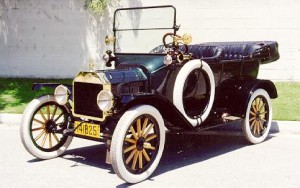
Model T tires are white until 1910 — when the petroleum product carbon black is added to improve durability.

The first production Model T Ford rolls off the assembly line at the company’s plant in Detroit.

Between 1908 and 1927, Ford will build about 15 million Model T cars – fueled by inexpensive gasoline. It is great timing for the petroleum industry, which has seen demand for kerosene for lamps drop because of electric lighting.

New oil field discoveries, including a 1901 massive find near Beaumont, Texas, will meet new demand for what had been a refining byproduct: gasoline. Visit the Spindletop-Gladys City Boomtown Museum and the Texas Energy Museum in Beaumont. Read the rest of this entry »


September 25, 1922 – First Oil Discovery in New Mexico

New Mexico has produced more than 5.5 billion barrels of oil since its September 1922 discovery well.

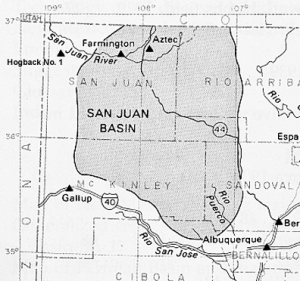
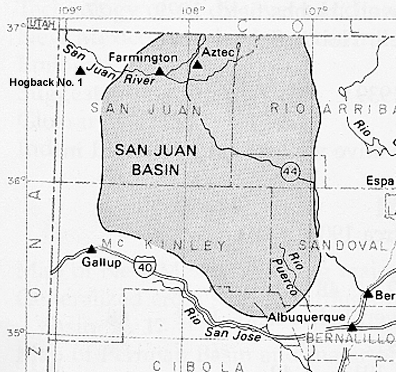
New Mexico’s first commercial oil well is drilled on the Navajo Indian Reservation near Shiprock by the Midwest Refining Company.

The Hogback No. 1 is a modest producer at 375 barrels per day, but Midwest soon drills eleven additional wells to establish the Hogback oilfield as a major producer of the San Juan Basin.

Two years later, a pipeline to Farmington is completed and oil is shipped by rail to Salt Lake City, Utah, for refining. However, discoveries in southeastern New Mexico will overshadow the San Juan Basin’s oil and natural gas possibilities. New Mexico has produced more than 5.5 billion barrels of oil since the Hogback No. 1 well.

Learn more about the industry at the New Mexico Oil & Gas Association - and visit the Farmington Museum. Read the rest of this entry »


September 18, 1948 – Oil found in Utah

After searching for oil in Utah for more than 25 years, J. L. “Mike” Dougan, president of the small independent Equity Oil Company, brings in the state’s first commercial well in the Uinta Basin — beating out larger competitors Standard Oil of California, Pure Oil, Continental, Gulf, and Union Oil. The discovery launches a  drilling boom.

J.L. “Mike” Dougan, left, watches oil flow from Utah’s first commercial well — the Ashley Valley No.1 about 10 miles southeast of Vernal.

The Ashley Valley No. 1 well, ten miles southeast of Vernal, comes in at 300 barrels a day from 4,152 feet. By the end of 1948, eight more wells are drilled and development of the field follows.

Production averages just less than a million barrels a year from the approximately 30 wells in the field. The Ashley Valley is the state’s largest producing oilfield until 1957. More discoveries follow as wells are drilled deeper.

Signs of oil had been noted as early as 1850 near Rozel Point on the northern shore of Great Salt Lake, notes the Utah Geological Survey:

“Although some oil was produced beginning in 1904 at the Rozel oil seep, and a few years later at the Virgin River field and at Mexican Hat, large-scale commercial oil development did not begin until the late 1940s and early 1950s in the Uinta and Paradox Basins.

Shortly thereafter, Utah was one of the top 15 oil producing states – a position it has held since. The value of extracted crude oil in Utah for 2008 was more than $1.9 billion.” Read the rest of this entry »


September 11, 1866 – Turning Kerosene into a “Vacuum Harness Oil”

Beginning in 1866, “Ewing’s Patent Vacuum Oil” preserved and lubricated leather harnesses.

Carpenter and part-time inventor Matthew P. Ewing patents a method of distilling kerosene in a vacuum to produce lubricants.

Three weeks later, with partner Hiram Bond Everest, he founds Vacuum Oil Company in Rochester, New York. Their first product is “Ewing’s Patent Vacuum Oil,” extolled for its virtues as a leather conditioner and preserver.

Ewing leaves the partnership, but Everest continues to develop his unique vacuum-produced lubricants such as a Vacuum Harness Oil - which he initially distributes in square containers previously used for canned oysters.

The company prospers with the production of heavy lubricating oils. In 1880, Everest sells 75 percent of Vacuum Oil to John D. Rockefeller’s Standard Oil for $200,000. More than half a century later, the company will become the Socony Mobil Oil Company (see “Mobil’s High-Flying Trademark”). Read the rest of this entry »


September 4, 1841 – Early Drilling Technology

Then 1841 invention greatly increases percussion drilling efficiency.

Early drilling technology advances when William Morris patents a “Rock Drill Jar” — a drilling innovation he began experimenting with 10 years earlier in Kanawha County, Virginia (now West Virginia). His wells provide settlers with much-needed salt for preserving food.

Morris, using his experience as a brine well driller, patents his device, No. 2243 — a “manner of uniting augers to sinkers for boring artesian well.” It is a telescoping link apparatus that greatly increases the efficiency of percussion drilling because it “would slacken off as the bit hit bottom and pick up the bit with a snap on the upstroke.”

After oil is discovered in Pennsylvania, cable-tool drilling technology will evolve rapidly as drillers improve upon Morris’ patented jars. Today, cable-tool rigs and jars are still in use around the world. See the article “Making Hole — Drilling Technology.” Read the rest of this entry »


August 27, 1859 – Birth of U.S. Petroleum Industry

“August 27, 1859, is one of those special dates that changed the world,” notes one historian. “Edwin Drake’s quest to find oil by drilling was a success, and the modern oil and gas industry took a giant leap forward.”

The modern American petroleum industry is born in Titusville, Pennsylvania. The Seneca Oil Company’s highly speculative pursuit of oil is rewarded when Edwin L. Drake and his blacksmith driller, William “Uncle Billy” Smith, bring in the first commercial oil well at 69.5 feet near Oil Creek in Venango County. They launch a new industry.

For many Americans, western Pennsylvania in the 1850s was considered wilderness. When a group of New Haven, Connecticut, investors sought someone to drill in a region known for its oil seeps, they turned to a former railroad conductor already familiar with the area. It also helped that Drake was allowed free passage on trains.

Although earlier cable-tool drillers of brine wells had found small amounts of oil – an unwanted byproduct – “Colonel” Drake’s 1859 discovery well along Oil Creek would launch the modern petroleum industry. As a result of his perseverance, many new products, including newly invented kerosene, would create the demand for oil and natural gas that continues to this day. Read the rest of this entry »


August 24, 1892 – Gladys City Oil, Gas & Manufacturing Company founded

Gladys City (Texas) Oil, Gas & Manufacturing Company drills near Spindletop Hill, which will become famous for a 1901 gusher.

One of the earliest Texas oil companies – the Gladys City Oil, Gas & Manufacturing Company – is formed by Patillo Higgins and three partners. They lease 2,700 acres in Jefferson County, Texas.

Higgins is convinced that an area known as “Big Hill” – Spindletop Hill – four miles
south of Beaumont, has oil despite all conventional wisdom to the contrary.

“As geologists would soon learn, salt domes are surrounded by oil, and one of the largest was Spindletop Hill, south of Beaumont,” notes a local petroleum  museum. Read the rest of this entry »


August 13, 1962 – Norman Rockwell illustrates Petroleum Industry

A Norman Rockwell illustration advertised a leading industry magazine.

Norman Rockwell’s art commemorated the 1959 centennial of the birth of the nation’s oil industry.

The Oil and Gas Journal advertises with an illustration from artist Norman Rockwell captioned, “Where Oil Men Invest Their Valuable Reading Time.”

Beginning in 1916, Rockwell’s renditions of American life and family brought him widespread popularity through magazines such as the Saturday Evening Post, Boy’s Life, and Leslie’s Illustrated Weekly.

In addition to the Oil and Gas Journal illustration, Rockwell also provides the American Petroleum Institute with first day of issue artwork to commemorate the 1959 centennial of the birth of the nation’s oil industry: “Oil’s First Century 1859-1959.” The Rockwell illustration depicts “the men of science, the rugged extraction of the crude oil, and ending with your friendly service station attendant,” notes one collector. Read the rest of this entry »


August 7, 1933 – Alley Oop’s Oil Field Roots

“Alley Oop” appears for the first time when former Ft. Worth Star-Telegram reporter Victor (V.T.) Hamlin publishes the caveman as a syndicated daily cartoon in Iowa’s Des Moines Register. The comic strip is a hit and ultimately appears in more than 800 newspapers. The West Texas oil town of Iraan lays claim to Hamlin’s paleontological inspiration.

A 1995 postage stamp commemorates “Alley Oop” by Victor Hamlin, a cartoonist originally from Iraan, Texas.

Iraan (pronounced eye-rah-ann) first appeared in 1926 as a company town following the discovery of the prolific Yates oilfield. Many of its early buildings were constructed by the Big Lake Oil Company.

The Yates field will produce more than 40 million barrels in just three years, but Iraan’s best years will be over by 1960 – when the band Hollywood Argyles sings that Alley Oop is “the toughest man there is alive.”

Although Alley Oop is one of 20 comic strips commemorated in a 1995 series of U.S. postage stamps, Yates oilfield production and Iraan’s fortunes have both declined. The town opened its Alley Oop Fantasy Land theme park in 1965 with favorite son Hamlin in attendance.

Today, tourists visit the Alley Oop Museum and R.V. Park on the northwest edge of Iraan at 9261 Alley Oop Lane, off of U.S. 190. Thanks to improved technologies, production from Yates oil wells continues – and the field is estimated to have one billion barrels of recoverable oil remaining. Read the rest of this entry »


August 1, 1872 – First Pennsylvania Natural Gas Pipeline

Natural gas will power Pittsburgh steel mills.

The first recorded large-scale delivery of natural gas by pipeline begins when gas is delivered to Titusville, Pennsylvania, through a two-inch wrought iron pipeline from a well five miles to the northeast. The well’s high production — four million cubic feet of natural gas a day –  is the largest in the oil region.

The mayor of Titusville and the Keystone Gas & Water Company constructed the pipeline to deliver “the most powerful and voluminous  gas well on record” to more than 250 residential and commercial customers in Titusville. A second 3.25-inch diameter pipe is soon added.  The well produces into the 1880s.

Once an underestimated byproduct of the new petroleum industry, practical uses of natural gas will be introduced by George  Westinghouse for the Pittsburgh steel and glass industries, notes David Waples, author of The Natural Gas Industry in Appalachia. Learn more  Pennsylvania petroleum history at the Drake Well Museum in Titusville. Read the rest of this entry »


July 23, 1951 – Desk & Derrick Clubs organize

An early leader in energy education.

The Association of Desk & Derrick Clubs of North America is formed with articles of association signed by presidents of the clubs of New Orleans, Louisiana; Jackson, Mississippi; Los Angeles, California and Houston, Texas.

Combined membership of the four charter clubs is 883. The association promotes “the education and professional development of individuals employed in or affiliated with the petroleum, energy and allied industries and to educate the general public about these industries.”

Today there are there are 61 clubs in seven regions throughout the United States and Canada.

July 24, 2000 – BP unveils New Logo

London-based BP was founded in 1908 as the Anglo-Persian Oil Company.

When BP – then British Petroleum – merges with Amoco in 1998, the company’s name changes to BP Amoco. U.S. Amoco stations eventually convert to the BP brand.

BP, in 2000 the official name of a group of companies that include Amoco, ARCO and Castrol, unveils its new corporate identity brand – replacing its “Green Shield” logo with a green and yellow sunflower pattern. The company introduces a new corporate slogan: “Beyond Petroleum.” Read the rest of this entry »


July 17, 1973 – Trans-Alaska Pipeline Authorization Act

Spiro Agnew

After three years of years of contentious congressional debate, legal challenges from environmental groups and Alaska native claims, Vice President Spiro Agnew breaks the deadlocked 49-49 vote in the U.S. Senate. His deciding vote passes the Trans-Alaska Pipeline Authorization Act.

Construction will begin in March 1975 on the 789-mile pipeline system, the largest private construction project in American history. Oil from the Prudhoe Bay oilfield will begin flowing to the port of Valdez in June 1977. Budgeted at $900 million, the pipeline ultimately costs about $8 billion to construct. Oil production tax revenues will earn Alaska $50 billion by 2002.

July 19, 1915 – Gasoline powers Washing Machines and Grass Cutters

One-cylinder, air cooled, two-cycle engines could run on gasoline, kerosene or alcohol.

Howard F. Snyder applies to patent his internal combustion-powered washing machine, assigning rights to the Maytag Company of Newton, Iowa. His invention is targeted “to the ordinary farmer” who does not have access to electricity.

Snyder’s washing machine uses a one-cylinder, air cooled, two-cycle engine that can run on gasoline, kerosene or alcohol. It provides “an assembled machine and power plant so constructed and arranged as to be compact, simple and economical.”

Four years after Snyder’s innovation, Edwin George of Detroit removes the Maytag engine from his wife’s washing machine, mates it with a reel-type lawn mower, and launches a new company, “Moto-Mower,” selling America’s first commercially successful power mower. Read the rest of this entry »


July 11, 2008 – World Oil Prices hit Historic High

Many types of crude oil are produced around the world, notes the U.S. Energy Information Administration, which publishes independent statistics and analysis. “Variations in quality and location result in price differentials, but because oil markets are integrated globally, prices tend to move together.”

U.S. “light sweet crude” rises to $147.27 a barrel, before dropping back to $145.08. Prices on the New York Mercantile Exchange peaked at $145.29 a barrel eight days earlier. As supply fears subside (despite speculation and concern about Iran and new demand from China and India competing for world oil supplies) oil prices fall to $36.51 a barrel on January 16, 2009. Read the rest of this entry »


July 2, 1910 – President Taft establishes Naval Petroleum Reserves

The U.S.S. Texas was the last American battleship to be built with coal-fired boilers. By 1927 she had been converted to burn fuel oil and served throughout World War II. The battleship now is a floating museum in LaPorte, Texas.

As the U.S. Navy rapidly converts from coal to oil-burning ships, President William Howard Taft establishes three Naval Petroleum Reserves.

National security concerns about an assured oil supply in the event of war or a national emergency resulted in the Pickett Act of 1910, which authorizes the president to withdraw large areas of potential oil-bearing lands in California and Wyoming as sources of fuel for the Navy.

Within 15 years, the properties that make up the Naval Petroleum and Oil Shale Reserves include the three Naval Petroleum Reserves and three Naval Oil Shale Reserves. A Naval Petroleum Reserve Number Four, on the north slope of Alaska, is added in 1923.

“As not only the largest owner of oil lands, but as a prospective large consumer of oil by reason of the increasing use of fuel oil by the Navy, the federal government is directly concerned both in encouraging rational development and at the same time insuring the longest possible life to the oil supply.” -  Message to Congress by President Taft Read the rest of this entry »


June 25, 1889 – First Oil Tanker catches Fire

The wooden-hulled W. L. Hardison had transported oil below decks in steel tanks.

The first oil tanker ever built, the W. L. Hardison, burns at its Ventura, California, wharf. The Hardison & Stewart Oil Company (forerunner of Union Oil Company) built the revolutionary schooner as an alternative to paying one-dollar per barrel railroad tank car rates to reach markets in San Francisco.

With oil-fired boilers and supplemental sail, the wooden-hulled W. L. Hardison had been capable of transporting 6,500 barrels of oil below decks in steel tanks. The vessel’s steel tanks are later recovered and used at the company’s Santa Paula refinery. Loss of the schooner severely strains Hardison & Stewart Oil Company finances; it will be 11 years before company launches a replacement tanker, the Santa Paula.

Learn more petroleum history by visiting the California Oil Museum in Santa Paula – the museum’s main building is the original Union Oil Company headquarters. Read the rest of this entry »


June 18, 1889 – Standard Oil Company of Indiana Incorporated

“Opened in 1889, the Standard Oil refinery in Whiting, Indiana, was one of the company’s largest and most productive,” notes the Encyclopedia of Chicago.

John D. Rockefeller’s Standard Oil Company establishes an Indiana-based subsidiary when Standard Oil Company of Indiana is incorporated. The company will begin processing oil the next year at a new refinery at Whiting, Indiana, southeast of Chicago.

“By the mid-1890s, the Whiting plant had become the largest refinery in the United States, handling 36,000 barrels of oil per day and accounting for nearly 20 percent of the total U.S. refining capacity” notes the Encyclopedia of Chicago. “By 1910, when it was connected by pipeline to oil fields in Kansas and Oklahoma, as well as Ohio and Indiana, the Whiting facility had about 2,400 workers.” Read the rest of this entry »


June 11, 1929 – Independent Producers organize

Founded in 1929 with headquarters in Tulsa, Oklahoma, IPAA today is based in Washington, D.C.

Wirt Franklin of Ardmore, Oklahoma, speaks on behalf of America’s independent producers at President Herbert Hoover’s Oil Conservation Conference at the Broadmoor Hotel in Colorado Springs, Colorado.

Franklin opposes any commission that could restrict domestic production – and allow an increase in importing foreign oil. “If this condition should be brought about,” proclaims Franklin, “it would mean the annihilation and destruction of the small producer of crude oil.”

Franklin will establish a new organization based in Tulsa, Oklahoma, to defend the interests of small U.S. producing companies – the Independent Petroleum Association of America, which today represents companies that drill 90 percent of domestic oil and natural gas wells, producing 68 percent of U.S. oil and 82 percent of its natural gas.

June 13, 1917 -  Phillips Petroleum founded in Bartlesville, Oklahoma

Phillips Petroleum Company is founded in Bartlesville, Oklahoma, during the early months of World War I – when the price of oil climbs above $1 per barrel. Read the rest of this entry »


June 4, 1892 – Flood devastates Pennsylvania Oil Region

After weeks of heavy rain in Pennsylvania’s Oil Creek Valley, Thompson & Eldred’s huge mill dam on Oil Creek at Spartanburg bursts, releasing a torrent of water that kills more than 100 people and destroys homes and businesses in Titusville and Oil City. The disaster is compounded when fire breaks out in Titusville.

Photography pioneer John Mather – renowned for his images of western Pennsylvania oilfields – will lose 16,000 glass-plate negatives when a flood ravages Titusville and Oil City. Above are two of his photographs of the 1892 destruction.

“This city during the past twenty-four hours has been visited by one of the most appalling fires and overwhelming floods in the history of this country” reports the New York Times. Noted oilfield photographer John A. Mather – whose studio and 16,000 glass-plate negatives are also ruined – begins documenting the devastation. Read the rest of this entry »


March 5, 1963 – Petroleum Product receives Patent

Arthur Melin receives a U.S. Patent (No. 3,079,728) for a “Hoop Toy.”

Oil Creek Plastics of Titusville, Pennsylvania, celebrates the 150th anniversary of the U.S. petroleum industry during a 2009 parade.

The Wham-O Company, founded in 1948 by Melin and partner Richard Knerr, previously trademarked the name “Hula Hoop.”

The California company began using Marlex, a new plastic from Phillips Petroleum Company of Bartlesville, Oklahoma, to manufacture its first hoop in 1958.

An estimated 20 million Hula Hoops are sold in six months.

Although Phillips Petroleum introduced Marlex polyethylene in 1954, there was little demand until orders came from the toy company that began by making wooden slingshots. In 1957 Wham-O added a plastic flying disc, the “Pluto Platter” – today’s Frisbee – to its products. The next year, the Marlex-made Hula Hoop was introduced, launching a national craze. Read the rest of this entry »


February 28, 1935 – Nylon is World’s First Synthetic Fiber

The world’s first synthetic fiber – nylon – is discovered by a former Harvard professor working at a DuPont Corporation research laboratory. Later called Nylon 6 by scientists, the revolutionary product comes from chemicals found in petroleum.

Wallace Carothers had experimented with artificial materials for more than six years. He previously discovered neoprene rubber (commonly used in wetsuits) and made major contributions to understanding polymers – molecules composed in long chains.

DuPont names the new petroleum product nylon – although chemists call it Nylon 6 because the adipic acid and hexamethylene diamine each contain 6 carbon atoms per molecule. Strong and durable petroleum-based polymer products like nylon are in common daily use throughout the world.

Just 32-years-old, Carothers creates fibers when he combines the chemicals amine, hexamethylene diamine, and adipic acid. He forms a polymer chain using a process in which individual molecules join together with water as a byproduct. But the fibers are weak, explains a PBS series, A Science Odyssey: People and Discoveries.

“Carothers’ breakthrough came when he realized the water produced by the reaction was dropping back into the mixture and getting in the way of more polymers forming,” notes the PBS website. “He adjusted his equipment so that the water was distilled and removed from the system. It worked!” Read the rest of this entry »


February 20, 1959 – First LNG Tanker arrives in England

After a three-week voyage, the Methane Pioneer – the world’s first liquefied natural gas tanker – arrives at the world’s first LNG terminal at Canvey Island, England, from Lake Charles, Louisiana.

The world’s first liquefied natural gas tanker is a converted World War II liberty freighter.

The vessel, a converted World War II liberty freighter, contains five, 7,000-barrel aluminum tanks supported by balsa wood and insulated with plywood and urethane, according to the Center for Energy Economics (CEE).

“This event demonstrated that large quantities of liquefied natural gas could be transported safely across the ocean,” notes CEE, a research arm of the Bureau of Economic Geology at the University of Texas.

The 340-foot Methane Pioneer, owned by the Comstock Liquid Methane Corporation, refrigerates its cargo to minus 285 degrees Fahrenheit. When vaporized, the LNG expands by the ratio of 600 to one.

“German engineer Karl Von Linde built the first practical compressor refrigeration machine in Munich in 1873,” CEE explains. “The first LNG plant was built in West Virginia in 1912 and began operation in 1917. The first commercial liquefaction plant was built in Cleveland, Ohio, in 1941.” Read the rest of this entry »


February 13, 1924 – Forest Oil incorporates

Forest Oil’s logo features the “Yellow Dog” — a two-wicked lantern once used on derricks.

A corporate logo with a lantern burning two wicks? An oil company originally founded in 1916 consolidates with four other independent petroleum companies — the January Oil, Brown Seal Oil, Andrews Petroleum and Boyd Oil — to form the Forest Oil Corporation, an early leader in secondary recovery technology.

Originally based in Bradford, Pennsylvania – site of the “first billion dollar oil field” in the United States – the Forest Oil logo features the lantern often seen on early wooden derricks. Some believe the lantern’s name, “yellow dog,” comes from the two burning wicks resembling a dog’s glowing eyes at night.

Read the American Oil & Gas Historical Society’s “Yellow Dog – Oilfield Lantern” article by Contributing Editor Kris Wells that appeared in the February 2009 issue of Hart’s E&P magazine.

Today headquartered in Denver, Forest Oil (publicly held since 1969) and its subsidiaries engage in petroleum exploration, production and marketing, with principal reserves and producing properties in Arkansas, Louisiana, New Mexico, Oklahoma, Texas, Utah, and Wyoming. Visit the Penn-Brad Historical Oil Park and Museum near Bradford, Pennsylvania — where a modern natural gas shale boom has renewed the historic oil patch economy. Read the rest of this entry »


February 8, 1836 – Natural Gas lights Philadelphia

Philadelphia Gas Works lamp.

Forty-six natural gas lights along Philadelphia’s Second Street are lit for the first time by employees of the newly formed Gas Works — the first municipally owned natural gas distribution company.

Today there are more than 900 public natural gas systems; the Philadelphia Gas Works is the largest. There are more than 70 million residential, commercial and industrial natural gas customers in the United States. America’s first commercial gas lighting company, the Gas Light Company of Baltimore, Maryland (now Baltimore Gas and Electric Company), incorporated in 1817. It distributed gas manufactured from tar and later coal.

Learn more about the early natural gas industry in “Indiana Natural Gas Boom.” Read the rest of this entry »


January 30, 1916 – Standard Oil promotes Petroleum Product “Nujol”

Standard Oil Company of New Jersey takes out a full-page advertisement in the New York Sun extolling the virtues of “Nujol,” one of the company’s many petroleum-based products.

A 1916 Standard Oil advertisement joins much earlier patent medicine promoters of petroleum’s medicinal value.

Nujol offers “Internal Lubrication As A Means To Health,” the ad proclaims. One historian will later note that “physicians disagree with the sales department of Standard Oil on this point.”

Standard promises to send a pint of Nujol anywhere in the United States for 75 cents in stamps or coin.

Since primitive people first found medicinal solutions in natural oil seeps, petroleum has been used with greater or lesser success to heal a variety of ailments. By  the 19th century, patent medicines and their “miraculous” curative claims have become part of American culture. In the 1840s, one such cure-all was American Medicinal Oil. It came from naturally occurring petroleum seeps in Kentucky.

Nancy Kier of Pittsburgh, Pennsylvania, will treat her consumption (tuberculosis) with oil. Her enterprising husband Samuel then begins packaging eight-ounce bottles and selling them for 50 cents through traveling salesmen and pharmacies.

He proclaims: ”KIER’S GENUINE PETROLEUM! OR ROCK OIL! A NATURAL REMEDY, Procured from a Well 400 feet deep, and possessing wonderful Curative Powers in diseases…”

A label from Samuel Kier’s patent medicine shows cable-tool rigs used for drilling brine wells — and soon for oil wells to launch the U.S. petroleum industry.

Kier’s patent medicine advertisement featuring brine-well wooden derricks is remembered for inspiring industrialist George Bissell to wonder if the same apparatus could be adapted to extract quantities of rock oil — from which highly prized kerosene could be distilled.

Bissell’s insight will ultimately lead to formation of the Pennsylvania Rock Oil Company — and birth of the American petroleum industry on August 27, 1859.

New products like “petroleum jelly” patented in 1872 as “Vaseline” — will prove superior in preventing infections for common abrasions. Its inventor, Robert Chesebrough, consumed a spoonful of Vaseline every day and lived to be 96 years old. Read “A Crude Story: Mabel’s Eyelashes.” Read the rest of this entry »