Your source for energy education. Petroleum history offers a context

for teaching the modern business of meeting America's energy needs.

Oil and Natural Gas History, Education Resources, Museum News, Exhibits and Events


By the summer of 1942, the situation was desperate. The future of Great Britain – and the outcome of World War II – depended on petroleum supplies. By the end of that year, demand for 100-octane fuel would grow to more than 150,000 barrels every day.

In August 1942, British Secretary of Petroleum, Geoffrey Lloyd called an emergency meeting of the Oil Control Board to assess the “impending crisis in oil.” This is the story of the “little-known, or at least seldom recognized, all-important role oil and oilmen played in the prosecution of the war,” note the authors of The Secret of Sherwood Forest – Oil production in England during World War II.

In 1942, England’s vital petroleum supplies, including high-octane aviation fuel, came by convoy — and continued to be subjected to relentless U-Boat attacks.

“The amazing and hitherto untold story, born in secrecy, has remained buried in the private diaries, corporate files and official records of government agencies,” explain Guy Woodward and Grace Steele Woodward in their 1973 book. “In the final analysis, oil was indeed the key to victory of the Allies over the Axis powers.”

————————————————————-

Two bronze statues separated by the Atlantic Ocean commemorate the achievements of World War II American roughnecks. The first stands in Dukes Wood near the village of Eakring in Nottinghamshire, England. Its twin greets visitors at Memorial Square in Ardmore, Oklahoma. Read the rest of this entry »


Geology in Bartlesville, Oklahoma, marks the spot where on April 15, 1897, a large crowd gathered at Nellie Johnstone No. 1 to watch as as a “go devil” was used to “shoot” the well – a downhole nitroglycerin explosion to maximize production – before it was completed.

Prior to the Civil War, America’s search for oil prompted entrepreneurs, speculators, and wildcatters to seek their fortunes on the great plains of the Indian Territory.

This was land reserved for Native Americans by Congress and home to its indigenous people as well as the “Five Civilized Tribes” – Choctaw, Cherokee, Seminole, Creek, and Chickasaw, which had been relocated from the Southeast.

Today, Oklahoma ranks 7th in U.S. oil production and 4th in natural gas. George B. Keeler and William Johnstone are remembered as the Indian Territory entrepreneurs who opened an Oklahoma oil boom that continues to this day.

Each of the Five Civilized Tribes established national territorial boundaries, constitutional governments, and advanced judicial and public school systems. The Indian Territory included present-day Oklahoma north and east of the Red River, as well as Kansas and Nebraska.

Discovering Indian Territory Oil

By 1856, fifty-one years before Oklahoma statehood, the Indian Territory had become home to the Five Civilized Tribes – as well as the Osage, Pawnee, Seneca, Shawnee, Delaware, and others.

A non-tribal member coming into the Indian Territory to work was required to take out a license or permit; one who married into a tribe was adopted and able to share in tribal property.

In 1859, Lewis Ross, a brother of Chief John Ross of the Cherokees, found a pocket of oil that produced about ten barrels a day for nearly a year. He was drilling for saltwater – brine being  much-desired for making salt, a food preservative.

Ross drilled his well on the Grand River near Salina in what is now Mayes County, Oklahoma. After deciding to sink a deeper well for greater production, he found oil instead. News spread of this potential source of tribal revenue.

Spectators watched as Miss Jenni Cass, dropped a weighted percussion device (often called a go devil) down the well bore to set off a waiting canister of nitroglycerin – producing a gusher that heralded the beginning of Oklahoma’s oil era.

According to the constitutions of the Choctaw and Chickasaw nations at that time, the land was held in common by the Indian citizens of the nations – but the individual citizens could lease out a limited amount of land.

The Ross well was quickly depleted, but it proved that there was oil to be found in the Indian Territory.

By 1875, Jacob H. Bartles, another pioneer and adopted Delaware Indian, was operating a trading post on the Caney River in the Cherokee Nation.

Bartles employed two ambitious young men, George B. Keeler and William Johnstone. They too were adopted members of the Osage and Delaware tribes, respectively.

Within a few years, Keeler and Johnstone started their own competing general store on the other side of the Caney River, in what became Bartlesville. It was a successful enterprise and while the partners knew of oil seeps in the area at this time, they lacked the financial support and tribal permissions necessary to pursue the opportunity.

More than 20 years later, Keeler and Johnstone would make oil history just around the river bend from their general store.

The Search for Rock Oil

In 1884, the Cherokee Nation passed a law authorizing the “Organization of a company for the purpose of finding petroleum, or rock oil, and thus increasing the revenue of the Cherokee Nation.”

Five years later, a wildcatter named Edward Byrd secured mineral leases from the Cherokee Nation. He drilled his first well near present-day Chelsea (Rogers County) in 1890, and found oil at a depth of only 36 feet. His well produced about a half a barrel a day but his efforts were hampered severely by government regulation, inadequate transportation facilities and the lack of a readily accessible market.

Edward Byrd organized the U.S. Oil and Gas Company, and sold one half of his acreage to the Cherokee Oil and Gas Company. His Chelsea well is still celebrated as Oklahoma’s first.

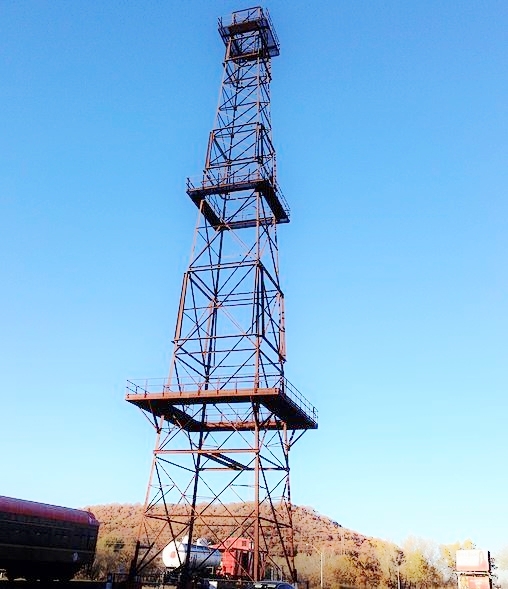
A re-enactment of the dramatic moment that changed Oklahoma history highlighted the 2008 dedication of a 84-foot replica derrick at Discovery 1 Park in Bartlesville. The derrick replaced one dedicated in 1948.

Following Edward Byrd’s success, Kansas oilmen James Guffey and John H. Galey approached several prominent Indian citizens, including general store partners Keeler and Johnstone, and offered to purchase mineral sub-leases and pay a royalty of three and one-half percent to the Cherokee Nation on any petroleum production.

Years later George B. Keeler recalled, “Guffey and Galey of Pittsburgh, Pennsylvania, were drilling at Neodesha, Kansas, in 1893. Mr. Galey got in his buggy and followed the mounds from Kansas to the mound at Bartlesville.

“He came to my store on the present site of Bartlesville and told me that there was oil here and that if I would get a lease from the Cherokees, he would drill a well. Mr. Galey said that he knew there was oil here because of the mounds which, in his opinion, had been thrown up by gas pressure; and he called attention to the broken edges of all the rocks which, he said, would be round if caused by water and erosion.”

However, before the deal could be completed, Guffey and Galey withdrew their backing and moved on to a new project near Beaumont, Texas. There, in 1901, they would bring in the famous well, “Spindletop.”

Nellie Johnstone No.1

Meanwhile, George Keeler, William Johnstone, Frank Overlees, their Indian wives, and other locals had acquired mineral leases on over 200,000 acres of Cherokee land. They ultimately secured new financial backing from the millionaire Chicago meat-packer Michael Cudahy’s “Cudahy Oil Company.”

The new venture’s search for oil began in earnest when they hired the well-known firm of “McBride and Bloom” from Independence, Kansas. Albert P. McBride and Camden L. Bloom had drilled Kansas’ first commercially successful well, Norman No.1, in what would come to be known as the Mid-Continent Field, before they ranged into the Indian Territory.

In December 1896, McBride and Bloom abandoned a 1,750 foot dry hole near Red Fork (today part of Tulsa) to drill a new well for Cudahy Oil Co. It took three-weeks of hauling equipment, tools, pipe and other materials 70-miles northward across the freezing Arkansas River to the new Keeler and Johnstone site on Spencer Creek of the Caney River.

Drilling began in January 1897, the same month that Bartlesville was incorporated with a population of about 200 people. Four months later, at 1,320 feet, the Nellie Johnstone No.1 well (named for partner William Johnstone’s six year-old daughter), showed for oil.

A downtown Oklahoma City parade celebrating the 2007 centennial of Oklahoma statehood included a float acknowledging Oklahoma’s petroleum heritage, seen here in an artist’s early conception.

“Shooting” had been used since the 1859 Drake well in Pennsylvania to stimulate production, so G. M. Perry, an expert shooter, was brought in. Perry had been McBride and Bloom’s shooter for the successful Norman No.1 well in Kansas.

Liquid nitroglycerin was poured into a metal canister – or “torpedo” – and lowered into the well on April 15, 1897, as a crowd of about 50 curious onlookers gathered. At 3 p.m., George Keeler’s stepdaughter, Miss Jenni Cass, dropped the “go devil” detonating device down the well bore to set off the waiting nitroglycerin.

The explosion caused Nellie Johnstone No.1 to blow in as a gusher, producing from 50 to 75 barrels of oil a day. Despite the production, the Cudahy Oil Co. was confronted with the same problem Edward Byrd had faced seven years earlier: more crude oil than the local market could consume.

With no storage tanks, pipelines, or railroads available, the Nellie Johnstone No. 1 was capped for two years.

Another chapter in Bartlesville’s rich petroleum history is exhibited at the Phillips Petroleum Company Museum, which opened May 12, 2007.

The railroad finally came to Bartlesville with the opening of the Atchison, Topeka and Santa Fe in 1899. Oil could then be shipped from Bartlesville to Caney, Kansas, and from there by pipeline to a small Standard Oil refinery in Neodesha for processing into kerosene and other products.

With the railroad and pipeline, the Nellie Johnstone No.1, became commercially profitable in May 1900 with the initial shipment of oil at a price of $1.25 per barrel, less 25 cents for handling.

As the discovery well for the giant Bartlesville-Dewey Field, the Nellie Johnstone No.1 ushered in the oil era for Oklahoma Territory. It produced more than 100,000 barrels of oil in its lifetime. In the ten years following the Nellie Johnstone discovery, Bartlesville’s population grew from 200 to over 4,000 while Oklahoma’s oil production grew from 1,000 barrels to over 43 million barrels annually.

At the age of 12, future oil giant J. Paul Getty started selling the “Saturday Evening Post” in Bartlesville. By the age of 23, he had earned his first million in oil. Frank Phillips, perhaps most beloved of all the Bartlesville oil legends, established the international Phillips Petroleum Company, which remained in Bartlesville until merging with Conoco in 2003.

After the Nellie Johnstone success, production in the Indian Territory rose rapidly, adding much impetus towards the granting of Statehood in 1907. In the 10 years between the Nellie Johnstone and Statehood, Oklahoma became the largest oil-producing entity in the world.

Today, Oklahoma still ranks 7th in United States’ oil production and 4th in natural gas. George B. Keeler and William Johnstone are remembered as the Indian Territory entrepreneurs who opened an Oklahoma oil boom that continues to this day. Oklahoma’s first commercial oil well is commemorated north of downtown Bartlesville on Cherokee Avenue, where a rebuilt replica of the Nellie Johnstone No.1, stands at the original site.

The 1948 presentation of the well to the city of Bartlesville appropriately noted, “Like the rush for Oklahoma land, the discovery of oil attracted both men and capital from far and near, these pioneers in petroleum development were as rugged and self-sufficient as those who settled the land … Oklahoma’s two greatest industries, agriculture and petroleum, have developed largely hand in hand, and back of both developments are the pioneers, men of restless energy and unbounded faith.”

———————————————————————–

Editor’s Note – According to the U.S. Energy Information Administration, Oklahoma continues to be a leading natural gas producing state with more than a dozen of the 100 largest natural gas fields in the country; Oklahoma has five petroleum refineries with a combined capacity of roughly three percent of the total U.S. distillation capacity.

Please support the American Oil & Gas Historical Society with a donation.


April 9, 1914 – Ohio Cities Gas Company

In Columbus, Ohio, Beman Dawes and Fletcher Heath form the Ohio Cities Gas Company. The company acquires Pennsylvania-based Pure Oil Company in 1917 and adopts that name three years later.

Pure Oil becomes one of the 100 largest industrial corporations in the United States by 1965, when it is purchased by Union Oil Company of California, now a division of Chevron Corporation. Chevron - established on September 10, 1879, as the Pacific Coast Oil Company – has used more than a dozen logos in 130 years. Read the rest of this entry »


When a well strikes a high-pressure formation about 6,500 feet beneath Oklahoma City – and oil erupts skyward – the prolific Oklahoma oilfield will become famous worldwide.

Newsreel photographers will send film of the “Wild Mary Sudik” well to Hollywood. Within a week, newsreels appear in theaters around the country. When the Mary Sudik is brought under control, crews will recover 200,000 barrels of oil from pits and ponds.

The Indian Territory Illuminating Oil Company’s Mary Sudik No. 1 well flows for 11 days before being brought under control on April 6, 1930.

The well, which produces about 20,000 barrels of oil and 200 million cubic feet of natural gas a day, becomes a public sensation known as “Wild Mary Sudik.”

The giant discovery is featured in newsreels and on radio, according to “Oklahoma Journeys,” an audio program of the Oklahoma History Center in Oklahoma City.

“At about 6:30 the morning of March 26, 1930, the crew of roughnecks drilling a well on the property of Vincent Sudik paused in their work,” the program begins about the well, which is near I-240 and Bryant Street in present day Oklahoma City.

“The tired drillers had been waiting for daylight to continue their work,” the audio tape notes.

Experts control the well with “a clever ball-shaped contrivance” that lowers a two-ton “overshot” cap.

The program’s narrator Michael Dean notes that after drilling to drilling to 6,471 feet, the roughnecks overlook a dangerous pressure increase in the well.

“The exhausted crew failed to fill the hole with mud,” he explains. “They didn’t know the Wilcox sand formation was permeated with natural gas under high pressure, and within minutes that sand under so much pressure found a release.”

The drilling crew is caught off guard when oil and natural gas suddenly “came roaring out of the hole,” Dean adds.

“Pipe stems were thrown hundreds of feet into the air like so many tooth picks. First there was gas then the flow turned green gold and then black,” he reports. “Oil shot hundreds of feet into the air, and for the next eleven days, the Mary Sudik ran wild.”

“Wild Mary” Daily Updates

On April 6, Floyd Gibbons of NBC Radio – who broadcast regular reports about the well – reports that after two unsuccessful attempts, the well is closed with a two-ton “overshot” cap.

An Associated Press article describes the “clever equipment” required to control the well without sparking a fire – a “double die was screwed into four inches of casing threads…a clever ball-shaped contrivance, called a fantail, was used to affix the double die to the casing.”

The fantail was placed over the well, “and the ‘Wild Mary’s’ pressure, playing through jets in the contrivance, aided in lowering the cap through the blast,” the article explains.

“With the petroleum geyser halted, operators in the field drew sighs of relief,” it concludes. “A stray spark from two clanking pieces of steel and the territory might have become a raging inferno.”

With the well was brought under control and the danger of fire eliminated, drilling continues at a frantic pace elsewhere in Oklahoma City.

However, the prolific, high-pressure of the Wilcox sands formation continued to challenge drillers and the technologies of the day.

An article in the Southwest Missourian newspaper reported:

Oklahoma City, April 7 – A gas well, estimated to be producing at a rate of 75,000,000 cubic feet a day, blew in at the edge of the city today, creating a new fire threat less than 24 hours after the wild No. 1 Mary Sudik gusher, several miles to the south, had been brought under control.

Recognizing the risks of drilling into the Wilcox sand, Oklahoma City passes additional ordinances for safety and well spacing in the city.

Although the first ram-type blowout preventer had been patented by James Abercrombie in 1926, many high-pressure Texas and Oklahoma oilfields would take time to tame.

The Oklahoma History Center in Oklahoma City includes the Devon Energy Oil and Gas Park.

In December 1933, Abercrombie patented an improved blowout preventer (patent No. 1,834,922), that set a new standard for safe drilling during the Oklahoma City oilfield boom. Read more in “Ending Oil Gushers – BOP.”

Visitors today  can see the valve that split in half and view newsreel film of the Wild Mary Sudik in the oil and gas and natural resources on exhibit at the Oklahoma History Center.

There also is the Devon Energy Oil and Gas Park with drilling and production equipment at the center, located on N.E. 23rd Street just east of the state capitol.

Please support the American Oil & Gas Historical Society with a donation.

“Like” AOGHS on Facebook

Oil patch postings about petroleum heritage. Share your stories, news and events. Read Today in Petroleum History updates.


March 4, 1918 – West Virginia Well sets World Depth Record

On the Martha Goff farm in Harrison County, West Virginia, the Hope Natural Gas Company drills to 7,386 feet and brings the world’s deepest well record to America.

Until then, the deepest well had been drilled to 7,345 feet near Czuehon, Germany.

A March 1974 well set a world record while drilling in Oklahoma’s Anadarko Basin, about 12 miles west of Cordell. The Bertha Rogers No. 1 drilled almost six miles into Oklahoma’s Anadarko Basin before the drill bit stuck.

Today, rotary rigs in the Gulf of Mexico reach up to 35,000 feet deep. A 1970s experimental well on Russia’s Kola Peninsula during the Soviet era exceeded 40,000 feet – after ten years of drilling. Visit the Oil and Gas Museum in Parkersburg, West Virginia. Read the rest of this entry »


When Erle P. Halliburton patents his remarkable “Method and Means for Cementing Oil Wells” on March 1, 1921, he brings greater efficiency, production and safety to America’s oilfields.

Erle Halliburton’s 1921 well cementing process isolates down-hole zones, guards against collapse of the casing – and permits control of the well throughout its producing life.

An Erle Halliburton statue was dedicated in 1993 in Duncan, Oklahoma.


Halliburton’s small petroleum equipment and service company headquartered in Ardmore, Oklahoma, will receive many more patents on its way to becoming a worldwide leader in extending the life of oil and natural gas wells.

After working in Burkburnett, Texas, in 1919 Halliburton had moved to the booming Healdton oilfield near Ardmore, where he established the New Method Oil Well Cementing Company.

“It is well known to those skilled in the art of oil well drilling that one of the greatest obstacles to successful development of oil bearing sands has been the encountering of liquid mud water and the like during and after the process of drilling the wells,” Halliburton notes in his 1920 patent application. Read the rest of this entry »


February 19, 1863 – Pennsylvania Pipeline

First pipeline from an oilfield to a refinery is completed at Oil Creek, Pennsylvania. New Jersey inventor J. L. Hutchings constructs the 2.5-mile pipeline from James Tarr’s farm near Oil Creek to the Humboldt refinery using newly patented rotary pumps to move the oil through two-inch diameter piping. Unfortunately, leaking makes this innovative pipeline impractical.

Visit the “valley that changed the world” and the Drake Well Museum in Titusville.

February 19, 1889 – Ohio acts to Conserve Natural Gas

The Ohio House of Representatives enacts the state’s first petroleum conservation measure – “an Act to prevent the wasting of Natural Gas and to Provide for the plugging of all abandoned wells.”

The Ohio Oil and Gas Association documents wells drilled/completed by County in 2010.

The state’s first commercial petroleum production had begun almost 30 years earlier in Macksburg, Washington County, according to the Ohio Department of Natural Resources.

Ohio remains a leading producer, ranking in the top half of all producing states, the agency notes. As of 2010, more than 275,700 wells have been drilled in the state – yielding more than 1.1 billion barrels of oil and more than 8.52 trillion cubic feet of natural gas. Modern technologies now are finding success in eastern Ohio – the Marcellus shale.

Ohio also claims an 1814 oil discovery as America’s first with a drilled well, according to the Ohio Oil and Gas Energy Education Program. “Two men drilled 475 feet in search of salt in Olive Township of Noble County,” says Director Rhonda Reda. “They cursed when a black liquid oozed into the pit.”

February 20, 1959 – World’s First LNG Tanker arrives

After a three-week voyage, the Methane Pioneer – the world’s first liquefied natural gas tanker – arrives at the world’s first LNG terminal at Canvey Island, England, from Lake Charles, Louisiana. Read the rest of this entry »


His 1939 “Oil Fields of Graham” today remains on display in its original Texas oil patch community’s historic U.S. Postal Service building – now a museum.

Born in Memphis, Missouri, on February 22, 1898, Alexandre Hogue will become known for his paintings of southwestern scenes during the Great Depression – including murals of the 1930s petroleum industry. Read the rest of this entry »


As early 20th century worldwide demand for oil grew – but the science for finding it remained obscure – a small group of geologists organized the American Association of Petroleum Geologists (AAPG).

Beginning as the Southwestern Association of Petroleum Geologists in Tulsa, Oklahoma, about 90 geologists gathered at Henry Kendall College, now Tulsa University, and on on February 10, 1917, formed an association “to which only reputable and recognized petroleum geologists are admitted.”

AAPG embraces a code that assures “the integrity, business ethics, personal honor, and professional conduct” of its worldwide membership.

The new association’s mission included promoting the science of geology, especially as it related to oil and natural gas, and encourage “technology improvements in the methods of exploring for and exploiting these substances.”

AAPG would also “foster the spirit of scientific research among its members; to disseminate facts relating to the geology and technology of petroleum and natural gas.”

Adopted its present name a year after the meeting at Henry Kendall College, AAPG begins publishing a bimonthly journal that remains among the most respected in the industry.

AAPG launches a peer-reviewed Bulletin that includes papers written by leading geologists. With a subscription price of five dollars, the journal is distributed to members, university libraries, and other industry professionals. Read the rest of this entry »


December 26, 1905 – Nellie Bly patents the 55-Gallon Drum

Nellie Bly – well known in her day as a journalist for the New York World newspaper – is issued a U.S. patent for the “metal barrel” that will become today’s 55-gallon steel drum.

Nellie Bly, known worldwide for her exploits as a reporter for the New York World, was issued a U.S. patent on December 26, 1905 — for the “Metal Barrel” that would become today’s standard 55-gallon steel drum.

Patent No. 808,327 is assigned to Elizabeth Cochrane Seaman, better known as Nellie Bly, the most famous woman journalist of her day – who is also president of the Iron Clad Manufacturing Company.

An 1890 photograph of Nellie Bly.

Bly’s company, which produces milk cans, boilers, enamel ware, and dozens of other steel products, will manufacture early versions of the “metal barrel” that becomes the now ubiquitous 55-gallon steel drum.

After marrying wealthy industrialist Robert Seaman in 1894, Bly’s invention begins with a 1904 visit to Europe, where she first sees glycerin containers made of steel. Read more in “The Remarkable Nellie Bly.”

“I determined to make steel containers for the American trade,” she recalls. “My first experiment leaked and the second was defective because the solder gave way, and then I brazed them with the result that the liquid inside was ruined by the brazing metal.”

Bly perfected her technique. “I finally worked out the steel package to perfection, patented the design, put it on the market and taught the American public to use the steel barrel,” she explains.

Soon she would proudly claim, “I am the only manufacturer in the country who can produce a certain type of steel barrel for which there is an immense demand at present, for the transportation of oil, gasoline, and other liquids.” Read the rest of this entry »


December 17, 1884 –  Fighting Oil Field Fires with Cannons

Especially in the Great Plains, frequent lightening strikes caused oil tank fires. This rare photograph is from the collection of the Kansas Oil Museum in El Dorado.

“Oil Fires, like Battles, are fought by Artillery” is the catchy phrase in a New England magazine.

The Massachusetts Institute of Technology publishes its firsthand account of the problem of lightning strikes in America’s growing number of oil fields – and the technology used to extinguish burning oil tanks. MIT not only reports on the fiery results of an oil field lightning strike, but also the practice of using artillery to fight such conflagrations.

A park in Bartlesville, Oklahoma, includes an “oil patch cannon.”

“A Thunder-Storm in the Oil Country” explains that “it is usually desirable to let (oil) out of the tank to burn on the ground in thin layers; so small cannon throwing a three inch solid shot are kept at various stations throughout the region for this purpose.”

Today, several oil patch community museums have a cannon on exhibit to educate visitors about this early firefighting technology, especially in the Great Plains, where frequent lightening strikes caused oil tank fires. Oil patch museums in Seminole and Bartlesville, Oklahoma, include cannons to educate visitors about this early fire-fighting technology. Read more in “Oil Field Artillery.” Read the rest of this entry »


Several oil and natural gas museums educate visitors about an early fire-fighting technology. Especially in the Great Plains, frequent lightening strikes causes oil tank fires. At a safe distance, cannons were used to shoot holes in the base of burning tanks, allowing oil to drain into a holding pit until the fire was out.

A cloud of black smoke marks the site of an early oil tank fire being fought with oil field artillery as spectators look on. This rare photograph is from the collection of the Butler County History Center & Kansas Oil Museum in El Dorado. The museum features a cannon exhibit, a large collection of antique drilling rigs — and a recreated boom town.

“Oil Fires, like Battles, are fought by Artillery” is the catchy phrase in an 1880s magazine article:

Lightning had struck the derrick, followed pipe connections into a nearby tank and ignited natural gas, which rises from freshly produced oil. Immediately following this blinding flash, the black smoke began to roll out.

“A Thunder-Storm in the Oil Country,” an October 22, 1884, article in Tech magazine, describes what happened next:

“Without stopping to watch the burning tank-house and derrick, we followed the oil to see where it would go. By some mischance the mouth of the ravine had been blocked up and the stream turned abruptly and spread out over the alluvial plain.

“Here, on a large smooth farm, were six iron storage tanks, about 80 feet in diameter and 25 feet high, each holding 30,000 barrels of oil. The burning oil spread with fearful rapidity over the level surface, and finally touched the sides of the nearest tank. Read the rest of this entry »


December 10, 1844 – “Coal Oil Johnny” adopted

“Coal Oil Johnny” Steele

The future “Coal Oil Johnny” is adopted as an infant by Culbertson and Sarah McClintock. John Steels is adopted along with his sister, Permelia, and brought home to the McClintock farm on the banks of Oil Creek in Venango County, Pennsylvania.

The petroleum boom prompted by Edwin Drake’s discovery 15 years later – America’s first commercial oil well – will lead to the widow McClintock making a fortune in royalties. She leaves the money to her only surviving child, Johnny, when she dies in a kitchen fire in 1864. At age 20, he inherits $24,500 – and $2,800 a day in royalties.

“Coal Oil Johnny” Steele will earn his name in 1865 after such a legendary year of extravagance that years later the New York Times will report: “In his day, Steele was the greatest spender the world had ever known…he threw away $3,000,000 in less than a year.”

Read more in “Legend of ‘Coal Oil Johnny.’” Read the rest of this entry »


Since 1896, when the first commercial oil well was drilled in Bartlesville, many historic Oklahoma oilfields have been discovered: Glennpool, Cushing, Three Sands, Healdton, Oklahoma City and others – including 20 “giants.” Few have had the tremendous economic impact as the late 1920s oilfields of the greater Seminole area. 

Prosperity brought traffic jams to Seminole, Oklahoma, in the mid-1920s when newly discovered oilfields “swung the United States’ oil inventory from scarcity to surplus.” Photo courtesy the Oklahoma Oil Museum.

A July 16, 1926, discovery well near Seminole, Oklahoma, revealed the massive potential of an oil producing formation, the Wilcox sand –  and launched a drilling boom that will make Oklahoma one of today’s leading producing states. The Fixico No. 1 well penetrated the Wilcox sand at 4,073 feet.

By 1935, the oilfields around Seminole became the largest supplier of oil in the world. More than 60 petroleum reservoirs were found in 1,300 square miles of east-central Oklahoma – and six were “giants,” producing more than million barrels of oil each. Read the rest of this entry »


By 1920, Tulsa is home to 400 petroleum companies, two daily newspapers, seven banks, four telegraph companies – and more than 10,000 telephones.

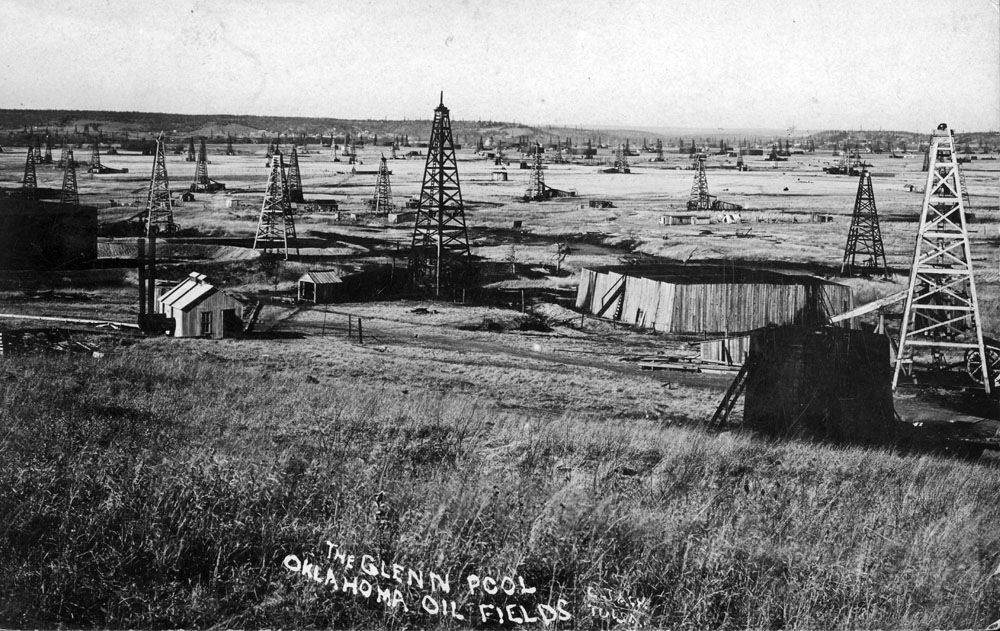
On a chilly fall morning in 1905 – two years before Oklahoma becomes a state – oil is discovered on the Glenn farm south of Tulsa.

Soon, there are hundreds of wells producing so much oil that the land is called the “‘Glenn Pool,” now the Tulsa suburb Glenpool.

This November 22 discovery well will help make Tulsa the “Oil Capital of the World.”

With daily production soon exceeding 120,000 barrels, Glenn Pool exceeds Tulsa County’s earlier “Red Fork Gusher” – and the giant Spindletop discovery near Beaumont, Texas, four years earlier. Read the rest of this entry »